Connect with us

News

Tinubu, US AFRICOM chief hold security talks in Abuja

Published

on

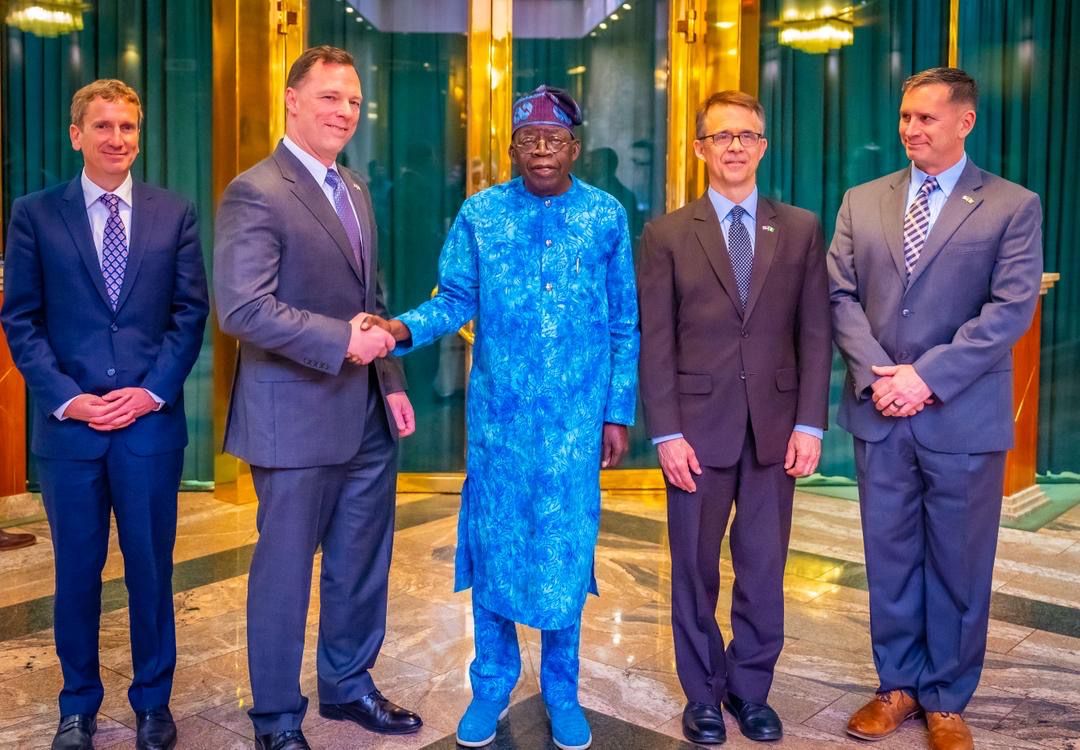
President Bola Tinubu on Sunday received a high-level delegation from the United States Africa Command led by its Commander, Gen Dagvin Anderson, at the Presidential Villa, Abuja.

Sunday’s meeting comes amid intensified security cooperation between Nigeria and the United States, following the Christmas Day airstrikes on terrorist camps in Sokoto State.

The State House media office revealed this in a terse photo news statement relayed to journalists Sunday evening.

The meeting comes months after US President Donald Trump redesignated Nigeria as a “Country of Particular Concern.”

Also present at the meeting were the Chargé d’Affaires at the US Embassy in Nigeria, Keith Heffern; Command Sergeant Major Garric M. Banfield, AFRICOM’s Command Senior Enlisted Leader; and Amb Peter Vrooman, AFRICOM’s Senior Foreign Policy Adviser.

On the Nigerian side, President Tinubu was joined by the National Security Adviser, Nuhu Ribadu; the Minister of Defence, Gen Christopher Musa (retd.); the Chief of Defence Staff, Gen Olufemi Oluyede; the Chief of Army Staff, Lt Gen Waidi Shaibu; and the Chief of Defence Intelligence, Lt Gen Emmanuel Uandiandeye.

The Director-General of the National Intelligence Agency, Mohammed Mohammed, and the Director-General of the Department of State Services, Tosin Ajayi, were also in attendance.

The visit follows the December 25 precision strikes in Sokoto State, which AFRICOM confirmed were conducted “at the direction of the President of the United States and the Secretary of War, and in coordination with Nigerian authorities.”

The strikes targeted Islamic State-linked militants in the Bauni forest of Tangaza.

In October 2025, Trump designated Nigeria a CPC under the International Religious Freedom Act, accusing the country of tolerating “severe violations of religious freedom” and the “mass slaughter” of Christians by “radical Islamists.”

See also  EFCC denies targeting Obasanjo, arraigns suspects - Sting Operation

He subsequently threatened military intervention if the killings continued.

The Federal Government rejected the characterisation, insisting that terrorist groups target Nigerians of all faiths.

The Tinubu administration reportedly hired a US-based lobbying firm, DCI Group, for $9m to communicate its efforts to protect Christian communities and maintain American support for counterterrorism operations in West Africa.

The contract, signed in December 2025 through the Office of the National Security Adviser, has drawn criticism from some US lawmakers.

The US said it will deepen security cooperation with Nigeria after Ribadu visited Washington in November 2025 for discussions with Pentagon officials.

AFRICOM said it has continued intelligence-sharing and joint operations with the Nigerian military.

punch.ng

FOLLOW US ON:

FACEBOOK

TWITTER

PINTEREST

TIKTOK

YOUTUBE

LINKEDIN

TUMBLR

INSTAGRAM

Continue Reading
Click to comment

Leave a Reply

Your email address will not be published. Required fields are marked *

News

Lawmakers hail EFCC, NFIU for boosting Nigeria’s financial credibility

Published

on

The House of Representatives has described the Economic and Financial Crimes Commission and the Nigerian Financial Intelligence Unit as pivotal institutions in Nigeria’s economic recovery drive and the stabilisation of the country’s financial system.

The lawmakers made the assessment against the backdrop of sustained recoveries of stolen public assets by the EFCC and Nigeria’s recent exit from the Financial Action Task Force grey list, a development widely regarded as a major boost to the country’s financial credibility.

The Chairman of the House Committee on Financial Crimes, Mr Ginger Onwusibe, stated this on Monday while commending the two agencies during their 2025 budget performance review and 2026 budget defence at the National Assembly Complex, Abuja.

Onwusibe said the growing synergy between the EFCC and the NFIU has significantly strengthened Nigeria’s anti-money laundering and counter-terrorism financing framework, restored international confidence in the financial system, and contributed to overall economic stability.

He said, “Permit me to commend the EFCC and NFIU for their tireless efforts, particularly Nigeria’s recent delisting from the FATF grey list.

“This achievement underscores the government’s commitment to combating financial crimes and strengthening our AML/CFT framework.”

According to him, the milestone will enhance Nigeria’s international reputation, improve access to global financing and credit, attract foreign direct investment, and reinforce the country’s financial security architecture.

The Abia lawmaker also disclosed that as of October 2025, the EFCC had recovered over ₦566bn, $411m, and 1,502 properties, while securing 3,175 convictions nationwide. He also noted that the NFIU played a critical role by providing financial intelligence that supported successful investigations and prosecutions.

See also  LASU professor reveals how to stabilize governance in Nigeria

“These achievements clearly demonstrate the agencies’ capabilities and dedication,” he said, attributing the successes to the leadership of EFCC Chairman, Mr Ola Olukoyede, and NFIU Director, Hajia Hafsat Bakari.

Over the past few years, the EFCC has intensified its asset recovery drive, recording consistent increases in both convictions and recovered proceeds of crime.

Between 2021 and 2023, the commission recovered hundreds of billions of naira in cash and assets, including luxury properties, vehicles, and funds linked to cybercrime, public sector fraud, oil theft, and money laundering.

The establishment of specialised units within the EFCC, improved collaboration with foreign law enforcement agencies, and enhanced use of financial intelligence have strengthened its capacity to trace and confiscate illicit assets.

The NFIU, which became operationally independent in 2018 following Nigeria’s suspension from the Egmont Group, has since emerged as a central hub for financial intelligence, supporting domestic agencies and international partners in tracking illicit financial flows.

Analysts have linked Nigeria’s removal from the FATF grey list to reforms driven largely by intelligence-led investigations, stronger regulatory compliance, and closer coordination between the EFCC, NFIU, the Central Bank of Nigeria, and other stakeholders.

While praising their performance, Onwusibe stressed that the operations of both agencies must continue to be guided by professionalism, transparency, and accountability, particularly amid growing public demand for visible and lasting results in the anti-corruption fight.

On the broader economic outlook, he said the 2026 budget places strong emphasis on infrastructure development and food security, with key objectives including macroeconomic stability, job creation, an improved business environment, and human capital development.

See also  World Polio Day: Sokoto, UNICEF renew push to end polio in N’West

He cautioned, however, that effective execution, timely implementation, increased oil production, and growth in non-oil revenue would be critical to achieving these targets.

While acknowledging that many Nigerians are still grappling with economic hardship, Onwusibe said the economy is beginning to show signs of revival, transitioning from post-reform stabilisation to modest recovery.

He cited projections by the International Monetary Fund, which forecast a 4.4 per cent growth rate for Nigeria in 2026, driven by improved macroeconomic stability, structural reforms, and rising domestic demand.

He added that financial crimes continue to pose a significant drain on the economy, underscoring the indispensable role of the EFCC and NFIU in asset recovery, corruption deterrence, and safeguarding financial stability.

The Committee Chairman assured that the 10th House of Representatives remains committed to strengthening Nigeria’s legal framework for combating financial crimes.

He disclosed that four critical bills aimed at promoting transparency, protecting public resources, and aligning Nigeria with global best practices have recently been considered by the House.

These include bills to amend the Money Laundering (Prevention and Prohibition) Act 2022, amend the EFCC Act 2004, and amend the Proceeds of Crime Act.

“These bills are designed to modernise our laws, bridge operational gaps, enhance enforcement mechanisms, and ensure that crime does not pay,” he said, expressing optimism that the legislation would receive accelerated assent from President Bola Tinubu.

On the 2026 budget proposal, Onwusibe assured that the committee would rigorously scrutinise submissions from both agencies to ensure optimal use of public funds and alignment with legislative priorities.

See also  Why Sowore is being detained – CP

Key focus areas, he said, include strengthening investigative and prosecutorial capacity, improving asset recovery and management, enhancing international cooperation, building institutional capacity, and addressing emerging threats such as cybercrime and virtual assets.

“The work of the EFCC and NFIU is critical to Nigeria’s economic stability and security. We must ensure they are adequately resourced, while upholding the highest standards of professionalism and accountability, to build a stronger, more transparent, and resilient financial system,” he added.

punch.ng

FOLLOW US ON:
FACEBOOK

TWITTER

PINTEREST

TIKTOK

YOUTUBE

LINKEDIN

TUMBLR

INSTAGRAM

Continue Reading

News

UK to bar eligible visitors without ETA from February 25

Published

on

The United Kingdom will begin full enforcement of its Electronic Travel Authorisation requirement for visa-exempt travellers from February 25, 2026, the UK government has said.

With just over two weeks to the enforcement date, UK authorities have warned that eligible visitors who fail to obtain an ETA before travelling risk being denied boarding on flights, trains or ferries bound for the UK.

The warning was issued in a statement posted on X by UK Visas and Immigration, an agency of the Home Office.

“From 25 February 2026, eligible visitors to the UK can’t legally travel without an Electronic Travel Authorisation,” the Home Office said.

It directed prospective travellers to the official GOV.UK website and urged them to apply through the UK ETA mobile app or online platform.

The ETA scheme forms part of the UK’s ongoing digital immigration overhaul, aimed at strengthening border security while simplifying entry procedures for short-term visitors.

It requires pre-travel authorisation for nationals of about 85 countries who do not ordinarily require a visa for short stays.

These include citizens of the United States, Canada, France and several other European countries.

ETA does not apply to Nigerians, as they need a visa to enter the UK

From February 25, transport operators will be legally required to confirm that travellers hold a valid ETA before allowing them to board, replacing the current discretionary checks.

Who needs an ETA

The authorisation applies to non-visa nationals travelling to the UK for tourism, business or short-term study of up to six months.

See also  Board warns Nigerians against fake paramilitary recruitment messages

British and Irish citizens, including dual nationals, are exempt from the requirement.

However, authorities advise such travellers to carry proof of citizenship—such as a valid British passport or a Certificate of Entitlement—to avoid delays.

Individuals with existing UK residency permission or an eVisa are also exempt.

Cost and validity

An ETA application currently costs £16 and is valid for multiple entries over a two-year period or until the applicant’s passport expires, whichever comes first.

The UK government has indicated that the fee may rise to £20 in the future.

How to apply

Applications can be submitted online via GOV.UK or through the official UK ETA app.

Applicants are required to provide passport details, contact information and answers to security-related questions.

While most applications are approved within minutes, travellers are advised to apply at least three days before departure to avoid last-minute complications.

punch.ng

FOLLOW US ON:
FACEBOOK

TWITTER

PINTEREST

TIKTOK

YOUTUBE

LINKEDIN

TUMBLR

INSTAGRAM

Continue Reading

News

Residents protest as bandits abduct seven in fresh Kaduna attack

Published

on

Residents of Danhonu II community in New Millennium City, Chikun Local Government Area of Kaduna State, on Monday protested against recurring kidnapping incidents, following the abduction of seven persons by suspected bandits.

The protesters marched to the Millennium City Divisional Police Headquarters, where they blocked the major access road while chanting solidarity songs and demanding urgent security intervention.

The latest attack, which occurred around 11:30pm on Sunday, involved bandits who stormed the community and abducted members of two families.

Those kidnapped were identified as Yahaya Yusuf, his wife, Latifat Yusuf, and their sons, Abdulgafar and Abdulqudus.

Also abducted during the raid were Mrs Abdulrazak Jimoh and two of her children, whose names were not immediately disclosed.

Protesters. Kaduna
Protesting residents of Danhonu II community in New Millennium City, Chikun Local Government Area of Kaduna. Photo: Godwin Isenyo

Residents said the incident had heightened fear in the community, noting that it brought the total number of kidnap cases recorded in the area to 11 within a few months.

They alleged that the attacks were targeted mainly at non-indigenes living in the community, raising suspicion that informants might be aiding the criminals.

One of the protesters, who spoke on condition of anonymity, said the bandits invaded the community in large numbers, armed with sophisticated weapons.

“In the last month, more than four residents have been kidnapped here. Yesterday, no fewer than 15 bandits came with AK-47 rifles and abducted about five residents to an unknown destination,” the protester said.

He added that residents had decided to march to the police station to formally lodge their complaints after enduring repeated attacks.

See also  Police back down on tinted glass enforcement

The Chairman of the Danhonu II Landlords Association and leader of the protest, Akoh Salifu, said the community could no longer live in peace due to the persistent kidnappings.

“We are here because we can no longer live in peace. The pressure from these repeated kidnapping incidents has become unbearable for us,” Salifu said.

He disclosed that some youths attempted to pursue the kidnappers into the bush after Sunday night’s attack, but were unable to catch up with them.

“As law-abiding citizens, we decided to come to the police to formally register our grievances and cry out for urgent intervention to save our community,” he added.

When contacted, the Kaduna State Police Public Relations Officer, DSP Mansir Hassan, confirmed the incident, saying the police received a distress call and responded promptly.

Hassan said police operatives, alongside soldiers, were deployed to the scene but arrived late due to poor road access and difficult terrain, allowing the bandits to escape despite an exchange of gunfire.

He added that the Commissioner of Police, CP Rabiu Muhammad, had visited the community and met with stakeholders, assuring them that the command would consider establishing a police outpost in the area.

punch.ng

FOLLOW US ON:

FACEBOOK

TWITTER

PINTEREST

TIKTOK

YOUTUBE

LINKEDIN

TUMBLR

INSTAGRAM

Continue Reading

Trending