Connect with us

Business

Revised Executive Order: FG quietly adjusts oil revenue remittance framework, see details

Published

on

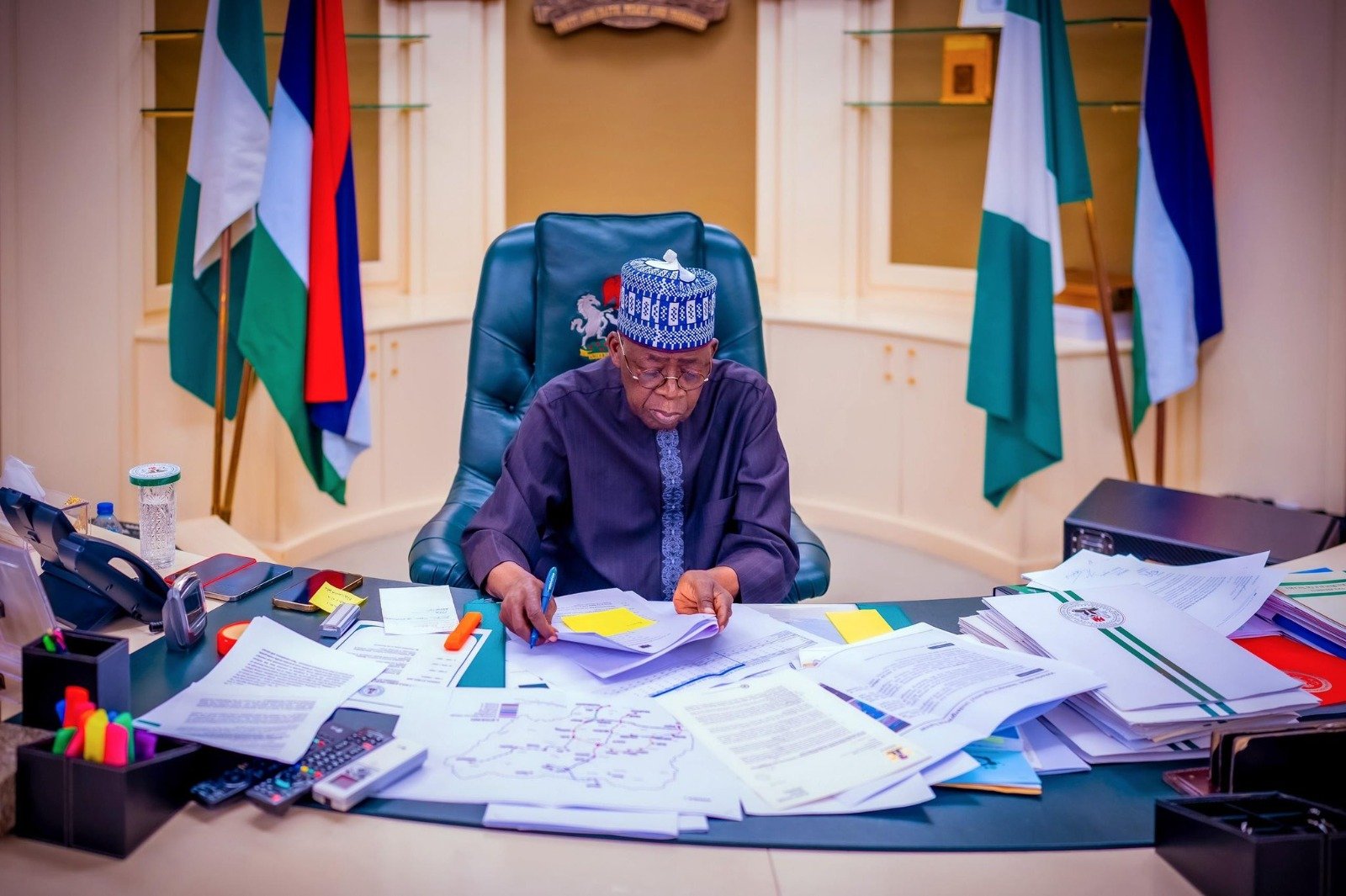
The Federal Government has quietly revised the implementation framework of Executive Order 9 of 2026 on oil revenue remittances, with royalties and taxes to remain under the collection of the Nigerian National Petroleum Company Limited and paid into a newly created account domiciled at the Central Bank of Nigeria, The PUNCH exclusively gathered on Monday.

The adjustment follows high-level deliberations at an implementation committee meeting held last Wednesday, where stakeholders examined practical challenges linked to the order mandating direct remittance of all oil-related revenues into the Federation Account.

Two senior officials involved in the talks, who spoke on condition of anonymity because they were not authorised to comment publicly, said the government was unlikely to rescind the directive but had begun modifying its execution to reflect industry realities.

Last month, President Bola Tinubu issued an executive order directing that royalty oil, tax oil, profit oil, profit gas, and other revenues due to the Federation under production sharing, profit sharing, and risk service contracts be paid directly into the Federation Account.

The order also scrapped the 30 per cent Frontier Exploration Fund under the PIA and discontinued the 30 per cent management fee on profit oil and profit gas retained by the NNPC. Effective February 13, 2026, the directive is intended to safeguard oil and gas revenues and strengthen remittances to the Federation Account.

According to the directive, the President invoked Section 5 of the Constitution of the Federal Republic of Nigeria (as amended), anchored on Section 44(3), which vests ownership and control of all minerals, mineral oils, and natural gas in the Government of the Federation.

Tinubu said excessive deductions, overlapping funds, and structural distortions in the oil and gas sector had weakened remittances to the Federation Account and warned that the practice must end to protect national revenue.

“For too long, excessive deductions, overlapping funds, and structural distortions in the oil and gas sector have weakened remittances to the Federation Account. When revenues meant for federal, state, and local governments are trapped in layers of charges and retention mechanisms, development suffers. That must end,” he said on his verified X handle.

He also approved the constitution of a joint project team to execute integrated petroleum operations, with the commission serving as the interface with licensees and lessees where upstream and midstream operations are fully combined.

Members of the committee include the Minister of Finance and Coordinating Minister of the Economy; the Attorney-General of the Federation and Minister of Justice; the Minister of Budget and National Planning; and the Minister of State, Petroleum Resources (Oil). Other members are the Chairman, Nigeria Revenue Service; a representative of the Ministry of Justice; the Special Adviser to the President on Energy; and the Director-General, Budget Office of the Federation, who serves as secretary.

See also  FG eyes oil windfall to fund N9tn budget gap

Following last week’s meeting, the government allowed the NNPC to continue commercialising crude barrels before remitting proceeds to the Federation Account, instead of the Nigerian Upstream Petroleum Regulatory Commission handling the process.

One source said the modification became necessary because royalties and taxes are typically settled in barrels of crude oil rather than cash, making direct remittance impractical.

“The government is not looking likely to reverse the order on oil revenue remittance, but they are likely to change the mode of implementation. That is what the situation is currently looking like.

“So the implementation now is that they may not come to read any executive order on the issue. But the implementation is that the order said taxes and royalties should be paid to the federation account directly. But now they have realised that this has already been done and royalties and taxes are not paid in dollars or naira but with barrels of crude oil, which must first be lifted and commercialised before revenue can be realised,” the official said.

He added, “So the implementation now is that the NNPC will continue to lift and sell the crude on behalf of the government and then remit proceeds accordingly. That is the likely operational framework going forward.”

Under the evolving structure, royalties and taxes would pass through the new CBN account, supervised by the Office of the Accountant-General of the Federation, rather than existing regulatory channels.

The official said discussions on profit oil remittances were still ongoing, but cautioned that the framework could undermine reforms introduced under the Petroleum Industry Act, which granted the national oil company commercial autonomy.

“That is the new mode of implementation. But the 30 per cent that comes from profit oil. Instead of the NNPC collecting it and then remitting to the government, the government will collect everything, and then the government will pay back the amount spent on the cost of operations. So those are the level of discussions and the kind of discussions that are ongoing.

“This new funding style will still affect operations at the NNPC and take us back to what was happening before the Petroleum Industry Act. And that was what the PIA tried to cure. During that period, it led to a backlog of issues, and the NNPC couldn’t fulfill its responsibilities. It was subjected to the government budget and the likes, and it is difficult to take back refunds from the government,” he said.

See also  FULL LIST: AFCON 2025 quarter-final fixtures, date, time, venue

He recalled that the previous arrangement created severe financial strain. “The industry ran into a problem that period, and the system owed national traders and companies over $6bn in cash call arrears.

“Government was also taking everything during that period, and the company would be waiting for cash calls and our own operations. Then the PIA solved all the issues. But the new order is now bringing back the issues. Now that the PSC has been attacked, the government will still come to joint ventures. Discussions are ongoing now on what the company is spending per month. So an amount would be released every month to run operations,” he added.

Another official confirmed the revised implementation but warned that tighter government control could weaken regulatory independence and efficiency.

“Regulatory agencies are supposed to operate independently and should not depend on government funding. But what we are seeing is increasing interference. This could condition the NNPC to rely on government releases to meet its obligations,” he said.

Drawing parallels with past refinery policies under former President Olusegun Obasanjo, he noted that dedicated turnaround maintenance funds were once diverted with reimbursement promises that never materialised, contributing to refinery decline.

He also warned that removing frontier exploration funding could undermine long-term energy security.

“Frontier exploration is a government responsibility because private companies do not take those risks. If the funds are removed, exploration activities will decline. That means we will only produce from existing discoveries, and once those reserves are depleted, Nigeria’s future as an oil-producing country could be threatened,” he said.

On operational sustainability, he cautioned that uncertainty over funding could have labour implications.

“The current expectation is that the government will begin to fund operational costs, including salaries and emoluments, as promised. But if this does not happen, it is only a matter of time before companies begin to consider difficult decisions. Job losses could occur if the funding structure is not sustainable,” he warned.

He added that another high-level meeting had been scheduled later in the week, involving the Nigerian Upstream Petroleum Regulatory Commission, the Federal Ministry of Finance, and industry operators.

See also  Poverty rate jumps to 63% after subsidy removal – Report

Confirming the phased approach in a statement on Monday, the Minister of Finance and Coordinating Minister of the Economy, Wale Edun, said a structured transition would ensure that direct payments by contractors into the Federation Account do not disrupt existing agreements.

“With respect to Section 2, Sub-section 3 of Executive Order 9 on direct payments by contractors into the Federation Account, the committee agreed that this transition must be implemented in a manner that respects existing contractual and financing arrangements, and maintains investor confidence,” the statement said.

Edun added that “until the committee issues detailed guidelines, contractors will continue to remit under the current process. During the transition period, the committee will issue clear, standardised guidance to ensure an orderly changeover.”

He said a Technical Subcommittee would develop detailed guidelines within three weeks and commence a review of the Petroleum Industry Act to address fiscal anomalies.

“The committee will continue to provide coordinated guidance and timely updates as implementation progresses. We commend the cooperation of all stakeholders in advancing the President’s efforts to ensure that Nigeria’s petroleum resources deliver tangible, measurable benefits to citizens across the Federation,” the statement concluded.

Meanwhile, an NNPC official warned that the directive could disrupt production sharing contract operations and affect between 400 and 500 personnel dedicated to such activities.

“It will affect us to a great extent because we have staff who are dedicated to these lines of activity. We have no fewer than 400 to 500 staff whose daily work is focused on production sharing contracts. These are professionals working on rigs, platforms, seismic operations, and cost monitoring. We are talking about personnel across 39 PSC sites, out of which 14 are producing, and about five major sites contribute nearly 80 per cent of output under these arrangements.”

Commenting earlier, a Professor of Economics at Babcock University, Sheriffdeen Tella, said the directive could increase funds available to governments but warned about utilisation.

“It means there would be more money to share for development, although they have not been using it to develop the states. They have been sharing for some states, but we haven’t seen improvement. Some states have done well, but many others haven’t done much.

But the new order simply means that more money will be available to the federation account and more allocation for what the government wants to use it for.”

punch.ng

FOLLOW US ON:

FACEBOOK

TWITTER

PINTEREST

TIKTOK

YOUTUBE

LINKEDIN

TUMBLR

INSTAGRAM

Continue Reading
Click to comment

Leave a Reply

Your email address will not be published. Required fields are marked *

Business

Nigeria pledges to strengthen bilateral cooperation with India

Published

on

The Permanent Secretary of the Ministry of Foreign Affairs, Ambassador Dunoma Ahmed, has reaffirmed Nigeria’s commitment to strengthening bilateral cooperation with India.

Ahmed stated this during a meeting with the High Commissioner of India to Nigeria, Abhishek Singh, at the Ministry’s Headquarters on Thursday in Abuja.

A statement issued by Kimiebi Ebienfa, the ministry’s spokesman, said Ahmed expressed appreciation to Singh for the cordial relations between Nigeria and India.

He said that cooperation between both countries would focus on deepening ties ahead of the India-Africa Forum Summit scheduled to be held in New Delhi in May, 2026.

According to him, both countries are strategic partners united by shared democratic values and common aspirations for sustainable development and South-South cooperation.

He underscored the importance of the forthcoming BRICS and India-Africa Forum engagements in advancing multilateral cooperation among developing countries amid evolving global political and economic realities.

Ahmed reiterated Nigeria’s interest in increased Indian investments in key sectors of the economy, particularly manufacturing, agriculture, mining, renewable energy, and local value addition.

He further stressed the need for strengthened collaboration in security and counter-terrorism, especially through technological cooperation and defence capacity building.

Earlier, Singh briefed Ahmed about preparations for the BRICS Foreign Ministers’ Meeting slated for May 14 to 15, at the Bharat Mandapam in New Delhi.

Meanwhile, the India-Africa Forum Summit is expected to convene African leaders and senior officials later in the month.

Singh said, “ Nigeria, as a BRICS partner country and a major stakeholder in Africa, occupies a strategic place in India’s foreign policy engagement with the continent.

See also  See why Wole Soyinka snubbed US Embassy’s summons

“The Government of India looks forward to Nigeria’s active participation at the meetings and in deepening cooperation between both countries in areas of trade, renewable energy, defence, industrialisation, agriculture, and technology.”

He further highlighted ongoing initiatives under the International Solar Alliance and Africa Solar Facility, including proposed renewable energy investments and enhanced developmental partnerships with Nigeria.

NAN

punch.ng

FOLLOW US ON:

FACEBOOK

TWITTER

PINTEREST

TIKTOK

YOUTUBE

LINKEDIN

INSTAGRAM

Continue Reading

Business

National Assembly okays N2.29tn FCT budget, sets 76% for capital projects

Published

on

The National Assembly on Thursday passed the 2026 Statutory Appropriation Bill for the Federal Capital Territory, approving a total expenditure of N2.285tn for the development and administration of the nation’s capital.

The approval followed the presentation and consideration of the harmonised report of the Senate and House of Representatives Committees on the FCT during plenary.

The report was presented by the Vice Chairman of the Senate Committee on the FCT, Austin Akobundu (Abia Central), on behalf of the committee chairman, Ibrahim Bomai (Yobe South).

Presenting the report, Akobundu said the joint committees recommended the sum of N2.285tn as the FCT statutory budget for 2026 from a projected revenue of N2.385tn.

He explained that the budget proposal contained N165.7bn for personnel costs, N378.2bn for overhead costs, while N1.741tn was allocated to capital expenditure.

According to him, the structure of the budget indicated a strong focus on infrastructure development and public service delivery, with 76.19 per cent of the total allocation devoted to capital projects, while recurrent expenditure accounted for 23.8 per cent.

Akobundu said the appropriation process complied with constitutional provisions and emerged after extensive deliberations between the National Assembly committees and officials of the Federal Capital Territory Administration.

He said, “The committees met with the minister and other relevant officials of the FCTA and deliberated extensively on the subject matter.”

Lawmakers who contributed to the debate commended the fiscal framework of the budget, describing it as balanced and development-oriented.

Deputy President of the Senate, Jibrin Barau, praised the spending plan, saying it demonstrated a strong commitment to infrastructural renewal in the FCT.

See also  Poverty rate jumps to 63% after subsidy removal – Report

He said, “Mr President, the budget is top-notch. You know, I am the only one in the history of the legislature in this country that has had the opportunity to serve as chairman appropriation committee in the House and in the Senate.

“So when I see a good budget, I know it’s a good budget. It is a budget that’s top-notch. We have to commend the FCT minister for doing a very good job.

“A budget that you have a total of N2.2tn, and out of this, N1.7tn is going for capital. It shows his willingness and determination to continue to show FCT to the admiration of all.”

Abdul Ningi (Bauchi Central) described the appropriation as well-structured and responsive to concerns previously raised by lawmakers during oversight engagements with the FCTA.

Ningi said the budget was well-packaged and well-balanced, considering the observations made by the Senate Committee on the FCT last year.

The Senate thereafter passed the bill through third reading, paving the way for its transmission for presidential assent.

At the House of Representatives, the lawmakers also passed the 2026 statutory budget proposals of the FCT.

They also passed N1.75tn respectively for the Niger Delta Development Commission.

The approvals followed the consideration and adoption of reports presented to the House during plenary by the relevant committees.

Presenting the report on the FCT budget, Chairman of the House Committee on the Federal Capital Territory, Muktar Betara, said the N2.29tn proposal was structured to address personnel obligations, overhead costs and critical infrastructure projects across the nation’s capital.

See also  Petrol, diesel vessels arrive Nigeria amid price surge

According to him, “Out of the N2.29tn, the sum of N165.78bn is for personnel costs while N378.23bn is for overhead costs.

“The balance of N1.74tn is for capital projects, for the service of the Federal Capital Territory, Abuja, for the financial year commencing January 1 and ending December 31, 2026.”

A breakdown of the recurrent expenditure showed that the Federal Capital Territory Administration secured N151.44bn for its operations.

In what lawmakers described as part of ongoing efforts to strengthen security architecture in Abuja and surrounding satellite communities, the House approved N6.79bn for the security services department of the FCTA.

The lawmakers also approved N1.51bn and N910.20m for the FCT Muslim Pilgrims Welfare Board and the Christian Pilgrims Welfare Board, respectively.

For capital projects, the education sector received N162bn, while engineering services got the largest allocation of N758.15bn.

The resettlement and compensation department was allocated N143.18bn, public buildings received N2.38bn, while the satellite towns development department secured N212.74bn.

Meanwhile, details of the N1.75tn NDDC appropriation obtained by The PUNCH showed that N47.57bn was earmarked for personnel costs, while overhead expenditure stood at N49.93bn.

The commission also secured N22.36bn for internal capital expenditure, with the bulk of the budget — N1.63tn — dedicated to development projects across the oil-producing Niger Delta region.

The approval followed the consideration of a report presented by the Chairman of the House Committee on NDDC, Erhiatake Ibori-Suenu.

For the NDDC, the passage of the N1.75tn budget is expected to strengthen intervention projects in the oil-rich region, where concerns over underdevelopment, environmental degradation and youth unemployment have persisted for decades despite the area’s contribution to national revenue.

See also  SEE FULL LIST: IG deploys new AIGs, CPs in major police re-organisation

Continue Reading

Business

Otti seeks partnership with NAADI to grow Abia’s agriculture, economy

Published

on

Governor Alex Otti has said the Abia State Government is ready to leverage the Nigeria Agribusiness and Agro-Industrial Development Initiative to grow the state’s economy and strengthen value addition across key agricultural sectors.

Otti stated this on Wednesday while receiving a delegation of the Nigeria Agribusiness and Agro-Industrial Development Initiative, led by its Director, Felix Charles, at the Government House in Umuahia.

The governor said the initiative aligns with his administration’s economic agenda and pledged the readiness of his team to work closely with NAADI.

“We are already looking forward to taking advantage of this,” Otti said.

“I believe that as you sit down with my team, we will begin to unveil the details and know how to work with you to take full advantage of this initiative that you brought.

“One thing I can assure you is that my team is very ready,” he added.

Otti noted that many of the objectives of NAADI were already reflected in his campaign promises and development plans for the state.

“If you have a look at our manifesto and my promise to our people here, you will find that a lot of the things that NAADI targets to achieve have been documented in the manifesto.

“So, I want to thank you very much for your visit and thank you for considering us as a beneficiary,” the governor stated.

He further stressed that countries and states cannot achieve meaningful economic growth by relying solely on the production of raw materials without processing and industrialisation.

See also  NAFDAC destroys N15bn fake, expired drugs in Oyo

According to him, Abia is richly endowed in palm oil, cassava, cocoa, cashew nuts, rubber, leather works, and fabrics, but said the products would add little economic value if they were not processed beyond subsistence production.

Earlier, Charles described NAADI as a Federal Government initiative aimed at promoting agricultural participation, strengthening agro-processing value chains, and improving access to international markets.

He disclosed that the programme had already been established in eight states, adding that Abia would become the ninth state to domesticate and launch the initiative.

Charles also commended Otti’s developmental projects and assured the state government of NAADI’s commitment to partnership.

According to him, Abia would benefit from key pillars of the initiative, including bridging capacity gaps, promoting agribusiness, improving market access, and addressing funding constraints.

The meeting was attended by Deputy Governor Ikechukwu Emetu, Chief of Staff Caleb Ajagba, Commissioner for Trade and Commerce Salome Obiukwu, Special Adviser on Trade and Commerce Nwaka Inem, and other senior government officials.

punch.ng

FOLLOW US ON:

FACEBOOK

TWITTER

PINTEREST

TIKTOK

YOUTUBE

LINKEDIN

INSTAGRAM

Continue Reading

Trending