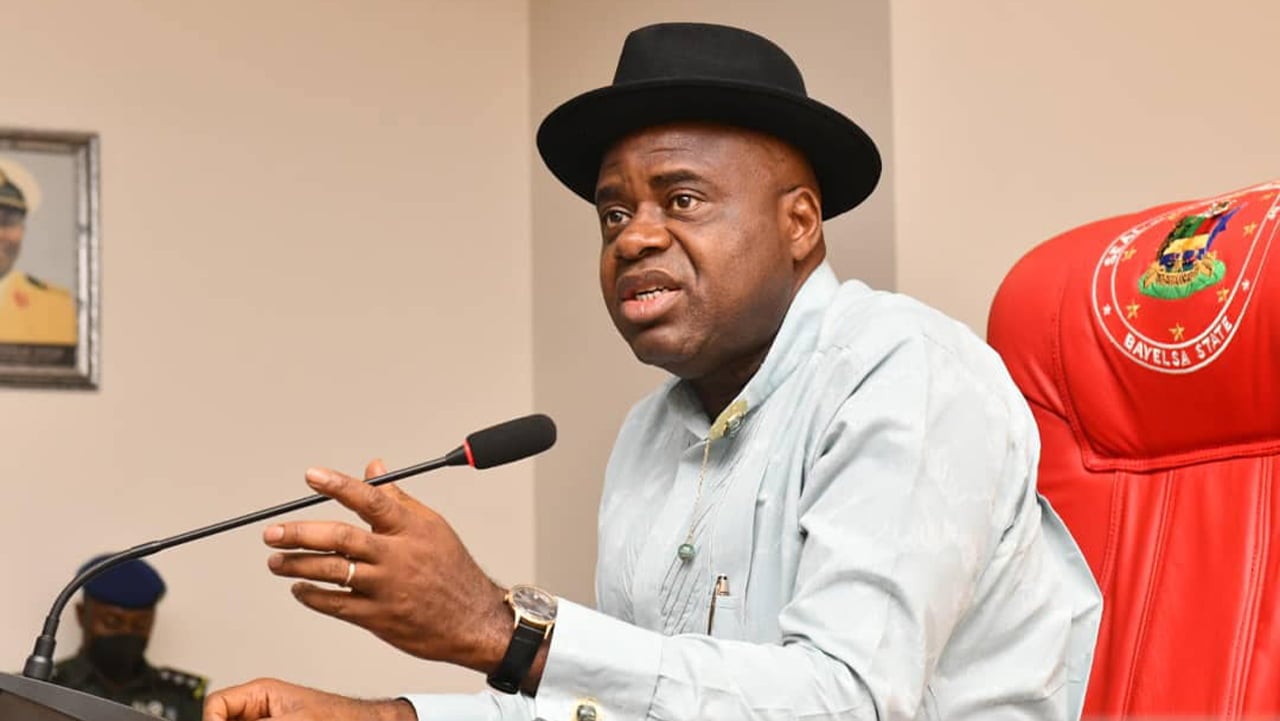
The sudden death of Bayelsa State Deputy Governor, Lawrence Ewhrudjakpo, has triggered an intense political scramble across the state, with power brokers, party leaders and interest. With Governor Diri holding the ace, stakeholders are divided over whether Sagbama LG should retain the position — or whether broader political considerations, including 2027 permutations, will ultimately shape the decision, LINUS EFFIONG reports
Just weeks after surviving a bitter political storm, Bayelsa State Deputy Governor, Lawrence Ewhrudjakpo, was gone.
The 60-year-old politician, who stood his ground when the state’s political landscape shifted beneath his feet, died on Thursday, December 11, 2025, bringing to a sudden end a career defined — in his final months — by loyalty, defiance and quiet resilience.
When Governor Douye Diri defected from the Peoples Democratic Party to the All Progressives Congress on November 3, Ewhrudjakpo refused to follow. While several state officials crossed over with the governor, he chose to remain in the PDP, the party he had long identified with.
That decision set off months of unease within the state’s political establishment. Rumours swirled of a plot to replace him with a more compliant ally. In response, the deputy governor took the extraordinary step of suing the Bayelsa State House of Assembly to forestall any move against him — a suit he later withdrew after Diri’s intervention paved the way for an out-of-court settlement.
Then came the shock.
Ewhrudjakpo slumped in his office in Yenagoa and was rushed to the Federal Medical Centre, where doctors pronounced him dead. The suddenness of it all stunned the state.
Only hours earlier, at exactly 11:48am, he had posted photographs on his Facebook page showing him in a meeting at Government House with UNICEF Country Representative in Nigeria, Wafaa Saeed. There were no outward signs that it would be his final public engagement.
Tributes poured in from across Nigeria, many describing him as a “gentleman” and an unrelenting workaholic. Former President Goodluck Jonathan called him “a devoted steward of Bayelsa, a patriot, and a loyal servant of our state and nation.”
“Throughout his years in public service, he demonstrated an unwavering passion for the welfare of our people and earned the respect and admiration of many across the country,” Jonathan said.
But even as tributes continued, political calculations quietly resumed.
Behind the scenes, lobbying intensified as attention shifted to who would fill the vacant office. His death has now ignited a fresh debate over zoning and equity, with many insisting that fairness demands the next deputy governor emerge from Sagbama Local Government Area, the late Ewhrudjakpo’s home base.
For Bayelsa, the mourning is real. But so too is the power struggle that has already begun.
The power play
If the battle for Bayelsa’s deputy governorship has a silent command centre, many believe it lies with Seriake Dickson.
The former governor and now senator is widely regarded as the most formidable force capable of shaping the succession conversation. Yet, in public, he has struck a careful tone — insisting he has not been consulted by Governor Douye Diri and stressing that the choice of a new deputy is solely the governor’s constitutional prerogative.
Few in Yenagoa take that at face value.
Observers of Bayelsa’s intricate political chessboard argue that such restraint is typical Dickson — measured words masking strategic patience. His relationship with Diri has remained outwardly cordial, even warm. He has openly supported the governor’s administration and pointed would-be aspirants away from his doorstep, advising them instead to lobby the man who holds the final pen.
But beneath that public posture, whispers persist.
Many believe Dickson is quietly rooting for his former deputy chief of staff, Hon. Ebizi Rosemary Brown Ndiomu, now representing Sagbama III in the state House of Assembly. Her emergence, should it happen, would not only preserve Sagbama’s hold on the office but also reinforce Dickson’s enduring relevance in Bayelsa’s evolving power matrix.
In Bayelsa politics, influence is rarely declared. It is inferred.
The Goodluck Jonathan factor
Then there is the shadow — calm but unmistakable — of Goodluck Jonathan.
No major political decision in Bayelsa is ever discussed without invoking the former President’s name. His influence in the state remains profound, particularly in his relationship with Diri.
Jonathan’s endorsement was pivotal to Diri’s re-election in 2023. At the time, the governor described that backing as “worth more than billions of naira,” a remark that underscored just how decisive it was. Diri has repeatedly acknowledged Jonathan’s role in shaping his political ascent — from the National Assembly to Creek Haven.
Now, as the deputy governorship hangs in the balance, stakeholders believe Jonathan’s voice — whether spoken publicly or whispered privately — could tilt the scales.
The uncertainty, however, lies in where that influence will fall. Will he align with Dickson’s perceived preference? Or does the former President have a different calculation altogether?
For now, Jonathan remains silent — and in Bayelsa, silence can be more powerful than speech.
Lokpobiri’s calculated presence
Hovering on the edges of the unfolding drama is Heineken Lokpobiri, whose growing visibility has not gone unnoticed.
A seasoned political operator, former Minister of State for Agriculture and Rural Development, two-term senator for Bayelsa West, and now Minister of State for Petroleum, Lokpobiri possesses both federal leverage and deep-rooted local networks.
His long-standing governorship ambition is no secret. Having openly expressed interest in succeeding Diri, his stake in the deputy governorship calculation is clear: whoever emerges could either strengthen or complicate his 2027 pathway.
Political watchers are therefore studying his movements carefully. An endorsement here, a meeting there — each gesture is dissected for meaning.
In a contest shaped by loyalty, zoning, defections and future ambitions, Lokpobiri represents not just a participant, but a strategist with eyes firmly set beyond the immediate vacancy.
And as Bayelsa mourns, the manoeuvring intensifies.
Diri at the centre of the storm
At the eye of the gathering storm is Governor Douye Diri himself.
His measured silence — and the careful, almost clinical way he chooses his words at public events — has only deepened the suspense. In a state where every handshake is analysed and every smile decoded, Diri’s refusal to drop the slightest hint about his preferred successor has left Bayelsans guessing.
Behind closed doors, however, the permutations are thick.
A source close to the governor confided that Diri may be considering his Chief of Staff, Pastor Peter Akpe — not just a trusted aide, but also his maternal cousin. Akpe’s proximity to power, administrative grip and daily access to the governor make him a natural contender. Yet, for some, that closeness raises questions about optics and political messaging at a time when zoning and inclusivity dominate the conversation.
But Akpe is not the only name on the chessboard.
Prince Ebitimi Amgbare, Managing Director and Chief Executive Officer of the Niger Delta Basin Development Authority, is said to be leveraging federal goodwill. Widely perceived to enjoy a cordial relationship with President Bola Tinubu, Amgbare’s growing praise of Diri’s infrastructural strides has not gone unnoticed.
With Diri now firmly aligned with the APC and publicly backing Tinubu’s 2027 re-election bid, some insiders speculate that a subtle nod from Abuja could influence the governor’s calculus. Amgbare’s credentials — foundation member of the old Action Congress of Nigeria, loyal APC stalwart, 2023 presidential campaign council member and former Youth and Sports Commissioner — position him as a bridge between Bayelsa’s old APC structure and the governor’s new political home.
Whether that bridge is one Diri is willing to cross remains the unanswered question.
Casting the net wider
Beyond loyalty and federal connections lies another powerful argument: zoning.
Many political leaders insist that Sagbama, the home base of the late Ewhrudjakpo, should retain the office in the spirit of balance and continuity. To abandon that unwritten arrangement, they warn, could unsettle delicate political understandings in the state.
If Sagbama remains the anchor, one prominent figure is the Speaker of the Bayelsa State House of Assembly, Rt. Hon. Abraham Ingobere. Though representing Brass Constituency III, Ingobere has maintained a close and cooperative relationship with Diri. The governor has repeatedly praised him as “a stabiliser of the polity,” crediting him with fostering a rancour-free executive-legislative partnership since his re-election as Speaker in June 2023.
Yet, the field remains crowded.
Dr. Peter Akpe’s name resurfaces here too — hardworking, administratively savvy and deeply entrenched within the corridors of Government House. His connections to former Vice President Yemi Osinbajo and First Lady Oluremi Tinubu add another layer to his political capital.
Then there is Dr. Dennis Otiotio, Bayelsa APC chairman from Nembe. A lawyer with a PhD and a history of fierce criticism of Diri — once describing his administration as “a punishment to Bayelsa State” — Otiotio’s political journey took a dramatic turn when he welcomed Diri into the APC fold in November 2025. Whether that reconciliation translates into consideration is another matter entirely.
In a quieter corner of the conversation is Christopher Ewhrudjakpo, elder brother of the late deputy governor and a serving aide to Diri. His possible emergence would carry emotional weight — a gesture of continuity and consolation — but whether sentiment aligns with political pragmatism remains uncertain.
Stakeholders weigh in
As lobbying intensifies, party chieftains are no longer shy about projecting their preferences.
PDP stalwart Christopher Abarowe argues that the governor must balance what he describes as a “political marriage” between the APC and PDP in the state. According to him, certain APC factions have already secured benefits, including commissioner slots tied to the David Lyon and Lokpobiri blocs.
“The foundational APC members — the old guard — should now be considered,” he said, listing figures such as Prince Ebitimi Amgbare and Briya Aganaba as worthy of attention.
On the other side of the divide, APC chieftain John Asawana insists the moral argument outweighs political arithmetic.
“To me, Sagbama should retain the position,” he said. “The state is now APC. What we should be considering is integrity. Whoever the governor appoints must be credible and not someone already compensated with political office.”
And so, the lines are drawn.
Loyalty versus zoning. Federal whispers versus local equilibrium. Sentiment versus strategy.
In the end, only one signature will settle the contest — that of Governor Douye Diri. But until the announcement is made, Bayelsa remains suspended between mourning and manoeuvring, waiting for the next move in a political drama that shows no sign of slowing.
punch.ng
FOLLOW US ON: