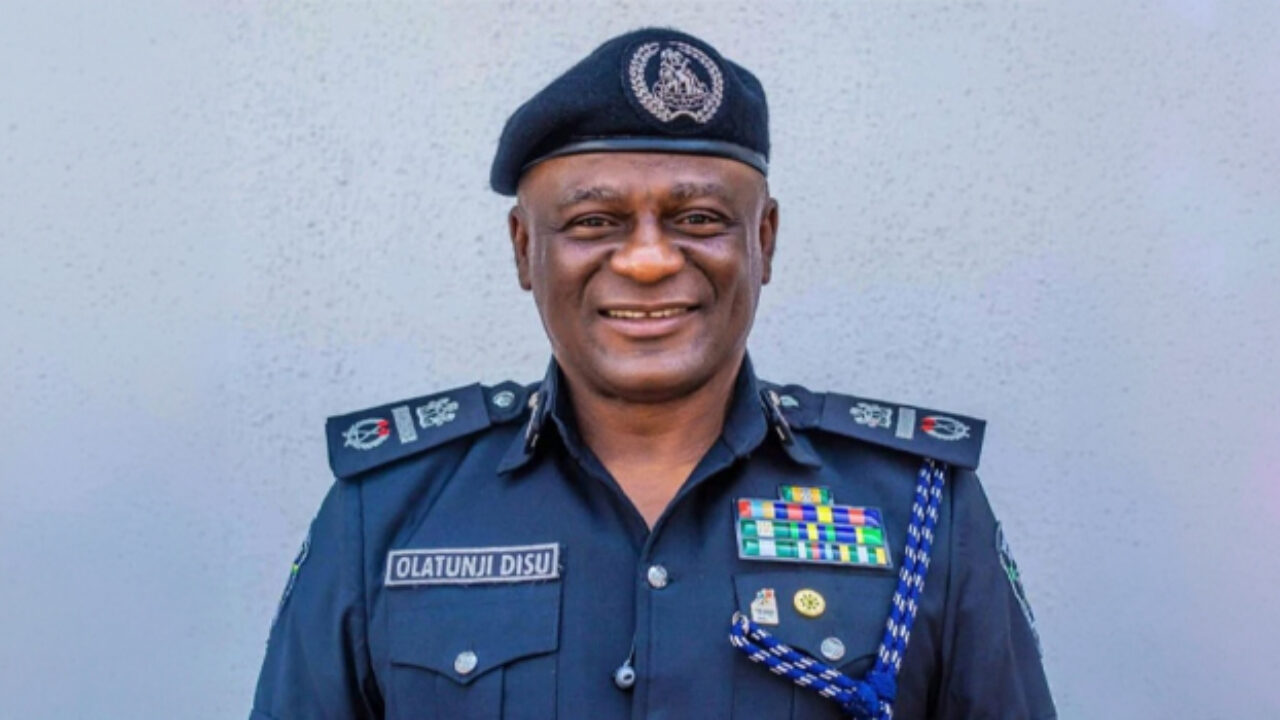
President Bola Tinubu on Wednesday charged the newly decorated acting Inspector-General of Police, Tunji Disu, to make the Nigeria Police Force better than he met it, as the country grapples with banditry, terrorism, and other criminal activities.
The President, who personally decorated Disu with his new rank at the State House, Abuja, said the appointment comes at “a defining moment for our nation’s security,” expressing confidence in the new police chief’s ability to restore public confidence in the Force.
“The commitment that I expect from you is for you to make it better than you met it. And I’m sure you can do it. Nigeria is challenged right now with banditry, terrorism and all sorts of criminal activities,” Tinubu stated during the decoration ceremony.
The President, who drew on his personal knowledge of Disu from his tenure as Lagos State Governor, said he believes in the dedication the new IGP exhibited while serving in Lagos.
“I know your record. I believe in the dedication that you’ve exhibited while you were in Lagos and I was the Governor of Lagos State.
“Now you assume this responsibility at a defining moment for our nation’s security,” the President said.
Tinubu outlined specific expectations for the new police chief, emphasising discipline, professionalism, and inter-agency collaboration.
“I expect you to strengthen the discipline, enhance inter-agency collaboration, and restore public confidence in the Nigeria Police.
“Lead firmly but fairly, demand professionalism at every level and ensure that safety of lives and property remains your highest priority,” he charged.
Acknowledging the magnitude of the task ahead, the President assured Disu of his full support.
“It is a daunting challenge. I know you can do it.
“You have my full support as you advance the security pillars of the Renewed Hope agenda.
“You are a straightforward individual, committed and respected. You have sufficient discipline,” Tinubu stated.
The President urged the new IGP to draw from the experience of his predecessor, Kayode Egbetokun, who attended the ceremony.
“You can draw from the experience of Kayode Egbetokun who had been there before you.
“You have been part of the thinking, and you’ve been part of the innovation.
“The challenge as you hold the baton of this leadership is the belief that you will excel and Nigeria will prevail,” he said.
Speaking to the outgoing IGP, Tinubu expressed gratitude for his service while linking his legacy to the success of his successor.
“To the outgoing Inspector-General of Police, I extend the gratitude of the entire country.
“Nigeria, we are a grateful nation to you for your dedication in service, expression of good leadership attributes within the Force.
“You have served with commitment and distinction, and Nigeria appreciates your contribution to maintaining law and order in our country,” the President said.
He added, “What you should look back and remember is this: you have not succeeded without a good successor.
“Therefore, the success of Tunji Disu as IGP, when confirmed, is part of your responsibility and the joy you should look forward to.”
Tinubu noted that Disu’s previous role as Principal Staff Officer to Egbetokun positioned him well for the new assignment.
“Having been part of your Principal Staff Officer, I have no doubt he understands the ins and outs of the operation.
“He will only improvise. He’s an operational person from what I know,” the President stated.
The decoration ceremony, which took place at 4:00 pm at the President’s office, had in attendance Chief of Staff to the President Femi Gbajabiamila, and other senior government officials.
President Tinubu personally pinned the new insignia on Disu’s uniform, marking the formal transfer of leadership of Africa’s largest police force.
In his response, Disu pledged to justify the confidence reposed in him, vowing to end impunity and enforce zero tolerance to corruption within the Force.
“The President mentioning a lot of activities about me, mentioning areas I’ve worked, mentioning successes I’ve recorded as a policeman, brought emotion to me, almost brought me to tears,” Disu told State House correspondents.
He added, “I will let them know that the era of impunity is over. I will ensure that I train them and encourage them to follow human rights. I will ensure that they know that I will try to follow a regime of zero tolerance to corruption.”
The new police chief emphasised that Nigerian citizens are the ultimate bosses of the police.
“One of the first lectures I’m going to have with my men, I’m going to talk to them, let them know that the citizen, the citizen of the country, are the boss. No police anywhere in the world can succeed without the cooperation of members of the public,” Disu stated.
Egbetokun, in his remarks, expressed confidence in his successor’s ability to surpass his achievements.

“I invested in likely successors in the Nigerian Police Force, and I’m happy that one of those that I’ve invested in has been found most suitable for the job. I have so much confidence that he would surpass what I have done,” Egbetokun stated.
The decoration came barely 24 hours after Egbetokun submitted his resignation letter on Tuesday, citing family issues that require his undivided attention.
However, multiple Presidency sources told our correspondent that Egbetokun was asked to step down during a meeting with the President on Monday evening at the Presidential Villa.
Disu’s appointment came just 48 days before his scheduled retirement on April 13, 2026, when he would have reached the mandatory retirement age of 60 years.
However, under the amended Police Act, which allows Inspectors-General of Police to serve a four-year tenure regardless of age, Disu may remain in office until 2030.
According to the Special Adviser to the President on Information and Strategy, Bayo Onanuga, President Tinubu will convene a meeting of the Nigeria Police Council shortly to formally consider Disu’s appointment as substantive Inspector-General of Police, after which his name will be transmitted to the Senate for confirmation.
Born on April 13, 1966, on Lagos Island, Lagos State, Disu joined the Nigeria Police Force on May 18, 1992, and has served for over three decades across multiple operational and leadership roles.
He rose to national prominence as Commander of the Rapid Response Squad in Lagos State, where he served for six years. Under his leadership, the unit won the Best Anti-Crime Squad award in West Africa in 2016.
On August 2, 2021, he was appointed to head the Intelligence Response Team, replacing the suspended Abba Kyari.
Before his elevation to IGP, Disu was Assistant Inspector-General of Police in charge of the Force Criminal Investigation Department Annex, Alagbon, Lagos.
Disu’s appointment will see the retirement of at least nine Deputy Inspectors-General of Police, in line with the tradition that senior officers vacate their positions when a junior colleague is appointed IGP.
Disu assumes duty
The acting Inspector-General of Police, Disu, on Wednesday formally assumed duty following his decoration by President Tinubu earlier in the day.
The new police boss took his first salute as Inspector-General from members of the Quarter Guard and other officers at the Force Headquarters after returning from the Presidential Villa at about 4:15 p.m. He thereafter proceeded to the official handover ceremony with Egbetokun.
Egbetokun, dressed in a blue suit, white shirt and tie, attended the ceremony alongside Deputy Inspectors-General of Police.
In his remarks, Disu thanked the President for the confidence reposed in him, noting that the Nigeria Police Force possesses the capacity to address prevailing security challenges.
He said the Force is endowed with brave and professional officers whose institutional knowledge, passion and resilience have enabled the country to overcome difficult security situations.
The acting IG, however, acknowledged existing challenges within the Force, including a trust deficit with communities, outdated systems, resource gaps and instances of misconduct.
“These are truths we must confront with resolve in order to reposition the Nigeria Police as a trusted, people-oriented institution,” he said.
Disu outlined three priorities for his tenure: professionalism and modernisation; accountability and integrity; and community partnership.
On professionalism, he said the Force would embrace intelligence-led policing, forensic investigation, digital tools and evidence-based practices, adding that officers would be better trained and equipped.
Addressing accountability, he declared that impunity would not be tolerated under his leadership, stressing that disciplinary measures would apply across all ranks without exception.
He said, ”I will say this plainly, so there is no confusion: the days of impunity are over. The badge is a symbol of public trust. Anyone who treats it otherwise will face the full consequences of our disciplinary processes.
This applies at every rank, without exception, including those closest to me. I will not ask the public to trust a Service that does not first hold itself accountable. We will strengthen our internal oversight mechanisms, make our processes more transparent, and mean what we say when we speak of the rule of law.”
He also pledged to strengthen internal oversight mechanisms and promote transparency in line with the rule of law.
On community partnership, Disu said effective policing requires collaboration with the public, noting that community policing would become central to the operations of the Force.
He urged officers to uphold integrity, compassion and courage in the discharge of their duties, while assuring them of improved welfare and dignified working conditions.
The acting IG also called on Nigerians to partner with the police by reporting crimes, engaging with officers and holding the institution accountable when necessary.