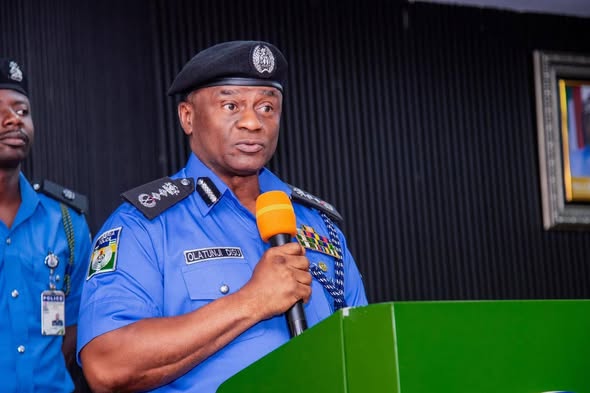
Newly sworn-in Inspector-General of Police, Tunji Disu, on Wednesday inaugurated a committee on the establishment of state police.
As part of ongoing discussions on policing reforms, President Bola Tinubu, had, last Wednesday, during the breaking of fast with senators at the Presidential Villa, Abuja, urged the leadership of the 10th Senate to initiate constitutional amendments to provide for the establishment of state police.
The President said decentralised policing would strengthen security at the grassroots and improve rapid response to threats within states, noting that the current centralised structure required constitutional review to accommodate the proposed reform.
Speaking during the inauguration, Disu said the committee’s task was to examine the concept of state policing as part of efforts to strengthen Nigeria’s internal security architecture and improve community-based policing.
He said the committee would review existing policing models within and outside Nigeria, assess community security needs, propose an operational framework for state police structures, and address issues of recruitment, training, standards, funding, accountability and oversight.
“Among other responsibilities, the committee is expected to review existing policing models within and outside Nigeria, assess community security needs and emerging risks across the country, propose an operational framework for the establishment and coordination of State Police structures, address issues relating to recruitment, training, standards, and resource allocation and develop robust accountability and oversight mechanisms to ensure professionalism and public trust,” he said.
Disu said state police formation could provide localised policing services focused on community safety, conflict prevention, neighbourhood patrols, and early response to emerging threats.
“This collaborative arrangement will encourage specialisation, strengthen professionalism, and ultimately deliver more effective security outcomes for our citizens,” he added.
The steering committee is chaired by Prof. Olu Ogunsakin, Director-General of the National Institute for Police Studies, Abuja, with CP Bode Ojajuni as secretary.
Other members are DCP Okebechi Agora, DCP Suleyman Gulma, ACP Ikechukwu Okafor, CSP Tolulope Ipinmisho and CP Emmanuel Ojukwu (retd.).
Also speaking shortly after his swearing-in as the substantive Inspector-General of Police, Disu disclosed that he had constituted a committee to develop the Nigeria Police Force’s position on the proposed establishment of state police.
He said, “The committee was set up early this morning to look into the issue of State Police from the angle of the Nigeria Police.
“We don’t want it to seem as if others are taking decisions, and we, the most important people concerned, did not do anything. We want to ensure that the best thing is done,” the IG stated.
He emphasised that the police was not opposed to state police, describing it as a partnership rather than a threat to the Force.
“State police has come to stay, and the police should be able to do their own part in making it succeed. The police are not afraid. Our jobs are not being taken. It’s just an issue of partnership,” Disu said.
Disu sworn-in
Disu took the oath of office at 2:53pm on Wednesday following the reading of his citation by the State House Director of Information and Public Relations, Mr. Abiodun Oladunjoye.
The ceremony was witnessed by Vice President Kashim Shettima, cabinet members, and other dignitaries.
Also in attendance were the Secretary to the Government of the Federation, Senator George Akume; National Security Adviser, Nuhu Ribadu; Chief of Staff, Femi Gbajabiamila; Minister of Police Affairs, Senator Ibrahim Gaidam; FCT minister, Nyesom Wike; and Head of Service, Mrs. Esther Walson-Jack.
Disu’s confirmation comes barely a week after President Tinubu appointed him acting IGP following the resignation of Kayode Egbetokun on February 23, 2026.
Ex-officers back committee
A retired Assistant Inspector-General of Police, Ali Amodu, described the Inspector-General of Police’s decision to set up a special committee on state policing as “a right step in the right direction.”
Speaking on the development, Amodu said the committee would provide professional input and advise the Presidency on the proposed decentralisation of the Nigeria Police Force.
“The decision or the thought of the IG in setting up a special committee is a right step in the right direction. The committee will actually provide the thinking, and then they will give advice to the Presidency because it is the police that they want to decentralise. It is good that the authority will want to hear from them,” he said.
He noted that he had canvassed the idea of decentralising the police as far back as 1981 after returning from detective training in the United Kingdom.
Amodu said, “As far back as 1981, I was a young superintendent. I came back from the UK and I actually made a suggestion to the police authority then that they should think of decentralising the police force because I saw the pattern in the UK.
“I said we can moderate our own and make adjustments. I was a very young officer, but the old hands were very angry with me to have said this. I remember my commissioner of police then said, ‘Young man, we sent you to the UK for detective training, and you are coming back thinking they should form a modality on how to decentralise the force.’”
Amodu added that the idea was now gaining traction globally. “The thing is coming to light. Light is shining on that area. It’s happening in many parts of the world,” he said.
According to him, policing differs from military operations because it requires close interaction with local communities.
“The police are not like the army or any arm of the Armed Forces. You work with the people, and people want to appreciate their own person. It is at that time they will be comfortable to even pass information which is needed for policing all over the world,” he said.
He also referenced ongoing legislative discussions on constitutional amendments, noting that the current constitution provides for a single police force.
“Just a few days ago, I heard the Senate President say that before the end of the year they will look into how the Constitution and see if it can be amended because the present Constitution says Nigeria has one police force. So, if we want to decentralise, they must amend that section of the constitution. I think they are working on it. Let’s see how it is going to work out,” he added.
On his part, a former Commissioner of Police, Lawrence Alobi, also backed the constitution of the committee, describing it as a professional and proactive move.
“It’s the right thing to have done because the police affair is all about policing, and police can come and handle police issues effectively,” Alobi said.
He stated that the committee should clearly define the structure and supervisory framework for state police formations.
“The committee should advise on the structure and how the state police would be supervised. Maybe they should be under the AIG in zones or the DIGs would have supervisory roles over them,” he said.
Alobi stressed the need to address jurisdictional issues in advance to avoid operational conflicts.
“If the structure is not determined now proactively and it is established, I don’t know the case, but if a case is committed in a state and the suspect is in another state, and the police from one state go there to get the suspect, how will the police in that state treat them when they come? This is something that needs to be determined. It should already be established and practiced,” he said.
He added, “I think the system is running in the right direction and doing the right thing.”
Middle East crisis
Meanwhile, Disu disclosed that the Nigeria Police Force wass closely monitoring Islamic groups with allegiance to Middle Eastern countries following the escalating US-Israel-Iran conflict, warning that developments in the Middle East could trigger repercussions in Nigeria.
“Everywhere in the world, we are aware that is what we call intelligence policing. Our ears are to the ground. We know we have groups of people, different kinds of Islamic sects in Nigeria. We have those who pay allegiance to this eastern part of the world as well,” Disu stated.
He added, “So we know if anything happens in the eastern part of the world, the repercussion will come to us.
“So, we are putting all necessary actions. You can see policemen on patrol, and most importantly, we are talking to them to ensure that they do not take law and order into their hands.”
The IGP’s statement comes amid heightened tensions in the Middle East following US and Israeli airstrikes on Iranian targets over the weekend and Iran’s retaliatory missile attacks on Israeli and American military installations.
Nigeria is home to significant Islamic groups with ideological and sometimes organisational ties to Middle Eastern countries, particularly Iran and Saudi Arabia.
The Islamic Movement in Nigeria, led by Sheikh Ibrahim El-Zakzaky, is known for its pro-Iranian stance and Shia Islamic orientation, while several Sunni groups maintain connections with Saudi Arabia and other Gulf states.