Connect with us

News

EFCC evicts Malami, family from Abuja residence

Published

on

Former Attorney-General of the Federation, Abubakar Malami (SAN), on Tuesday confirmed that operatives of the Economic and Financial Crimes Commission forcefully evicted him and his family from their Abuja residence, despite ongoing court proceedings over the property.

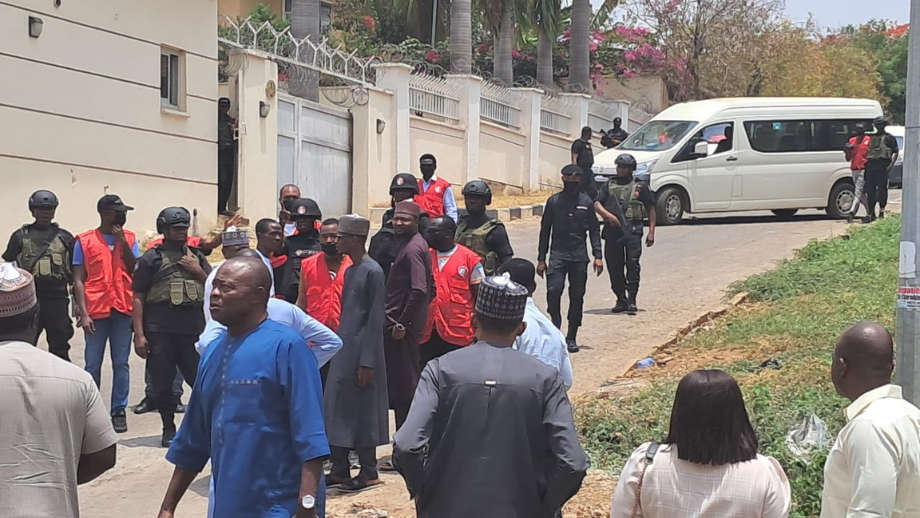
Malami disclosed this while addressing journalists at a press conference, stating that EFCC officials stormed the premises on Monday and returned on Tuesday with armed personnel to complete the takeover.

“Yesterday, without further recourse to the court, without seeking an order to seal my properties, without seeking an order to evict my family members and me from the property, without seeking a court order for the appointment of a receiver manager, the EFCC came to effect a forceful eviction.

“They were unable to conclude the process yesterday and reinforced this morning with a lot of personnel that are armed and indeed forcefully took over possession of my family residence,” he said.

The former AGF identified the property as his family home located at No. 2, Koronakh Close, off Amazon Street, Maitama, Abuja.

He explained that the action followed an interim forfeiture order granted on January 6, 2026, but insisted that the order did not authorise eviction or immediate takeover of the property.

“The most interesting part of the order was that there was no clear directive or instruction… that the premises would be taken over forthwith or perhaps is being sold, or perhaps evicting the occupants,” he said.

Malami noted that he had already challenged the forfeiture order before the Federal High Court, with the case adjourned till April 20, 2026.

See also  LASG Addresses Makoko Demolition Concerns, Unveils $2m Redevelopment Initiative

According to him, with both parties already before the court, the EFCC ought to have exercised restraint rather than taking unilateral enforcement steps.

“It is only natural, logical and judicial that no party is expected to overreach by taking unilateral steps that would place a court in a situation of purposelessness,” he stated.

He faulted the commission for allegedly bypassing due process, stressing that enforcement of court orders was the responsibility of judicial authorities, not litigants.

“Execution of court orders and processes is an exclusive function of court bailiffs and sheriffs… and is not in any way the prerogative of a party to the litigation,” he said.

Malami described the eviction and takeover as unlawful and outside established legal procedure.

“What happened by way of forceful eviction of my family members and forceful takeover of my properties is legally and judicially unprecedented in the Nigerian legal system,” he added.

He further alleged that the EFCC neither obtained a specific eviction order nor involved court officials before carrying out the action.

The former minister also hinted at possible political undertones, noting that the incident occurred shortly after his release from detention and during a period of increased political visits and support.

“The fact that these things happen at a time when I was receiving tremendous goodwill messages… can certainly be a basis for people to insinuate perhaps political persecution,” he said.

However, he declined to directly describe the action as a vendetta, citing the pending nature of the case.

Malami said he would pursue legal remedies to challenge the EFCC’s action.

See also  Eight buildings collapse as flood takes over Borno streets

“For me, the steps are legal, legitimate and judicial, and we will certainly embark on the judicial process to do the needful,” he added.

Efforts to reach his lawyer on the asset forfeiture case, J.B Daudu, to confirm the sealing of the properties and next legal steps were unsuccessful as of the time of filing this report, as he did not respond to repeated calls from our correspondent.

The PUNCH reported that earlier on Tuesday, the anti-corruption agency moved to take over the Maitama residence of the former AGF.

The operatives, reportedly led by Folarin Dare, arrived in about five buses, heavily armed and dressed in their red and black jackets, as they barricaded the road leading to Malami’s residence.

punch.ng

FOLLOW US ON:

FACEBOOK

TWITTER

PINTEREST

TIKTOK

YOUTUBE

LINKEDIN

Continue Reading
Click to comment

Leave a Reply

Your email address will not be published. Required fields are marked *

News

FG names 10-member panel to probe deaths of 37 NSCDC detainees

Published

on

The Federal Government has constituted a 10-member independent committee to investigate the deaths of 37 people detained by the Nigeria Security and Civil Defence Corps in Niger State over suspected illegal mining.

The Minister of Interior, Olubunmi Tunji-Ojo, announced the constitution of the committee on Saturday, following a directive by President Bola Tinubu for a comprehensive investigation into the incident.

The 37 detainees died on Thursday, September 17, 2026, while in the custody of the NSCDC Niger State Command.

The cause of the deaths has not been established, with authorities ordering investigations to determine the circumstances surrounding the incident.

In a statement signed by the minister, the government said the committee would establish the identities of the deceased and investigate their arrests, detention and the cause and circumstances of their deaths.

It would also determine responsibility, complicity, negligence and misconduct, as well as recommend appropriate action, compensation where applicable and measures to prevent a recurrence.

“Any attempt to destroy or conceal evidence, intimidate witnesses or obstruct the investigation will be treated as a serious offence,” he said.

The committee is chaired by retired Deputy Director-General of the Department of State Services, Jonathan Kure, while Professor Isa Hayatu Chiroma (SAN), former Director-General of the Nigerian Law School, will serve as secretary.

Other members include retired AIG Hosea Hassan Karma; Professor Olayinka Buhari, a professor of Histopathology and former Chief Medical Director of the University of Ilorin Teaching Hospital; a representative of the Minna Emirate Council; and a representative of the Niger State Government.

The committee also includes Alhaji Liman Sulaiman, National Secretary of the Miners Association of Nigeria; lawyer and human rights activist Deji Adeyanju; Mrs Zainab Suleiman Okino of Blueprint Newspaper; and public affairs analyst, Dr George Agbakahi.

See also  PHOTOS: Nigerian man fighting for Russia k!lled in battle field

According to the statement, the committee may co-opt relevant experts, access facilities and documents, visit relevant locations and request memoranda from members of the public.

It has two weeks to complete its work and submit its report to the minister.

The minister also expressed condolences to the families of the deceased and appealed for calm while the investigation continues.

Source: punchng.com

FOLLOW US ON:

FACEBOOK

TWITTER

PINTEREST

TIKTOK

YOUTUBE

LINKEDIN

INSTAGRAM

Continue Reading

News

Oriire: Abductors fed us only when convenient for them – DSS witness tells court

Published

on

The witness of the Department of State Service, DSS in the ongoing trial of five alleged Ansaru terror group members on Friday, September 18 told the Federal High Court in Abuja that their abductors fed them only when it was convenient for them.

The witness code named AAA who was one of the victims of Orire school abduction said they were seriously traumatised during and after their ordeal that lasted 56 days.

Under cross examination by the counsel to the five accused persons Mr Bala Dakum, the witness said they were offered food by the abductors at their own convenient time despite the presence of little children of 18 months among them.

She admitted that the alleged kidnappers used the mobile phone of the victims to contact government officials but said she did not know the phone number of the government officials that were called.

She further told the court that upon their rescue by security operatives, she was interrogated by DSS operatives in their office and also while in the hospital.

Answering a question, the witness admitted that the three out of the five defendants on trial were with them in the forest while she got to know the other two during interrogation at the DSS office.

She also told the court that Michael Oyedokun and John Olaleye were killed at camp A and Camp B respectively but that she was not present at the scene where they were beheaded.

The witness further told the court that because she was not at the scene where the two teachers were beheaded, she did not know the specific kidnappers that carried out the killing.

See also  Insecurity: State Assemblies move to debate state police

Meanwhile justice Salim Olasupo Ibrahim has fixed October 12 and 13 for continuation of trial of the five accused person.

FOLLOW US ON:

FACEBOOK

TWITTER

PINTEREST

TIKTOK

YOUTUBE

LINKEDIN

INSTAGRAM

Continue Reading

News

Protesters March Against Sunday Igboho’s Iru Ekun Security Outfit In Oyo, Allege Tribal Discrimination

Published

on

group of protesters on Friday took to the streets in Oyo State to demonstrate against the Iru Ekun Security Network, a private security outfit associated with Yoruba Nation activist Sunday Adeyemo, popularly known as Sunday Igboho.

The protesters, who carried placards, accused the security outfit of allegedly discriminating against people from some ethnic groups and called for equal treatment of all residents irrespective of their tribe or background.

Some of the placards displayed during the protest read: “Say No To Iru Ekun, Crime Knows No Tribe,” “A Criminal Is A Criminal. One Nation, One People, One Nigeria,” and “Our Diversity Is Our Strength.”

The demonstration comes amid growing public debate and criticism surrounding the activities and methods of the Iru Ekun Security Network, particularly concerns over the role of privately organised security groups and their relationship with formal law-enforcement agencies.

The latest controversy followed an incident in Oyo State in which Iru Ekun operatives were accused of obstructing police officers who were attempting to arrest a suspect in Ibadan.

A rights group, Vocalpoint Human Rights Initiative (VOHRI), on Wednesday warned against allowing Iru Ekun or any other private group to operate as a parallel law-enforcement institution.

The group said no individual or organisation should be allowed to determine who should be arrested or punished without lawful authority and due process.

The criticism also comes after reports of confrontations involving Iru Ekun operatives during security operations in Oyo State.

In June, members of the group reportedly came under attack during a surveillance operation in the Old Oyo National Park while searching for suspected kidnappers and armed criminals. Igboho subsequently vowed that the group would continue its anti-kidnapping operations in the South-West.

See also  Those denying Christian genocide need psychiatric evaluation – Enenche

Iru Ekun was established by Igboho as a community security initiative aimed at tackling kidnapping, banditry and other criminal activities across parts of the South-West.

At the launch of the Lagos chapter earlier this month, Igboho directed members of the network operating in Lagos, Oyo, Ogun, Ondo and Ekiti states to intensify efforts against criminality.

According to reports, Igboho said the group would confront anyone threatening peace and security regardless of ethnic or religious affiliation and urged its members to operate within the law.

However, critics have continued to question the structure, accountability and methods of the privately organised security network, particularly given the existence of established state security structures such as the police and Amotekun.

A recent commentary published by Nigerian Tribune also raised concerns about the regulation and oversight of Iru Ekun, while discussing Igboho’s growing involvement in regional security matters.

The protesters’ demonstration on Friday adds a new dimension to the debate, with the placards emphasising ethnic inclusiveness and warning against treating crime through a tribal lens.

The protesters called for security operations to be conducted without discrimination, insisting that criminality should be addressed based on individual conduct rather than ethnic identity.

Source: Saharareporters

FOLLOW US ON:

FACEBOOK

TWITTER

PINTEREST

TIKTOK

YOUTUBE

LINKEDIN

INSTAGRAM

Continue Reading

Trending