Connect with us

Business

Dangote rejects NNPC offer to increase stake in refinery; read why

Published

on

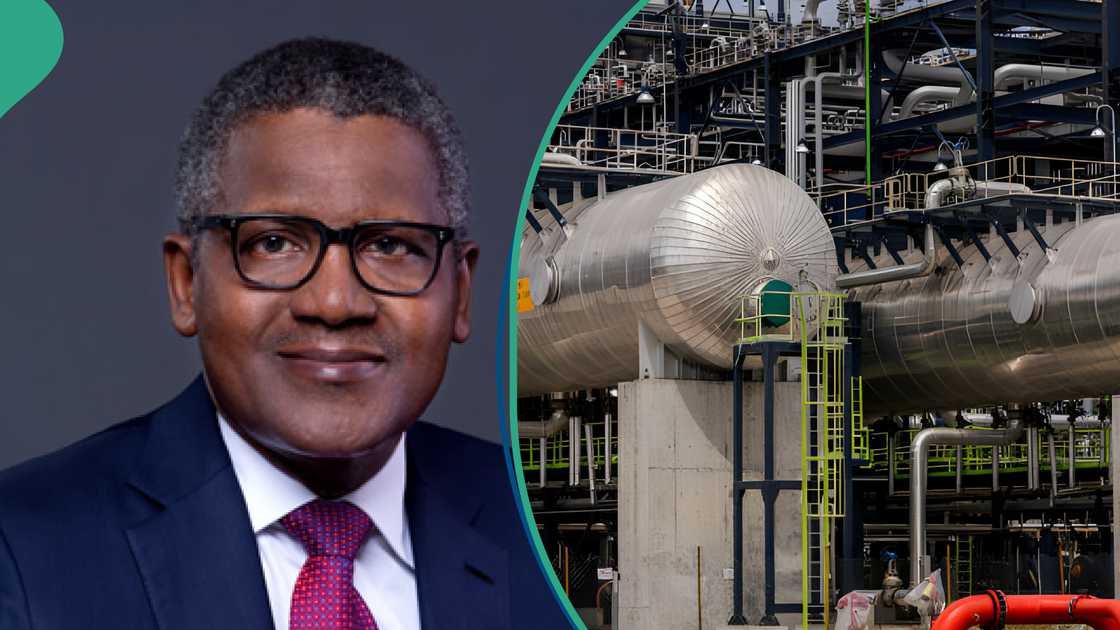
The President of the Dangote Group, Alhaji Aliko Dangote, has said the group rejected requests by the Nigerian National Petroleum Company Limited to increase its 7.25 per cent stake in the Dangote Petroleum Refinery.

Dangote stated this in an interview with the Chief Executive Officer of the Norwegian Sovereign Wealth Fund, Nicolai Tangen. The interview was monitored by one of our correspondents on Wednesday.

This came as findings by The PUNCH showed that petrol supply from the $20bn Lekki-based refinery rose to 3.18 billion litres in the first quarter of 2026, while imports fell sharply to 965.52 million litres.

Further findings indicated that the average domestic ex-depot petrol price from the Dangote refinery across January to March 2026 was about ₦1,000 per litre. This implies that the multi-billion-dollar plant supplied over N3.2tn worth of petrol domestically during the review period.

Also, the war between the United States and Iran, and its resultant disruption of the oil sector and other sectors, has led to increased revenue for the Dangote refinery, as the plant has raised its refined petroleum products export.

According to Dangote during the interview, the NNPC’s offer to increase its 7.25 per cent stake in the refinery was rejected because the company is planning to go public and give other Nigerians the opportunity to own shares in the plant.

It was reported that in 2021, the NNPC acquired the 7.25 per cent stake in the refinery for $1bn, with an option to acquire the remaining 12.75 per cent stake by June 2024. But the national oil firm reneged on its decision.

During the interview with the Norwegian Sovereign Wealth Fund CEO, Dangote revealed that the national oil company had made attempts to acquire more stakes in the refinery, but this was turned down.

Responding to questions about what could be the biggest risks to his businesses, Dangote mentioned civil war and government policy inconsistencies, saying, “Actually, if there are civil wars, which is not in the offing at all.

“The other biggest risk is government inconsistencies in policies, and we are addressing that one because if you look at our refinery, the national oil company already owns 7.25 per cent, and they are trying to buy more. We are the ones that said no; we want to now spread it and have everybody be part of it.”

Recall that the NNPC, under the former Group Chief Executive Officer, Mele Kyari, reduced its stake in the refinery from 20 per cent to 7.25 per cent. Aliko Dangote made this public in 2024. He disclosed that the NNPC had only a 7.2 per cent stake in the refinery and not 20 per cent as many Nigerians believed.

“The agreement was actually 20 per cent, which we had with NNPC, and they did not pay the balance of the money up until last year; then we gave them another extension up until June (2024), and they said that they would remain where they had already paid, which is 7.2 per cent. So NNPC owns only 7.2 per cent, not 20 per cent,” Dangote stated in 2024, to the surprise of many Nigerians.

Speaking further during the latest interview, the billionaire businessman said shareholders can get their dividends in dollars. “What we are announcing is that when you invest in any of our businesses going forward, in cement or in the refinery, in petrochemicals, in fertiliser, we guarantee to pay you a dividend in dollars because we are very well into exports. 80 per cent of our revenue will be in dollars,” he said.

To raise funds for building the refinery, Dangote said he got a lot of support from various financial institutions, including Nigerian banks.

According to him, the initial plan was to fund most of the construction work “from our internally generated funds”, but because of naira devaluation, the group “had to rely on Afreximbank, Africa Finance Corporation, Zenith Bank, Access Bank, UBA and a couple of the local banks, but of course we also have a very good relationship with the Standard Bank of South Africa and, at the beginning, Standard Chartered Bank of the UK”.

He maintained that the company was lucky and what happened when the plant was completed “turned out to be much more than our own expectations”.

See also  Flutterwave expands open banking with Mono acquisition

In the interview, Dangote disclosed how he sold his properties in the United States and the United Kingdom to settle in Nigeria.

“When I decided to go into the industry, you know what I did? I sold all my properties in the US. I had two houses in the US, big mansions, and I had a house in the UK. I wanted to really sit in Nigeria and concentrate.

“You know, sometimes when you own a holiday home anywhere, you have to create that time to go and use that property. So, now my life is very simple. Wherever I go, I use hotels; I pay. When I leave, nobody will call me and say I have a burst pipe or something is wrong. So I’m committed to what I do, and I just don’t do things; I always create a vision.

“It’s just like now; we created a vision for 2030. So, I know I have a target to meet. I just don’t do business. All my businesses are targeted,” he said.

On how he decides which business to venture into, the business mogul replied, “I first of all look at what we need as a people? What is it that we are supposed to be producing, and we’re importing? So we do what you call ‘backward integration’. We produce what the people need, and we are now producing things that when you wake up as a human being every morning, you must use part of what we produce,” he said.

While defending why the NNPC reduced its planned stake in the Dangote refinery in 2024, the NNPC’s former spokesman, Olufemi Soneye, said it was to invest in compressed natural gas stations.


N3.2tn petrol supply

Petrol supply from local refineries rose to 3.18 billion litres in the first quarter of 2026, while imports fell sharply to 965.52 million litres, according to data from official documents of the Nigerian Midstream and Downstream Petroleum Regulatory Authority analysed by The PUNCH.

Although the NMDPRA documents did not directly name Dangote refinery in the first-quarter supply table, industry records show that it is the only refinery in Nigeria currently known to be producing Premium Motor Spirit on a commercial scale.

The agency’s fact sheet also listed Dangote among Nigeria’s active refineries and separately tracked its PMS performance. The figures showed that Nigeria’s total petrol supply stood at 4.14 billion litres between January and March 2026, with local refinery supply accounting for 76.7 per cent, while imports contributed 23.3 per cent.

This marked a major shift from the first quarter of 2025, when domestic refineries supplied 1.99 billion litres, while oil marketers imported 2.43 billion litres. Total supply in Q1 2025 stood at 4.42 billion litres.

For a proper year-on-year comparison, The PUNCH converted the 2025 figures from the average daily supply provided by the NMDPRA into monthly volumes by multiplying each month’s million litres per day by the number of days in the month and then by one million. This became necessary because the 2026 report provided actual monthly litre volumes, while the 2025 data was presented as daily averages.

The analysis showed that local refinery supply jumped by 59.2 per cent from 1.99 billion litres in Q1 2025 to 3.18 billion litres in Q1 2026. Importation, however, dropped by 60.2 per cent from 2.43 billion litres to 965.52 million litres.

Despite the increase in local refining, total petrol supply declined by 6.2 per cent year-on-year from 4.42 billion litres in Q1 2025 to 4.14 billion litres in Q1 2026.

In January 2026, local refinery supply stood at 1.24 billion litres, importation was 698.19 million litres, while total supply reached 1.94 billion litres. This translated to a daily average of 40.07 million litres from local refining, 22.52 million litres from imports, and 62.59 million litres in total supply.

Compared with January 2025, local refinery supply rose by 109.8 per cent from 19.1 million litres per day, while imports fell by 8.8 per cent from 24.7 million litres per day. Total daily supply also increased by 43.2 per cent from 43.7 million litres per day.

In February 2026, local refinery supply dropped to 824.45 million litres, while imports collapsed to 85.10 million litres. Total supply fell to 909.55 million litres. On a daily basis, local refinery supply averaged 29.44 million litres, imports averaged 3.04 million litres, and total supply averaged 32.48 million litres.

See also  Big money, small impact: Governors face fire over N9tn FAAC windfall

This showed that while local refinery supply was 18.7 per cent higher than the 24.8 million litres per day recorded in February 2025, imports crashed by 88.9 per cent from 27.5 million litres per day. Total supply also fell by 37.9 per cent from 52.3 million litres per day in the same month of 2025.

In March 2026, local refinery supply recovered to 1.11 billion litres, while importation rose to 182.24 million litres. Total supply stood at 1.29 billion litres. This amounted to daily averages of 35.87 million litres from local refining, 5.88 million litres from imports, and 41.75 million litres in total supply.

Compared to March 2025, local refinery supply increased by 56.6 per cent from 22.9 million litres per day, while importation fell by 79.5 per cent from 28.7 million litres per day. Total supply declined by 19.1 per cent from 51.6 million litres per day.

Month-on-month, total petrol supply fell by 53.1 per cent from 1.94 billion litres in January 2026 to 909.55 million litres in February, before rising by 42.3 per cent to 1.29 billion litres in March.

Local refinery supply also fell by 33.6 per cent between January and February, before rising by 34.9 per cent in March. Imports declined by 87.8 per cent in February but increased by 114.2 per cent in March.

The NMDPRA’s April 2026 FAAC report showed that PMS supply rose from 909.55 million litres in February to 1.29 billion litres in March, representing a 42.29 per cent increase. It also showed that PMS distribution through truck-out fell from 1.59 billion litres in February to 1.47 billion litres in March.

The figures indicate that Nigeria’s petrol market is becoming less dependent on imports, with domestic refining now providing the bulk of the national supply.

However, the decline in total Q1 supply suggests that increased local refinery output has not fully translated into higher overall petrol availability compared with the same period of 2025.

The PUNCH earlier reported that Nigerians consumed about 4.93 billion litres of Premium Motor Spirit (petrol) to fuel various economic activities in the first quarter of 2026, according to an analysis of the Nigerian Midstream and Downstream Petroleum Regulatory Authority’s downstream fact sheet monthly data.

It revealed that this amount represents a 7.4 per cent increase from the 4.59 billion litres recorded in the corresponding period of 2025.

The PUNCH also reported that the Dangote Petroleum Refinery exported about 434 million litres of Premium Motor Spirit (petrol) in March 2026, as the facility diversified its customer base after significantly outpacing domestic consumption.

The report indicated that the refinery, owned by Aliko Dangote, operated at an average capacity utilisation of 93.62 per cent, reinforcing its position as the dominant supplier of refined petroleum products in Nigeria.

In earlier remarks reported in 2025, the Dangote group chairman, Aliko Dangote, asserted that the refinery had sufficient refined products in storage to meet domestic needs, saying:

“Right now, we have more than half a billion litres in storage. The refinery is producing enough refined products, gasoline, diesel, and kerosene to meet all of Nigeria’s needs.”

Commenting in an earlier report, renowned energy economist Professor Wumi Iledare, noted that Nigeria’s reliance on imported petrol has declined but has not been eliminated. He also warned against claims that fuel importation has ended following increased domestic supply from the Dangote Petroleum Refinery.

In a personal note titled “Dangote Refinery, Petrol Imports, and Market Reality,” Iledare said recent assertions that Nigeria no longer imports petrol reflect “understandable optimism” but overstate the economic reality of the downstream oil market.

“Recent claims that petrol importation into Nigeria has ended because Dangote Refinery now meets domestic demand reflect understandable optimism, but they overstate economic reality.

“Dangote Refinery has significantly improved domestic supply conditions and reduced Nigeria’s marginal reliance on imported petrol. However, neither Dangote refinery nor petroleum marketers determines national supply outcomes,” he said.

The Chief Executive Officer of petroleumprice.ng, Jeremiah Olatide, recently said that Nigeria’s domestic refining capacity has grown significantly.

Olatide described the development as a major milestone in the country’s long-standing quest to reduce dependence on imported petroleum products.


661,000bpd output

Also during the latest interview, Dangote revealed that his refinery is now operating at 661,000 barrels per day. This was even as he recounted the gains of the US-Iran war for its refinery and fertiliser business.

See also  Tinubu, Atiku, Obi weigh ex-govs for campaign DG roles ahead of 2027 elections

Dangote boasted that the company has proved its capacity by building a refinery of that magnitude in Nigeria, commissioning it, and running it above its 650,000 bpd nameplate capacity.

With this, he said financial institutions would be ready to support the group whenever the need arises.

“The refinery has been tested. We have now processed even crude at 661,000 barrels a day. So we have demonstrated that capability. Now, a lot of financial institutions are saying that, ‘Yes, if it is you doing this project, we are there to back you because we know that you can deliver; you have the capacity, you have the knowledge, and you have the experience,” he said.

Asked to speak about the impact of the Middle East crisis on his businesses, Dangote recounted the gains of the war, which has sent energy prices high across the globe.

To Dangote, there were windfalls as the demand for fuel rose globally, even with the prices. According to him, fertiliser has risen from $400 to $850 per tonne. Polypropylene went up from $900 to about $3,000. Dangote added that most Nigerian plastic companies would have shut down by now if not for his polypropylene.

“The effect of the war on our businesses is more beneficial than a downside because today, fertiliser is in very high demand. In February, before the Middle East crisis, urea was selling for about $400 a tonne. Today we are selling a tonne of fertiliser for $850, and we are actually oversold. In plastics, polypropylene has moved from $900. In the UK today, it is about $3,000.

“And if not because of the polypropylene we are producing today, all the plastic industries in Nigeria would have shut down because there’s nowhere you can even get it. Our aviation fuel is oversold till the middle of July, and we’re producing 20 million litres of jet fuel a day,” Dangote disclosed.

Speaking about crude supply, Dangote said, “We source about 56 per cent from Nigeria and some from Angola. We buy quite a bit from Angola, we buy from Libya, and we buy from the US. At one point, we were doing about seven to eight cargoes of WTI from the US. But we’re getting more of Nigeria’s crude now. We have to now buy 21 cargoes every month. That’s how big we are. And we’re more than doubling the refinery. You know, in the next 30 months, we will be at 1.4 million barrels per day, which is huge.”

Aliko Dangote named a category of those he called the ‘Mafia,’ trying to sabotage the refinery.

“The Mafia are the people who are actually benefiting because Nigeria was giving out almost $10bn every year as a subsidy. There are shippers who are making tonnes of money. There are traders who are making a lot of money buying crude and sending us refined products. There are also the local people; because it was subsidised, very few people are getting allocations. So they are making billions of naira. So, these are the people that did not want us to settle down because they believed that we were coming here to displace them, and of course, that’s what we have done now,” he said.

He added that plans are underway to sell stakes and inject about $45bn into the businesses for a target of $100bn revenue by 2030.

“We are coming up with selling part of the business, getting more investors into the business, and also making sure that we continue to grow the business. Cement production is going to 100 million tonnes. In cement, we don’t even need much money; we are getting financing, and the cash generation is very liquid.

“So, we’ll be able to actually fund this $45bn, which will eventually take us to $100bn of revenue, because our target is to get to $100bn by 2030, with a market valuation of maybe more than $250bn, because as we speak today, last year, our EBITDA was $3bn, but the target by 2030 is to be 10 times that amount, to be at over $30bn of EBITDA,” he stated.


Continue Reading
Click to comment

Leave a Reply

Your email address will not be published. Required fields are marked *

Business

30 months after subsidy removal, FG spends N30.6tn, saves N15.8tn

Published

on

30 months after President Bola Tinubu removed petrol subsidy and introduced other sweeping economic reforms, the Federal Government has spent N30.64tn as government expenditure to ease effect of its policies, while the policies generated N15.8tn in savings for the Federation.

The government said its total incremental expenditure between June 2023 and December 2025 was N30.64tn, exceeding the N20.4tn in additional resources available to the Federal Government from subsidy savings, higher revenue and borrowing by N10.24tn, or 50.2 per cent.

This show that the removal of petrol subsidy created significant fiscal space but did not produce a pool of idle cash for the Federal Government.

Instead, the government said the resources were absorbed by rising wage costs, debt servicing, infrastructure spending and other obligations arising from the same economic reforms.

Put differently, for every N100 the Federal Government generated in additional resources, it spent about N150, leaving about one-third of the expenditure to be funded from its existing revenue base.

The development came as the Finance Minister and Coordinating Minister of the Economy, Taiwo Oyedele, disclosed that the removal of petrol subsidy and the unification of the foreign exchange market mobilised N15.8tn in additional resources for the Federation during the period.

However, the government received only N5.4tn, representing 34 per cent of the subsidy savings, while the states received N6.5tn and local governments got N3.9tn under the Federation Account allocation formula.

These figures were contained in the Federal Government’s Nigeria Reform Scorecard titled, “The Benefits, Costs and Harm Prevented”, released on Wednesday. The purposes of the news conference was to provide Nigerians with clear and factual information on the savings arising from the removal of the foreign subsidy and foreign exchange unification.

According to Oyedele, the N15.8tn was not paid into the Federation Account under a heading described as “subsidy savings.”

Instead, he said the combined effect of the petrol subsidy removal and foreign exchange reforms increased the naira value of revenues accruing to the Federation.

“Between June 2023 and December 2025, subsidy savings mobilised a sum of N15.8tn in resources for the Federation,” Oyedele said.

“Many people will say, ‘Where is the subsidy saving?’ As a matter of fact, there wasn’t any line in the Federation Account with the description, ‘subsidy savings.’

“So, the subsidy savings showed up in the form of higher collection by Customs because, for every one dollar of import duty before, at N460, it became one dollar at N1,004, N1,003, N1,005.

“The NRS, Petroleum Profit Tax that it collected before, same dollar, higher amount in naira. So, the savings showed up in the Federation accounts by way of higher revenue collections as a result of the reforms.”

The minister said the additional fiscal resources were not generated by the petrol subsidy removal alone, arguing that the foreign exchange reforms also ended what he described as an implicit subsidy that had created opportunities for rent-seeking.

See also  KWAM1 loses bid to block Awujale selection process

He said, “Not just the subsidy removal, but also the exchange rate flotation, because we were subsidising the exchange rate. And that subsidy was not going to the ordinary person or manufacturers. It was going to rent-seekers.”

The Finance Minister explained that although the removal of petrol subsidy generated N15.8tn in savings for the Federation between June 2023 and December 2025, only N5.4tn, or 34 per cent, accrued to the Federal Government.

The balance was shared among the states and local governments under the statutory Federation Account allocation formula.

According to the scorecard, states received N6.5tn, representing 41 per cent of the total subsidy savings, while the 774 local government areas received N3.9tn, or 24 per cent.

The Federal Government also generated N3.1tn in additional independent revenue, mainly from increased remittances by government-owned entities, while N11.9tn came from additional borrowing.

This brought the Federal Government’s total incremental resources to N20.4tn, of which borrowing accounted for 58 per cent, subsidy savings 27 per cent and other revenue 15 per cent.

Of the N30.64tn in total incremental expenditure during the 31-month period, N9.39tn was spent on wage adjustments, including the increase in the national minimum wage, wage awards and allowances for public servants.

Another N9.37tn was spent on additional external debt servicing resulting from the depreciation of the naira, while N6.47tn went into strategic infrastructure development.

The three items alone accounted for about N25.22tn, or more than 82 per cent of the total incremental expenditure.

The remaining spending included N3.14tn in additional electricity subsidy costs, N1.24tn in increased domestic debt servicing linked to higher interest rates, N423.8bn for social welfare transfers and N419.1bn for the Federal Capital Territory, Ecological Fund, Natural Resource Fund and other interventions.

The government also spent N201.26bn on the higher naira cost of foreign obligations.

He said, “In addition, the Federal Government earned incremental independent revenue of

N3.1tn, principally remittances from government-owned entities while N11.9tn came from incremental borrowing, a figure that would have been far higher, and economically destabilising, without the fiscal space the reforms created.

“Altogether, the Federal Government’s incremental resources over the period came to N20.4tn. That money did not sit idle, it partly funded incremental expenses of N30.64tn. Of this, N9.39tn went to wage adjustments, minimum wage increases and allowances for public servants; N9.37tn went to external debt service made necessary by exchange rate depreciation; and N6.5tn went into strategic infrastructure, making the top three expenditure lines. Every naira of this is accounted for, and the breakdown is in the scorecard we are releasing today.

See also  Tinubu picks Disu for pre-2027 security boost, DIGs to retire

“Put another way: of the N20.4tn, 58 percent came from borrowing, 27 per cent from subsidy savings, and 15 per cent from other revenue. Against total incremental spending of N30.64 trillion, two-thirds was funded by these new resources, while the remaining third, about N10tn, came from the existing revenue base, despite ending the excessive printing of naira. That, in itself, is evidence of improved public financial management.”

He added, “Every naira of this is accounted for, and the breakdown is in the scorecard we are releasing today.”

The latest disclosure provides a detailed answer to the question that has followed the removal of petrol subsidy since President Bola Tinubu announced the policy on May 29, 2023: where did the savings go?

Tinubu had promised that money previously spent on subsidy would be redirected towards investments and programmes that would benefit Nigerians, including infrastructure, education and other social interventions. In a July 2023 national broadcast, the President said more than N1tn had been saved within the first few months of the policy and pledged that the resources would be used “more directly and more beneficially” for Nigerians.

However, the administration faced persistent public demands for a clear account of the savings as inflation, transport costs and other living expenses surged after the subsidy removal.

Last month, Oyedele acknowledged that the question was legitimate and promised to publish a comprehensive breakdown of the subsidy savings and their utilisation. He explained that the money was not kept in a separate savings account but was absorbed by higher government obligations, particularly debt servicing, wages and social interventions.

The new scorecard appears to be the government’s most detailed accounting yet of the resources generated by the reforms and how they were deployed.

It also underscores a central contradiction in the post-subsidy fiscal narrative: while the removal freed trillions of naira for the Federation, the Federal Government’s share was significantly smaller than the headline savings figure, and its new expenditure still outpaced its additional resources by more than N10tn.

Oyedele argued that the difference was partly financed from the existing revenue base and reflected improved public financial management, rather than a return to heavy monetary financing.

The government also maintained that the reforms prevented a deeper fiscal and economic crisis, arguing that debt service had fallen relative to revenue and that states which previously struggled to pay salaries now had improved fiscal capacity.

Oyedele said the scorecard was not designed to claim that the reforms had come without costs.

“We invited you here today not to declare a victory, but to give an account,” he said.

“For the past three years, the administration of President Bola Ahmed Tinubu has embarked on major reforms to address age-long economic challenges, the removal of a fuel subsidy that was quietly bankrupting the country, and the unification of an exchange rate system that had become a source of arbitrage, distortion and corruption rather than stability.”

See also  14 banks have met CBN’s new capital requirement

He added, “Those decisions came at a real cost, and we are not here to pretend otherwise. Prices rose. The naira adjusted sharply. Households and businesses felt it, and many still do.”

The Federal Government said the scorecard was intended to show not only what the reforms generated, but also what the administration believes Nigeria would have faced if the subsidy regime, multiple exchange rates and unchecked Ways and Means financing had continued.

Also speaking, the Minister of Information and National Orientation, Mohammed Idris described the decision to remove the fuel subsidy as one of the most significant and difficult economic reforms undertaken by the Tinubu administration, acknowledging that it had imposed real costs and adjustments on households, businesses and communities.

He, however, said the reforms were necessary to redirect resources previously committed to an unsustainable subsidy regime towards investments capable of delivering greater and more sustainable value to Nigerians.

“Citizens have a right to know what resources have been freed up, what these resources mean for the Federation, and how the benefits of reform are being translated into tangible improvements in their lives,” the minister said.

Also in his remarks, the Minister of Budget and Economic Planning, Senator Abubakar Atiku Bagudu, provided further context on the rationale for the reforms, noting that President Tinubu inherited an economy with one of the world’s lowest revenue-to-GDP ratios and, consequently, limited fiscal capacity relative to Nigeria’s population and developmental needs.

Bagudu said the administration had to make bold and difficult choices to address fiscal leakages, restore confidence in the economy and create greater room for investment in security, infrastructure, human capital development and grassroots development.

He said President Tinubu chose to confront the economic realities he inherited rather than apportion blame, drawing lessons from international experience in pursuing the difficult reforms required to place the Nigerian economy on a more sustainable footing.

The minister said the reforms had also been accompanied by interventions to cushion their effects on vulnerable Nigerians, stressing that increased revenues would provide government with greater capacity to discharge its constitutional and developmental responsibilities.

He noted that resources generated and mobilised through the reforms were being invested in projects and programmes across the six geopolitical zones, adding that improved connectivity, security, infrastructure and economic opportunities would ultimately benefit Nigerians across the Federation.

Source: punchng.com

FOLLOW US ON:

FACEBOOK

TWITTER

PINTEREST

TIKTOK

YOUTUBE

LINKEDIN

INSTAGRAM

Continue Reading

Business

FG, states, councils share record N3tn in July

Published

on

The Federal Government, 36 states and 774 local government councils shared a record N3.007tn from the Federation Account in July 2026, the highest monthly FAAC allocation ever recorded, as stronger statutory revenue pushed the amount available for distribution above the N3tn mark for the first time.

The statutory collections rose by N658.09bn, driven by improved receipts from petroleum and non-oil taxes. The disbursement was approved at the August 2026 meeting of the Federation Account Allocation Committee held in Owerri, Imo State.

The PUNCH reports that the N3.007tn distributed in July is the highest monthly FAAC allocation recorded in 2026 and the largest allocation in the reviewed FAAC records from 2019 to July 2026.

A statement issued on Tuesday by the Director of Press and Public Relations in the Office of the Accountant-General of the Federation, Bawa Mokwa, said the gross statutory revenue rose to N4.359tn in July from N3.700tn recorded in June.

The increase represented N658.087bn, or 17.8 per cent, signalling stronger collections across several oil and non-oil revenue sources. However, gross Value Added Tax revenue declined marginally to N793.968bn in July from N799.746bn in the preceding month, representing a decrease of N5.778bn, or 0.7 per cent.

The statement read, “In its regular monthly business, FAAC approved the disbursement of a total of N3.007tn to the Federal Government, the 36 state governments and the 774 Local Government Councils as revenue for July 2026.

“The month’s figures point to a strengthening underlying revenue base. Gross statutory revenue rose to N4.359tn in July 2026, up N658.087bn, a 17.8 per cent increase, from N3.700tn in June 2026, reflecting improved collection performance across oil and non-oil statutory sources. Gross VAT revenue held broadly steady at N793.968bn, a marginal decline of N5.778bn (0.7 per cent) from N799.746bn in June, suggesting consumption-tax receipts remain resilient month-on-month.”

See also  Terrorists dare Trump, kill scores

The communiqué showed that Petroleum Profit Tax, Hydrocarbon Tax, Companies Income Tax, Capital Gains Tax, Stamp Duty Tax, petroleum royalties, mineral royalties, excise duty and gas flaring penalties recorded increases during the month.

The gains, however, were partly offset by declines in VAT, import duty, CET levies, rental of gas flaring fees and miscellaneous oil revenue. “The committee will continue to monitor as it works with revenue-generating agencies to close collection gaps and improve remittance discipline,” Bawa stated.

The development comes amid a sustained rise in revenues accruing to the Federation Account following major fiscal reforms, including the removal of petrol subsidy, foreign exchange reforms and efforts to widen the tax base.

Beyond the monthly allocation, the Owerri meeting also shifted attention to a broader question confronting the country’s three tiers of government: whether rising federation allocations would translate into stronger state economies, improved infrastructure and better social services.

The FAAC meeting, which was held on the sidelines of the National Council of Federation and Economic Development, brought together finance commissioners and accountants-general to discuss the fiscal health of the federation and ways of converting recent revenue growth into long-term economic strength.

Bawa said government officials were urged to focus on six key areas described as vital to fiscal fitness, including improving the quality of internally generated revenue, strengthening and commercialising public assets, expanding economic activity, attracting private capital, investing in human capital and improving transparency in public finance.

States were also encouraged to use the period of stronger revenue to build comprehensive asset registers, verify payrolls and ensure the timely publication of audited accounts.

See also  Flutterwave expands open banking with Mono acquisition

“The FAAC convened its August 2026 meeting in Owerri, the Imo State capital, on the margins of the ongoing National Council of Federation and Economic Development, pairing the Committee’s routine monthly business with a broader push to strengthen fiscal fundamentals across Nigeria’s federating units.

“The FAAC session discussed the state of the economy, fiscal governance, and federal and subnational fiscal fitness. The session set out the scale of the recent revenue windfall and called for deliberate reform to convert it into durable fiscal strength rather than a temporary gain. The meeting noted that gross FAAC have risen significantly over the past three years, driven by subsidy removal, exchange-rate unification and tax reform,” the statement added.

The meeting further highlighted changes introduced under the Nigeria Tax Act 2025, which took effect from January 1, 2026, and altered the distribution of VAT revenue among the tiers of government.

Under the new framework, the states’ share of VAT revenue increased from 50 per cent to 55 per cent, while the Federal Government’s share declined from 15 per cent to 10 per cent.

The new arrangement also provides that 30 per cent of the states’ VAT pool should be distributed according to the place of consumption rather than the location of a company’s registered headquarters.

The change is expected to create a stronger link between economic activity within a state and the revenue it receives from the Federation Account, potentially increasing competition among subnational governments to attract businesses and expand their economies.

The committee also reaffirmed its commitment to the full and timely remittance of collectible revenues by Ministries, Departments and Agencies into the Federation Account.

See also  NFF blasts Cyriel Dessers, faults Ekong after Eagles’ draw with South Africa

It stressed the need to diversify government revenues beyond crude oil and said solid minerals and other non-oil royalty streams would remain areas of focus as the federation seeks to build a more resilient revenue base.

The committee noted that sustaining the strong statutory revenue recorded in July would depend on improved collection and remittance discipline by revenue-generating agencies.

It added that the challenge for governments was no longer merely to share rising revenues but to ensure that the additional funds were converted into productive investments capable of strengthening public finances and improving living standards.

The meeting therefore urged the Federal Government and the states to use the current period of revenue growth to institutionalise reforms that would make federation allocations more predictable while building stronger foundations for long-term economic development.

“The committee noted that sustaining the statutory revenue gains recorded in July 2026 will depend on continued discipline in collection and remittance across Ministries, Departments and Agencies, and reiterated its support for reforms aimed at improving the predictability and growth of allocations to all three tiers of government,” the statement concluded.

The PUNCH reports that FAAC distributed N1.96tn in January, N1.89tn in February, N2.04tn in March, N2.25tn in April, N2.30tn in May and N2.55tn in June.

The total amount distributed between January and June 2026 stood at N12.99tn. With the latest July allocation of N3.007tn, the Federal Government, 36 state governments and 774 local government councils have collectively received N15.997tn from FAAC so far in 2026.

Source: punchng.com

FOLLOW US ON:

FACEBOOK

TWITTER

PINTEREST

TIKTOK

YOUTUBE

LINKEDIN

INSTAGRAM

Continue Reading

Business

Nigerians pay more for cement than African neighbours – FCCPC

Published

on

The Federal Competition and Consumer Protection Commission has said its preliminary investigation into Nigeria’s cement industry suggests possible manipulation of cement prices, following widespread complaints over the soaring cost of the commodity despite the country’s large production capacity and abundant limestone deposits.

It has also opened an investigation into possible price manipulation in Nigeria’s cement industry after a three-month inquiry raised concerns that prevailing market conditions may not fully explain the cost of the building material.

The preliminary findings followed a cross-border study conducted by the commission’s Anticompetitive Practices Department in response to widespread complaints over the rising cost of cement.

In a statement issued on Tuesday by the FCCPC Director of Corporate Affairs, Ondaje Ijagwu, the commission said its investigation compared Nigeria’s cement market with those of Kenya, Tanzania, South Africa, Egypt, Morocco, Algeria and Togo.

An analysis of findings in the FCCPC report showed that the cost of cement in Nigeria is higher than the prices of the same quantity of the commodity in neighbouring African countries.

This, however, came as building sector leaders and economists explained that the factors behind the high cement prices in Nigeria are compounded.

The study examined the availability of limestone, population, production capacity, consumption and retail prices. The statement read, “Findings from an industry-wide investigation conducted by the Federal Competition and Consumer Protection Commission suggest possible manipulation of prices of cement in the Nigerian market.

“This is the preliminary summation of the 40-page field reports collated following a three-month cross-border study by the Anticompetitive Practices Department of the Commission, undertaken in response to widespread public complaints over the high cost of cement, a common staple in the country’s construction industry.”

The commission noted that Nigeria has substantial limestone deposits and installed cement production capacity estimated at between 60 million and 65 million metric tonnes annually, against domestic consumption of about 25 million to 30 million metric tonnes.

Despite the reported excess capacity and Nigeria’s position as a net exporter to neighbouring countries, the commission said domestic prices had continued to rise.

Market intelligence reviewed by the FCCPC showed that a 50kg bag of cement, which sold for between N9,300 and N9,700 in January, rose to between N10,500 and N13,000 by mid-year. By July, prices of between N13,000 and N15,000 were reported in some parts of the country.

The commission also found that cement sold at lower prices in some African markets. In Kenya, where the population is about 58.6 million and cement demand was estimated at 9.3 million metric tonnes in 2025, a bag sold for about $5.40, or N7,344.

In Tanzania, with a population of about 66.3 million and similar cement demand, a bag sold for about $4.80, or N6,528. In Togo, which the commission said has no limestone deposits, cement retailed at about $6.75, or N9,180 per bag.

The FCCPC said the price disparity had raised questions about why Nigeria’s significant production capacity and raw material endowment had not translated into greater downward pressure on prices.

See also  14 banks have met CBN’s new capital requirement

It said industry players had attributed the high prices to energy costs, naira depreciation, imported machinery and spare parts, as well as transportation and logistics expenses.

However, the commission said it was testing those explanations against verified information on production costs, pricing, capacity utilisation and other market conditions.

“Of particular concern to the commission is that this level of production capacity has not resulted in the downward pressure on domestic prices that might ordinarily be expected in a competitive market with substantial excess capacity.

“Information provided by industry participants has identified energy costs, depreciation of the Naira and its effect on imported machinery and spare parts, as well as transportation and logistics costs, among the factors contributing to cement prices.

“The commission is testing these explanations against verified information on costs, production, pricing and market conditions. However, the weight of preliminary findings provides sufficient grounds for the investigation to continue,” the statement said.

The FCCPC said the preliminary findings provided sufficient grounds to continue the investigation and determine whether cement prices were driven by legitimate costs or by anti-competitive practices.

The probe will examine possible coordinated conduct, abuse of market power, restriction of domestic supply and anti-competitive distribution practices.

Accordingly, the commission has issued Notices of Commencement of Investigation and Summons to Produce to key players in the sector, demanding records on pricing methodologies, production, capacity utilisation, exports and commercial relationships.

“Next is to determine whether prevailing cement prices can be explained by legitimate costs and market conditions, or whether there is evidence of coordinated conduct, abuse of market power, restriction of domestic supply, anti-competitive distribution practices or other conduct contrary to the provisions of the FCCPA,” it added.

Commenting, the Executive Vice Chairman and Chief Executive Officer of the FCCPC, Tunji Bello, said the investigation was necessary because of cement’s strategic importance to the economy.

“Cement occupies a strategic place in the Nigerian economy. Its price affects the cost of building a home, developing commercial property, delivering public infrastructure and, ultimately, the cost of doing business. When concerns persist about how such an important market is functioning, the Commission has a duty to look beyond assumptions and establish the facts,” Bello said.

He stressed that the investigation was not aimed at dictating how companies should conduct their businesses or limiting legitimate profits.

“Businesses are entitled to make legitimate commercial decisions and earn returns on their investments. Competition law does not prevent that. Its purpose is to protect the competitive process, so that prices, output and other market outcomes are determined by genuine competition rather than conduct that unlawfully restricts it,” Bello said.

The investigation comes amid growing pressure on the construction sector, where rising cement prices have increased the cost of housing and infrastructure projects across the country.

OPS, economists react

Building sector leaders and economists explained that the factors behind the high cement prices in Nigeria are compounded; on the one hand, it is largely structural, including transportation of limestone on impassable roads, and on the other hand, it could be influenced by monetary policy, including taxes.

See also  Court freezes N448m assets in Keystone Bank debt recovery suit

They noted that there is only so much that the FCCPC could do, especially because any government intervention risks could impact free trade.

In separate phone interviews with The PUNCH, business leaders including the Chairman of the Lagos Chamber of Commerce and Industry Construction Group, Soji Adeniji, explained that his experience in a recent project confirmed the FCCPC report

He said, “I was in Canada recently, and a friend of mine who is having a project in Canada was contemplating buying cement from abroad. He was of the opinion that, why can’t we buy cement from Nigeria, as in he wants to import cement from Nigeria and stuff like that.

“By the time he did his calculations, he found out that cement is not as cheap in Nigeria, and that we could arrange for the importation. Eventually, as the report stated, he found out that Turkey is more price-friendly. He was able to establish a relationship with Turkey. Of course, the Tanzania, Kenya market too was a bit preferable, which boils down to the fact that the price of cement in Nigeria is high. But then the question would be, what is the location of that kind of high cost?”

Adeniji also acknowledged that the cement market in Nigeria is experiencing a moment of scarcity, but noted that the given reasons may not be as satisfying.

“Why are we having scarcity? Some people are saying because it was raining and therefore limestone deposits, well, that is not, I mean, for me, for the past two weeks now, since the beginning of August, there has not been much rainfall to affect any production. But what is happening to the limestone would be another thing,” the LCCI construction group leader stated.

He noted that other business factors could play a role, adding, “If you check the production line and look at that production chain line, you look at it from limestone to the facility that is an infrastructure facility for production.

“You look at the economy, which is stable, so we cannot be saying that things are changing. The economy is stable, and has been consistent for too long a time. Then other challenges, maybe with the manufacturer.

“You’d notice that Lafarge has just changed. A company called HBM has just bought over Lafarge, meaning that maybe the management issue or something like that. So, when you look at that production, up to the level of distribution, you’ll ask again, why are we experiencing this? They will be telling you logistics, transportation for delivery, and that kind of thing.

He noted that taxation could be another factor. “Some people from the manufacturer’s side too might be talking about the issue of double taxation, and things like that. If the tax regime is not favorable, there’s nothing definite.”

See also  Insecurity: Tinubu meets service chiefs as military pounds terrorists

These experts urged the government to invest in improving supply to meet increasing demand, which may have caused exorbitant prices. They recommended working with researchers and the private sector to develop alternatives to cement for concrete making.

On his part, Professor of Economics and Public Policy, University of Uyo, Prof Akpan Ekpo, said the housing sector, the housing sector, is a very crucial part of investment where the cement issue could be a supply problem. He said, “This could be more demand than supply. So what the government should do is that you look at that sector properly and see whether you can help that sector.

Ekpo called on the government to help people who need access to finance in order to be in the cement business. “Otherwise,” he said, “you’d keep having this problem of high cost of cement.”

A member of the Nigerian Institute of Building and Yaba College of Technology researcher, Samuel Shonibare, said, “I urged the government to look for alternatives to the use of cement in construction. There has been a lot of research that studied other materials that can be used to replace cement partially in concrete production.

“I’m trying to look at the probability of using rice shells as partial replacements for cement in concrete production. It’s one research project I’m currently working on. Not that I’m even trying, I’m on it.

He explained that if the country reduces the use of cement in construction, of course, there will be a drastic reduction in the price of cement that is being used in construction. “So the recommendations I would make for now is telling the stakeholders in the construction industry to focus on research that will yield an alternative material to cement. If the producers of cement have discovered that there’s a shift in the usage, I think that will lead to a reduction in the price,” Shonibare noted.

Meanwhile, the Chief Executive Officer of the Centre for Promotion of Private Enterprise, Dr Muda Yusuf, urged the government to carry out more rigorous research to ensure a detailed solution.

He said, “In order for a balanced view, it is important to hear from the FCCPC what the producers and distributors of cement have to say. Secondly, we need to know the cost structure of the cement producers and suppliers in the foreign countries. It will help us gain clear insight.”

Yusuf noted that understanding what factors impact the pricing of cement in the other countries will enrich the FCCPC inquiry.

He added, “The report needs to be more rigorous and show us the cost structure in the other countries. We need to know their cost of production, taxes, logistics and energy. Having the factors that underlie the prices will help (the probe), since it is presented as a comparative report.”

Source: punchng.com

FOLLOW US ON:

FACEBOOK

TWITTER

PINTEREST

TIKTOK

YOUTUBE

LINKEDIN

INSTAGRAM

Continue Reading

Trending