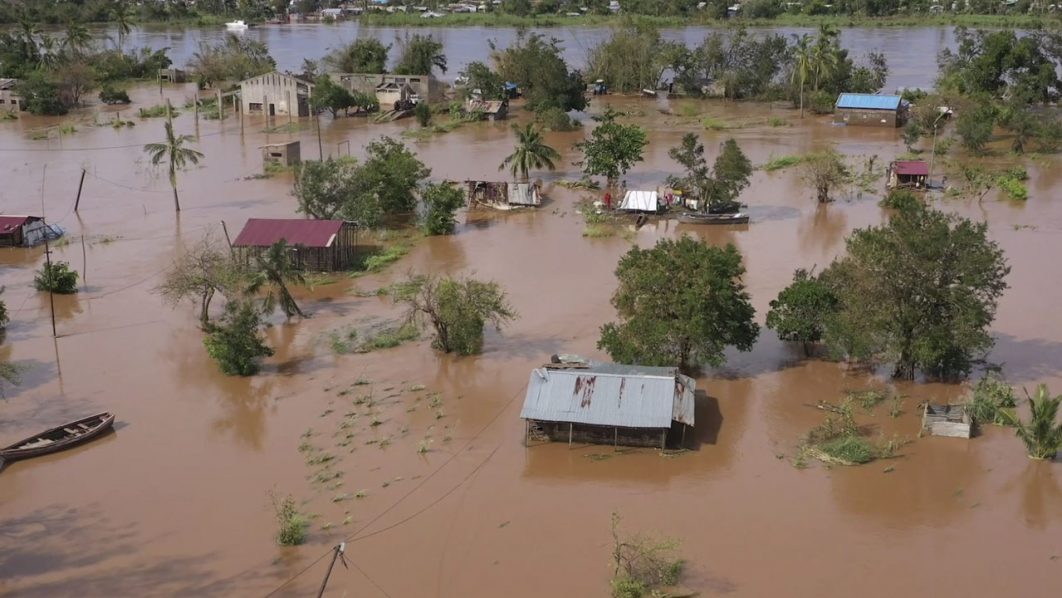
The National Economic Council on Thursday approved N83.21bn for the implementation of an Anticipatory Action Task Force to mitigate the impact of flooding and other climate-related disasters nationwide.
This came as the Council held its 158th meeting presided over by Vice President Kashim Shettima at the Aso Rock Villa, Abuja.
Cross River State Governor, Bassey Otu, who briefed State House correspondents alongside other governors, said the Council approved N83.21bn after receiving an initial request of N166.42bn tabled by the Minister of Budget and Economic Planning, Atiku Bagudu.
According to Otu, “The purpose of the request was to seek the consideration of the council for the approval and disbursement of funds through the Federal Account Allocation Committee to facilitate the implementation of the approved Anticipatory Action Task Force interventions aimed at mitigating the impact of anticipated flooding and other climate-related agencies across the country.
“We know that flooding now is almost a recurring decimal, and the Federal Government was very happy that we are putting some retroactive steps to make sure that the mitigation comes on in time to save the states,” he added, noting that states historically prone to flooding were specifically mentioned during deliberations.
He said the council ultimately resolved to approve only half of what was requested, while committing to revisit the framework at subsequent meetings.
“Council noted the importance of the AATF in addressing disasters and emergencies across the country.
“Council also underscored the fact that NEC must act promptly and must not be seen as always reacting to situations rather than being proactive when these disasters occur.
“Council approved the sum of N83,211,800,818.81, 50 per cent of the proposed budget for the AATF, with a plan to review the framework at subsequent meetings as part of broad measures aimed at tackling flood and related disasters,” he stated.
Responding to questions on the rationale for the 50 per cent cut, Otu explained that the reduction was based on a resource-conscious initial step and not a rejection of the urgency of the request.
He explained, “I want you to know that this is the first time as a nation that we are taking proactive steps. Most of the time, we’ve waited till flood has done its damage before we act, but this time around, we are taking proactive steps to mitigate the possibilities of the flood, which is a perennial issue.
“Therefore, it’s a work in progress. We thought that at least we should begin to put things in place, and as we evaluate and assess the situation going forward, the council will definitely make more provisions going forward.
“But you have to now look at it in the context of the resources available, so that you can be able to put mechanisms in place in a very proactive manner.
“That is the essence for which the council decided to reduce it by 50 per cent, and as we get along and evaluate the situation, we’ll be able to make more adequate provisions.”
Plateau State Governor, Caleb Mutfwang, responding to the same line of questioning, said the funding represented only the first phase that would consider immediate intervention with longer-term infrastructure solutions, including reservoirs designed to address flooding driven by the periodic release of water from Cameroon’s Lagdo Dam.
According to Mutfwang, “Even in addition to that, we quite understand the long-term plans which have to be put in place for this flood to actually be put to an end to this perennial flooding every now and then.
“Like my own state, we are building some reservoirs to make sure, because the flood we have, apart from the one that comes with climate change and the rains, there is the other one that comes when the Cameroon Dam is opened. That puts states across the South in a lot of danger.”
He added, “It is commendable that this particular year, under the distinguished chairman of the council, the Vice President, we are being proactive for the first time, because most of the time the intervention comes after we’ve lost a lot of property and life.
“But this time around, there’s going to be that prevention in a way that will be able to contain whatever is going to come our way.
“We understand the long-term measures, the medium-term measures, and of course, this is just the first intervention to make sure that we are prepared even before it starts coming. Whether N83bn will do is something that we are going to start with what we have at the moment.”
Meanwhile, Kano State Governor, Abba Yusuf, briefing on a separate agenda item, said the council deliberated on a presentation by the Minister of Regional Development on the proposed National Regional Development Policy spanning 2026 to 2030.
Yusuf said the policy was necessitated by persistent spatial inequalities, fragmented regional interventions, the need for alignment with the Medium-Term National Development Plan, and international best practice.
“Council was called to note that Nigeria needs the national regional development policy now because of one, persistent spatial inequalities; two, fragmented regional interventions; three, the MTNDP 2026 to 2030 alignment; and four, international best practice,” the governor said.
He explained that the core mandate of the policy included providing oversight in the formulation and implementation of regional development frameworks, coordinating master plans for regional development commissions in collaboration with states, and supervising the operations of those commissions, aligned with presidential priorities including economic rebound, national security, food security, energy sector growth and industrialisation through the digital economy.
On the resolutions reached, he said: “Council directed the Minister of Regional Development to share the proposed NRDP 2026 to 2030 with the state governors in order to digest and make input.
“Council also urged the Minister of Regional Development to reach out to the Nigeria Governors’ Forum to have robust consultation with subnationals on the proposal.”
For his part, Osun State Governor, Ademola Adeleke, revealed details of a presentation made by the Chairman of the Nigerian Agro Export Setup Committee on the need to achieve international ship and port facility security compliance, eliminate export bottlenecks and strengthen Nigeria’s agro-export value chain.
He said, “There was a presentation on the need to achieve international ship and port facility security compliance, eliminate export bottlenecks, and strengthen the Nigerian agro-export value chain.”
Adeleke noted that the council was informed that crude oil currently accounts for 80 per cent of Nigeria’s export revenue, while an estimated $50bn in annual agro-export potential remained unlocked, tied to compliance with International Ship and Port Facility Security code requirements across six major crops, including sesame, ginger, soybean and cashew.
He said council’s resolutions on the matter included prioritising full ISPS code compliance as a critical national economic and security objective, assuming full funding responsibility for ISPS infrastructure across seaports, inland dry ports and export corridors, and approving the establishment of a dedicated national agro-export board.
“Council directed the chairman of the Nigerian Agro Export Setup Committee to meet with the Minister of Digital and Blue Economy and the Export Promotion Council and fine-tune the proposal for further presentation,” Adeleke said.
punch.ng
FOLLOW US ON: