

Connect with us

News

PHOTOS: NDLEA Nabs South African Woman with 5.75kg Heroin, Seizes N10.3bn Cannabis

Published

on

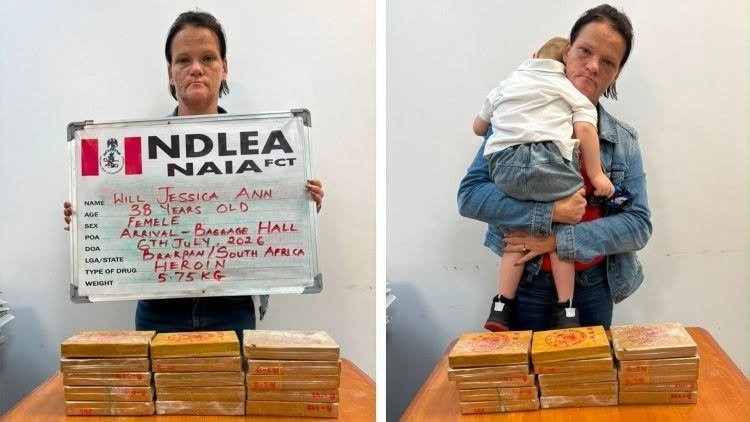
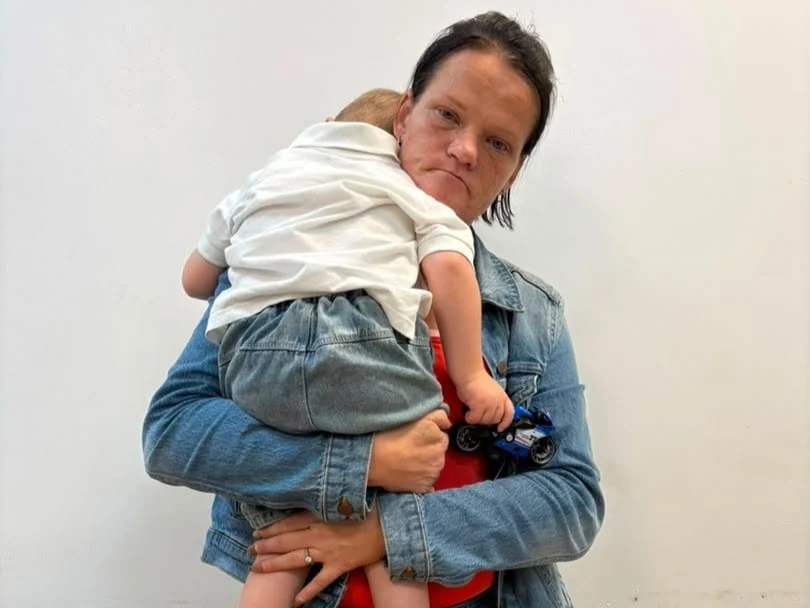
he National Drug Law Enforcement Agency (NDLEA) has arrested a 38-year-old South African woman, identified as Will Ann, at the Nnamdi Azikiwe International Airport, Abuja, for allegedly attempting to smuggle 5.75 kilogrammes of heroin into Nigeria while travelling with her three-year-old son.

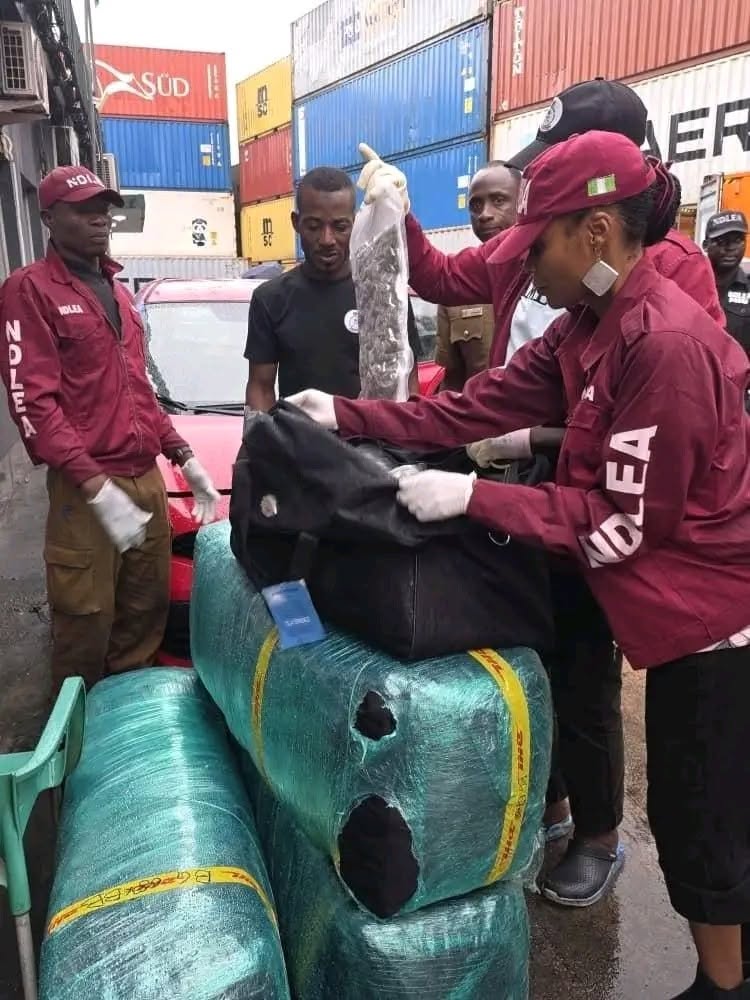
The agency also announced the seizure of 4,143.5 kilogrammes of synthetic cannabis valued at over N10.3 billion at the Apapa Seaport, Lagos, alongside several other major anti-drug operations across the country.

In a statement issued on Sunday by the agency’s Director of Media and Advocacy, Femi Babafemi, the suspect was arrested on Monday, July 6, during the inward clearance of passengers on Qatar Airways Flight QR1433 from Doha.

According to the NDLEA, the woman allegedly concealed 14 large blocks of heroin inside two suitcases and initially denied travelling with any checked baggage.

The agency said its operatives, however, discovered that the baggage tags matched the claim tags attached to her passport, forcing her to admit ownership of the luggage.

“Though she initially denied travelling with check-in bags, after operatives were able to quickly establish that the two bags containing the drugs had tags which tallied with the claim tags attached to her passport, she recanted and admitted ownership of the bags, adding that she forgot she checked in the two bags,” the statement said.

The suspect reportedly told investigators she travelled from Cambodia through Doha to Abuja.

The NDLEA added that intelligence reports linked her to a transnational drug trafficking syndicate operating along the Cambodia-South Africa route, allegedly involving her husband and partner, Jan Coenraad De Jager.

See also  Lagos state urges Makoko residents to vacate buildings under power line

In a related operation at the Murtala Muhammed International Airport, Lagos, operatives arrested a 48-year-old commercial motorcycle rider, Onyechere Chinadu, after he arrived from Madagascar via Addis Ababa aboard an Ethiopian Airlines flight.

The agency said 87 wraps of methamphetamine were initially recovered from his backpack, concealed inside clothing.

According to investigators, the suspect confessed that he had worked as an okada rider in Lagos for 15 years before being recruited into international drug trafficking by an associate based in Uganda.

NDLEA said the suspect admitted swallowing methamphetamine pellets in Uganda before embarking on his trip to Madagascar to deliver the illicit consignment.

After he was reportedly denied entry into Madagascar, his sponsor allegedly redirected him to Lagos, where he was arrested.

The agency said he was placed under observation because he could not state the exact number of drug pellets he had ingested. Between his arrest and July 11, he excreted 13 additional pellets, bringing the total recovery to 100 wraps of methamphetamine weighing 1.715 kilogrammes.

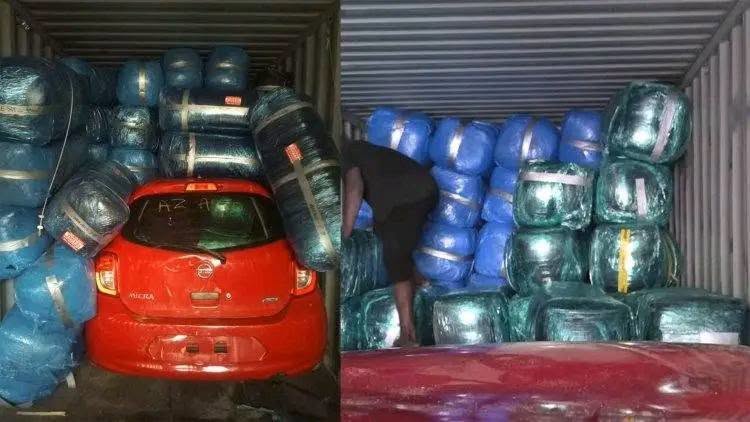
Meanwhile, at the Apapa Seaport, Lagos, NDLEA officers intercepted 8,287 bags of Canadian Loud, a potent synthetic cannabis strain, weighing 4,143.5 kilogrammes with an estimated street value exceeding N10.3 billion.

The agency said the consignment was uncovered during a joint examination involving NDLEA operatives, the Nigeria Customs Service and other security agencies after weeks of intelligence-led surveillance on the container imported from Montreal, Canada.

“The discovery followed weeks of targeted tracking and monitoring of the shipment since its departure from Montreal, Canada, by operatives of the Maritime Intelligence Unit of NDLEA in close collaboration with the Apapa Strategic Command of the Agency,” the statement said.

See also  We are Not Opposed to Creation of Anioma State, Says Delta Govt

In another operation, the anti-narcotics agency said it thwarted an attempt to export 2.5 kilogrammes of skunk concealed inside a gas compressor bound for Cyprus through a Lagos-based courier company.

Beyond enforcement activities, the NDLEA said its commands across the country continued the War Against Drug Abuse campaign through sensitisation programmes in secondary schools in Ebonyi, Kano, Ekiti and Ogun states, while officials of its Zone 14 Command paid an advocacy visit to Rivers State Governor, Siminalayi Fubara.

Commending officers involved in the operations, NDLEA Chairman and Chief Executive Officer, retired Brig. Gen. Buba Marwa, praised the commands for combining aggressive drug supply reduction efforts with sustained public awareness campaigns.

Marwa urged officers nationwide to remain committed to the agency’s fight against illicit drug trafficking and substance abuse, charging them “not to rest on their past laurels” in the ongoing campaign against narcotics.

FOLLOW US ON:

FACEBOOK

TWITTER

PINTEREST

TIKTOK

YOUTUBE

LINKEDIN

INSTAGRAM

Continue Reading
Click to comment

Leave a Reply

Your email address will not be published. Required fields are marked *

News

Anthropic flags five Claude AI uses linked to biological weapons research

Published

on

Anthropic, the company behind Claude AI, says it identified five cases in which users employed its artificial intelligence models in ways that could support biological weapons development.

The company disclosed this in its latest threat intelligence report published on Thursday, saying the cases were among a range of malicious or potentially harmful activities detected and disrupted on its platform between December 2025 and August 2026.

Anthropic particularly flagged five Claude AI use cases that involved research into areas including chikungunya virus, highly pathogenic avian influenza, orthopoxviruses, venom peptides and toxins.

The company said it had banned the accounts involved and incorporated information from its investigations into its safeguards, enforcement and threat intelligence systems.

However, Anthropic stressed that it was not asserting that the scientists involved intended to cause harm.

“We do not assert that they intended harm, and identifying them or their labs could expose them to harm,” the company said, adding that it would withhold the names of the research institutions, countries and specific biological agents or techniques involved.

Anthropic said the cases demonstrated the difficulty of distinguishing between legitimate scientific research and activities that could be used for harmful purposes.

“Biological misuse is one of the most serious risks of frontier AI models,” the company said, warning that AI could potentially be used to make existing pathogens more dangerous or create new ones.

“The same information that can be used to develop a biological weapon could also be used to develop, for example, a vaccine or a cure for a disease,” the AI giant added.

See also  Lagos: Tears, chaos as bulldozers storm Oworonshoki at midnight, demolish more buildings

In the first case, Anthropic said its biological safety classifier blocked a request to help prepare a grant application involving gain-of-function research on chikungunya virus.

The company said its subsequent investigation found that a reseller platform was being used to provide access to Claude to researchers in regions where Anthropic does not offer its services.

The platform also allegedly routed requests rejected by Claude to other AI models with more permissive safeguards.

Anthropic said it banned the associated accounts, worked with partners to take down the relay networks and shared its findings with AI companies and government authorities.

In a second case, the company said a researcher outside the US used Claude over several weeks while planning research involving highly pathogenic avian influenza and its adaptation to mammals.

According to Anthropic, the researcher used Claude for study planning, data analysis, interpretation and prioritisation of experiments, as well as editorial assistance.

The company said its safeguards restricted the researcher to weaker Claude models and that the AI’s contribution was primarily limited to clerical assistance, study ideation and design.

Anthropic said the case nevertheless provided evidence of active research programmes involving pathogens with enhanced pandemic potential.

A third case involved a grant application for orthopoxvirus research at a state-associated infectious disease laboratory. Anthropic said a reseller relay serving more than a dozen customers used Claude to draft the application.

The company said the application involved research into how orthopoxviruses interact with the immune system and was produced using Claude Opus 5 in about an hour.

The fourth and fifth cases involved research into venoms and toxins.

See also  Senate panel orders probe after inspecting burnt Lagos airport terminal

Anthropic said one researcher used Claude to develop an atlas of venom toxin peptides and a generative system for optimising toxin characteristics, with the stated goal of developing therapeutic molecules.

In another case, a researcher used Claude in projects involving the computational redesign of toxins under a national public research programme. Anthropic said the researcher deliberately obscured the identities of some toxins and viral proteins in progress reports.

The company said both accounts were banned in May 2026 for violating its Supported Regions Policy.

Anthropic said the cases highlighted the challenge of regulating AI-assisted biological research because many applications are “dual use”, meaning they can have both beneficial and harmful applications.

Anthropic, however, cautioned against interpreting its findings as evidence that Claude was currently enabling imminent biological threats.

“We take these cases as evidence not of the imminence of biological threats currently uplifted by Claude, but rather as evidence that significant dual-use research efforts are associated with state actors of concern,” the company said.

The report is part of a wider disclosure by Anthropic on the misuse of its AI systems.

The company said its investigations over the past eight months also uncovered cyber operations, surveillance, influence operations, scams and fraud, conventional weapons development and attempts to illicitly distil its models.

The report comes shortly after concerns raised publicly by former Anthropic researcher Jacob Coxon about the risks posed by increasingly capable AI systems.

PUNCH Online previously reported that Coxon resigned from Anthropic and said “people building AI earnestly believe that it could kill us all by the end of the decade.”

See also  Lagos state urges Makoko residents to vacate buildings under power line

Anthropic’s latest report also said it had identified a Russia-linked cyber espionage operation in which Claude was used to automate parts of attacks against organisations in Ukraine and Europe.

Source: punchng.com

FOLLOW US ON:

FACEBOOK

TWITTER

PINTEREST

TIKTOK

YOUTUBE

LINKEDIN

INSTAGRAM

Continue Reading

News

South Korea, Iran discuss Strait of Hormuz security

Published

on

The foreign ministers of South Korea and Iran discussed the Strait of Hormuz in a phone call on Friday, Seoul said, days after confirming it was weighing a “contribution” to the waterway’s security.

US President Donald Trump has repeatedly pressured ally South Korea to provide help for the war in the Middle East, saying Seoul rejected his request for assistance in securing the waterway that is crucial to global oil supplies.

South Korean Foreign Minister Cho Hyun spoke by phone with his Iranian counterpart Abbas Araghchi at Tehran’s request, “discussing the recent situation in the Middle East”, and the Strait of Hormuz, the foreign ministry in Seoul said in a statement.

The Friday announcement followed a warning from Tehran earlier this week that any South Korean military contribution to the conflict would have “serious consequences”.

South Korea sent a fact-finding team to assess the situation in the strait and has repeatedly said it has not decided whether to deploy its military to Hormuz.

Traffic through the vital shipping route has been virtually paralysed since the US-Iran war began on February 28, disrupting global energy markets.

Negotiations between Iran and the United States have stalled as they vied for control over Hormuz, which normally carries around a fifth of the world’s oil and liquefied natural gas exports.

AFP

Source: punchng.com

FOLLOW US ON:

FACEBOOK

TWITTER

PINTEREST

TIKTOK

YOUTUBE

LINKEDIN

INSTAGRAM

See also  Senate panel orders probe after inspecting burnt Lagos airport terminal
Continue Reading

News

US arms NAF for terror war

Published

on

The United States has delivered military equipment to the Nigerian Air Force as part of efforts to strengthen the security partnership between both countries and support Nigeria’s counter-terrorism operations.

The United States Africa Command disclosed this in a post on its X handle on Thursday, along with pictures of a U.S. Air Force C-17 aircraft delivering the equipment.

AFRICOM said the equipment was supplied under a foreign military sales agreement between the two countries.

“PARTNERSHIP IN ACTION: A U.S. Air Force C-17 delivers equipment to the Nigerian Air Force this weekend. The equipment is part of a foreign military sales agreement that furthers the U.S.-Nigerian partnership and will aid in Nigeria’s efforts to counter terrorism in the region,” the command said.

The latest delivery comes against the backdrop of continued military cooperation between Nigeria and the United States, including training and capacity-building programmes.

On August 23, US forces began training Nigerian troops in unmanned aircraft systems, combat casualty care and other military skills at Operating Location Bauchi, as part of efforts to strengthen security cooperation between the two countries.

According to AFRICOM, the training covered combat lifesaver and tactical combat casualty care instruction, weapons familiarisation, camouflage, water treatment and testing, explosive ordnance disposal, small-unit tactics and unmanned aircraft systems.

The command said the training was developed based on the expertise available among US forces and areas identified by their Nigerian counterparts as beneficial.

It added that unmanned aircraft systems generated particular interest among Nigerian forces, with about 10 members of the Nigerian Air Force Special Forces Regiment receiving practical training on operating the systems.

See also  Xenophobia: Nigeria weighs sanctions against South Africa

The US personnel also trained the Nigerian troops on techniques for employing unmanned aircraft systems and incorporating information gathered by the systems into military operations.

The development followed AFRICOM’s disclosure in July that the United States had withdrawn most of its troops deployed to Nigeria for a specific counter-terrorism operation, while retaining an intelligence-sharing and security partnership with the country.

Despite the withdrawal, both countries have continued to engage in military cooperation through intelligence sharing, training and other capacity-building initiatives.

Source: punchng.com

FOLLOW US ON:

FACEBOOK

TWITTER

PINTEREST

TIKTOK

YOUTUBE

LINKEDIN

INSTAGRAM

Continue Reading

Trending