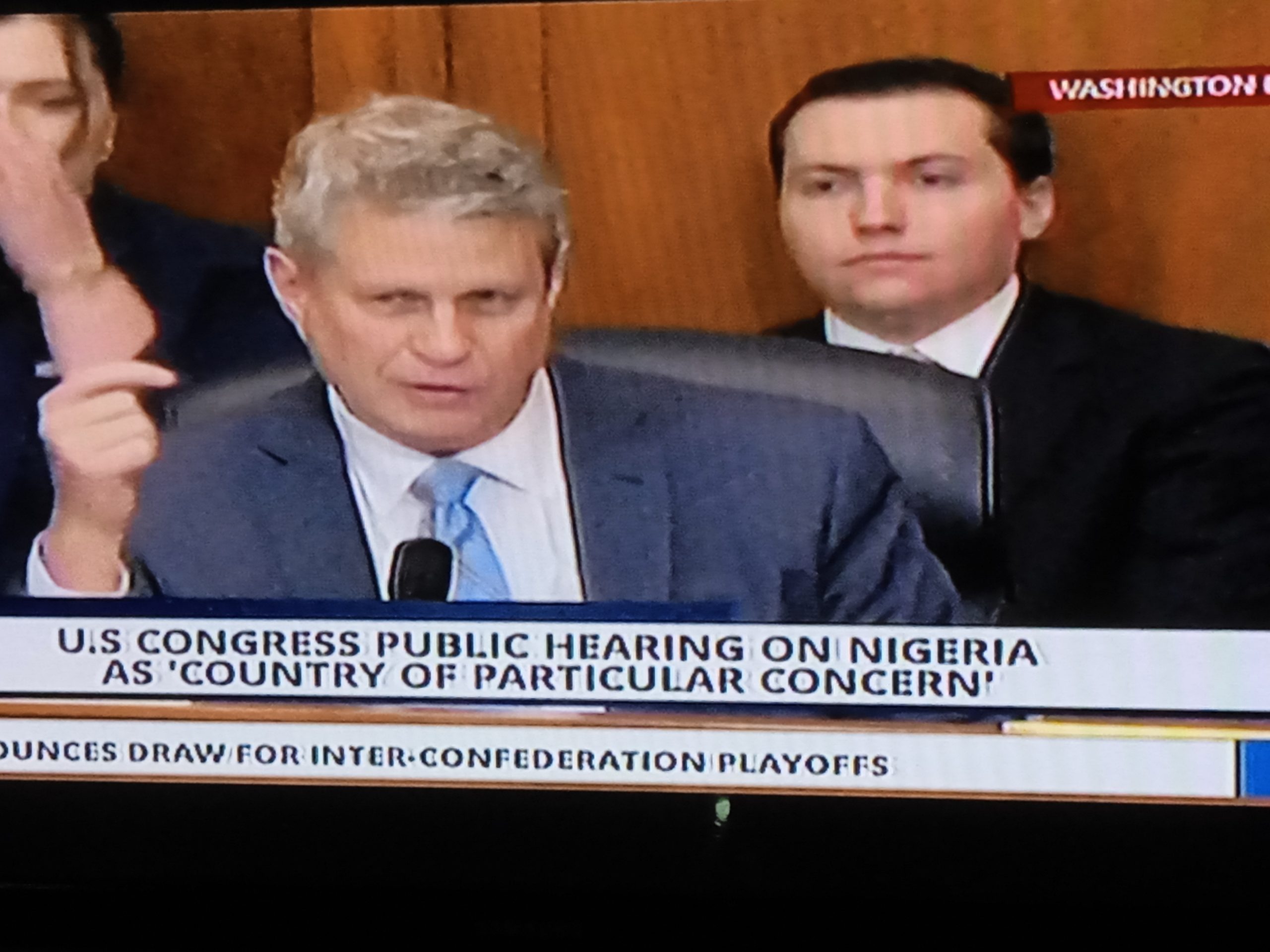
Lawmakers, religious leaders, United States Department officials, and witnesses were divided in their views as the United States House Foreign Affairs Subcommittee on Africa on Thursday held an open hearing on President Donald Trump’s redesignation of Nigeria as “Country of Particular Concern” over alleged Christian genocide.
Following the redesignation, the President threatened that the US military would enter Nigeria “guns-a-blazing to completely wipe out the Islamic terrorists who are committing these horrible atrocities.”
The Chris Smith-led committee had convened the hearing to review the scope of religious persecution in Nigeria, potential policy responses, including targeted sanctions, humanitarian assistance, and collaboration with Nigerian authorities to prevent further violence.
The first set of panellists at the hearing held at Room 2172 of the Rayburn House Office Building and streamed live online were Senior Bureau Official of the Bureau of African Affairs, Jonathan Pratt, and Deputy Assistant Secretary of the Bureau of Democracy, Human Rights, and Labour, Jacob McGee, who faced numerous questions posed by the lawmakers.
The second panel featured presentations by the Director of the Centre for Religious Freedom, Ms Nina Shea; Bishop Wilfred Anagbe of Makurdi Catholic Diocese in Nigeria; and Ms Oge Onubogu of the Centre for Strategic and International Studies.
Setting the tone for the hearing, Chairman Chris Smith highlighted that 89 per cent of all Christians martyred worldwide are in Nigeria, with over 52,000 Christians slaughtered since 2009.
He accused militant Fulani herdsmen of committing acts of rape, kidnapping, and murder with “total impunity” from Nigerian officials.
Smith argued the attacks were unequivocally “religiously motivated” as he blamed the previous administration for weakening U.S. pressure by removing Nigeria from the “Country of Particular Concern” list, despite recommendations from the U.S. Commission on International Religious Freedom.
Furthermore, he emphasised that the U.S. will not be silent while people are persecuted and will not stop fighting until perpetrators are brought to justice.
He also pointed to the compelling and disturbing testimony of witnesses, such as Bishop Wilfred Anagbe of the Catholic Diocese of Makurdi, to underscore the severity of the crisis.
Giving his presentation, Senior Bureau Official of the Bureau of African Affairs, Jonathan Pratt, said the US was worried that the violent activities of extremist groups such as Boko Haram, ISIS West Africa, ISIS Sahel, Al-Qaeda affiliate Ansaru, and Lakurawa were now spreading beyond the North-East to other regions, particularly Nigeria’s Middle Belt.
“Terrorists, separatists, bandits and criminal militias in Nigeria are all over the country with ongoing attacks often deliberately targeting Christian communities,” Pratt said, adding that the violence in the Middle Belt reflects a “problem of prioritisation” by the government.
According to the US official, although Nigerian security forces are engaged in counter-terrorism operations and taking significant losses in the North-East, more needs to be done to protect vulnerable communities and hold perpetrators accountable.
“The administration’s approach intends to raise the protection of Christians to the top of Nigeria’s priorities, especially in the Middle Belt,” Pratt said.
He noted that Nigeria, as Africa’s largest democracy and a key regional partner, shares economic and security interests with the United States. Pratt said Washington welcomes Nigeria’s willingness to cooperate following its designation as a “Country of Particular Concern” and looks forward to seeing these commitments translated into concrete actions on the ground.
Pratt also revealed that the Trump administration is developing a plan to incentivise and compel the Nigerian government to strengthen security for Christian communities and improve religious freedom. The plan will involve engagement from the US State Department, Treasury and potentially the Department of War to bolster counter-terrorism and protection measures.
“The levels of violence and atrocities committed against Christians and communities of all faiths in Nigeria are appalling and threaten the universal right to religious freedom,” Pratt said. “We remain open to working together with the Nigerians, but we also expect the Nigerian government to deliver results on the ground as proof of their commitment to this universal right.”
Smith and Pratt’s initial remarks set the tone for a variety of reactions.
During the session, Representative John James, Representative of the people of Michigan’s 10th Congressional district, and a member of the Energy and Commerce Committee, said the designation is necessary to address what he described as a worsening crisis for Christians in Nigeria.
“Nigeria is facing one of the gravest religious freedom crises in the world. I have visited and have seen firsthand the direness of the conditions in what is now the deadliest place on earth to be a Christian,” James said.
He detailed the extent of the violence. “Since 2019, nearly 17,000 Christians have been killed. In the first seven months of this year alone, hundreds more were murdered. These are not isolated tragedies, but a sustained pattern of religiously motivated violence, often ignored or even enabled by the Nigerian government.
“Extremist groups like Boko Haram, Fulani militants, and ISIS West Africa attack often without any meaningful intervention from authorities. The lack of response has created an atmosphere of impunity where Christians continue to live in constant threat and fear.”
James also referenced the detention of Nnamdi Kanu, saying, “Religious persecution is tied to political repression and weakening institutions in Nigeria. The detention of Mazi Nnamdi Kanu is a clear example.
“In 2022, Nigeria’s Court of Appeals struck down the charges against him and ordered his release. The UN Working Group for Arbitrary Detention has also called for his unconditional release, yet he remains in solitary confinement in deteriorating health and recently had to represent himself in court.
“Nigeria has signalled that the law is optional and targeting Christians is fair game. Just hours ago this morning, despite the pleas and cries of Nigerian people and many Nigerian lawmakers, Kanu was convicted on all charges.”
In response to a question about the Nigerian government being infiltrated by extremist groups, Senior Bureau Official Jonathan Pratt of the US Department of State’s Bureau of African Affairs said, “I do not believe that the government of Nigeria has been infiltrated by jihadists.”
James pressed further on government response, asking, “because when you look at the selective enforcement of the rule of law, one might question if there is any favouritism or looking the other way when groups are being specifically targeted, despite the fact, as my colleague Moore mentioned, not enforcing the rule of law about weapons.
“My next question is, how has the Nigerian government reacted since President Trump’s country of particular concern designation announcement?”
Pratt replied, “They have taken the designation very seriously. There is a senior delegation here now.
“They will meet with the most senior officials of the US government this week, and we have already demarched the government in Abuja and here in Washington on the action plan, and I can say that the results so far have been positive in terms of cooperation.”
Speaking, Congressman Bill Huizenga criticised President Bola Tinubu’s administration for what he described as ongoing attacks by “radicalised Islamists” against Christians in Nigeria.
Huizenga, who said he grew up around Nigerians and has followed the country’s security challenges for years, accused both US lawmakers and the media of downplaying religious-related violence in Nigeria.
“I went to school with kids from Nigeria,” he said, pausing as he attempted to control his emotions.
“We’ve got neighbours who’ve been missionaries there, who have family there, who have friends there, who know this is going on.
“Yet, we’ve got not just the mass media, we’ve got people within the Congress denying that this is happening, or certainly de-emphasising it,” he said.
He said Christians, moderate Muslims and “anyone being terrorised by these radicalised Islamists in Nigeria” require stronger protection, arguing that the Nigerian government “is not doing enough.”
Huizenga also questioned the level of US humanitarian assistance to internally displaced persons in Benue and Taraba states, noting that Benue alone has “1.4 million” displaced people.
Concluding his remarks, he referenced a written submission from House Financial Services Committee Chairman, French Hill, who stressed the need for enforceable sanctions.
Similarly, A member of the United States House of Representatives, Johnny Olszewski, has expressed deep concern over the alleged inability of the Nigerian government to protect communities against insurgent attacks.
He stated, “The Nigerian government lacks the means to protect communities against groups that kill indiscriminately.
“To be clear, this does not abdicate the Nigerian government from responsibility.
“Muslims and Christians alike have lived under the constant threat of extreme groups like Boko Haram and ISIS West Africa for far too long. And so the real story here for me is not about Nigeria’s intent at the institutional level to persecute people based on faith.”
The lawmaker, who openly identified as a Christian, said the debate around Nigeria should not be framed as persecution by the government but as a critical “capacity problem” that has left millions exposed to extremist groups.
“Jesus Christ is my Lord and Saviour. I have no problem sharing that. I am also troubled by the state of religious freedom in Nigeria and around the world.
“So, I want to be clear upfront, violence against Christians in Nigeria is a serious issue. Christians are being massacred, and communities are living in constant fear. But this suffering is not just confined to one religious group,” he added.
Citing President Donald Trump’s senior adviser on Africa, Masabulo, the congressman noted that terrorism in Nigeria affects people irrespective of “colour, religion or tribe,” stressing that Muslims and Christians have equally endured persistent attacks from Boko Haram and ISIS-West Africa.
He, however, stressed that acknowledging this lack of capacity does not absolve Nigeria’s leaders of responsibility, warning that governance failures, corruption and neglect must be confronted.
“A government’s duty is to protect its people. And when there’s a failure to do so, whether that’s neglect or corruption or governance, leaders must be held accountable. But capacity within Nigerian institutions to maintain peace is a real question,” Olszewski stated.
The lawmaker also questioned the effectiveness of US policy towards Nigeria, calling for more meaningful support rather than threats of sanctions or military action.
“And we should be asking what the US is doing to help Nigeria build that capacity. Are we offering real partnerships or just threatening airstrikes and sanctions? Or instead, are we thinking about technical support, training and investment in the institutions that prevent violence in the first place?
“So let’s work together to fix what is broken. And I appreciate the ranking member for opening up this hearing with additional support options,” he said.
His remarks come amid renewed global scrutiny of insecurity in Nigeria, following the recent designation by President Donald Trump of Nigeria as a Country of Particular Concern.
During the session, Representative Pramila Jayapal warned against framing Nigeria’s violence as targeting only one religious group.
“But I appreciate that people have also recognised it isn’t just the persecution of Christians. This is persecution of multiple groups. And I think we have to be careful not to portray it just as persecution of Christians.
“That feels to me simplistic, and it doesn’t account for the intersectional diversity of Nigeria,” she said.
Citing research on drivers of conflict in Nigeria’s Middle Belt, Jayapal added that violence had affected both Christians and Muslims alike. She also expressed concern over Trump’s response to a televised report.
“I’m very concerned that a day after President Trump saw a clip on Fox News about the persecution of Christians in Nigeria, he threatened to go guns-a-blazing in Nigeria and revoke all assistance,” she said, noting that such a move would jeopardise health programmes critical to combating malaria and HIV.
Jayapal pressed officials on the legality of any US military action in Nigeria. “Can you tell me under what authority the US military strikes inside of Nigeria?” she asked.
Jayapal questioned whether the administration had considered diplomatic options before Trump’s public comments.
“Don’t you think it would have been appropriate to have the task force discussion and the alternatives presented prior to the president going on Truth Social and saying we’re going to go guns a-blazing into Nigeria?” she asked.
Pratt responded that Washington had long been engaged in Nigeria-related security and development issues.
“We have been working on these problems in Nigeria for a long time. We have a lot of programmes of assistance in the country. They did undergo a foreign assistance review, but many of them continue, and we want to make sure that we are using them strategically to get the best outcomes,” he said.
Jayapal, in closing, criticised what she described as a confrontational approach. “I just wish we would actually stick to that playbook rather than bully and threaten a country that is extremely important to us and to the region,” she said.
Quoting former US Ambassador Kelly Currie, she added, “You cannot solve problems created by men with guns by turning to men with guns for the solution.”
Christianity is facing the threat of extinction in Northern and Middle Belt regions of Nigeria, Bishop Wilfred Anagbe of the Diocese of Makurdi warned in a testimony before the United States House Subcommittee on Africa on Thursday.
The bishop said the country is entering one of its darkest periods for Christians as killings, mass displacement and targeted attacks continue with “impunity.”
Before the lawmakers, Anagbe declared that “Christianity risks elimination in parts of Northern and Middle-Belt Nigeria within a very short time,” describing the violence as a systematic effort to wipe out Christian communities and erase their cultural and religious identity.
The bishop said the ongoing crises marked by killings, kidnappings and widespread destruction have intensified despite recent international attention, including the redesignation of Nigeria as a Country of Particular Concern by US President Donald Trump.
He called that move “a serious, well-founded wakeup call.”
Reflecting on the deepening humanitarian catastrophe, he told US lawmakers, “Millions of displaced persons remain in camps, unable to return to their ancestral lands. This threatens cultural continuity, religious and economic survival.”
He added that women “endure sexual violence as a weapon,” warning that such tactics are designed to ensure that “no more Christians will be born from so many traumatised women.”
Anagbe recounted a series of recent violent incidents, including the May 22 attack on his hometown, where several of his relatives were killed.
“An entire convent of Reverend Sisters of the Order of St. Clare was displaced, along with the local Catholic parish,” he said.
He also described the attempted killing of one of his priests, Father Solomon Atongo, on May 24. “He was shot and left to die in the pool of his blood. Though he survived the attack, he is unable to walk freely because he has a broken bone.”
The bishop referenced attacks across Plateau, Benue, Kaduna and Kogi, including the June 13 massacre in Yelwata, Benue State, where he said 278 people—men, women and children—were slaughtered.
“It took the prayers of the Holy Father, Pope Leo XIV, for the government in Nigeria to even acknowledge this evil,” he said.
He accused the Federal Government of failing to confront the crisis.
“The government of Nigeria’s silence and refusal to engage in the fates of continued killings and displacements has deepened feelings of abandonment among the people,” he warned.
The bishop asked lawmakers pointedly, “Who is killing the Muslims up north? Is there any Christian militia displacing millions and occupying lands in Nigeria?”
According to the bishop, extremist groups—including Fulani militants, Boko Haram and ISWAP—are now pushing further South, worsening food insecurity and creating one of the largest displacement crises in Africa.
“Violence is spreading southward, displacing millions and destroying farmland,” he noted.
Anagbe thanked the subcommittee for its continued attention and reiterated his gratitude to President Trump.
“On behalf of millions of Christians in Nigeria and in the diaspora, we want to thank President Donald Trump for his bold leadership in designating Nigeria as a CPC,” he said.
But he insisted that words must be followed by action.
Among other steps, he called for targeted sanctions, expanded humanitarian support for internally displaced persons, and the passage of the Nigerian Religious Freedom and Accountability Act.
“This point cannot be overemphasised because it is impunity that fuels the violence we suffer,” he told the committee.
He urged allies to challenge discriminatory laws in Nigeria and push for the elimination of blasphemy laws.
As he closed, Anagbe warned that time is running out for Christian communities. “The church alone cannot stop the killings. It requires coordinated political, military and humanitarian intervention.”
His final plea was solemn and urgent: “Mr Chairman and members, we cannot afford to wait any longer. Please enact concrete actions according to the CPC designation. We all know that inaction emboldens the extremists even more.”
However, Congresswoman Sara Jacobs described President Donald Trump’s recent threat to deploy military action in Nigeria as “reckless.”
She cautioned against framing the situation solely in religious terms.
“Distorting what’s happening into a solely religious narrative erases the real drivers of violence and makes it harder to implement effective solutions, and it can fuel violence against the very groups the Trump administration claims it wants to protect,” she said.
Jacobs added, “That’s why I’m alarmed by President Trump’s rhetoric about this violence and threats to go into Nigeria ‘guns-a-blazing’ and to wipe out terrorists.
“We are already receiving reports of increased tensions between Christian and Muslim populations following this rhetoric. President Trump’s threat is reckless, and any unilateral military action in Nigeria would be illegal.
“Congress has not authorised force in Nigeria to protect Christians, and any action without Nigeria’s consent violates international law.”
The congresswoman also warned that a military-led approach could worsen civilian casualties and impunity, potentially fueling violent extremism.
“We need to use more tools from our foreign policy toolbox if we’re serious about helping Nigeria protect its citizens.
“That means we need to leverage diplomacy and engage with Nigeria on how we can help support their response while pushing for important reforms within Nigeria’s institutions,” she said.
Jacobs further emphasised the importance of funding programmes aimed at preventing violence and addressing the root causes of conflict.
In response to a question about the Nigerian government being infiltrated by extremist groups, Senior Bureau Official Jonathan Pratt of the US Department of State’s Bureau of African Affairs said, “I do not believe that the government of Nigeria has been infiltrated by jihadists.”
James pressed further on government response, asking, “because when you look at the selective enforcement of the rule of law, one might question if there is any favouritism or looking the other way when groups are being specifically targeted, despite the fact, as my colleague Moore mentioned, not enforcing the rule of law about weapons.
“My next question is, how has the Nigerian government reacted since President Trump’s country of particular concern designation announcement?”
Pratt replied, “They have taken the designation very seriously. There is a senior delegation here now.
“They will meet with the most senior officials of the US government this week, and we have already demarched the government in Abuja and here in Washington on the action plan, and I can say that the results so far have been positive in terms of cooperation.”