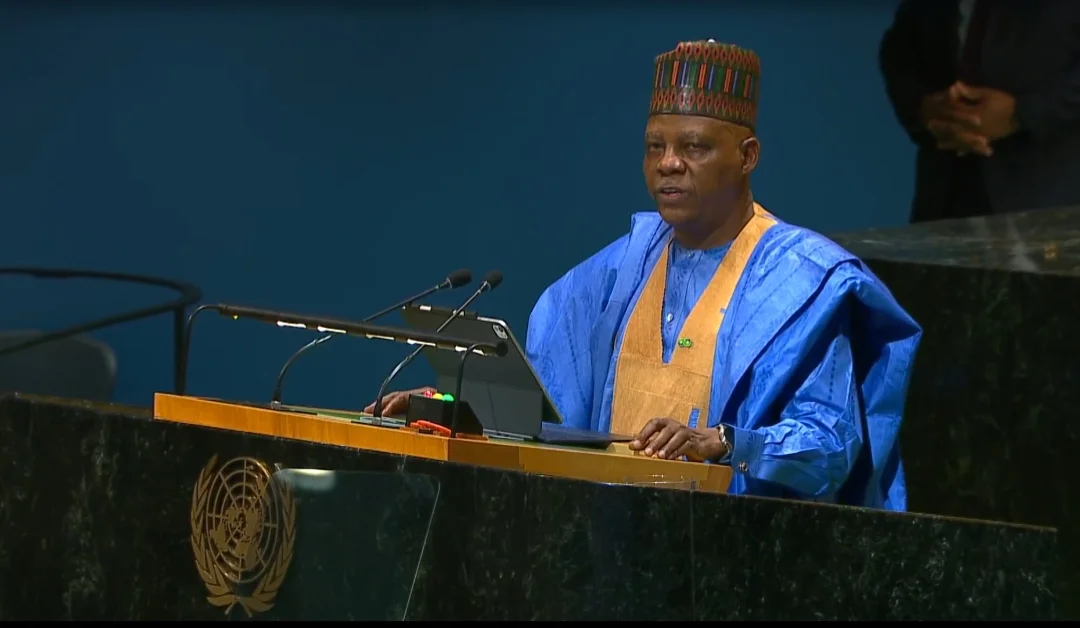
President Bola Tinubu addressed the 80th United Nations General Assembly in New York on Wednesday. His address was delivered by his deputy, Vice President Kashim Shettima.
Read full text below:
THE NATIONAL STATEMENT OF HIS EXCELLENCY, PRESIDENT BOLA AHMED TINUBU GCFR,
DELIVERED BY
HIS EXCELLENCY, KASHIM SHETTIMA, GCON,
VICE-PRESIDENT, FEDERAL REPUBLIC OF NIGERIA,
DURING THE GENERAL DEBATE OF THE 80TH SESSION OF THE UNITED NATIONS GENERAL ASSEMBLY,NEW YORK
THEME: BETTER TOGETHER: 80 YEARS AND MORE FOR PEACE, DEVELOPMENT, AND HUMAN RIGHTS
24th SEPTEMBER 2025
Madam President,
Mr. Secretary-General,
Excellencies, Heads of State and Government,
Distinguished Delegates,
The chaos that shadows our world is a reminder that we cannot afford the luxury of inaction. We would have been consumed by our differences had there been no community such as this to remind us that we are one human family. Even in our darkest hours, we have refused to be broken. This community was born from the ashes of despair, a vehicle for order and for the shared assurance that we could not afford to falter again. Our belief in this community is not a posture of moral superiority but an undying faith in the redemption of humanity. It is, therefore, with profound humility that I stand before you today, as Vice-President of the Federal Republic of Nigeria, to renew this pledge on behalf of my country.
Madam President,
1. Nigeria joins the comity of nations in congratulating you on your election as President of the General Assembly for the 80th Session and assures you of our unalloyed support during your tenure. I commend your predecessor, my brother, His Excellency, Philémon Yang, and the Secretary-General, His Excellency, António Guterres, for the outstanding stewardship and unifying leadership during these extraordinary times.
2. This anniversary must not be a sentimental retreat into nostalgia. It must be a moment of truth, a pause to measure where we have stumbled and how we might have done better in turning our values into action that meets the demands of today. We are here to deliver a world of peace and development, where the respect for human rights is paramount. We must recalibrate the delicate balance between our roles as sovereign governments and our duties as collective partners, to renew multilateralism in a world that has evolved far beyond what it was in 1945.
3. The pace of change across borders is a force without pause. It manifests in the tools of technology, in the movements of information and finance, in the corrosive ideologies that preach violence and division, in the gathering storm of the climate emergency, and in the tide of irregular migration. We must own this process of change. When we speak of nuclear disarmament, the proliferation of small weapons, Security Council reform, fair access to trade and finance, and the conflicts and human suffering across the world, we must recognize the truth. These are stains on our collective humanity.
4. For all our careful diplomatic language, the slow pace of progress on these hardy perennials of the UN General Assembly debate has led some to look away from the multilateral model. Some years ago, I noticed a shift at this gathering: key events were beginning to take place outside this hall, and the most sought-after voices were no longer heads of state. These are troubling signs. Nigeria remains firmly convinced of the merits of multilateralism, but to sustain that conviction, we must show that existing structures are not set in stone. We must make real change, change that works, and change that is seen to work. If we fail, the direction of travel is already predictable.
5. We are here to strengthen the prospects for peace, development and human rights. Madam President, I want to make four points today to outline how we can do this:
One: Nigeria must have a permanent seat at the UN Security Council. This should take place as part of a wider process of institutional reform.
Two:We need urgent action to promote sovereign debt relief and access to trade and financing.
Three: Countries that host minerals must benefit from those minerals.
Four: The digital divide must close. As our friend the Secretary General has said: ‘A.I.’ must stand for ‘Africa Included’.
6. On my first point: the United Nations will recover its relevance only when it reflects the world as it is, not as it was. Nigeria’s journey tells this story with clarity: when the UN was founded, we were a colony of 20 million people, absent from the tables where decisions about our fate were taken; today, we are a sovereign nation of over 236 million, projected to be the third most populous country in the world, with one of the youngest and most dynamic populations on earth. A stabilising force in regional security and a consistent partner in global peacekeeping, our case for permanent seat at the Security Council is a demand for fairness, for representation, and for reform that restores credibility to the very institution upon which the hope of multilateralism rests.
7. This is why Nigeria stands firmly behind the UN80 Initiative of the Secretary-General, and the resolution adopted by this Assembly on 18 July 2025, a bold step to reform the wider United Nations system for greater relevance, efficiency, and effectiveness in the face of unprecedented financial strain. We support the drive to rationalise structures and end the duplication of responsibilities and programmes, so that this institution may speak with one voice and act with greater coherence.
Madam President,
8. None of us can achieve a peaceful world in isolation. This is the heavy burden of sovereignty. Sovereignty is a covenant of shared responsibility, a recognition that our survival is bound to the survival of others. To live up to this charge, we must walk hand in hand with our neighbours and partners. We must follow the trails of weapons, of money, and of people. For these forces, too often driven by faceless non-state actors, ignite the fires of conflict across our region.
Madam President,
9. Nigeria’s soldiers and civilians carry a proud legacy. They have participated in 51 out of 60 United Nations peacekeeping operations since our independence in 1960. We have stood with our partners in Africa to resolve conflicts, and we continue that commitment today through the Multinational Joint Task Force. At home, we confront the scourge of insurgency with resolve. From this long and difficult struggle with violent extremism, one truth stands clear: military tactics may win battles measured in months and years, but in wars that span generations, it is values and ideas that deliver the ultimate victory.
10. We are despised by terrorists because we choose tolerance over tyranny. Their ambition is to divide us and to poison our humanity with a toxic rhetoric of hate. Our difference is the distance between shadow and light, between despair and hope, between the ruin of anarchy and the promise of order. We do not only fight wars, we feed and shelter the innocent victims of war. This is why we are not indifferent to the devastations of our neighbours, near and distant. This is why we speak of the violence and aggression visited upon innocent civilians in Gaza, the illegal attack on Qatar, and the tensions that scar the wider region. It is not only because of the culture of impunity that makes such acts intolerable, but because our own bitter experience has taught us that such violence never ends where it begins.
11. We do not believe that the sanctity of human life should be trapped in the corridors of endless debate. That is why we say, without stuttering and without doubt, that a two-state solution remains the most dignified path to lasting peace for the people of Palestine. For too long, this community has borne the weight of moral conflict. For too long, we have been caught in the crossfire of violence that offends the conscience of humanity. We come not as partisans, but as peacemakers. We come as brothers and sisters of a shared world, a world that must never reduce the right to live into the currency of devious politics. The people of Palestine are not collateral damage in a civilisation searching for order. They are human beings, equal in worth, entitled to the same freedoms and dignities that the rest of us take for granted.
12. We want to make the choice crystal clear: civilised values over fear, civilised values over vengeance, civilised values over bloodshed. We show the opportunities that peace brings, just as the extremist hopes to drive apart rival communities and different religions. We work through multilateral platforms within the rule of law, to build the consensus and support that makes this immensely difficult and dangerous task that much easier. This is how we deny our enemies the space they crave to fuel tension and despair. It is our experience that this offers the best, perhaps only hope for peace, reconciliation and victory for the civilised values of a shared humanity. Nigeria, as a diverse country, also recognises the variable geometry of Democracy, its different forms and speeds. For this reason, we are working with the United Nations to strengthen Democratic institutions in our region and beyond, through the Regional Partnership for Democracy.
Madam President,
13. Point two: the price of peace is eternal vigilance. The increasingly difficult security outlook has prompted many Member States to count the cost of the emerging world order. We in Nigeria are already familiar with such difficult choices: infrastructure renewal or defence platforms? schools or tanks? Our view is that the path to sustainable peace lies in growth and prosperity. The government has taken difficult but necessary steps to restructure our economy and remove distortions, including subsidies and currency controls that benefited the few at the expense of the many.
14. I believe in the power of the market to transform. Our task is to enable and facilitate, and to trust in the ingenuity and enterprise of the people. But the process of transition is difficult and brings unavoidable hardship. This year, we held the inaugural West Africa Economic Summit in Abuja to bring investors and opportunities together. The results exceeded our expectations and are a clear indication of what innovation can deliver.
15. It is in that same spirit of dynamic review that I invite the United Nations to re-examine the best use of scarce resources. One critical area is climate change. It is not an abstract issue about an indeterminate fate, to be settled at some distant point in the future. It is not even solely an environmental issue. It is about national, regional, and international security. It is about irregular migration. Truly, this is an “everyone issue.” We are all stakeholders, and we are all beneficiaries of the best outcomes.
Madam President,
16. This is why relevant Ministers have been instructed to work with the UN to make the best use of climate funds. We believe there are huge, shared dividends to accrue from increased support for education, for resilient housing, for access to technology and financing to allow vulnerable communities to thrive: to become part of solutions, rather than problems.
17. Nigeria and Africa have made significant strides in recent years to put our affairs in order. We can take that progress to the next level, a level that presents new opportunities for trade, investment and profit, if we can access reforms to strengthen the international financial architecture. We need urgent action to promote debt relief – not as an act of charity but as a clear path to the peace and prosperity that benefits us all.
18. I am calling for new and binding mechanism to manage sovereign debt, a sort of International Court of Justice for money, that will allow emerging economies to escape the economic straitjacket of primary production of unprocessed exports.
19. It has been over for decades since the Lagos Action Plan outlined a route away from debt and dependence that highlighted opportunities, that today should still be explored for local added value for processing and manufacturing in everything from agriculture to solid minerals and petrochemicals. The African Continental Free Trade Area is a remarkable achievement of co-operation. We remain fully committed to the achievement of SDGs – and are convinced this can be best delivered by focusing principally on our primary mission of growth and prosperity.
Madam President,
20. Our third point. We welcome steps to move towards peace in the Democratic Republic of Congo. We agree that international investment and engagement offer a way out of the cycle of decay and violence. Access to strategic minerals, from Sierra Leone in the 1990s and Sudan today, has for too long been a source of conflict rather than prosperity. Africa – and I must include Nigeria – has in abundance the critical minerals that will drive the technologies of the future. Investment in exploration, development and processing of these minerals, in Africa, will diversify supply to the international market, reduce tensions between major economies and help shape the architecture for peace and prosperity, on a continent that too often in the past has been left behind by the rivalries and competition between different blocs.
21. We know in Nigeria, that we are more stable when those communities that have access to key resources are able to benefit from those resources. This has been our journey in the oil producing region of the Niger Delta. I believe that we will strengthen the international order, when those countries that produce strategic minerals benefit fairly from those minerals – in terms of investment, partnership, local processing and jobs. When we export raw materials, as we have been doing, tension, inequality and instability fester.
Madam President,
22. The fourth pillar for change that I am advocating, is a dedicated initiative, bringing together researchers, private sector, governments and communities, to close the digital divide. As we stand on the threshold of new and dramatic technological change, we are still absorbing the impact of the revolution in information and communication of the past 20 years. We understand better than we did, the opportunities technology offers as well as the safeguards we need to enable growth and mitigate the potential for corrosion. Some worry about fake news. We have plenty of that, with the potential of devastating real-world consequences in countries rich and poor. I am more worried about an emerging generation that grows ever more cynical, because it believes nothing and trusts less. As technology shakes up public administration, law, finance, conflict and so much of the human condition, I am calling for a new dialogue, to ensure we promote the best of the opportunities that are arising – and promote the level of access that allows emerging economies more quickly, to close a wealth and knowledge gap that is in no one’s interest.
23. I join you today to reassert that Nigeria’s commitment to peace, to development, to unity, to multilateralism, and to the defence of human rights is beyond compromise. For none of us is safe until all of us are safe. The road ahead will not be easy, and we know there are no quick fixes to the trials that test the human spirit. Yet history reminds us that bold action in pursuit of noble ideals has always defined the story of the United Nations. Time and again, we have found the wisdom to balance sovereign rights with collective responsibility. That balance is once again in question, but I believe that a renewed commitment to multilateralism, not as a slogan but as an article of faith, remains our surest path forward. Nigeria dedicates itself fully and without reservation to that noble cause.
24. I thank you.
FOLLOW US ON:
FACEBOOK
TWITTER
PINTEREST
TIKTOK
YOUTUBE
LINKEDIN
TUMBLR
INSTAGRAM







 Politics6 hours ago