

Connect with us

Business

UK bans over 100 jobs from foreign recruitment to curb migration

Published

on

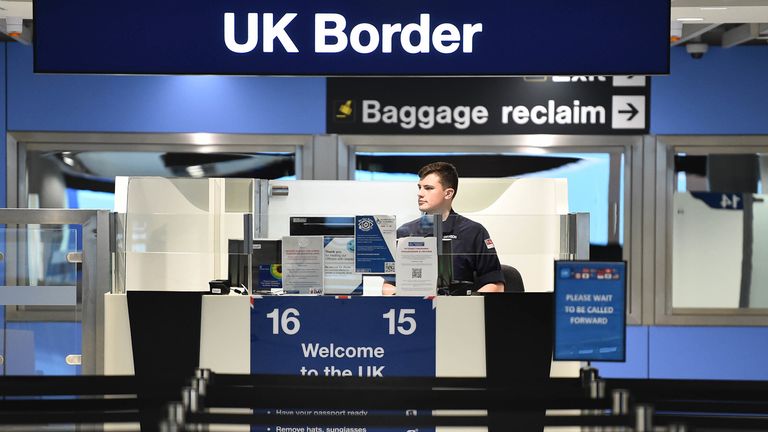
The United Kingdom Government has unveiled sweeping new restrictions on overseas recruitment, blocking more than 100 occupations from being filled by foreign workers in a bid to reduce net migration.

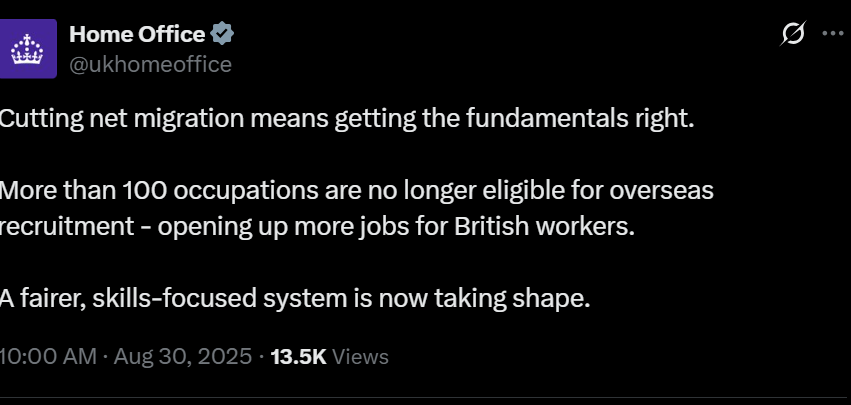
The Home Office announced the decision in a statement on X on Saturday, August 30, describing it as part of efforts to prioritise British workers and reshape the country’s visa system.

“Cutting net migration means getting the fundamentals right. More than 100 occupations are no longer eligible for overseas recruitment – opening up more jobs for British workers. A fairer, skills-focused system is now taking shape,” the statement read.

The move is the latest immigration reform under Prime Minister Sir Keir Starmer, who came into office on July 5, 2024, after Labour’s landslide victory, replacing Conservative leader Rishi Sunak.

While ministers argue the changes will create opportunities for UK residents, critics have warned the restrictions could deepen labour shortages, particularly in sectors such as health and social care that have relied heavily on overseas staff.

The Home Office has yet to publish the full list of affected occupations.

FOLLOW US ON:

FACEBOOK

TWITTER

PINTEREST

TIKTOK

YOUTUBE

LINKEDIN

TUMBLR

INSTAGRAM

See also  FX inflows, reserves boost naira to N1,497 per dollar
Continue Reading
Click to comment

Leave a Reply

Your email address will not be published. Required fields are marked *

Business

Dangote refinery eyes $2bn in historic listing – Report

Published

on

The planned public listing of Dangote Petroleum Refinery has triggered an unprecedented wave of investor interest across Nigeria and beyond, a Bloomberg report has stated.

According to the report published on Thursday, the proposed Initial Public Offering, expected to take place in September 2026, could raise as much as $2bn and become the largest stock market listing in Africa’s history.

The report said demand for shares in the refinery has already surged ahead of the offering, attracting interest from institutional investors, wealthy Nigerians, and first-time retail investors eager to gain exposure to what many consider one of the continent’s most strategic industrial assets.

Bloomberg reported that institutional investors have already indicated interest amounting to nearly $2bn even before the formal launch of the IPO, underscoring growing confidence in the refinery’s prospects and Nigeria’s capital market.

The offering is expected to value the refinery at about $40bn, although some market estimates place its potential valuation as high as $50bn.

The report read, “Dangote Petroleum Refinery and Petrochemicals FZE’s plan to raise as much as $2bn in Africa’s biggest initial public offering has sparked an investor frenzy across Nigeria, drawing interest from some of the country’s wealthiest people to first-time investors. A rare public market debut for an industrial asset of this scale on the continent will be a once-in-a-generation test of market depth.”

Dangote Petroleum Refinery plans to sell approximately 10 per cent of its equity through the offering, which is expected to be listed across multiple African exchanges, including the Nigerian Exchange Limited.

See also  Banks earn N225bn from ATM, e-banking charges

The refinery, owned by Africa’s richest man, Aliko Dangote, has emerged as a transformative force in Nigeria’s energy sector since commencing operations. Located in the Lekki Free Trade Zone in Lagos, the facility has reportedly ramped up production to an estimated 700,000 barrels per day, making it one of the largest single-train refineries in the world.

The development has significantly altered Nigeria’s long-standing dependence on imported petroleum products despite being one of Africa’s leading crude oil producers.

Bloomberg noted that the refinery has helped shift Nigeria from being a major importer of gasoline to becoming a net exporter of refined petroleum products to regional markets.

The intense appetite for the shares has, however, drawn regulatory attention. The SEC reportedly suspended marketing activities related to the IPO in June after concerns emerged over aggressive promotional campaigns surrounding the offer.

Despite the pause, investor interest has remained strong, with sophisticated institutional investors continuing to position themselves ahead of the planned listing.

The refinery had earlier tested investor appetite through a private placement exercise. Dangote disclosed during an interview on Arise Television in May that the company received about $2bn in subscriptions for a private share placement despite seeking to raise only $1bn.

According to a prospectus seen by Bloomberg, the company was targeting a valuation of $39.1bn during that exercise. Responding to Bloomberg’s inquiries, the company acknowledged the strong investor reception.

It stated, “We have successfully completed a number of domestic and international company introduction and market-sounding activities and have been encouraged by the level of interest received from both local and international investors.”

See also  OPay secures double honours at Tech Innovation Awards

The company added that discussions on the final structure of the IPO were still ongoing. “The group hasn’t finalised the size, timing, or structure of the IPO,” it said.

The offering could serve as a major test of the depth and maturity of African capital markets, given its size and anticipated participation from retail investors. The listing is also expected to benefit from improving sentiment in Nigeria’s equities market.

The report noted that Nigeria’s benchmark stock index has gained about 58 per cent in dollar terms this year, making it one of the world’s best-performing markets and second only to South Korea’s technology-driven rally.

The refinery’s financial performance has further strengthened investor confidence. According to people familiar with the company’s finances cited by Bloomberg, Dangote Refinery recorded earnings before interest, taxes, depreciation, and amortisation margins of about 23 per cent last year, placing it among the world’s most profitable refining operations.

The report also highlighted how recent geopolitical tensions have unexpectedly supported the group’s earnings. Dangote reportedly told Nicolai Tangen, Chief Executive Officer of Norges Bank Investment Management, that the crisis in the Middle East had been beneficial to the refinery, fertiliser, and petrochemical businesses.

The anticipated listing has also attracted support from government officials who believe broader retail participation could help democratise wealth creation.

Minister of Finance and Coordinating Minister of the Economy, Taiwo Oyedele, speaking on the significance of the offer, said widespread public participation could have positive economic consequences. “We can see the excitement already about the IPO, not only in Nigeria, but beyond Nigeria,” the minister said.

See also  Confiscated undeclared cash at airports hits $2.2m – Report

He added, “If you get a million people to invest and then they see appreciation over time, they have more disposable income, they have more wealth.”

The Dangote Petroleum Refinery, which commenced production in 2024, was conceived as a solution to Nigeria’s decades-long reliance on imported refined petroleum products despite abundant crude oil reserves.

With a nameplate capacity of 650,000 barrels per day and recent production increases reportedly pushing output towards 700,000 barrels daily, the facility has become a central pillar of Nigeria’s energy security strategy.

The planned IPO is expected to provide investors with a rare opportunity to own a stake in one of Africa’s largest industrial projects while potentially setting a new benchmark for capital raising on the continent.

punch.ng

FOLLOW US ON:

FACEBOOK

TWITTER

PINTEREST

TIKTOK

YOUTUBE

LINKEDIN

Continue Reading

Business

CBN orders banks to freeze six terror suspects’ accounts

Published

on

The Central Bank of Nigeria (CBN) has directed banks and other financial institutions to immediately freeze the accounts and assets of individuals and companies designated for terrorism and terrorism financing following fresh sanctions issued by Nigerian and United States authorities.

The directive was contained in a circular dated June 24, 2026, issued by the CBN’s Compliance Department and addressed to all banks, Payment Service Banks, and other financial institutions regulated under the Banks and Other Financial Institutions Act 2020.

According to the circular, the action follows recent sanctions designations by the Nigeria Sanctions Committee and the United States Department of the Treasury’s Office of Foreign Assets Control under Executive Order 13224, as amended, on terrorism and terrorism financing.

“The Nigeria Sanctions List has been updated as of June 18, 2026. These designations constitute binding sanctions measures requiring immediate implementation by all regulated entities,” the apex bank said.

The CBN listed six individuals designated under the sanctions regime as Muktar Muhammad Adamu, Babangida Muhammed Adamu Hammajam, Abdullahi Umar Usman, Ibrahim Abubakar, Adamu Chiroma, and Yakubu Ogirima Ibrahim.

It also named four Nigeria-based Bureau de Change operators designated as being owned or controlled by the individuals. They are Generation Currency Bureau de Change Limited, Manhattan Bureau de Change Limited, Nine to Nine Exchange Bureau de Change Limited, and Abbal Bako & Sons Bureau de Change Limited.

As part of the compliance measures, the apex bank directed all financial institutions to immediately screen existing customers, beneficial owners, and all incoming and outgoing transactions against the updated sanctions lists, including known aliases and identifiers.

See also  Presidency eyes NNPC shake-up as oil output falters

It also ordered banks to freeze, without prior notice, all funds, assets, and other economic resources belonging to or controlled, directly or indirectly, by the designated persons and entities.

The circular stated, “Identify and immediately freeze, without prior notice, all funds, assets, and other economic resources belonging to, owned, held, or controlled (directly or indirectly) by the designated persons and entities, including those owned 50 per cent or more, individually or collectively.”

The CBN further directed financial institutions to ensure that no funds, financial services, or economic resources are made available, directly or indirectly, to the sanctioned persons or entities.

It instructed banks to immediately file Suspicious Transaction Reports with the Nigerian Financial Intelligence Unit for any confirmed or attempted matches.

The regulator also directed all financial institutions to submit compliance reports to the CBN within 48 hours of the circular, stating whether any matches were identified, the accounts affected, amounts frozen or restricted, and actions taken.

It added that institutions with no matching accounts must also submit mandatory nil returns.

The circular also directed banks to intensify monitoring for terrorism-financing indicators, including the structuring and rapid movement of funds, the use of money service businesses, bureaux de change, and informal channels, as well as transactions involving high-risk jurisdictions.

It further ordered financial institutions to conduct retrospective reviews to identify previous or attempted transactions and customer relationships linked to the designated parties.

Warning against non-compliance, the CBN said all submissions must be accurate, complete and verifiable, noting that false or misleading information would constitute a regulatory violation.

See also  OPay named The Sun’s first-ever Fintech/Digital Bank of the Year 2025

“Any false or misleading information shall constitute a regulatory violation and will attract sanctions under BOFIA 2020 and other applicable laws,” the circular stated.

It added that the CBN would conduct off-site reviews, on-site examinations and supervisory engagements to verify compliance, stressing that the directive “takes immediate effect.”

The United States recently designated a Nigerian national and three companies operating in the country as alleged financial facilitators of activities linked to the terrorist group, the Islamic State of Iraq and Syria.

They were designated in the latest action, which targeted a total of three individuals and six entities accused of facilitating the movement of funds for ISIS operations globally.

The PUNCH earlier reported that the Association of Bureaux De Change Operators of Nigeria strongly condemned terrorism financing, declaring its full support for recent domestic and international enforcement efforts aimed at safeguarding the integrity of Nigeria’s financial system.

punch.ng

FOLLOW US ON:

FACEBOOK

TWITTER

PINTEREST

TIKTOK

YOUTUBE

LINKEDIN

Continue Reading

Business

Petrol remains pricey as crude crashes to $73

Published

on

The price of petrol has remained high even as crude oil prices crashed to $73 per barrel on Wednesday, their lowest level since the US-Iran conflict began in February.

According to Oilprice.com, crude oil fell from $76.75 per barrel on Tuesday to $73.50 on Wednesday, extending the decline in oil prices since the United States and Iran signed a peace deal.

However, petrol prices have yet to drop in line with the latest crude oil rates. As of Wednesday, many filling stations were still selling petrol at about N1,205 per litre, a price many consumers said does not reflect current global oil prices.

Following the drop in crude oil prices from a high of about $120 per barrel during the United States-Iran conflict to around $73 after a peace deal was reached on June 14, many Nigerians expected petrol prices to fall below N1,000 per litre. That expectation has yet to materialise.

Recently, the Dangote refinery reduced its petrol gantry price by N75 per litre, from N1,250 to N1,175, prompting importers to also adjust their prices downward.

PUNCH recalls that the Dangote refinery increased its gantry price from N774 to N874 per litre when the Middle East crisis started. This came as crude oil prices rose to $84 per barrel from below $70 in the days leading up to the airstrikes involving the United States, Iran, Israel, and other countries. Filling stations had earlier raised petrol prices from about N830 to over N1,300 per litre during the crisis.

See also  Presidency eyes NNPC shake-up as oil output falters

With crude now trading at $73.69 per barrel, stakeholders expect petrol prices to fall below the current level of over N1,200 per litre.

The Petroleum Products Retail Outlets Owners Association of Nigeria called on refiners, depot owners, and petroleum product importers to reduce their ex-depot and retail pump prices in line with the decline in international crude oil prices.

The National President of PETROAN, Billy Gillis-Harry, said the drop in global crude oil prices presents an opportunity for operators in the downstream petroleum sector to pass on the benefits of lower crude costs to consumers.

In a statement signed by the National Public Relations Officer of PETROAN, Dr Joseph Obele, on Friday, Gillis-Harry said market realities should be reflected in both ex-depot and retail pump prices.

“The recent decline in global crude oil prices presents an opportunity for stakeholders in the downstream petroleum sector to pass the benefits of lower crude oil costs to Nigerian consumers. Market realities should be reflected in both ex-depot and retail pump prices in the interest of fairness and economic relief for the public,” Gillis-Harry said.

Gillis-Harry also expressed concern over pricing trends in the domestic market, saying, “In some instances, the landing cost of imported petroleum products appears to be lower than the prices offered by domestic refiners. This development is surprising and underscores the need for a more competitive downstream petroleum market that guarantees consumers access to the most affordable products available.”

However, a Dangote refinery official told our correspondent that no importer was selling petrol below the refinery’s current rates. The official, who pleaded anonymity, said the refinery was still processing relatively expensive crude purchased during the crisis.

See also  FX inflows, reserves boost naira to N1,497 per dollar

It appears importers are waiting for the Dangote refinery to take the lead before lowering their prices further.

Oil prices surged during the conflict as tensions threatened shipping through the Strait of Hormuz. However, prices have declined in recent days as traders grew optimistic that the US-Iran agreement would help keep the strategic waterway open, alongside reports of a slight increase in shipping traffic.

According to CNN, traders are still monitoring whether traffic continues to flow smoothly through the strait and whether tensions remain contained across the Middle East.

On Tuesday, President of the United States, Donald Trump, said a record 19 million barrels of oil flowed out of the Strait of Hormuz on Monday. According to Trump, oil prices are tumbling as a result of the oil flow through Hormuz.

“19 million barrels of oil flowed out of the Hormuz Strait yesterday, an all-time record. Oil prices are tumbling down, and the world is a much safer place,” Trump said in a post on his social media handles.

punch.ng

FOLLOW US ON:

FACEBOOK

TWITTER

PINTEREST

TIKTOK

YOUTUBE

LINKEDIN

Continue Reading

Trending