Connect with us

Lifestyle

Vintage Coca-Cola Cone-Top Cans: 1950s Packaging Innovation

Published

on

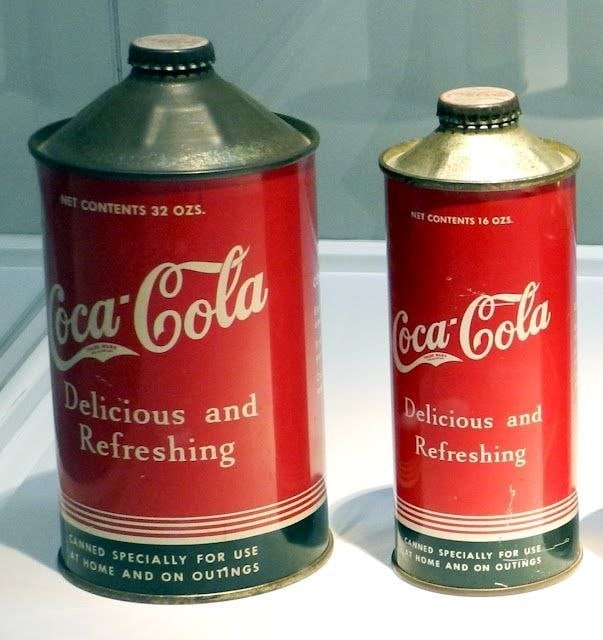
The image shows two vintage Coca-Cola cone-top cans from the 1950s—rare relics that mark a turning point in beverage history. With their bold red branding, crown-cap tops, and distinct sizes (pint and quart), these cans reflect Coca-Cola’s early experiments with packaging beyond the glass contour bottle that defined its identity for decades.

The Cone-Top Era

Introduced in the United States in the mid-1930s, cone-top cans were a bridge between bottles and modern cans. Designed with a narrow spout sealed by a crown cap, they mimicked the familiar shape of a glass bottle while allowing beverage companies to use existing bottling machinery.

For Coca-Cola—synonymous with its patented contour bottle—cone-top cans were a cautious but innovative step, ensuring loyal customers accepted the shift to canned drinks without losing brand familiarity.

Sizes and Consumer Appeal

The two cans in the image highlight Coca-Cola’s mid-century strategy of offering convenience and choice:
Quart (32 oz.) – Marketed for families and group consumption.

Pint (16 oz.) – Ideal for individuals or small gatherings.

Both carried the clear label “NET CONTENTS”, reinforcing Coca-Cola’s transparency in portion sizes at a time when standardized packaging was building consumer trust.

Branding and Marketing Messages

Despite the new format, Coca-Cola stayed anchored to its identity:

The timeless slogan “Delicious and Refreshing” (first used in the 1880s) appears prominently.
The phrase “CANNED SPECIALLY FOR USE AT HOME AND ON OUTINGS” targeted post-WWII suburban life—picnics, road trips, and family recreation—positioning Coca-Cola as both portable and social.

This approach echoed America’s booming leisure culture, tying the brand to relaxation and togetherness.
Historical Context: From Bottles to Cans

See also  South Africa’s top court rules men can take wives’ surnames

Coca-Cola began testing cans in 1936, but wartime rationing and consumer habits delayed large-scale adoption. After WWII, soldiers’ familiarity with canned beverages accelerated demand back home. By the 1950s, with improved steel can technology, Coca-Cola expanded its canned offerings in select markets.

Cone-top cans were phased out in favor of flat-top steel cans in the late 1950s and early 1960s, which required a “church key” opener. This evolution paved the way for pull-tab aluminum cans by the late 1960s—the format still dominant today.

Legacy and Collectibility

Today, Coca-Cola cone-top cans are prized artifacts of both design and cultural history. Collectors especially seek:

Intact cans with legible labels and minimal rust.

Large quart-size cans, which are far rarer than pints.

Values vary by condition and rarity, with some cone-top Coca-Cola cans fetching $200 to over $1,000 at auctions. Beyond their monetary worth, they symbolize Coca-Cola’s adaptability: from soda fountains in the 1890s, to glass bottles in the 1910s, and cans by the mid-20th century.

Sources
Coca-Cola Archives. “Coca-Cola Packaging: A Timeline.” The Coca-Cola Company.

FOLLOW US ON:

FACEBOOK

TWITTER

PINTEREST

TIKTOK

YOUTUBE

LINKEDIN

TUMBLR

INSTAGRAM

Continue Reading
Click to comment

Leave a Reply

Your email address will not be published. Required fields are marked *

Lifestyle

ARE SOME PARENTS CHOOSING MONEY OVER THEIR OWN CHILDREN?

Published

on

Some parents spend years chasing money, building businesses and accumulating wealth—all in the name of “giving their children a better life.”

But here is the uncomfortable question:

What if your child has everything money can buy, but doesn’t have YOU?

A child needs more than school fees, expensive clothes, gadgets and a comfortable home.

They need your time.
They need your attention.
They need your affection.
They need to know that they are loved, heard and valued.

💰 Money can be earned again.

❤️ But once a child’s trust is broken, rebuilding it may not be easy.

🕰️ And once childhood is gone, you can never buy it back.

Don’t become so busy providing for your children that you forget to actually be present in their lives.

Because one day, your child may remember the money you provided—but they may remember even more clearly the moments you were never there.

🔥 QUESTION:

Do you believe some parents are sacrificing too much family time in the pursuit of money?

Tell us what you think in the comments.

#Newsbreak365 #Parenting #Children #Family #Parenthood #LifeLessons #FamilyValues #Money #Childhood #Relationships

FOLLOW US ON:

FACEBOOK

TWITTER

PINTEREST

TIKTOK

YOUTUBE

LINKEDIN

INSTAGRAM

See also  Police - Peller safe, investigation over alleged kidnap ongoing
Continue Reading

Lifestyle

A WORD OF WARNING: NEVER LET YOUR SUCCESS MAKE YOU LOOK DOWN ON PEOPLE.

Published

on

Since you are not feeding anyone, you should never see anyone as being beneath you.

Having money does not make you more human.
Having a degree does not make you more valuable.
Having a big position does not give you the right to disrespect people.

Today, you may be comfortable while someone else is struggling. But life can change unexpectedly. Never use your current advantage to humiliate someone who has less than you.

True greatness is not measured by what you have in your bank account, the car you drive, or the position you occupy.

Your real character is revealed by how you treat people who cannot give you anything in return.

Be humble. Be respectful. Treat people with dignity.

You are not better than anyone simply because you have more than they do.

💬 Do you agree? What do you think makes a person truly great?

#NewsBreak365 #LifeLessons #Respect #Humility #Character #Wisdom #Motivation #Humanity #Inspiration

FOLLOW US ON:

FACEBOOK

TWITTER

PINTEREST

TIKTOK

YOUTUBE

LINKEDIN

INSTAGRAM

See also  The First Reported Three-Storey Building in Lagos: Petesi Anduru
Continue Reading

Lifestyle

BEING EDUCATED SHOULD NEVER MAKE YOU LOOK DOWN ON AN UNEDUCATED PERSON.

Published

on

Education should give you knowledge, but character determines how you use that knowledge.

Not everyone had the opportunity to attend school or earn academic qualifications. Some people learned through life, work, family, hardship and experience.

Having a degree does not make someone more valuable than the person without one.

Your education should make you more humble, not more arrogant.

Respect the cleaner.
Respect the farmer.
Respect the mechanic.
Respect the trader.
Respect the labourer.
Respect everyone.

Because the person you look down on today may have life lessons you will never learn in a classroom.

Education is powerful—but humility is priceless.

💬 Do you agree? Can someone be highly educated but still lack wisdom?

#NewsBreak365 #Education #Wisdom #Humility #Respect #LifeLessons #Character #Knowledge #Nigeria #AfricanValues

FOLLOW US ON:

FACEBOOK

TWITTER

PINTEREST

TIKTOK

YOUTUBE

LINKEDIN

INSTAGRAM

See also  A Husband Should Not Neglect His Family
Continue Reading

Trending