Connect with us

Lifestyle

Tension in Osun council as Ataoja, Oluwo battle for seniority

Published

on

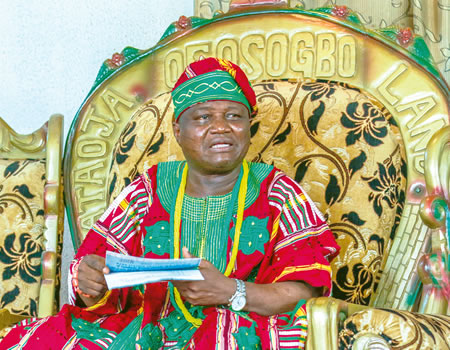
A supremacy battle is threatening to unsettle the Osun State Council of Obas as the Ataoja of Osogbo, Oba Jimoh Oyetunji, and the Oluwo of Iwo, Oba Abdulrosheed Akanbi, are locked in a bitter row over who occupies the fourth position in the hierarchy of monarchs in the state.

Beyond the palaces, the tussle has spilt into the digital space, with supporters of both monarchs taking to social media to defend the honour of their rulers.

Ataoja’s loyalists argue that Osogbo’s historic role as the state capital confers a higher ranking, insisting that the stool of the Ataoja should not be relegated.

On the other hand, Oluwo’s supporters counter that the Iwo throne predates Osogbo and carries greater ancestral weight. The exchanges have often turned heated, with sharp words traded, heightening public tension.

The latest round of the dispute erupted when Ataoja, during a lecture at Osun State University to mark his 15th coronation anniversary, revisited the long-standing controversy by insisting that his stool historically occupies the fourth position in the Council—a status he alleged was wrongly ceded to the Oluwo during the reign of his predecessor, Oba Iyiola Matanmi III.

Oba Oyetunji narrated how the confusion began, stressing that he was not fighting any monarch but merely asserting the historical rights of his stool.

He said, “Late Ataoja of Osogbo, Oba Iyiola Oyewale, during his reign, went abroad, and before he came back, his position was given to the Oluwo of Iwoland. That was how Oluwo became number four in the hierarchy. That position is for Ataoja.

See also  12 POWERFUL BALOGUN IN YORÙBÁ HISTÒRY.

“When I spoke about it some time ago, people twisted my words, and that was why I kept silent. However, I have been working underground. I am not fighting any monarch, but Ataoja’s stool is number four in Osun State.”

The Ataoja also recalled an encounter with the Oba of Ila Orangun, who questioned him over his reported claim that the Oluwo ranked below him.

Oba Oyetunji explained that his remarks were misconstrued.

“When I got to Ila Orangun, he asked why I started fighting for a monarch’s position a few days after my ascension. I told him I did not know anything about that.

“He said I was quoted as saying I am the fourth monarch in ranking, while Oluwo is fifth. I explained that Oluwo and I were not fighting, but my predecessors had always occupied the fourth seat,” the monarch explained.

Despite his clarifications, Oba Oyetunji admitted that the issue continued to haunt him.

He said, “Since then, I have been silent on this issue because I do not know a way out, but I have been doing my work quietly. No matter how long you cook, the flame will go out. I am not fighting any monarch, but Ataoja’s stool is fourth in ranking in Osun State.”

Reacting to Ataoja’s fresh remarks, Oluwo fired back through his Chief Press Secretary, Alli Ibraheem, accusing Oba Oyetunji of attempting to distort history.

He urged Ataoja to seek accurate historical knowledge from respected elders of Osogbo rather than distort the hierarchy of Yoruba traditional stools.

“The good people of Iwoland are not unaware of a video circulating on social media, reportedly made by the Ataoja of Osogbo, contesting stool hierarchy.

See also  The day Chief Obafemi Awolowo left the world (May 9, 1987)

“Personally, I watched with disappointment but no dismay. This clarification becomes necessary to protect the ancient stool of Oluwo and prevent distortion of Yoruba history.”

Oba Akanbi maintained that the Oluwo’s crown flows directly from Oduduwa, the progenitor of the Yoruba race, dismissing Ataoja’s claim of deriving his crown from Ipole as recent and politically influenced.

He said, “As far as we know, Ataoja was a Baale until 1948. Ataoja’s crown was of recent origin, along with some others, when the then military governor, David Jemibewon, decreed them into existence in 1976. Oluwo’s beaded crown is ageless and from the pristine source—undiluted and authentic.”

Oluwo also reminded Ataoja of their earlier clash at the Council, insisting that the episode was a demonstration of where true seniority lies.

The Ataoja’s secretary, Bello Oyewale, in a statement posted on social media, stressed that when Osun was carved out of old Oyo State in 1992, the Ataoja was recognised as fourth in the Council, with Oluwo following behind.

He listed other monarchs such as the Timi of Ede, the Ogiyan of Ejigbo, and the Akinrun of Ikirun as part of the vice-chairmanship cadre, maintaining that Ataoja’s stool was historically elevated as monarch of the state capital.

Sources confirmed that both monarchs clashed at a Council of Obas meeting recently when the absence of the Ooni of Ife, the Orangun of Ila, and the Owa Obokun of Ijesaland left Ataoja as the most senior monarch present.

They said Ataoja presided over the meeting until Oluwo arrived.

“Ataoja acknowledged Oluwo’s presence and continued with the meeting. Oluwo expected to be invited to preside immediately, but Oba Oyetunji didn’t do that. Oba Akanbi felt disrespected and protested.

See also  Political titans, Dangote attend El-Rufai mother’s burial

“The meeting was disrupted, and it took the intervention of other royal fathers to restore order. The matter was later settled by the Ooni at the following month’s meeting,” they recounted.

But the Iwo Board of Trustees rejected the explanation and called on Governor Ademola Adeleke to compel Ataoja to apologise.

Its statement read, “The truth is that Ataoja’s crown was of recent origin. Oluwo’s beaded crown is ageless. No doubt, the misuse of political power is a common phenomenon in Nigeria, as it often seeks to distort authentic historical facts.

“The relative peace in Osun State must not be disturbed. We therefore call on the Governor to direct the Ataoja, with due respect, to recant the provocative statement and apologise to Oluwo and the Council of Obas.”

The Asiwaju of Osogbo, Justice Moshood Adeigbe (retd.), appealed for restraint and urged reconciliation among the monarchs.

punch.ng

FOLLOW US ON:

FACEBOOK

TWITTER

PINTEREST

TIKTOK

YOUTUBE

LINKEDIN

TUMBLR

INSTAGRAM

Continue Reading
Click to comment

Leave a Reply

Your email address will not be published. Required fields are marked *

Lifestyle

Nigeria’s ambassador-designate to Algeria, Lele, dies at 50

Published

on

The Federal Government has announced the death of Nigeria’s ambassador-designate to Algeria, Mohammed Mahmud Lele, who died at the age of 50.

The Ministry of Foreign Affairs disclosed this in a statement issued in Abuja on Wednesday by its spokesperson, Kimiebi Ebienfa.

According to the ministry, Lele died in the early hours of April 19, 2026, in Ankara, Türkiye, after a protracted illness.

The ministry described the late diplomat as a dedicated officer who served the country with distinction.

“The late Ambassador Lele, until his death after a protracted illness, was the Director in charge of the Middle East and Gulf Division in the Ministry of Foreign Affairs.

“Ambassador Lele, a career diplomat, was recently appointed by President Bola Ahmed Tinubu as Ambassador-designate to the People’s Democratic Republic of Algeria, following the Nigerian Senate’s confirmation of his nomination,” the statement said.

Born in Gamawa, Bauchi State, in 1976, Lele studied Economics at Bayero University, Kano, and went on to serve in Nigerian missions in Berlin, Lomé and Riyadh.

“Ambassador Lele was known for his intellectual depth, strategic insight and commitment to the advancement of Nigeria’s foreign policy objectives,” the statement added.

The Permanent Secretary of the ministry, Dunoma Umar Ahmed, who received the remains of the late diplomat at the Nnamdi Azikiwe International Airport, Abuja, described him as “a hardworking, humble and fine officer, who will be sorely missed by the ministry.”

The ministry added that his death “is a monumental loss not only to his immediate family but also to the entire Foreign Service community and the Federal Republic of Nigeria.”

See also  Untold story of workers who keep Lagos running while others sleep

Lele was buried on Wednesday in Kano in accordance with Islamic rites.

The ministry extended condolences to his family, associates, and the government and people of Bauchi State, praying for the peaceful repose of his soul and strength for those he left behind.

Continue Reading

Lifestyle

Governor Amuneke reveals party officials offered him dollars to alter anti-govt skits

Published

on

Comedian Kevin Chinedu, popularly known as Kevinblak, has revealed that officials of a political party offered him dollars to change his satirical skits criticising politicians and governance.

He made the disclosure on Monday in an interview on ARISEtv’s Arise 360 programme, where he spoke about the pressures facing content creators who hold public officials accountable through humour.

Chinedu, known for his character Governor Amuneke, said the approach came at a particularly vulnerable moment, shortly after his wife had a Caesarean section and he was under financial strain.

“They said they were going to change my life, that I’m earning crumbs, you know, give me dollars. They mentioned that my colleagues are in the game and all of that,” he said.

He declined to name the party, saying only that it was “Amuneke’s party”, a reference to the fictional political figure in his skits, and cautioned against any attempt to identify it publicly.

“Don’t mention names, trust me, don’t mention names,” he said.

Despite the financial pressure, the comedian said he turned down the offer, recalling how the officials had tried to lure him to Abuja with the promise of a life-changing sum.

“I had a lot of bills on my head and I just heard come, come to Abuja, let’s change your life. Dollars upon dollars,” he said.

He said he ultimately held firm, guided by a personal code he had maintained throughout his career.

“I looked at it, I said, no, I am who I am. I’ve been here for a long time, and I’ve never been in any illegal thing, and I’ve never been somewhere, you know, I’m doing something because I’m being influenced, because of money.

See also  Funke Akindele’s new movie opens with over ₦200m at box office

“If I want to do it, it should be something I’m doing because I want to do it. So, you know, it is what it is,” he said.

When asked whether friends had urged him to accept the money, Chinedu said his inner circle was equally principled, and had themselves been approached and refused.

“I don’t have friends that are easily overwhelmed with money. I have people who have principles because they have, you know, approached them, they themselves. So, we always have that conversation,” he said.

punch.ng

FOLLOW US ON:

FACEBOOK

TWITTER

PINTEREST

TIKTOK

YOUTUBE

LINKEDIN

INSTAGRAM

Continue Reading

Lifestyle

Over 4,600 Nigerian doctors relocate to UK in three years – Report

Published

on

Nigeria’s already fragile healthcare system is facing renewed strain as no fewer than 4,691 doctors have relocated to the United Kingdom since President Bola Tinubu assumed office on May 29, 2023, fresh data from the General Medical Council shows.

The UK GMC is a public official register detailing the number of practising doctors in the UK alongside other details such as their areas of speciality, country of training, among others.

The mass migration represents not just a human resource crisis but a significant economic loss.

With the Federal Government estimating that it costs about $21,000 to train a single doctor, Nigeria has effectively lost at least $98.5m in training investments within less than two years.

The figure put the total number of Nigeria-trained doctors currently practising in the UK to about 15,692, making Nigeria one of the largest sources of foreign-trained doctors in Britain, second only to India.

As of May 28, 2025, official records showed that the number of Nigerian-trained doctors in the UK was a little over 11,000. The figure has grown significantly since then.

The exodus of doctors comes as Nigeria’s doctor-to-population ratio hovers around 3.9 per 10,000 people, far below the minimum threshold recommended by the World Health Organisation.

For many health experts, the numbers confirm what has long been visible: a system gradually losing its most critical workforce.

The Nigerian Medical Association has repeatedly warned that poor remuneration, unsafe working conditions, and inadequate infrastructure are pushing doctors out of the country.

“Our members are overworked, underpaid and exposed to unsafe environments daily. Many are simply burnt out,” the NMA said in one of its recent statements addressing workforce migration.

See also  General Adetunji Idowu Ishola Olurin: Nigerian Army Officer and Statesman

Similarly, the National Association of Resident Doctors has consistently highlighted the toll on younger doctors, who form the backbone of Nigeria’s tertiary healthcare system.

“Doctors are leaving because the system is failing them—irregular salaries, excessive workload, and lack of training opportunities,” NARD noted during one of its nationwide engagements.

Ironically, the doctor exodus persists even as Nigeria continues to spend heavily on healthcare abroad.

While official foreign exchange data shows only modest spending on medical tourism in recent years, broader estimates suggest Nigerians still spend hundreds of millions of dollars annually seeking treatment overseas.

For instance, a recent report by The PUNCH revealed that foreign exchange outflow for health-related travel by Nigerians surged to $549.29m in the first nine months of 2025, a 17.96 per cent increase from $465.67m in the same period of 2024, according to official data by Nigeria’s apex bank.

A public health expert, Dr David Adewole, noted that the Federal Government’s national policy on health workforce migration, aimed at curbing the growing trend of health professionals leaving the country—commonly referred to as ‘Japa’—is a good initiative, but may not do much to address the fundamental problems of the shortage of skilled healthcare professionals in Nigeria, particularly in rural and underserved areas.

According to him, many of the push factors for health professionals emigrating to greener pastures, like insecurity, emolument and lack of basic amenities like potable water, health facilities, cost of living and constant electricity, persisted.

He stated: “To make healthcare workers stay here, let the salaries be enough so that what you earn will be much more than the multiples of what you need for basic needs, like food, power supply, housing, and so forth.

See also  The day Chief Obafemi Awolowo left the world (May 9, 1987)

“People still look at life after retirement. You might have a good policy, but its implementation is the issue. For example, you are retired, and for your retirement package, you don’t need to know anyone for it to be processed promptly.

“Then subsequently, your monthly pension, without pressing anybody, should be paid. Those things are not here.

“And when you go to the hospital abroad, if you tell them that you are in a hurry, you go to your home; they’ll bring the medicines to your doorstep.”

Continue Reading

Trending