Connect with us

Education

FG scholars abroad stage protest over unpaid allowances

Published

on

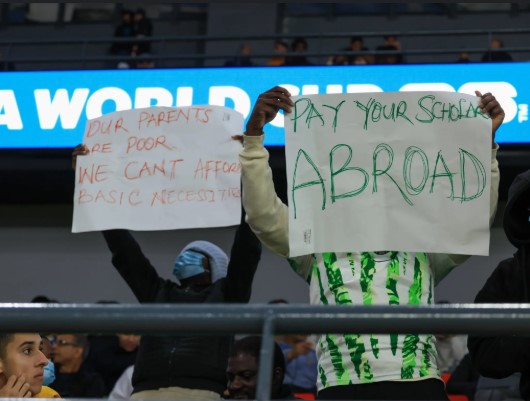
Nigerian students studying abroad under the Federal Government’s Bilateral Education Agreement and their parents are set to stage a protest today (Monday) over the non-payment of scholarship stipends, which they say has pushed many scholars into distress, The PUNCH learnt.

The demonstration, according to a notice issued by the Forum of BEA Scholars, will take place at the Ministry of Finance headquarters in the Central District of Abuja at 10am.

Parents of the affected students, who said they could no longer bear the financial and emotional strain of supporting their stranded children abroad, confirmed they would join the protest.

In the notice, the scholars said they are entitled to monthly stipends of $500 but have not received any payment this year, leaving 11 months outstanding.

They added that the Federal Government cut their 2024 stipends by 56 per cent, paying only $220 instead of the approved $500. According to the notice, the government still owes them arrears for September, October, November and December 2023.

Many of the students, who are studying in countries such as Hungary, Morocco, China, Russia and Serbia, said they were struggling to afford food, accommodation, medical care and transportation due to the prolonged delay.

The Forum of BEA Scholars said several students had taken informal jobs in violation of their scholarship terms, while others had been relying on charity.

The group linked the recent death of a Nigerian student in Morocco to the hardship caused by unpaid allowances, warning that more students were at risk if the government continued to delay payments.

See also  FG drops mother tongue policy

The PUNCH earlier reported that the Federal Government in April 2025 announced the cancellation of the Bilateral Education Agreement scholarship programme, describing it as an unsustainable and inefficient use of public funds.

The decision followed months of complaints by stranded Nigerian scholars abroad who accused the government of failing to meet its financial obligations under the scheme.

Established through diplomatic agreements with countries such as China, Russia, Algeria, Hungary, Morocco, Egypt, and Serbia, the BEA programme has allowed hundreds of Nigerian students to pursue higher education overseas on government sponsorship.

Despite recent assurances by the Federal Government that all supplementary allowances had been paid up to December 2024—with further funds requested to cover outstanding entitlements affected by exchange rate fluctuations—the Minister of Education, Dr Tunji Alausa, announced a definitive end to the programme.

Speaking during a courtesy visit by newly elected officials of the National Association of Nigerian Students, Alausa said the government would redirect BEA funding to domestic scholarship programmes to reach a broader number of students across the country.

“In 2024, when I assumed office, I was asked to approve N650m for 60 students going to Morocco under the BEA programme. I refused. It’s not fair to Nigerian students,” Alausa said.

Alausa also expressed dissatisfaction with the lack of oversight and performance monitoring under the BEA, noting that the government sponsors annual travel for scholars without tracking their academic progress.

“In 2025 alone, we projected N9bn to fund just 1,200 students abroad. Meanwhile, millions of students in Nigeria get no support. It’s unjust and unsustainable,” the minister stated. “We have evaluated every single course these 1,200 students are studying abroad—every one of them is offered in Nigerian universities.”

See also  FG, avert looming ASUU strike

He confirmed that while current BEA beneficiaries will be supported to complete their programmes, the scheme will not accept new admissions beyond 2025.

“This programme is not the best use of public funds. That money will now be used to fund local scholarships and support more students,” Alausa concluded.

By May 2025, Alausa lamented that 85 per cent of Nigerian students sent abroad on government scholarships never returned to contribute to national development.

This came as he announced that tertiary institutions with fewer than 2,000 students will no longer be eligible for funding from the Tertiary Education Trust Fund.

On foreign scholarships, Alausa revealed a shift in policy, explaining that more funds would now be invested in building local capacity.

With the Federal Government’s decision not to fund foreign scholarships anymore, several beneficiaries of the BEA scholarship programme have been stranded in foreign countries.

punch.ng

FOLLOW US ON:

FACEBOOK

TWITTER

PINTEREST

TIKTOK

YOUTUBE

LINKEDIN

TUMBLR

INSTAGRAM

Continue Reading
Click to comment

Leave a Reply

Your email address will not be published. Required fields are marked *

Education

FG bans admission and transfer into SS3 nationwide from 2026/27 session

Published

on

The Federal Government has announced a nationwide ban on admission and transfer of students into Senior Secondary School Three (SS3), effective from the 2026/27 academic session.

The directive applies to both public and private secondary schools across Nigeria, Punch reported.

According to a statement signed by Boriowo Folasade, Director of Press and Public Relations at the Federal Ministry of Education, the decision is part of efforts to curb examination malpractice and restore credibility to the country’s education system.

The ministry explained that only admissions and transfers into SS1 and SS2 will now be allowed, stressing that no student will be permitted to enter SS3 under any circumstance.

Officials said the move is aimed at stopping last-minute transfers often linked to so-called “special centres” during external examinations, as well as ensuring proper academic monitoring and continuity in teaching and learning.

School owners, principals, and administrators have been directed to comply strictly with the new policy, with the Federal Government warning that any violation will attract sanctions in line with existing education regulations.

The ministry added that the policy reflects its commitment to fairness, improved academic standards, and rebuilding public confidence in national examinations.

FOLLOW US ON:

FACEBOOK

TWITTER

PINTEREST

TIKTOK

YOUTUBE

LINKEDIN

TUMBLR

INSTAGRAM

See also  Foundation empowers 400 Kaduna students
Continue Reading

Education

NDLEA, HEPPWAS warn students against drug abuse

Published

on

A non-governmental organisation, Health Promotion for People With Addiction and Suicide, has partnered the National Drug Law Enforcement Agency, Rotary Club of Yenagoa City Centre and Damaris Hotel and Suites to sensitise students on the harmful effects of drug abuse.

Over 100 senior secondary school students of the Government Secondary School, Obogoro on Tuesday benefited from the sensitisation programme with the theme, ‘Sensitisation On Substance Uses And Its Impacts On Youths’ Brain.’

The President and Chief Executive Officer of HEPPWAS, Prof Izebeloko Jack Ibe, a professor of Mental Health and Psychiatric Nursing at the Niger Delta University spoke on the harmful effects of drugs on the human brain.

Ibe, who hails from Obogoro community in the Yenagoa Local Government Area of Bayelsa State, said she shared the same background with the students and enjoined them to strive for the top.

The Prof added, “Don’t let circumstances make you a stumbling block to others. You can be what you want to be, you can strive for the top.”

She, however, warned that while some organs of the body can regenerate, the brain does not regenerate, and “when we take substance in this brain that cannot expand, they excite the brain cells which cannot regenerate, and they damage the brain.”

According to her, some of the social ills among children such as stubbornness and lack of respect for elders are traceable to substance abuse and cautioned the students against engaging in it

Mr. Godwin Erepa, NDLEA Assistant State Commander, Drug Demand Reduction Unit, enumerated some harmful drugs including ice, fentanyl, cannabis and local gin (ogogoro).

See also  FG releases approved subjects for basic, senior secondary education

Erepa said such substance abuse leads to crime and criminality, adding that many cases of domestic violence are caused by substance abuse.

Another native of Obogoro community, Dr. Pawei Igodo, warned the students to shun drugs and focus on their studies and also highlighted the harmful effects of drugs on the human brain.

HEPPWAS Executive Secretary, Mr. Ben Ibe, said, “An estimated 14.3 million Nigerians are using drugs and could be responsible for the growing cases of insecurity in the country.”

Earlier, the owner of Damaris Hotel and Suites, Dr. Boma Spero-Jack, an Obogoro indigene who is serving as security adviser to Bayelsa State Governor, Senator Douye Diri, urged the students to listen to the various speakers.

The Principal of Government Secondary School, Obogoro, Mrs. Dick Agbeyen, expressed appreciation to the organisers of the sensitisation programme and said it will be beneficial if government would incorporate teachings on drug abuse in the school curriculum.

A student of the school, Awake Dufaye Daniel, said the programme was helpful as he has learned about the effects of drug abuse and misuse on the brain.

Continue Reading

Education

Law student Ayomiposi Ojajuni kills self over failure to write final exam

Published

on

A student in the Yola Campus of the Nigeria Law School, identified as Ayomiposi Ojajuni, has allegedly taken his own life over failure to sit for his final examination.

The news broke Sunday that he killed himself on Saturday, December 6, because he was barred from doing the bar final examination at the Yola Campus.

People close to the deceased allege that he became distressed in the morning of Saturday on finding that he was indeed not going to be allowed to take the professional examination that commenced that morning.

He reportedly swallowed a deadly substance on receiving the news and died Sunday morning even after he was rushed to nearby Modibbo Adama University Teaching Hospital, Yola.

Sources have explained that the authorities came to the decision to stop him from taking his examination because he did not respond to multiple queries previously issued to him by the school authorities.

The Police Public Relations Officer in Adamawa State, SP Sulaiman Nguroje could not be reached for comment Sunday afternoon when this report was being concluded, but a different police source confirmed Ayomiposi Ojajuni’s suicide story.

FOLLOW US ON:

FACEBOOK

TWITTER

PINTEREST

TIKTOK

YOUTUBE

LINKEDIN

TUMBLR

INSTAGRAM

See also  FG, avert looming ASUU strike
Continue Reading

Trending