Thursday’s proceedings in Nnamdi Kanu’s terrorism trial at the Federal High Court, Abuja, turned dramatic as the IPOB leader defiantly challenged the court, prompting Justice James Omotosho to order his removal. Kanu’s repeated objections and outbursts met firm judicial authority, and senior legal practitioners later backed the judge’s decisive handling, praising him for upholding courtroom decorum while exercising his powers judiciously in a politically charged case, writes Deborah Musa
A new layer of judicial scrutiny unfolded on Thursday inside Court 7 of the Federal High Court, Abuja, where Justice James Omotosho presided over what was expected to be a straightforward final phase in the long-running terrorism trial of Indigenous People of Biafra leader, Nnamdi Kanu.
However, the courtroom became the scene of a dramatic confrontation, blending legal argument, personal defiance, and a judge’s resolve to maintain the dignity of the court.
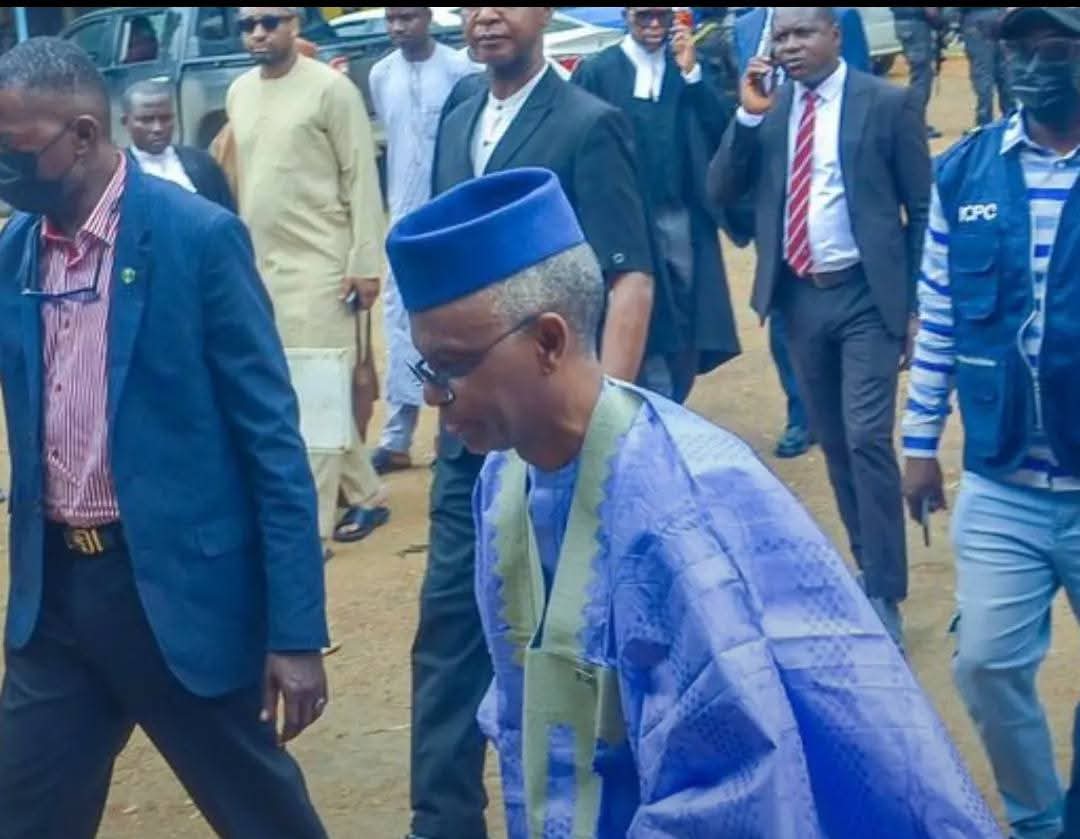
Kanu, whose cases have spanned nearly a decade, arrived as usual from the Department of State Services custody, clad in his trademark Fendi attire. But as proceedings began, tension simmering beneath years of legal maneuvering quickly rose to the surface.
The immediate trigger came when Justice Omotosho dismissed three fresh applications filed by Kanu. The motions, challenging jurisdiction, seeking a stay of proceedings, requesting referral of certain issues to the Court of Appeal, and asking for bail, were described by the judge as unmeritorious. The court had already fixed the matter for judgment.
Kanu, however, insisted the court could not proceed because he had not filed his final written address. What began as a procedural objection escalated rapidly.
Raising his voice, Kanu accused the court of bias, arguing that the Supreme Court’s earlier pronouncement, which described Count 7 of his charge as defective, voided the trial entirely.
“My contention ab initio is that the court lacks jurisdiction to try me… Count 7 destroys this entire trial because it doesn’t exist,” he declared from the dock.
He further argued that the prosecution’s evidence was “surgically defective,” insisting he had entered his defence and therefore deserved the right to file a final written address.
Prosecution counsel, Chief Adegboyega Awomolo, countered sharply, urging the court to disregard what he described as repetitive motions already settled by higher courts.
In his ruling, Justice Omotosho held firm: most of Kanu’s arguments had been raised repeatedly and were reserved to be addressed in the final judgment; Section 306 of the Administration of Criminal Justice Act expressly bars stay of proceedings in criminal trials; and Kanu’s bail application did not meet the categories recognised by law, either bail pending trial or bail pending appeal.
He also noted that the defendant failed to file his final written address within the timeline given by the court.
At this stage, frustration spilt over. A visibly agitated Kanu, standing in the dock, interrupted the judge: “My lord, you are biased! This is not the law! You don’t know what you are doing…”
The courtroom atmosphere tightened instantly. Justice Omotosho paused, then calmly ordered security operatives to remove the defendant. As DSS personnel approached, Kanu continued shouting, turning briefly to the prosecution counsel: “God will punish you!”
Only after he had been escorted out did the judge reconvene and announce that, because of the defendant’s “violent conduct,” judgment and subsequent proceedings would move forward in his absence.
Before the sentence was delivered after the court convicted Kanu on all seven counts preferred against him, the Federal Government’s counsel urged the court to impose the maximum punishment, which is the death penalty.
Awomolo said the convict had shown no remorse for the “innocent lives” lost due to the actions attributed to him and members of his organisation.
“The convict (Kanu) has neither shown penitence nor remorse for the lives of innocent Nigerians cut short,” he said.
The senior counsel added that Kanu had remained “arrogant” and had not demonstrated regret for the alleged damage attributed to him.
“Somebody in this position ought to show some penitence, remorse, throw away arrogance, which he didn’t,” he added.
Awomolo told the court that more than 75 security personnel were killed as a result of the terrorist activities allegedly carried out by Kanu, his group, and followers, while many other Nigerians were also killed and public property destroyed.
The trial judge invited one of Kanu’s supporters in court to make an allocutus plea on his behalf.
A member of the House of Representatives representing Ikwuano–Umuahia North and South Federal Constituency, Obi Aguocha, stepped forward and pleaded with the court to show mercy and allow peace to prevail.
Aguocha noted that Kanu, who is 57 years old, had been away from his family for an extended period. “I appeal to the court to temper justice with mercy,” he said.
Justice Omotosho acknowledged Aguocha’s allocution but stated that he was not convinced, as Kanu himself had failed to demonstrate remorse.
The judge noted that while he had reviewed the entire file from the start of the matter in 2015, the convict had caused repeated delays and remained unruly throughout the trial. He emphasised that Kanu had consistently displayed arrogance and defiance.
Legal analysts say the episode reflects a broader pattern emerging in Nigeria’s high-stakes political trials, one in which defendants increasingly speak directly, dramatically, and sometimes defiantly, aware that every gesture can be clipped, posted, and shared online.
A senior federal court practitioner who preferred to remain anonymous described the judge’s approach as “a calibrated response.”
“Judges today must protect the authority of the court without appearing to silence defendants. It is a tightrope,” he said.
Another analyst pointed out: “The moment a defendant begins to dominate proceedings outside proper procedure, the court is bound to intervene. What you saw was the court enforcing order.”
In trials involving political or separatist leaders, the pressure on judges is even more pronounced. Courtrooms inevitably become stages where law, politics, and emotion intersect, made more volatile by public scrutiny and digital amplification.
Kanu’s journey through the Nigerian justice system has been anything but ordinary. Arrested in 2015 on charges including treasonable felony and terrorism, he was granted bail in 2017 before fleeing after the military’s raid on his Abia home.
His controversial extradition from Kenya in 2021 brought him back into DSS custody, where he remains while facing prosecution.
The gravity of his case and the symbolism his supporters attach to him have ensured that each court appearance was a national event.
Thursday’s confrontation, however, stands out. It was not merely another procedural disagreement. It was a moment when the court, in full view of the digital public, drew a line on decorum.
For Justice Omotosho, the message was unmistakable: the courtroom is a place of law, not agitation. And for Kanu, it was another chapter in a long, fraught battle against a state he accuses of persecuting him.
For observers, it was a rare, unfiltered look into the pressure-cooker environment Nigerian judges face in politically sensitive cases.
As the trial culminated in judgment last Thursday, one reality became clear: a firm bench and a defiant defendant collided as Nigerians watched every second of the proceedings.
Speaking on Kanu’s outburst in open court, Adedayo Adedeji (SAN) said unruly conduct, as exhibited by Kanu, can be regarded as contempt of court in the face of the court.
He added that as a defendant, no matter the reservations about a proceeding or the judge, there is a procedure provided by law to address such issues.
“Not coming out, insulting the judge or insulting the courts, that’s a disrespect to the courts. That’s contempt of court, and the court has the inherent powers to sanction or punish any party that is in contempt of court,” Adedeji (SAN) said.
He added that while Justice Omotosho simply walked Kanu out of the court, stating that he could not be present while proceedings were delivered, he acted rightly as the court is dominus.
“The judge is the master of its proceedings and, if the court is of the view that it cannot continue proceedings with the attitude put up by the defendant, it is within its inherent powers to make such orders.
“Justice Omotosho’s action is backed up by law,” he said.
Adedeji commended Justice Omotosho for his candour in the face of the outburst, stating that it is expected of a judge.
“Because if it were someone else who is not trained or experienced in that regard, he probably would have acted differently, and this is not the first time that this has happened in that same court, irrespective of the judge.
“So if my lord, in his wisdom — because, as I said, he is a master of his court — if in his wisdom, based on what has transpired, of course, because it is accumulated, it didn’t just happen… probably it just got to the very peak of it.
“As I said, the court is an authority for what it decides. The court has its discretionary power on how to manage the affairs in its court. If the court in those particular instances feels that the actions warrant the defendant being removed, it is backed by law,” he said.
He further stated, “But if for any reason the court says, okay, I want to pardon you, I’m just going to admonish or caution you, so be it. Certainly, the law gives a judge the power to manage the affairs of his court in a way that is done judicially and judiciously. And don’t forget that justice is a two-way traffic.
“It is not only for the defendants. Justice is also for the prosecution — that is, the state — and it is also for the general public that is watching the proceedings.
“Can the general public say that what transpired is what we want for our country, is what we want for our judicial process? Certainly, the answer is no. So my simple response in summary is that, yes, I strongly feel, I am strongly of the opinion, which I hold firmly, that the judge acted within the confines of his judicial powers to make those orders he made.”
He stated that the defendant went above board and that is why “my lord invoked his powers. He has the power to do it.”
Kunle Adegoke (SAN) noted that regarding the defendant’s unruly conduct, there are many reasons why some defendants would act in such a manner.
While he noted that such conduct as Kanu’s has been recorded before, he remarked that Kanu’s conduct has been quite unfortunate for a while, adding that it has been his attitude to be unruly while in court, and that such behaviour does not promote the interest of the defendant.
“At the end of the day, justice must be done based on evidence laid before the court, and in such a case where there was overwhelming evidence of transgressions made by the defendants that led to this prosecution, it would be right for the judge to convict the defendant based on the evidence before the court,” Adegoke said.
He also said Kanu’s conduct was contempt of court: “Whereas, such being the kind of contempt committed in the face of the court, the judge may still impose sanctions for such unruly attitudes.”
On speculation that the prolonged trial or detention might have affected Kanu mentally, Adegoke said, “Every human being is presumed to be sane until the contrary is proved.
“So, if you want to claim somebody had mental challenges due to long incarceration, there must be proof. Where there hasn’t been any defence of mental illness, it would be improper to ascribe unruliness in court to that. The case of Kanu is not one of those. He appeared well-fed and coherent throughout.”
He added, “He sacked all his lawyers. Could his lawyers be conspiring against him? He decided to defend himself. He just felt that he was always right, that he knew better than everybody, and that the court prosecuting him was beneath him. That mentality made him behave as he did.”
Simon Lough (SAN) noted that Kanu’s outburst could have been out of frustration.
“He feels frustrated. That is how a frustrated person can act. He has been standing trial and detained in the DSS office all this time. This matter shouldn’t last more than one year, but his lawyers kept prolonging the trial.”
He recalled how the matter had gone through multiple courts and judges.
“So, all those delays were caused by his lawyers. They were thinking that they would delay, and maybe the Federal Government would release him.
“But the offence committed by Kanu, many people didn’t know because the facts were not public, and people assumed it was not a crime. But it was intimidation.
“128 police officers were killed, 6,000 vehicles were destroyed, 180 police stations were burned, and over 3,600 arms and ammunition were taken. These are documented facts. Kanu directed his people: Go here, destroy this, go there, kill that. And they reported back,” Lough said.
He added that all of it was broadcast on Kanu’s Radio Biafra. “They reported back. If they were attacked, he abused them: You are very stupid. Go there, make sure you kill all of them.
“You need to watch this video. When you watch this video, you say, Ah! This guy deserves it. Many people were killed: police, civil defence, military, and customs. 157 people in total.”
He described the destruction in Lagos, including the Oba of Lagos’ palace, as uncalled for.
Speaking further, he said, “I don’t know why he was given life imprisonment because the Terrorism Prevention Act prescribes death by hanging. But the judge decided to show mercy.”
He explained the judge’s discretion: “The judge has no discretion where the law prescribes a punishment. But for mercy, he can act differently. Life imprisonment and death are effectively the same.”
He added that Kanu’s outburst was unnecessary because the delays were caused by his lawyers’ multiple applications.
“And you don’t misbehave in court. The court is a sacred place. Somebody can determine whether you are to die or go free. You are misbehaving. But I commend the judge for acting as an unbiased umpire. He didn’t show emotion despite all the outbursts.”
Lekan Ojo (SAN) said the unruly behaviour of the convicted defendant would amount to speculation if anyone tried to explain motives.
“Where a defendant behaves in an unruly manner, that has always been a valid reason to dispense with his presence in the proceedings. Generally, a defendant is required to be present, except when misconduct occurs, as in this case.
“ACJA 2015 permits trial in absentia. In this case, he was never granted bail. He did not run away. The judge acted within the law in delivering judgment, ordering him removed from the courtroom, and reading judgment in his absence. I do not think any appellate court will nullify that judgment on that ground.”
punch.ng
FOLLOW US ON: