News
GNI Fire Disaster: Three Brothers Buried Amidst Tears, Wailing

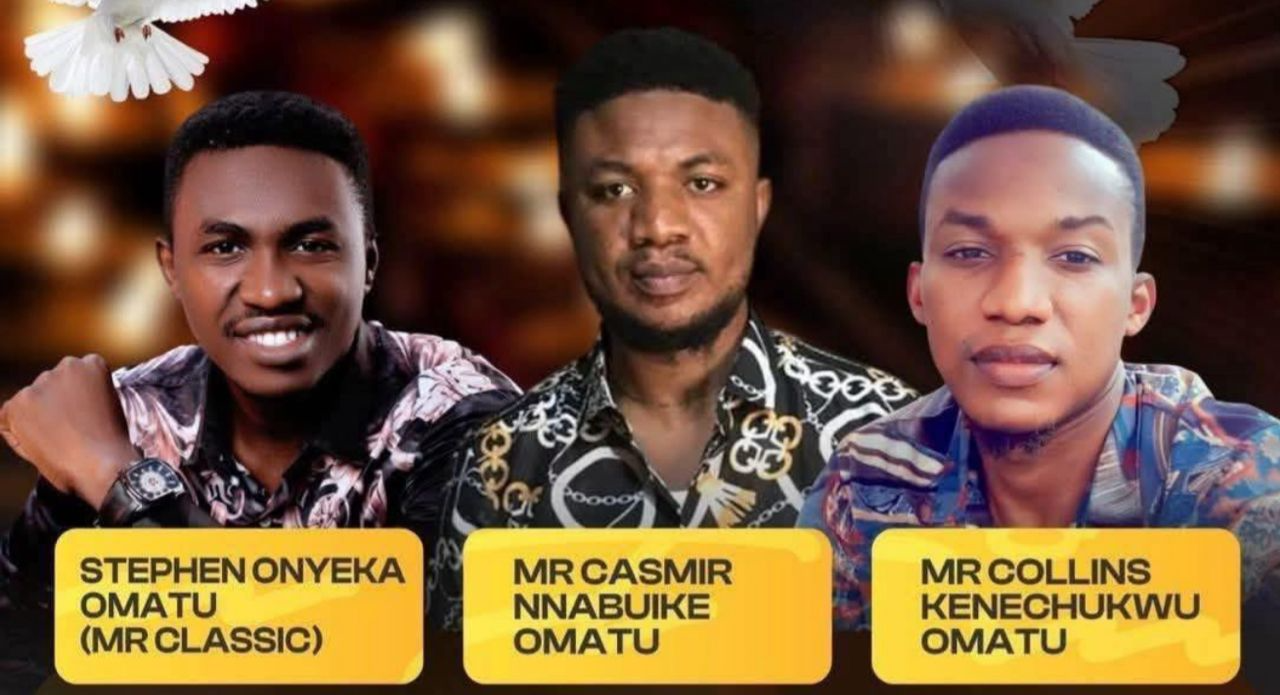
OKECHUKWU OBETA, who covered the burial of three brothers who were consumed by the fire that ravaged the Great Nigeria Insurance House in Lagos, reports that tears flowed from sympathisers and relations as the remains of the three victims were buried in Anambra a few days ago
The atmosphere in Nze Omatu Ikwuamaeze family house in Uzoakwa village, Ihiala local government area of Anambra state, on Wednesday, 14 January 2026, was, indeed, pathetic as hundreds of mourners gathered to bid farewell to three brothers of the family who lost their lives in the 24 December 2025 fire disaster that ravaged the Great Nigeria Insurance House in Lagos.
The mood among those who thronged into the sprawling family compound in their hundreds, most of whom dressed in black attire, was, indeed, that of deep sorrow and heavy heart.
Some even wailed, bore swollen eyes with tears flowing down their cheeks like running taps as the three caskets bearing the remains of the three brothers were placed in the family compound for the requiem Mass.
Mourners became more grieved and emotional when the eldest son of the family, a priest of the Catholic Church, Minna Diocese, Niger state, Rev. Fr. William Ugonna Omatu, narrated the tragic story of the demise of his three brothers in the 25-storey building, Great Nigeria Insurance House fire disaster.
The deceased brothers were Steve, aged 40, Casmir, aged 39, and Collins, a twin, aged 37. He said that it was possible that his three brothers and even other victims might have been saved if the Lagos state government had intervened early to save the situation. The Catholic clergy insisted that the Lagos State government, particularly the state government’s fire service, did not intervene when the inferno engulfed the Great Nigeria Insurance House. So, he called for a thorough probe into the fire disaster, describing it as a “national tragedy”.
He notably dismissed the superstition rumoured among some traditional worshippers in the town that it was a “curse” that claimed his three brothers.
It was gathered that it was firmly believed by some traditional worshippers that their late father, Polycarp Omatu, a Knight of St John International, refused to make a sacrifice to a deity in the community, so they believe that the deity, popularly known as “Ogwugwu”, caused the untimely death of the three sons as revenge.
But, Rev. Fr. Williams dismissed the insinuation with a wave of the hand, saying that the superstition “does not hold any water”, arguing, “My three brothers were not the only ones who died; there were others who died”. He narrated the sad story of the death of his three brothers in an interview, saying, “It (the death of his three brothers) is a national tragedy. It is so unfortunate that the world is not aware of what happened to my three brothers, and not only my three brothers, but many other souls perished in the Great Nigeria Insurance House on the 24th of December, 2025.
“I want the media to find out what happened. It is said that injustice done to one is to all. How must souls be there languishing on 24 December, and the Lagos state government could not provide fire service to rescue Nigerians who were there? It was too unfortunate. And it is my wish that this will never happen to anyone again.”
The clergy argued that the fire raged with the trapped victims for more than one week, from 24 December to 31 December, and the Lagos state government could not do anything to rescue the victims. “What kind of government do we have?” he asked. The clergy continued, “Let the whole world know what is going on in Ihiala, Anambra state, those three brothers: Steve, Casmir, and Collins Omatu – they were my younger brothers, they were victims of what happened on 24 December 2025.
“I am speaking for others who also lost their lives because nobody is speaking for them; I am a priest, and, by virtue of my ordination, I am bound to speak on justice for those who cannot speak for themselves. So, I want the media to find out what happened there. Let there be research, let there be a documentary on what happened on 24 December 2025. It shouldn’t be swept under the carpet”, Rev. Fr. Omatu advised.
An uncle to the deceased three brothers, who said that he was an eyewitness to the Great Nigeria Insurance House fire disaster, Chief Basil Bobity Ndedigwe alleged that it was the Lagos state government’s nonchalant disposition toward the fire disaster that made it impossible for some of the victims to be rescued.
He said that immediately after the state governor, Babajide Sanwo-Olu, visited the fire disaster site, government agents cordoned off the area.
Narrating the story of the fire incident in an interview on the sidelines, shortly after the three brothers were interred, Ndedigwe said, “I was there live. The most important thing that got me annoyed is that when the Lagos state governor, Babajide Sanwo-Olu, arrived, they did not allow us to go there to explain certain things.
“And the announcement is what baffled me most. He (Gov. Sanwo-Olu) said there were no casualties. And after two days, when they were bringing out some corpses, they (agents of the government) refused that the corpse be videoed.
“They said, ‘If you video it (the corpses), what will you say when the governor has said that there was no casualty?’ So, if you are carrying it and the police stop you and ask you where you are carrying the corpse from, where will you say you are holding the corpse from?”
He expressed grave regret that when he was eventually allowed entry into the scene of the fire disaster, even the skeletons of his three nephews had turned into ashes. So, all he could do was to take the ashes for burial at home. He said that the government agents only allowed him access to the burnt building more than a week after.
Emotions deepened in the mourners at the sight of the children and widows of the deceased when they were being helped to the graveside to perform the burial rites of throwing sand into the grave. Their sights, indeed, provoked heavy hearts as many mourners wailed and rained curses on whosoever had a hand in the circumstance that caused the lives of the three brothers.
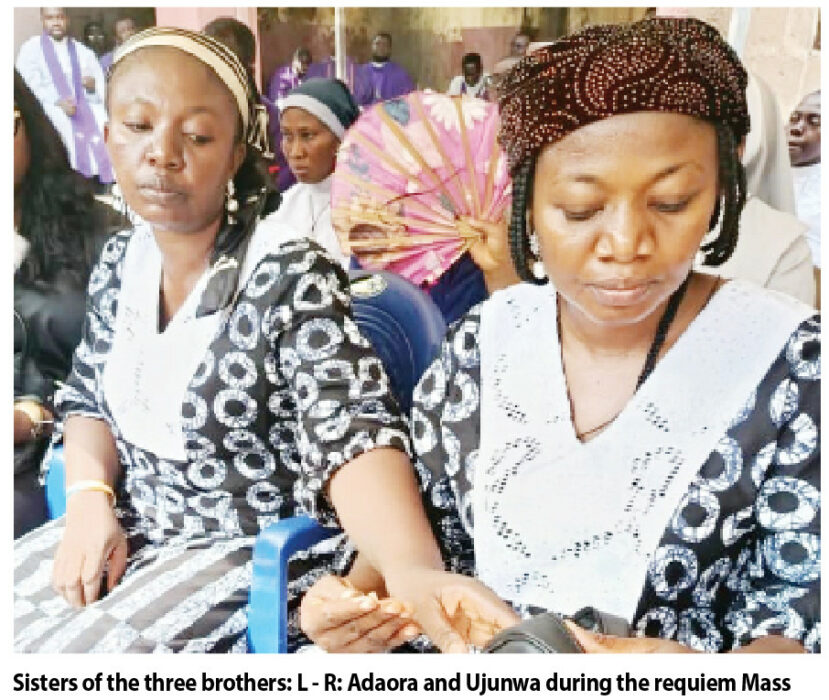
Steve left behind a widow and three children: first, two daughters, Ifunanya, aged 7, and Chukwunonyerem, aged 5, and the last child, a boy, Somtochukwu, aged 1. Casmir, according to one of their uncles, who also said that he lived in Lagos with the deceased’s three brothers, left a pregnant widow. Their third brother, Collins, a twin, has not been married. According to tradition, his twin brother, Ugochukwu, was absent from the burial ceremony. He was not allowed to see the remains of his twin, even as his casket was being lowered into the grave. Their parents, Sir Polycarp Omatu and his wife, Lady Juliana, have also already joined their ancestors some years ago. With the demise of their three children, those left in the family are the priest, Rev. Fr. William Omatu, who is, incidentally, the first male child, but second child, after Adaora (first child), Ujunwa (third child), and Ugochukwu, the last child. Adaora and Ujunwa are already married. So, Fr. William and Ugochukwu are left to care for the two widows and children of their deceased brothers.
However, a former Anambra State governor, Mr Peter Obi, who visited the bereaved family, consoled them and promised to maintain a close relationship with them. He told them that he shared in their pain over the tragic demise of their family members. The Chairman of Ihiala local government, Hon. Anayochukwu Ojiakor, said that he was mandated by the state governor, Prof. Chukwuma Soludo, to represent him at the funeral. He promised that his local government would do everything within its power to support the bereaved family of the three deceased brothers.
But as far as Fr. William and the homilist during the requiem Mass, spiritual director of Upper Room Ministry, Enugu, Rev. Fr. Anthony Nnaji, are concerned, “God does not abandon orphans”. They expressed strong faith that God will always cater for the widows and orphans. For instance, Fr. William, referencing the Bible passage, said, “In Job chapter 19:25, Job said ‘I know that my redeemer liveth’. And in Romans 8:37, it is said ‘in all these things we are more than conquerors’”. “What we have today is by the grace of God. The sustenance of the two widows, children, and my siblings is in the hands of God,” Fr. William said. Fr. Nnaji was emphatic that God knew about the tragedy that befell the three brothers. He particularly cautioned those making negative comments about their death to desist, warning that such statements could be a reason for such people to be condemned to hellfire on their last day. “God does not tell anyone when He will come for him or how He will come for him,” Fr. Nnaji admonished.
Similarly, the president of the Ihiala indigenous priests and religious, Rev. Fr. Desmond Ebulue, a Redemptorist priest, dismissed the superstition being alluded to as the cause of the tragic death of the three brothers. He said that though their death was a tragedy, as Christians, they were not subject to any deity. The Vicar-General of the Minna Diocese, Rev. Fr. Tadeus Umaru, represented the Bishop at the requiem Mass attended by 47 Catholic priests and over 20 Reverend Sisters.
Chinedu said that he got the worst beating of his life from soldiers and police personnel when he attempted to go to the scene of the fire disaster to see if he could rescue his three trapped nephews. Chibuzo Mbachi, a trader at the Balogun Market, dealing in ladies’ wear and T-shirts, said that he lost goods worth over N70 million to vandals who invaded the market. He lamented that, even though security agencies and other agents of the Lagos state government prevented them from entering the market to retrieve their goods, the thieves still carted them away.
“I want to plead with the Lagos state government to come to our help. In such a market, we are supposed to have a functional fire service station. I lost between N70 million and N78 million. I deal in ladies’ wear and T-shirts. As we were running away, because security people were chasing us away, thieves were carting away our goods,” Mbachi lamented.
FOLLOW US ON:





2027: Wike To Lead Campaign Team For Tinubu’s Re-election

Tinubu Makes Demands From Nigerians Over 2027 Election

PHOTOS: Full List Of Children Of Ex-Presidents, Govs, Lawmaker Seeking NASS Seat

‘Sleeping Prince’ of Saudi Arabia dies after 20 years in coma

2027: Atiku delays ADC membership card collection amid rumoured Jonathan comeback

How A Class Of 24 Students Produced 2 Presidents, 4 Governors, 2 Ministers, 4 Emirs, 3 Justices, 4 Ambassadors and Other Influential Leaders


-

 Politics6 hours ago
I’ll never abuse Tinubu, he has my respect – Peter Obi
-
News6 hours ago
Court rejects suit seeking fresh police investigation into late singer Mohbad’s death
-
Crime5 hours ago
PHOTOS: Police arrest suspect over de@th of Delta Education Director; launch manhunt for fleeing suspects
-
Politics4 hours ago
PHOTOS: Full List Of Children Of Ex-Presidents, Govs, Lawmaker Seeking NASS Seat
-
Crime5 hours ago
PHOTOS: Police arrest suspected child trafficker, rescue two-month-old baby in Niger State
-
News6 hours ago
VIDEO: Police identify officer in viral video saying Obi can never be President
-
Lifestyle17 hours ago
Many Parents Nowadays Are Failing to Give Their Children Proper Home Training — Why?
-
Politics4 hours ago
Tinubu Makes Demands From Nigerians Over 2027 Election