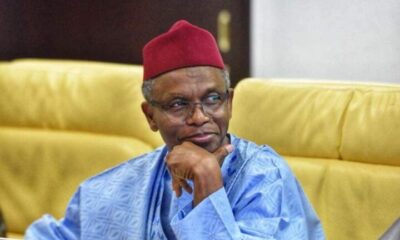
The Independent Corrupt Practices and Other Related Offences Commission (ICPC) on Tuesday arraigned former Kaduna State Governor, Nasir El-Rufai, before the Federal High Court in Kaduna after 38 days in detention over alleged corruption-related offences.
El-Rufai was brought before Justice Rilwan M. Aikawa on a 10-count charge bordering on alleged conversion and possession of public property as well as money laundering.
The court subsequently fixed March 31, 2026, to hear pending applications, including a bail request by the former governor.
Counsel for El-Rufai, Ubong Akpan, who spoke with journalists after the proceedings, described the charges as largely relating to alleged deposits into his client’s domiciliary account and the monetisation of his earnings.
“Out of 10 counts, they joined him on only one,” Akpan said.
He disclosed that the defence raised objections to the arraignment on the grounds of a pending matter involving the presiding judge, but noted that the court proceeded regardless.
“What we have now is that they applied to arraign, and I respectfully pointed out that since Malam El-Rufai has a pending proceeding with respect to the judge himself, the court cannot proceed. However, the judge, in his wisdom, decided to go ahead with the arraignment,” he said.
Akpan added that the court adjourned the case to March 31 to take all pending applications.
Clarifying the issue of bail, the lawyer said no application was made during Tuesday’s proceedings.
“It cannot be made for bail today because the application was made for arraignment today. It was adjourned to the 31st of this month to hear the application for bail,” he explained.
The defence counsel also said he was unaware of other pending cases against his client until formally served. Meanwhile, the ICPC legal team declined comments when approached by journalists after the court session.
Son, supporters back ex-governor
Speaking after the adjournment, a member of the House of Representatives representing Kaduna North, Bello El-Rufai, described his father as the “father of modern Kaduna,” citing infrastructural development during his tenure.
“I’m here in solidarity as his son and as a representative of the people. Malam El-Rufai, to us, is the father of modern Kaduna. We believe in the judicial process and the rule of law,” he said.
Supporters of the former governor thronged the court premises, chanting solidarity slogans and expressing confidence in his eventual acquittal.
One of them, Suleiman Ibrahim Dabo, described the charges as politically motivated.
“Malam Nasir El-Rufai is an exceptional leader. The charges are an exercise in futility. There is no evidence, and this is a political witch-hunt. He will emerge victorious,” he said.
Dabo also criticised the involvement of security agencies, including the Department of State Services, alleging rights violations.
He lamented that the former governor spent the Ramadan period in custody without access to his family, describing the situation as contrary to democratic norms.
“We claim to operate a constitutional democracy, yet fundamental human rights are being disregarded. Detaining someone without a timely arraignment suggests an emerging culture of autocracy,” he said.
Heavy security, restricted access
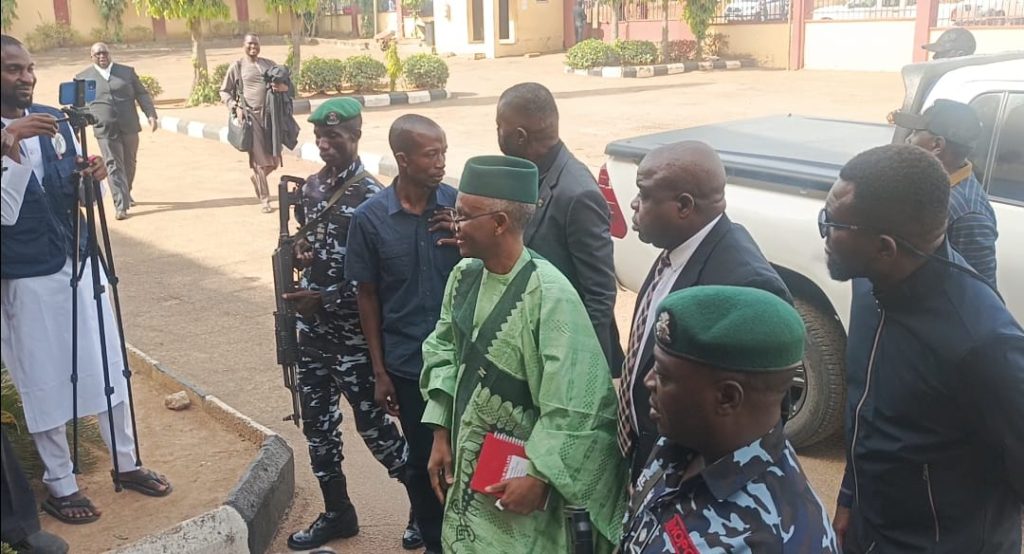
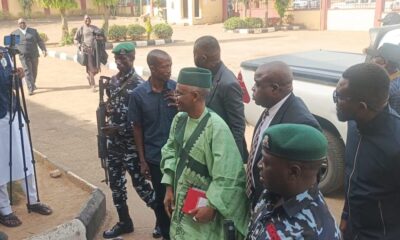
Security was significantly heightened around the Federal High Court, located at the old Nigerian Defence Academy, ahead of the arraignment.
Operatives of the DSS, Nigeria Police Force, Mobile Police, and the Nigeria Security and Civil Defence Corps were deployed to strategic points as early as 7:00 a.m.
Vehicular movement was restricted along the Ungwan Sarki–Kawo axis, forcing motorists into a single lane and causing traffic disruptions.
El-Rufai arrived the court premises at about 9:00 a.m. in a Hilux vehicle and remained inside for over 30 minutes before being escorted into the courtroom at approximately 9:34 a.m. under heavy security.
Journalists were barred from accessing the courtroom by security operatives.
Multiple Charges Filed
In a statement issued earlier, the ICPC said the former governor was arraigned alongside one Joel Adoga in suit number FHC/KD/73/2026.
It added that a separate charge had also been filed against El-Rufai and one Amadu Sule before a Kaduna State High Court, bordering on abuse of office, fraud, and conferring undue advantage.
The commission maintained that the charges were filed on March 18, 2026, and that the defendant had been duly served in line with due process.
The arraignment followed weeks of controversy surrounding El-Rufai’s detention, which began with his arrest by the Economic and Financial Crimes Commission on February 16 before he was granted bail and subsequently re-arrested by the ICPC.
The case has continued to draw reactions from political stakeholders and civil society groups, many of whom have called for adherence to due process and respect for the rule of law.
punch.ng
FOLLOW US ON:
FACEBOOK
TWITTER
PINTEREST
TIKTOK
YOUTUBE
LINKEDIN