
Connect with us

News

Lucky soul. He d!ed in Jihad – Sheikh Gumi reacts to Iran’s Supreme leader Khamenei’s d3ath

Published

on

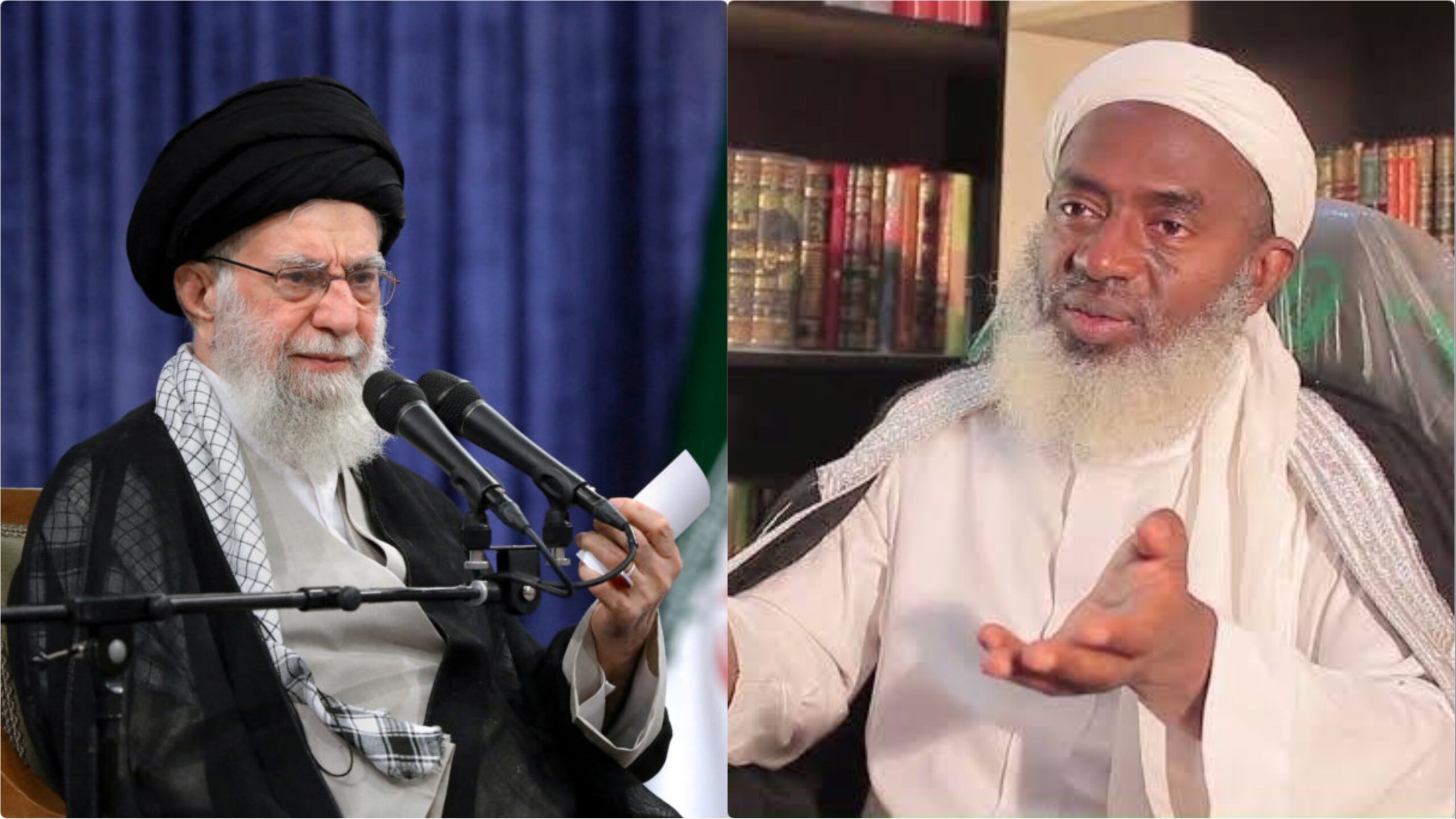
Kaduna-based Islamic scholar, Ahmad Gumi has reacted to the k!lling of Iran’s Supreme leader, Ayatollah Ali Khanenei, describing him as a “lucky soul who d!ed in Jihad.”

Khanenei was k!lled by US and Israeli missiles in Tehran on Saturday, February 28, 2026.

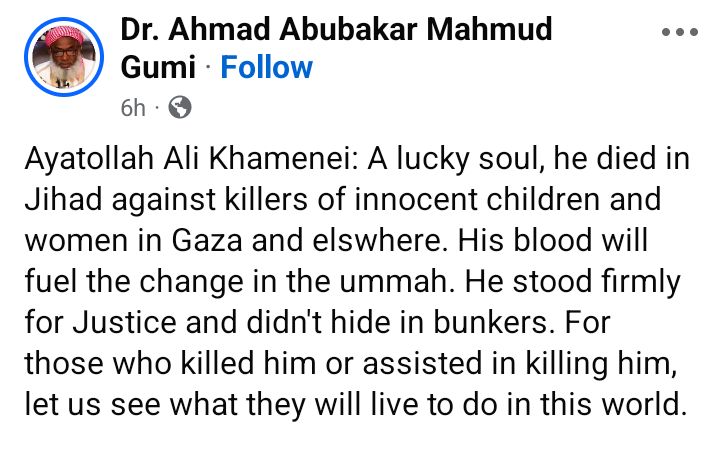
In a post shared on his verified Facebook page, Gumi said Khamenei’s blood “will fuel the change in the ummah.”

“A lucky soul, he d!ed in Jihad against k!llers of innocent children and women in Gaza and elsewhere,” Gumi wrote.

He added that the late Iranian leader’s blood “will fuel the change in the ummah,” noting that Khamenei “stood firmly for justice and didn’t hide in bunkers.

“For those who k!lled him or assisted in killing him, let us see what they will live to do in this world.”

FOLLOW US ON:

FACEBOOK

TWITTER

PINTEREST

TIKTOK

YOUTUBE

LINKEDIN

TUMBLR

INSTAGRAM

See also  Nigerians languish in prisons as Ethiopia stalls repatriation MoU
Continue Reading
Click to comment

Leave a Reply

Your email address will not be published. Required fields are marked *

News

Court adjourns Emefiele’s case till May 4 following heated legal arguments

Published

on

Justice Rahman Oshodi of an Ikeja Special Offences Court on Friday adjourned till May 4, 2026, to deliver a ruling on the admissibility of an extra-judicial statement made by Henry Omoile, a co-defendant in the trial of former Central Bank of Nigeria Governor, Godwin Emefiele.

The judge fixed the date for the ruling after counsel for both the prosecution and defence adopted their final written addresses in a trial-within-trial focused on whether the statement was voluntarily made.

Emefiele is facing a 19-count charge bordering on alleged gratification, corrupt demands, and abuse of office tied to financial transactions, while Omoile is standing trial on a three-count charge over the alleged unlawful acceptance of gifts in connection with CBN-related dealings.

The prosecution alleged that the transactions involved about $4.5bn and N2.8bn.

While arguing on behalf of the second defendant, Adeyinka Kotoye, (SAN), told the court that the crux of the matter is the voluntariness of the statement.

“The issue before this court is whether the statement credited to the second defendant was made voluntarily,” he said.

Kotoye argued that the process of obtaining the statement breached Sections 9(3) and (4) of the Administration of Criminal Justice Law (ACJL) and Sections 17(1) and (2) of the Administration of Criminal Justice Act (ACJA).

“In situations where voluntariness is contested, video recording of the interrogation is essential. It is the most reliable way to establish compliance with due process,” he submitted.

He further faulted the prosecution for failing to provide independent evidence to support the alleged confessional statement and questioned the role of the lawyer said to have been present.

See also  Nigerians languish in prisons as Ethiopia stalls repatriation MoU

“The mere presence of a legal practitioner is not enough where that counsel was unable to effectively discharge his duty,” Kotoye argued, adding that the statement may have been influenced by coercion or inducement.

Counsel to the first defendant, Olalekan Ojo, (SAN), also urged the court to discountenance the statement.

“Any doubt regarding the voluntariness of a statement must be resolved in favour of the accused,” Ojo said.

Citing Section 29(2) of the Evidence Act, he added, “A statement obtained through oppression, inducement, or improper means is inadmissible, and the prosecution has failed to prove otherwise.”

He maintained that the burden rests on the prosecution once voluntariness is challenged.

“The prosecution has not discharged this burden, particularly in light of the circumstances surrounding the making of the statement,” he said, noting that key aspects of the defendant’s testimony were not challenged.

But the Director of Public Prosecutions of the Federation, Rotimi Oyedepo (SAN), urged the court to admit the statement in evidence.

“The first defendant’s counsel cannot challenge the admissibility of a statement he did not object to when it was tendered. That amounts to an abuse of court process,” Oyedepo argued.

He insisted that the statement was obtained in line with the law.

“Though the statement was not video-recorded, it was made in the presence of the second defendant’s counsel,” he said.

Oyedepo also pointed to the contents of the statement as evidence of its voluntariness.

“The second defendant refused to implicate the first defendant and denied committing the alleged offences. That clearly shows he was not under any form of duress,” he submitted.

See also  Alleged Christian Genocide: US Congress split over Nigeria’s CPC designation

He dismissed claims of intimidation, stressing that the process was transparent.

“The statement was taken in the presence of several individuals, and the defendant was duly cautioned and voluntarily signed the cautionary form,” he added.

Following the submissions, Justice Oshodi adjourned the matter for ruling on May 4, 2026, and fixed June 26 and June 30, 2026, for the continuation of the substantive trial.

punch.ng

FOLLOW US ON:

FACEBOOK

TWITTER

PINTEREST

TIKTOK

YOUTUBE

LINKEDIN

Continue Reading

News

IPCR boss seeks adoption of national peace policy

Published

on

The Director-General of the Institute for Peace and Conflict Resolution (IPCR), Dr Joseph Ochogwu, has called for the urgent adoption and implementation of Nigeria’s National Peace Policy, warning that the country’s worsening security challenges require a coordinated and institutionalised response.

Speaking at the Second High-Level Expert Dialogue on the draft National Peace Policy on Friday in Abuja, Ochogwu said peace in Nigeria is “not a luxury but a foundational imperative,” stressing that the time had come to move beyond rhetoric to concrete action.

He emphasised that words must yield to architecture, noting that good intentions must be backed by robust systems, institutionalised coordination, and a clearly defined roadmap for implementation.

Ochogwu described Nigeria as being at a “defining crossroads,” citing persistent insecurity across regions, including insurgency in the North-East, farmer-herder clashes in the North-Central, separatist tensions in the South-East, and widespread banditry and kidnapping in the North-West.

According to him, the situation demands more than isolated interventions.

“What is urgently needed is an overarching framework that coordinates efforts across all tiers of government and ensures measurable, people-centred outcomes,” he stated.

He explained that the proposed National Peace Policy was designed to address gaps in Nigeria’s peacebuilding efforts, lamenting the absence of a unified framework to harmonise interventions by government agencies, civil society organisations, and development partners.

“Nigeria currently lacks a coherent, nationally owned policy that harmonises the multiplicity of conflict prevention, management, and peacebuilding interventions.

“The result has been duplication, resource wastage, institutional rivalry, and communities that fall through the gaps,” he said.

See also  Alleged Christian Genocide: US Congress split over Nigeria’s CPC designation

Ochogwu added that the policy would provide legitimacy for an integrated peacebuilding system, making interventions less “ad hoc” and more accountable within Nigeria’s governance structure.

He further noted that the framework would enable evidence-based decision-making and shift the country’s approach from reactive crisis management to preventive and strategic peacebuilding.

“It transforms peacebuilding from a reactive, crisis-driven enterprise into a strategic, preventive, and developmental pursuit,” he stated.

Highlighting the importance of coordination, he said peacebuilding must be mainstreamed across key sectors such as security, justice, education, and economic planning, rather than treated as a standalone initiative.

“Integration means ensuring that peacebuilding is mainstreamed across all sectors. Coordination requires a central architecture that maps who is doing what, where, and with what resources,” he explained.

He also underscored Nigeria’s alignment with global and regional peace frameworks, noting that the policy reflects commitments under the United Nations, African Union, and ECOWAS systems.

On implementation, Ochogwu warned that dialogue alone would not suffice, urging stakeholders to take ownership of the process.

“Dialogue without implementation is mere eloquence. We are here to generate the political will and inter-institutional consensus that will carry this policy from formulation to implementation,” he said.

He called on participants to act as “co-architects of Nigeria’s peace,” warning against bureaucratic delays and institutional rivalry.

“The time for a unified, integrated, and credible National Peace Policy is not tomorrow. The time is now,” he added.

Ochogwu further noted that the administration of President Bola Tinubu had created a fresh opportunity to actualise the long-delayed policy, stressing the need to avoid past setbacks.

See also  UK announces road closures, no-fly zones for Tinubu’s state visit

Describing the current peacebuilding landscape as fragmented, he warned that uncoordinated efforts had weakened impact.

“As we speak today, it’s a bit chaotic in terms of the approach. People are working in silos. The National Peace Policy provides an opportunity to harmonise all these efforts,” he added.

He also explained that the policy was being updated to reflect emerging threats such as banditry and climate change, noting that earlier frameworks no longer captured current realities.

“Society is dynamic; a lot of the things that were captured in 2012 have gone. Now we’re talking about issues around banditry, climate change, and several other new dynamics,” he said.

He disclosed that stakeholders were co-developing an implementation framework to be presented to the Federal Executive Council for approval.

Beyond policy, the IPCR boss urged the political class to embrace issue-based politics ahead of future elections, warning against divisive rhetoric.

“We must stop divisive politics. Democracy is to serve the people and to promote peace, not to create division and, at the end of the day, promote violence,” he stated.

The draft National Peace Policy traces its origins to a 2012 initiative aimed at establishing a comprehensive framework for conflict prevention, management and peacebuilding in Nigeria.

However, the policy was not approved at the time, despite its broad objectives to address recurring inter-group conflicts, establish a National Peace Commission, and create sustainable “infrastructure for peace” involving both government institutions and civil society actors.

The renewed push for the policy comes amid growing security challenges and evolving conflict dynamics, which stakeholders say have outpaced the provisions of the original draft.

See also  Electoral Act Amendment: Opposition protests as senators back manual results transmission

While the 2012 framework laid important groundwork, current realities have necessitated a review and update of the policy, which seeks not only to revive the stalled initiative but also to strengthen it into a more responsive and implementable national framework capable of addressing Nigeria’s complex, changing peace and security landscape.

punch.ng

FOLLOW US ON:

FACEBOOK

TWITTER

PINTEREST

TIKTOK

YOUTUBE

LINKEDIN

Continue Reading

News

US ambassador posts vacant in Nigeria, 116 countries – Report

Published

on

The United States ambassadorial positions in Nigeria and 116 other countries are currently vacant, reflecting a broader diplomatic gap affecting countries across different regions of the world, according to official records released by the US Department of State.

The document, published on April 8, 2026, via the US Department of State’s website and titled “Ambassadorial Assignments Overseas” by the Office of Presidential Appointments, showed that Nigeria is among 117 countries yet to have a Senate-confirmed US ambassador.

The document was obtained by our correspondent on Thursday.

The affected countries spread across Africa, Europe, Asia, the Americas and Oceania.

In Africa, the vacancies exist in countries including Algeria, Angola, Benin, Burundi, Cabo Verde, Cameroon, Central African Republic, Chad, Comoros, Democratic Republic of the Congo, Côte d’Ivoire, Egypt, Eritrea, Eswatini, Gabon, The Gambia, Ghana, Guinea, Guinea-Bissau, Kenya, Lesotho, Liberia, Libya, Madagascar, Malawi, Mauritania, Mauritius, Mozambique, Niger, Nigeria, Republic of the Congo, Rwanda, Sao Tome and Principe, Senegal, Seychelles, Sierra Leone, Somalia, Sudan, Tanzania, and Togo.

Across Europe, the list includes countries such as Albania, Belarus, Bosnia and Herzegovina, Bulgaria, Germany, Hungary, Iceland, Kosovo, Moldova, Montenegro, North Macedonia, Norway, Russia, Serbia, the Slovak Republic, Slovenia and Ukraine.

In Asia and the Middle East, those affected include Afghanistan, Armenia, Azerbaijan, Burma, Cambodia, Indonesia, Iraq, the Republic of Korea, Kuwait, Laos, Malaysia, Maldives, Nepal,  Pakistan, Philippines, Qatar, Saudi Arabia, Sri Lanka, Syria, Tajikistan, Timor-Leste, United Arab Emirates and Vietnam.

In the Americas, the vacancies extend to countries such as Antigua and Barbuda, Barbados, Belize, Bolivia, Brazil, Colombia, Cuba, Commonwealth of Dominica, Ecuador, El Salvador, Grenada, Guatemala, Haiti, Honduras, Jamaica, Nicaragua, Paraguay, Saint Kitts and Nevis, Saint Lucia, Saint Vincent and the Grenadines, Suriname, Trinidad and Tobago and Venezuela.

See also  Nigerians languish in prisons as Ethiopia stalls repatriation MoU

Meanwhile, in Oceania, several island nations are also without confirmed US ambassadors, including Australia, the Cook Islands, Fiji, Kiribati, the Marshall Islands, Nauru, New Zealand, Niue, Papua New Guinea, Samoa, the Solomon Islands, Tonga, Tuvalu, and Vanuatu.

This development followed earlier diplomatic changes reported in December 2025, when the administration of President Donald Trump recalled nearly 30 career diplomats from ambassadorial and senior embassy positions worldwide.

According to a report published in The Guardian, attributing it to AP, the move affected mission chiefs in at least 29 countries, including 15 in Africa.

The recalls were part of efforts to reshape US diplomatic representation in line with the administration’s foreign policy priorities.

Although such envoys typically serve at the pleasure of the president, the large-scale withdrawals raised concerns about gaps in the US diplomatic presence globally.

punch.ng

FOLLOW US ON:

FACEBOOK

TWITTER

PINTEREST

TIKTOK

YOUTUBE

LINKEDIN

Continue Reading

Trending