Connect with us

Business

Nigeria, UK seal £746m deal to redevelop Tin Can, Apapa ports

Published

on

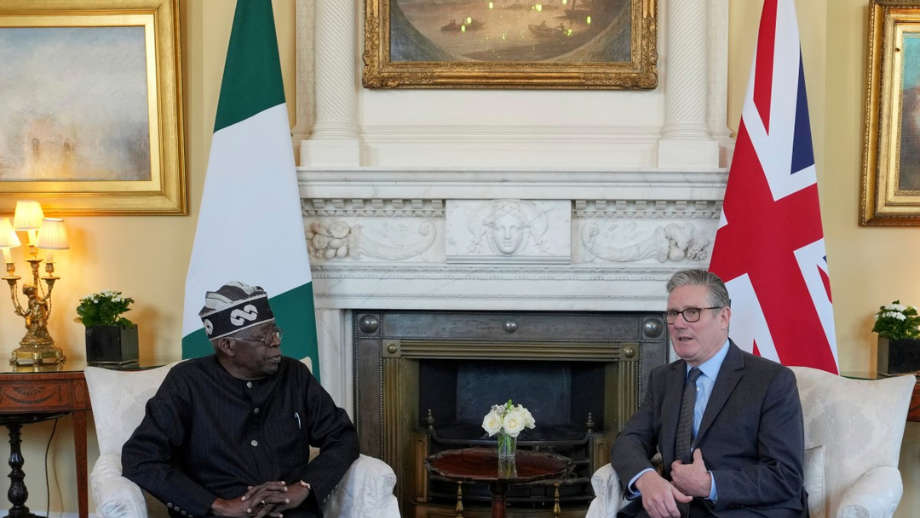
Nigeria and the United Kingdom have signed a £746 million export finance deal to support the redevelopment of Lagos’ Apapa and Tin Can Island port complexes.

UK Prime Minister Keir Starmer stated this during a bilateral meeting with President Bola Tinubu at 10 Downing Street on the second day of the Nigerian leader’s historic state visit to Britain.

“Today is the opportunity to take that to another level with the agreements that we’ve been able to reach on exports, and I think that shows we can go even further than we’ve already gone,” he stated.

Tinubu, in his remarks, revealed that Nigeria is currently undergoing “very strong reform of the economy” and linked the terrorism challenges facing West Africa to climate change conflict.

“We need more trade agreements and economic relationships that we build between nations. Nigeria is currently going through a very strong reform of the economy,” Tinubu said.

The President described Nigeria as facing significant challenges, stating, “The largest country in West Africa, and on the continent, is challenged by terrorism coming from the conflict of climate change.”

Tinubu emphasised that both countries face global economic challenges, noting, “Currently, the entire world is challenged. Nigeria is not immune. Britain is not immune.”

He said the discussions focused on the “economic welfare of the people and how we can work together to improve livelihood” amid economic volatility.

The President affirmed that Thursday’s bilateral discussions would address what Britain can do to “accelerate the friendship, partnership and collaboration” between both nations.

See also  Fuel distribution controversy: Dangote restores marketers amid mounting pressure

On his part, Starmer described the visit as historic, noting it was the first inward state visit for 37 years by a Nigerian leader.

“The long and shared history between our countries is obvious and much valued, as is the people-to-people contact and engagement that enriches lives here in the United Kingdom,” he said.

He noted that both countries already collaborate on economy, defence, and security matters but expressed determination to deepen the partnership.

“Today is the opportunity to take that to another level with the agreements that we’ve been able to reach on exports,” he stated.

Speaking before the meeting,  Tinubu said discussions with the UK government would focus on “trade, economic cooperation, and shared challenges — including security and climate change.”


The Minister of Marine and Blue Economy, Adegboyega Oyetola, also said the port redevelopment would strengthen Nigeria’s role in regional trade.

He said, “This project will strengthen Nigeria’s position as a leading maritime hub in West and Central Africa.”

PUNCH Online reports that Tinubu’s state visit to the UK began on Wednesday, following an invitation from Their Majesties King Charles III and Queen Camilla at Windsor Castle.

The visit also includes plans to sign a Memorandum of Understanding to deepen trade and investment ties between the two countries.

Tinubu was accompanied by a high-profile delegation, including Senate President Godswill Akpabio; Attorney General and Minister of Justice, Prince Lateef Fagbemi; Minister of Solid Minerals, Dele Alake; Minister of Information and National Orientation, Idris Mohammed; and Minister of State for Foreign Affairs, Ambassador Bianca Ojukwu.

See also  Schools, markets open as IPOB ends Monday sit-at-home

Other members of the delegation include Minister of Finance and Coordinating Minister of the Economy, Wale Edun; Minister of Industry, Trade and Investment, Dr. Jumoke Oduwole; Minister of Culture and Creative Economy, Hannatu Musawa; Minister of Communications and Digital Economy, Bosun Tijani; Minister of Defence, Gen. Christopher Musa; National Security Adviser, Malam Nuhu Ribadu; and Director-General of the National Intelligence Agency, Mohammed Mohammed.


punch.ng

FOLLOW US ON:

FACEBOOK

TWITTER

PINTEREST

TIKTOK

YOUTUBE

LINKEDIN

Continue Reading
Click to comment

Leave a Reply

Your email address will not be published. Required fields are marked *

Business

Dangote denies rift with Elumelu, funding claims

Published

on

The Dangote Group has dismissed as false and malicious claims of a rift between its President, Aliko Dangote, and the Chairman of Heirs Holdings, Tony Elumelu, and also rejected allegations that he (Dangote) solicited support for financing his refinery project.

In a statement issued on Sunday, the group described as “entirely baseless” a publication stating that Dangote had revealed why he distanced himself from Elumelu, stressing that neither the businessman nor the organisation made such remarks.

The statement, signed by the Group Chief Branding and Communications Officer, Anthony Chiejina, said the report misrepresented both personal and corporate positions and added that there was no disagreement between the two prominent business leaders.

“The Dangote Group has become aware of a publication titled ‘Aliko Dangote Speaks Out on Why He Distanced Himself from Tony Elumelu’, which is false, malicious, and baseless. At no time did the President or the Group make such statements or express such sentiments,” the statement read in part.

The company further dismissed claims that the multi-billion-dollar Dangote Petroleum Refinery & Petrochemicals was financed through personal borrowing from friends, describing such assertions as inaccurate and a deliberate misrepresentation of facts.

According to the group, Dangote does not fund projects through informal personal loans, noting that any such claims should be backed by verifiable evidence.

“As a matter of principle, Aliko Dangote neither finances his projects through personal borrowing from friends nor engages in lending arrangements of that nature. Any individual making such claims should provide verifiable evidence to substantiate them,” the statement added.

See also  Flight fury: Inside story of KWAM 1, Emmason’s pardon

The group also clarified that there was no strain in the relationship between Dangote and Elumelu, maintaining that both men continue to enjoy a longstanding and cordial relationship despite the claims circulating in the report.

The clarification follows the circulation of a widely shared online post which alleged that Dangote fell out with Elumelu after a failed financial assistance request during the construction of the refinery.

In the post, attributed to Dangote but now disowned by the company, the author claimed that in 2021, when the refinery project was about half-completed, he ran out of funds and approached several business associates for support, including Femi Otedola, Abdulsamad Rabiu, Mike Adenuga, and Elumelu.

The post further alleged that Elumelu promised $20m but later became unreachable, while other associates reportedly raised $500m to support the project, with Otedola said to have contributed $300m.

However, the Dangote Group said such claims were fabricated and should not be attributed to its president, reiterating that the financing narrative presented in the post was false.

Beyond the disputed publication, the company raised concerns over what it described as a growing trend of fabricated statements and the unauthorised use of Dangote’s identity in digitally manipulated content.

It warned that the misuse of his name, likeness, and image in artificial intelligence-generated advertisements and other misleading materials poses reputational risks and could amount to fraud.

“Furthermore, the group notes with concern a rising pattern of fabricated statements and the unauthorised use of Aliko Dangote’s name, likeness, and image in AI-generated advertisements and other misleading content. These actions amount to reputational harm and potential fraud,” the statement said.

See also  PENGASSAN fires back as Shettima defends Dangote

The company cautioned individuals, organisations, and platforms involved in creating or disseminating false information to desist immediately, warning that it would not hesitate to pursue legal action where necessary to protect its reputation and that of its leadership.

The Dangote Group reaffirmed its commitment to maintaining high standards of integrity while continuing its industrial and economic contributions across Africa, particularly in advancing self-sufficiency and sustainable development.

punch.ng

FOLLOW US ON:

FACEBOOK

TWITTER

PINTEREST

TIKTOK

YOUTUBE

LINKEDIN

INSTAGRAM

Continue Reading

Business

States, FCT external debt nears $5.7bn amid higher FAAC

Published

on

Thirty-two states and the Federal Capital Territory’s debt rose to nearly $5.7bn in fresh external loans in 2025, driving a year-on-year surge in subnational foreign debt despite higher inflows from Federation Account Allocation Committee disbursements, an analysis by The PUNCH has shown.

Data from the Debt Management Office indicated that the combined external debt stock of the 36 states and the FCT increased from $4.80bn as of December 31, 2024, to $5.68bn as of December 31, 2025, reflecting a net increase of $884.66m, or 18.43 per cent year-on-year.

A breakdown of the data showed that 33 out of the 37 subnational entities recorded increases in their external debt positions during the period under review, representing 89.19 per cent of the total, while only four states posted declines, accounting for 10.81 per cent.

The scale of the increase shows a continued reliance on external financing by state governments amid fiscal pressures, infrastructure demands, and rising FAAC revenues.

Analysis of year-on-year movements revealed that total increases across the 32 states and the FCT amounted to $944.12m, while total reductions across the four states amounted to $59.46m. The net effect of these opposing movements resulted in the overall increase of $884.66m in the external debt stock.

This indicates that the modest declines recorded in a few states were insufficient to offset the widespread borrowing expansion across most states, with increases outweighing reductions by nearly 16 to 1.

The rise in indebtedness comes at a time when FAAC disbursements to states have improved considerably, fuelled by rising oil prices, gains from naira devaluation, and revenue freed up from petrol subsidy removal.

However, the figures suggest that rather than leveraging these inflows to reduce debt, some states are borrowing even more from foreign sources. The 32 states and FCT, which recorded a $944.12m increase in foreign loans, got about N1.36tn in naira terms using the exchange rate adopted by the DMO for 2025, which is N1,435.2571/$1.

Among the states that recorded declines were Edo, Rivers, Anambra, and Bayelsa. Edo posted the largest reduction, with its external debt falling by $29.02m, representing a 7.58 per cent decrease from $383.05m in 2024 to $354.03m in 2025.

Rivers followed with a decline of $28.69m, or 14.37 per cent, dropping from $199.58m to $170.90m. Anambra recorded a marginal decrease of $1.11m, while Bayelsa’s debt reduced slightly by $0.64m.

Despite these reductions, the overwhelming trend across states was upward. Several states recorded significant increases in both absolute and percentage terms, indicating aggressive borrowing patterns.

See also  Nigerians self-deport amid Trump’s deadly ICE raids

Katsina recorded one of the largest increases in absolute terms, with its external debt rising by $100.16m, nearly doubling from $100.46m in 2024 to $200.62m in 2025, representing a 99.70 per cent increase.

Kaduna also posted a substantial increase of $59.19m, bringing its total external debt to $684.29m, making it one of the most indebted states externally after Lagos.

Kogi’s external debt rose by $66.08m, representing a 126.07 per cent increase, while Niger recorded a $73.38m rise, more than doubling its debt stock with a 109.18 per cent increase. Plateau recorded the highest percentage increase overall at 187.24 per cent, with its debt rising by $60.24m.

Gombe posted one of the highest percentage increases at 168.70 per cent, with its external debt jumping by $55.67m from $33.00m to $88.66m. Benue also recorded a sharp increase of 128.16 per cent, while Yobe’s debt surged by 136.56 per cent, further highlighting the rapid pace of borrowing among several states.

Imo’s external debt rose by $45.64m, representing a 63.90 per cent increase, while Oyo recorded a $34.71m rise, translating to a 65.73 per cent increase. Sokoto’s debt increased by $42.92m, or 84.15 per cent, while Jigawa posted a 95.87 per cent increase, adding $22.38m to its debt stock.

At the lower end of the spectrum, Lagos, which remains the most externally indebted state, recorded only a marginal increase of $4.83m, representing 0.41 per cent growth from $1.17bn in 2024 to $1.17bn in 2025.

The relatively flat growth in Lagos’ external debt suggests a more cautious borrowing approach compared to other states, despite maintaining the largest debt stock.

Cross River’s debt rose by $20.46m to $222.92m, while Bauchi recorded an increase of $33.75m to $220.57m. Ogun’s external debt rose by $24.10m, while Ondo recorded an $8.25m increase.

In the South-East, Ebonyi’s debt rose by $16.94m, while Enugu recorded a $12.83m increase. Abia’s external debt also rose by $5.69m, representing a modest 5.61 per cent increase.

Adamawa posted a $26.03m increase, while Akwa Ibom’s debt rose by $19.90m, representing a 55.97 per cent increase. Delta recorded a $6.28m increase, while Ekiti saw a marginal rise of $1.73m, indicating relatively moderate borrowing activity in those states. The FCT also recorded an increase of $7.31m, representing a 37.53 per cent rise from $19.48m in 2024 to $26.80m in 2025.

Further analysis of the debt composition showed that the bulk of external loans were multilateral, with limited exposure to bilateral and other commercial sources, according to the DMO breakdown.

The sustained increase in external borrowing at the subnational level comes amid rising fiscal constraints, including higher recurrent expenditure and growing infrastructure financing needs, despite higher FAAC revenue.

The PUNCH earlier reported that FAAC allocations to states surged by over N2tn in 2025, according to an analysis of Federation Account disbursement data published by the National Bureau of Statistics and collated by The PUNCH.

See also  FG consultants begin workers’ verification Oct 16

The Federation Account disbursement data show that state governments received a total of N7.315tn from the Federation Account Allocation Committee in 2025, compared with N5.186tn in 2024. The year-on-year increase of roughly N2.13tn represents a jump of about 41 per cent in direct FAAC allocations to states.

When the constitutionally mandated 13 per cent derivation revenue is included, total inflows attributable to states rose to N8.934tn (about N9tn) in 2025, up from N6.533tn in 2024, an increase of N2.4tn or 36.74 per cent.

This surge came amid an increase in total FAAC distributions. Aggregate allocations to the three tiers of government, including derivation, rose from N15.259tn in 2024 to N21.897tn in 2025.

States therefore captured a substantial share of the overall increase, both in absolute terms and as a proportion of total federation revenues. Without the 13 per cent derivation component, states’ N7.315tn allocation in 2025 accounted for about 33.4 per cent of the N21.897tn total FAAC disbursement for the year, compared with roughly 34.0 per cent in 2024.

When derivation revenue is included, total state-linked receipts of N8.934tn represented about 40.8 per cent of total FAAC disbursements in 2025.

The PUNCH also reported that states paid N455.38bn in foreign debt service in 2025, up from N362.08bn in 2024, according to Federation Accounts Allocation Committee figures released by the National Bureau of Statistics and obtained and analysed by The PUNCH.

The year-on-year comparison indicated that subnational governments’ foreign debt deductions rose by N93.30bn, representing a 25.77 per cent increase in 2025 over the prior year.

In plain terms, states collectively lost a larger share of their FAAC inflows to external loan repayments and related obligations in 2025 than in 2024, tightening the fiscal space available for salaries, capital projects, and routine governance.

In a recent statement, the acting Director of Communication and Stakeholders Management at the Nigeria Extractive Industries Transparency Initiative, Mrs Obiageli Onuorah, noted that states face financial strain due to debt repayments, despite record-high disbursements from the Federation Accounts Allocation Committee.

According to the statement, a NEITI report showed that several states with high debt burdens also ranked lower in FAAC allocations, raising concerns about their fiscal sustainability and their ability to fund critical projects.

See also  NABTEB releases 2025 NBC/NTC results, records improved performance

“The report noted that many states with high debt ratios were in the lower half of the FAAC allocation rankings but ranked higher for debt deductions, raising concerns about their debt-to-revenue ratios and overall fiscal health,” the statement read.

Speaking recently on Channels Television’s Politics Today programme, the Country Director of BudgiT, Vahyala Kwaga, expressed concern that the more FAAC allocations go to states, the more disincentivised they appear to be to boost their internally generated revenue.

Kwaga further said that “Fiscal sustainability requires that states look inward, improving revenue systems, cutting waste, and prioritising infrastructure and human development investments that deliver long-term value.”

Analysts earlier told The PUNCH that continued reliance on foreign loans exposes states to even greater fiscal risks amid a weakening naira.

“Since most of the debts are dollar-denominated, every depreciation of the local currency automatically inflates repayment obligations, forcing states to channel a larger share of their revenues into debt servicing at the expense of development projects,” says a Professor of Economics at the Ekiti State University, Taiwo Owoeye.

Beyond repayment costs, Owoeye noted that heavy external borrowing also undermines states’ financial autonomy.

“By taking on more foreign obligations, many states risk mortgaging future federal allocations to meet repayment schedules, leaving them with little room to respond to emergencies or fund critical sectors such as health, education, and infrastructure,” he explained.

The Director and Chief Economist at Proshare Nigeria LLC, Teslim Shitta-Bey, warned that the rising debt burden on Nigeria’s subnational governments could challenge their fiscal stability in the coming years.

He stressed that most state governments, along with the Federal Government, had failed to effectively manage their balance sheets. Speaking recently to The PUNCH, Shitta-Bey said, “The challenge here is that most of the governments, including the Federal Government, are unable to manage their balance sheets properly. While borrowing might seem like an easy way to run operations, it is not necessarily the right approach.”

According to Shitta-Bey, borrowing should not be the default solution for governments. “Governments could consider longer-term debt structures that resemble equity, which might actually be more beneficial in the long run,” he explained.

A macroeconomic analyst, Dayo Adenubi, also emphasised the need for states to take more targeted steps toward boosting internally generated revenue as they grapple with rising debt obligations and constrained federal transfers.

punch.ng

FOLLOW US ON:

FACEBOOK

TWITTER

PINTEREST

TIKTOK

YOUTUBE

LINKEDIN

INSTAGRAM

Continue Reading

Business

Ikeja Electric reveals why Lagos is experiencing persistent power interruptions

Published

on

Ikeja Electric Plc has explained why Lagos is experiencing persistent power interruptions, linking the situation to reduced electricity allocation from the national grid.

In a statement posted on its official X handle on Friday, the electricity distribution company apologised for the outages and said the supply constraints were affecting several areas within its coverage.

“We sincerely regret the ongoing power supply challenges currently affecting some areas within our network due to reduced power allocation from the grid,” the company said.

To manage the shortfall, Ikeja Electric said it had introduced controlled rationing of supply, explaining that the step was necessary to maintain system stability and ensure fair distribution.

“As part of efforts to maintain grid stability and ensure equitable distribution of available power, temporary load shedding is being implemented across affected feeders and locations,” it stated.

The company also said it was engaging stakeholders in the power value chain to improve supply and limit the impact of the disruptions.

The development comes as electricity shortages persist across Lagos and other parts of the country, largely linked to gas supply issues affecting power generation nationwide.

The situation has continued despite recent efforts at the state level to reduce reliance on the national grid.

tribuneonlineng.com

FOLLOW US ON:

FACEBOOK

TWITTER

PINTEREST

TIKTOK

YOUTUBE

LINKEDIN

INSTAGRAM

See also  India, others reject Tinubu’s envoys, see why
Continue Reading

Trending