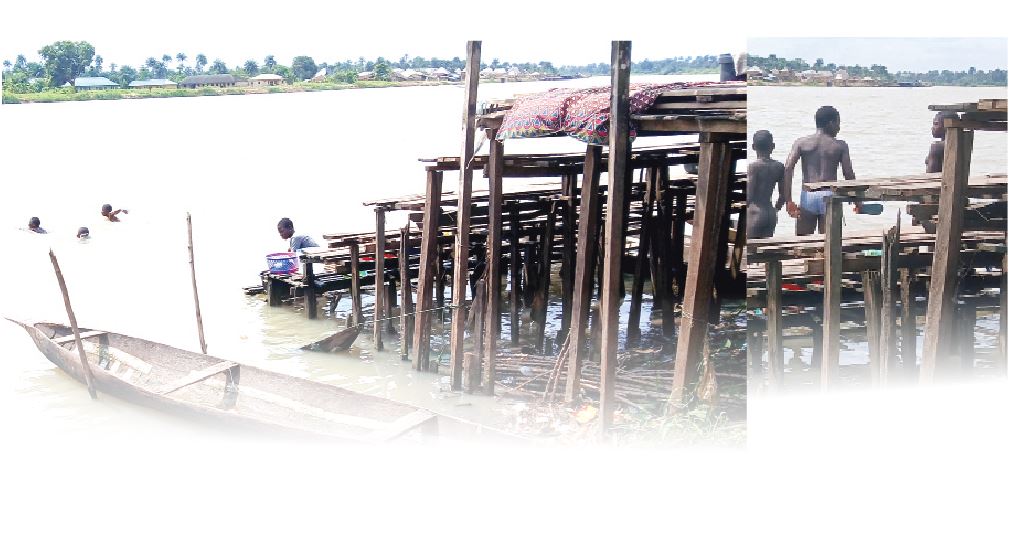
Torugbene, in Burutu Local Government Area of Delta State, is a remote riverine community where residents depend on a river contaminated with human waste for their daily water needs, exposing them to serious health risks. Amid reports of rising child deaths, deteriorating water infrastructure, and worsening climate pressures, the community’s plight underscores decades of unfulfilled government promises that have not translated into access to safe and potable drinking water, DANIEL AYANTOYE writes
A 26-year-old Adaobi Ogbemudia strapped her five-month-old son, Freedom, to her back and held tightly to a commercial motorcycle as it sped along the rough Torugbene–Bomadi road in a desperate attempt to save his life.
But midway along the battered stretch, the infant stopped breathing. He died before they could reach Bomadi General Hospital.
It was the third time Adaobi would be making that journey since his birth on October 1, 2025, in their home in Torugbene, Burutu Local Government Area of Delta State.
Barely a month after birth, Freedom began to experience continuous diarrhoea. Soon after, his fragile body developed widespread rashes, which Adaobi described as “pimples like chickenpox.”
“We kept taking him to the health centre. They gave him antibiotics and later referred us to Bomadi, where he was admitted for a week,” she told Saturday PUNCH, her voice breaking with grief.
Although Freedom’s condition improved briefly after treatment, the relief was short-lived. Within days of returning home, he began to vomit again.
On March 14, when the symptoms became severe, the toddler was rushed to the hospital, but he did not survive the journey.
Tears welled in Adaobi’s eyes as she said softly, “His death has emptied me.”
Her grief is not an isolated case.
In the same Torugbene community, 35-year-old Vivian Kiji is also mourning her one-year-old daughter, Peace, who died on April 8, 2026.
According to the infant’s mother, her body began to swell, and small rashes appeared.
“I noticed her body was swelling. I then took her to the clinic, but there was no improvement. They said it was a fever,” she said. Days later, the child died.
Findings by Saturday PUNCH show that these children, like many others in the community, were bathed and fed with water from the Torugbene River, a polluted stream that remains the community’s main source of water.
Worrisome situation in Torugbene
After several hours on a commercial motorcycle along the rough, sandy Bomadi–Torugbene road, the journey into the community feels like entering a forgotten settlement.
The farther one moves away from Bomadi, the more evident the signs of neglect become: waterlogged bushes, broken stretches of land, and stagnant creeks that cut off parts of the terrain.
By the time this reporter arrived, the atmosphere was calm, but the air carried a thick, humid earthiness mixed with the unmistakable stench of polluted water.
In Torugbene, life revolves around water, not from taps or boreholes, but from a slow-moving brown river that runs through the heart of the community and is increasingly affected by environmental and climate pressures.
The river is part of a wider network of creeks in the Niger Delta, linked to the Fokado River system that flows through the Burutu axis in Burutu LGA.
Through Torugbene, it connects to other waterways that lead toward Warri and neighbouring communities.
Along its banks, 14-year-old Tariere Kuro was seen sitting on a wooden staircase leading into the river. She leaned forward as she washed plates, dipping them into the river and lifting them out in a steady rhythm.
Nearby, already-washed plates and cups were arranged in a basket.
“This is where we wash plates and cloths,” she said, smiling.
For Kuro, the river is more than a water source; it is central to daily survival, used for cooking, washing, bathing, and even drinking.
Like many residents, she has grown up with complete dependence on it.
A few metres away, children played in another section of the river, splashing and laughing as they bathed. One of them alternated between bathing and fetching water, repeatedly filling yellow jerry cans after brief dips in the river.
One of them, identified simply as Aboy, said fetching water was part of his daily routine.
“I fetch water and also bathe before going home. I come here every day while my elder sister washes plates. She will come later,” he said.
When asked what the water would be used for, he replied, “We drink it and also cook with it.”
Nearby, another child carefully placed a bucket already filled with river water on a wooden stool, preparing to carry it home.
The brownish waterway, as observed by our reporter, appears darker in some stretches and is lined with floating debris, broken plastics, nylon bags, and fragments of household waste.
Yet, despite its visibly poor condition, it remains the community’s only reliable source of water and a vital lifeline.
Canoes glide across its surface, while children repeatedly throng the banks with empty buckets and jerry cans, returning home with water from the same contaminated source that sustains daily life.
Makeshift toilets on the river
Just a short distance from where residents fetch water and children bathe stands a cluster of makeshift toilets.
Constructed from rough timber and supported by slender poles, the structures hang precariously above the water and are divided into compartments.
Their frames are weak and weather-beaten, with sections enclosed by rusted zinc sheets, while others remain partially open, offering little or no privacy.
Beneath them, the stream flows steadily, carrying waste directly into its current. Only a few metres separate these facilities from the exact points where residents collect water for drinking and cooking.
In addition to human waste, Saturday PUNCH observed that household refuse is also routinely dumped into the stream due to the absence of an organised waste disposal system.
Community without borehole
For many residents, the lack of alternatives has turned what should be alarming into an accepted reality.
55-year-old Florence Akpule said the river is central to the community’s survival.
“In this village, this stream is very important to us. We drink, cook, wash and fish there,” she said.
Akpule, a fisherwoman, depends on the creek not only for domestic use but also for her livelihood.
Like many others in Torugbene, she spends long hours on the water setting nets and checking traps.
“This is how we have been living,” she said with a faint smile. When asked about the water quality, she acknowledged its contamination but stressed that there is no alternative.
“We know the water is not clean, but there is no other option. It has become part of our lives.”
She added that there were no functional boreholes in the community.
A visit to Torugbene confirmed this: there is no borehole or alternative clean water source for residents.
What should serve as a lifeline has instead become a persistent public health concern.
Across the Niger Delta, water contamination remains a recurring environmental crisis.
Unsafe water kills 829,000 yearly
Global and local studies highlight the deadly consequences of unsafe water, linking contaminated sources to hundreds of thousands of preventable deaths annually.
The World Health Organisation estimates that about 829,000 people die each year from diarrhoeal diseases caused by unsafe drinking water, poor sanitation, and inadequate hygiene, while at least 1.8 billion people globally rely on faecally contaminated water sources.
Further estimates attribute about 502,000 diarrhoeal deaths annually to polluted water, underscoring the scale of the crisis in low- and middle-income countries where many health facilities lack basic water, sanitation, and hygiene services.
WHO data also indicates that, as of 2025, half of the global population lives in water-stressed areas.
In Nigeria, the situation mirrors this global pattern. Data from the National Bureau of Statistics and UNICEF show that about one-third of households consume contaminated water, while studies suggest that between 77.3 per cent and over 90 per cent of household drinking water contains harmful bacteria.
In the Niger Delta, research consistently traces the crisis to environmental pollution.
A study by John Nduka published on PubMed identified chemical, microbial, and heavy-metal contamination in streams and creeks in the region.
Other assessments in Burutu Local Government Area have also reported polluted waterways linked to waste effluents and environmental degradation, including findings on Ojobo Creek.
These studies point to a wider pattern of ecological decline driven by oil spills, industrial discharges, and poor waste management practices.

Even the Delta State Government has acknowledged the challenge, noting that while rivers and streams remain vital to livelihoods, their pollution continues to threaten public health and well-being.
Budget promises, persistent crisis
Over the years, successive administrations in Delta State have repeatedly pledged to expand access to potable water and rural infrastructure, particularly in riverine communities, alongside significant capital allocations in annual budgets.
Under former Governor James Ibori, about 59 per cent of the N747.42bn budget was allocated to capital expenditure.
His successor, Emmanuel Uduaghan, maintained a similar focus, committing roughly 54.4 per cent of an estimated N2.83tn budget to capital projects.
During Ifeanyi Okowa’s administration, the state reported 110 operational water schemes across parts of Delta, with N1.7tn of a N3.48tn budget, about 50 per cent, earmarked for capital projects.
In the current administration of Governor Sheriff Oborevwori, capital expenditure has remained significant.
The 2025 budget of N1.179tn allocated N689.8bn to capital projects, while the 2026 budget rose to N1.729tn, with about N1.21tn, approximately 70 per cent, set aside for capital expenditure.
In 2025, the state also contracted 51 water supply schemes across 39 small towns in six local government areas, with 40 executed in partnership with the World Bank, the Federal Ministry of Water Resources, and the state SURWASH programme.
Speaking during a courtesy visit by the SURWASH Steering Committee in Asaba in February 2024, Governor Oborevwori reaffirmed the state’s commitment to improving rural water access.
“Last week, I spoke with the commissioner, and I told him that we must take the lead as a state,” he said.
“I know many states here will be jealous, but among the seven states, we must take the lead… Delta State cannot carry last.”
Yet despite years of budgetary commitments and repeated assurances, findings from Torugbene reveal a stark disconnect between policy promises and lived reality, as residents continue to depend on a polluted river for drinking, cooking, and daily survival.
Poorly equipped health centre rely on polluted river
Torugbene residents depend on a single government-owned primary health centre that is poorly equipped, while a missionary facility offering limited support remains overstretched.
A visit to the community health centre revealed a troubling picture. There was no visible medical equipment, no resident doctor, and no nurse on duty. Only two health workers were available to attend to patients.
The situation is further worsened by the absence of a clean water source within the facility. Health workers are forced to rely on the same polluted river used by residents for drinking and domestic purposes, raising serious concerns about infection control and patient safety.
Speaking with our correspondent, the Community Health Officer in charge of the Torugbene Health Centre, Mrs Evelyn Fufeyin, described the condition as both difficult and hazardous.
“Truly, we don’t have water. We fetch water from the same river. And we go a long distance daily to get water from that river to attend to patients. It is increasing the health risk because we don’t have any other option,” she said.
The health officer added that the centre frequently records cases of diarrhoea, vomiting, and cholera, which she linked to poor water quality in the community.
Fufeyin noted that the facility operates round the clock despite severe manpower shortages.
“We run a health centre, not a standard hospital. Anything beyond our capacity, we refer to where there are medical doctors. If they want to go to a general hospital, they go to Bomadi. When you talk about skilled workers, we have just two of us, a community health officer and a health educator. We don’t have a nurse or a doctor,” she said.
Climate threat worsening situation
30-year-old farmer and father of two, Ovoke Ejiro, told this correspondent that conditions around the river worsen when it rains, and the community gets flooded.
“When it rains, the water comes inside our house and brings dirt with it. When it happens like that, we usually sweep it, but that is when the water recedes. You will even see fish swimming inside the water in the house. We are used to it. We need help,” he said.
Similarly, Reverend Sister Augusta Ubaegbonwu of the Medical Missionaries of Mary Sisters, a missionary medical team providing healthcare and charity support in the community, said flooding worsens contamination as rising water spreads waste across homes and streets.
“When there is rainfall and the water level increases, it takes the water into the homes of people and the streets. When that happens, wastes and other things will find their way into their houses,” she said.
Ubaegbonwu noted that diarrhoea remains one of the most dangerous illnesses affecting children in the area, especially in the absence of timely medical intervention and fluid replacement.
“What we are doing is limited. Government needs to step in,” she said.
Indigenes, residents lament
Residents and indigenes of Torugbene say the health crisis in the community has claimed several lives, including children, from illnesses they believe are largely preventable.
In separate interviews, they described recurring infections linked to poor water conditions, with symptoms such as diarrhoea and skin complications common among children.
They blamed the situation on the absence of clean water and accessible healthcare.

A health worker in the community, identified simply as Mercy, described the situation as dire.
“It is a bad situation. What is affecting these children is infection from the water. They will be stooling and the skin will be peeling off,” she said.
A prominent indigene and National Publicity Secretary of the Ijaw National Congress, Chief Ezonebi Oyakemeagbegha, who does not reside in the village but visits occasionally, also raised concerns about the conditions.
He recounted instances where children and adults died from illnesses that could have been treated in better-equipped environments.
“The first time I took my children to the village, they saw some children defecating in the river. The next day, we asked them to go and bathe, but they all refused because they realised it was water from the same river. It is not just one person; hundreds of people defecate there. It is a bad situation,” he lamented.
The Chairman of Torugbene community, Sami Koti, called for urgent government intervention, saying the scale of the problem is beyond the community’s capacity.
He noted that all households in the community lack access to clean water and proper sanitation.
“The community is big. We have tried to see what can be done, but the problem is too much,” he said.
Silent killers beneath – Public health experts
Public health experts warn that the use of polluted water exposes communities to a wide range of fatal and often overlooked diseases.
A Professor of Public Health at the University of Calabar, Nelson Osuchukwu, said contaminated water can harbour dangerous bacteria responsible for diseases such as cholera, typhoid fever, diarrhoea, dysentery, hepatitis A and polio.
He explained that many of these infections are transmitted through contaminated food and water and can become life-threatening if not treated promptly.
Osuchukwu also noted that using polluted water for bathing exposes people to skin diseases, as chemicals, heavy metals and pathogens can cause rashes, irritation, infections and in severe cases dermatitis and fungal conditions.
Similarly, a Professor of Parasitology and Public Health at Rivers State University, Ngozika Wokem, said while cholera outbreaks are often visible, many other infections remain hidden but equally dangerous.
“Some of them are slow killers. They are not visible, but they are dangerous. Many people in such communities may think they are fine without knowing they are infected,” the don said.
Wokem stressed that basic hygiene practices and household water treatment methods such as boiling could reduce risks in the absence of alternative sources, but emphasised that sustainable solutions require government intervention.
Rainfall worsening disease impact – Expert
Speaking in an interview with Saturday PUNCH, Professor of Climatology at the Federal University of Agriculture, Abeokuta, Joseph Adejuwon, warned that persistent rainfall patterns and environmental conditions are worsening the impact of contaminated water in riverine communities.
Drawing from field experience across Delta communities, he explained that rivers in the Bomadi axis connect several settlements, allowing floodwaters to move freely and spread waste across communities, particularly during the long rainy season, which can last up between nine to eleven months.
“The water moves and carries everything put into it around,” he said.
The don added that while climate factors cannot be controlled, human activities significantly intensify their effects, noting that gas flaring remains a major driver of climate change in oil-producing regions.
According to him, Nigeria’s high level of gas flaring worsens atmospheric conditions that contribute to heavy rainfall and flooding, increasing the vulnerability of already exposed communities.
He called for measures to reduce gas flaring, noting that this could help moderate long-term climatic impacts.
Beyond climate concerns, Adejuwon advocated eco-friendly engineering solutions, including dredging waterways, sand-filling low-lying settlements, and constructing proper drainage systems and bridges to reduce erosion and prevent floodwaters from entering homes.
“These interventions are important to shield communities from frequent flooding and the spread of contamination,” he said.
Delta govt mum
When contacted, the Delta State Commissioner for Works and Public Information, Charles Aniagwu, declined comment but promised to refer the matter to the Commissioner for Water Resources. He had not done so nor responded as of the time of filing this report.
Efforts to reach the Commissioner for Health, Dr Joseph Onojaeme, were unsuccessful as calls, SMS, and WhatsApp messages were not returned.
punch.ng
FOLLOW US ON: