Connect with us

News

11th NASS: Senate blocks ex-govs, Uzodimma from principal offices

Published

on

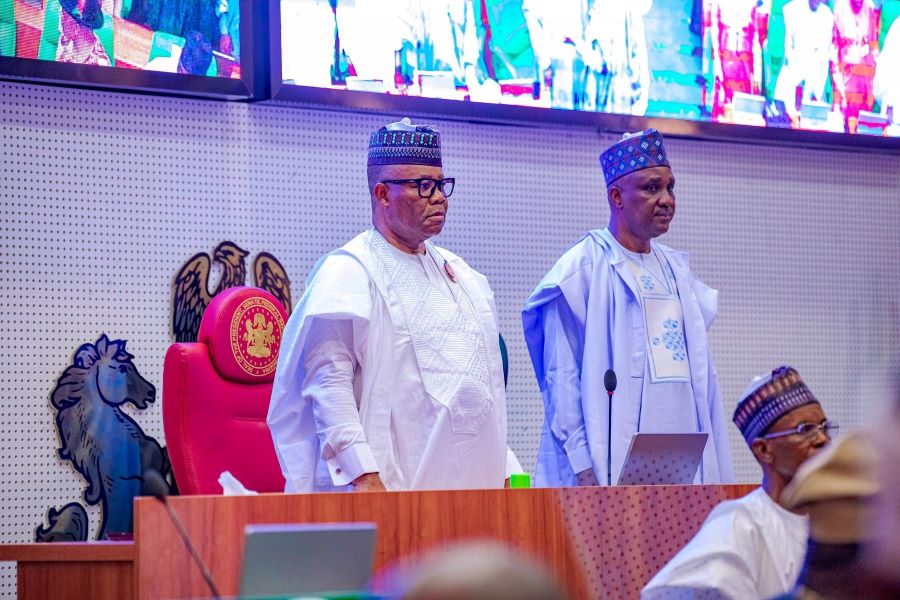
Barely a year to the inauguration of the 11th National Assembly, the Senate on Tuesday moved to tighten its internal rules, effectively narrowing the path to its most powerful offices and edging out a class of incoming lawmakers, including serving governors and former senators eyeing leadership positions.

In a move widely seen as pre-emptive, the red chamber, after about three hours of a closed-door session, amended Orders 4 and 5 of its Standing Rules, restricting eligibility for both presiding and principal offices to ranking lawmakers with defined legislative experience.

The amendments come amid growing interest by outgoing governors and political heavyweights, many of whom are positioning to enter the Senate in 2027 to contest for top leadership roles such as Senate President and Deputy Senate President.

Under the Revised Order 4, the Senate reinforced a strict hierarchy for the emergence of presiding officers, stating that “Nomination of senators to serve as Presiding Officers shall be in accordance with the ranking of senators and shall be strictly adhered to.

“The order of ranking are (i) Former President of the Senate, (ii) Former Deputy President of the Senate, (iii) Former Principal Officers of the Senate, (iv) Senators who had served at least one term of four years, (v) Senators who had been members of the House of Representatives, (vi) In the absence of i to v, senators elected into the Senate for the first time,” it stated.

Beyond this ranking structure, the Senate introduced a more stringent provision in Order 5, effectively excluding first-time and non-consecutive lawmakers from contesting principal offices.

See also  Natasha broke penal code in attacks on Akpabio, Bello –AGF

The amended rule states: “Any senator shall not be eligible to contest for any principal office of the Senate unless he has served as a senator for at least two consecutive terms immediately preceding nomination.”

The implication is far-reaching: senators-elect who were not members of both the 9th and 10th National Assembly would be ineligible to vie for key leadership roles in the 11th Assembly.

Presiding offices in the Senate include the Senate President and Deputy Senate President, while principal offices comprise Senate Leader, Deputy Senate Leader, Chief Whip, Deputy Whip, Minority Leader, Deputy Minority Leader, Minority Whip and Deputy Minority Whip.

The rule changes come against the backdrop of an intensifying scramble for Senate seats ahead of the 2027 general elections, driven largely by governors completing their constitutionally allowed two terms.

No fewer than 10 state governors and several former governors are already angling to secure senatorial tickets, leveraging their influence over party structures to emerge as consensus candidates in their respective states.

At least 12 of the 36 state governors are in their second and final terms, with 10 set to complete their tenure by May 29, 2027.

The looming transition has triggered a wave of political realignments, with many seeking to maintain relevance and influence by moving to the National Assembly.

Eight of the affected governors are from the ruling All Progressives Congress, while Oyo State Governor, Seyi Makinde, belongs to the Peoples Democratic Party, and Bauchi State Governor Bala Mohammed is aligned with the Allied Peoples Movement.

Those expected to exit office in 2027 include AbdulRahman AbdulRazaq (Kwara), Abdullahi Sule (Nasarawa), Ahmadu Fintiri (Adamawa), Babagana Zulum (Borno), Inuwa Yahaya (Gombe), Mai Mala Buni (Yobe), Babajide Sanwo-Olu (Lagos), and Dapo Abiodun (Ogun), alongside Makinde and Bala Mohammed.

See also  NUPENG suspends strike

Although Bayelsa State Governor Douye Diri and Imo State Governor Hope Uzodimma will complete their tenures in early 2028 due to off-cycle elections, both have been drawn into early permutations for Senate seats.

In Imo State, the political temperature has risen sharply following moves by the All Progressives Congress to position Uzodimma for the Imo West senatorial seat.

Party leaders in the state have already named him as the consensus candidate, even as the incumbent senator, Osita Izunaso, is reportedly seeking a return to the red chamber.

Last Saturday, APC leaders from the Orlu Zone (Imo West), led by the state chairman, Chief Austin Onyedebelu, purchased the 2027 senatorial nomination form for the governor, urging him to accept the ticket.

Onyedebelu, who presented the forms to Uzodimma’s Chief of Staff, Chief Nnamdi Anyaehie, called for pressure on the governor to “accept the plea of Orlu people by filling the forms so that it can be submitted before the deadline of 5th May, 2026.”

The state APC has also warned other aspirants against contesting the seat, insisting that Uzodimma remains the consensus choice.

Complicating the contest, former Governor Rochas Okorocha equally purchased nomination forms in a bid to return to the Senate, a move confirmed by one of his aides, Darlington Ibekwe.

The Orlu Political Consultative Assembly further reinforced Uzodimma’s candidacy, declaring him the sole candidate for the district in what it described as a “total, unanimous, and irrevocable decision.”

The unfolding contest is also shaped by internal power dynamics within the ruling party.

Last month, President Bola Tinubu reportedly rebuffed attempts by National Assembly leaders to secure automatic return tickets for lawmakers, instead reaffirming the authority of state governors over candidate selection.

See also  18 senior Army officers retire after 35 years of service

The stance has strengthened governors’ grip on party structures, enabling many of them to influence senatorial nominations as they prepare for life after office.

Against this backdrop, the Senate’s rule amendments appear designed to preserve institutional hierarchy and prevent an influx of first-time lawmakers, many of them politically powerful, from immediately taking control of the chamber’s leadership.

For ambitious entrants like Uzodimma and others plotting a return or debut in the Senate, the message from the red chamber is clear: experience within its ranks, not political clout outside it, will determine who leads in the 11th National Assembly.


Continue Reading
Click to comment

Leave a Reply

Your email address will not be published. Required fields are marked *

News

South Korean judge who hiked ex-first lady’s jail sentence found dead

Published

on

A South Korean judge who more than doubled the former first lady’s prison sentence last month was found dead on Wednesday, police said.

Shin Jong-o was “found unconscious around 1:00 am (1600 GMT on Tuesday)… at the Seoul High Court building”, an investigator at Seocho district police station told AFP.

Shin was taken to the hospital and pronounced dead, he said, adding: “There is no sign of foul play in the death.”

Local media reported that Shin had left a suicide note, but the investigator said there was none.

Last month, Shin presided over 53-year-old Kim Keon Hee’s appeal trial, finding her guilty of stock manipulation and bribery, and increasing her sentence to four years from 20 months.

The heavier sentence came after her acquittal by a lower court on the stock manipulation charge was overturned.

Shin said at the time that Kim had “failed to acknowledge her culpability and has instead consistently resorted to excuses”.

The police investigator said on Wednesday that the judge’s “bereaved family is stricken by the incident” and requests privacy.

AFP

See also  DIG Frank Mba, others retire, seven AIGs for promotion
Continue Reading

News

Court frees ex-HOS Oyo-Ita in N570m money laundering case

Published

on

The Federal High Court in Abuja on Tuesday discharged and acquitted former Head of Service of the Federation, Winifred Oyo-Ita, of alleged N570m money laundering charges filed against her by the Economic and Financial Crimes Commission.

The trial judge, Justice James Omotosho, upheld the no-case submissions filed by Oyo-Ita and eight co-defendants, holding that the EFCC failed to establish a prima facie case against them after about six years of trial.

“The case presented by the prosecution has no weight whatsoever,” the judge ruled.

Justice Omotosho described the anti-graft agency’s case as one “built on the quicksand of speculations, suspicions and shoddy investigation.”

He added that the prosecution failed to establish the predicate offences required to prove money laundering allegations.

“Crucial elements of money laundering offences, which are the establishment of a predicate offence, were glaringly absent in this case presented by the prosecution,” he said.

The judge held that the prosecution failed to prove that funds allegedly traced to Oyo-Ita were proceeds of unlawful activities.

According to him, evidence before the court showed that contracts linked to the allegations were duly approved and executed.

He also held that estacodes, duty tour allowances and air tickets allegedly received by Oyo-Ita were properly approved.

“There is no proof before the court that estacodes or duty allowances were approved and subsequently collected without the corresponding trips being undertaken,” the judge said.

He faulted the prosecution for failing to tender travel approvals, official memos, audit queries or other documentary evidence to support its allegations.

“The prosecution has, in effect, invited the court to engage in speculation,” he added.

See also  Tinubu’s Executive Order: FG, states, LGs allocation may increase by N15tn

Justice Omotosho further held that Oyo-Ita was neither a director nor shareholder in the companies allegedly linked to the transactions under investigation.

“The prosecution did not provide any shred of evidence to show that the monies are tainted with illegality,” the judge ruled.

He subsequently upheld the no-case submissions filed by all the defendants and discharged and acquitted them on the 18-count charge.

The EFCC had arraigned Oyo-Ita and others in March 2020 over allegations bordering on fraud involving duty tour allowances, estacodes and contract kickbacks amounting to about N570m.

During the trial, the commission called eight witnesses and tendered documentary exhibits.

However, the defendants argued that the prosecution failed to establish any ingredient of the offences to warrant them entering a defence.

Justice Omotosho also rejected confessional statements allegedly obtained from Oyo-Ita and some co-defendants, ruling that they were not obtained in compliance with provisions of the Administration of Criminal Justice Act.

He held that the prosecution failed to produce video recordings of the statement-taking sessions as required by law and consequently expunged the statements from evidence.

Oyo-Ita was removed from office by the administration of the late President Muhammadu Buhari in September 2019, amid corruption allegations.

Continue Reading

News

Missing Ebonyi engineers’ families demand fresh probe

Published

on

Wives of five engineers linked to NELAN Consulting have rejected recent comments by the Minister of Works, David Umahi, accusing him of attempting to “sweep the truth under the carpet” over the disappearance and presumed killing of their husbands in 2021.

In a strongly worded rejoinder signed by the wives of the engineers, namely Mrs Patricia Onyemeh, Mrs Lovette Edeani, Mrs Ifeoma Ejiofor, Mrs Esther Aneke, and Mrs Nwazulum, the women said Umahi’s response failed to address “grave factual and moral concerns that have persisted for nearly five years.”

The statement follows Umahi’s March 16, 2026, response in which he reportedly linked the engineers’ disappearance to communal unrest.

But the families disputed this, insisting that “the characterisation of the disappearance of the five engineers… as a general consequence of communal crisis is completely outrageous, misconceived, misrepresented, and flawed.”

The engineers, who were supervising an African Development Bank-backed ring road project in Ebonyi State, went missing on November 3, 2021, during Umahi’s tenure as governor.

According to the families, their husbands had travelled for an official meeting arranged by the state government, and were last seen in connection with the project.

“Credible accounts indicate that the victims were last seen in connection with official engagements linked to the Ebonyi Ring Road project,” the statement read, raising “legitimate questions” about attempts to attribute the incident to communal violence.

The wives alleged irregularities in the handling of the case by security agencies, particularly the Department of State Services and the Nigeria Police Force.

See also  FG to get $500m budget support from AfDB

They questioned why a DSS investigator, identified as Victor Chijioke Onyesom, was “suddenly sacked at the peak of his investigation,” alleging that he had been tracking communications linked to the case.

“Who influenced the conspiracy to terminate the investigation at DSS?” they asked.

The families also faulted the police for presenting skeletal remains without conducting DNA verification.

“The police presented them to the family as remains of the victims, but refused to do a DNA test.

“The test further showed that one of the five skeletal remains belonged to a female, whereas the five missing engineers are all men,” the statement said.

It further accused authorities of rushing to file charges against six suspects without concluding investigations or producing bodies.

“Without a doubt, the conspiracy in hurriedly filing the purported charge… was to tactically close the investigation… and shield the real culprits,” the wives said.

They added: “Where are the bodies of our husbands? You arrested their killers.”

The families also alleged intimidation after petitioning top government officials, including President Bola Tinubu, Senate President Godswill Akpabio, and House Speaker Tajudeen Abbas.

According to them, “an undisclosed person… threatened us not to push further for the reinvestigation of the case.”

Rejecting Umahi’s position outright, the wives said: “We totally reject David Umahi’s responses as misconceived and unfounded,” citing “interference in the investigative process, the sudden termination of the investigation, the removal of key investigators, and the suppression of critical evidence.”

They described the case as a “whitewash, cover-up, mischief, conspiracy, and plot to use the court to foreclose investigation.”

See also  Disu inaugurates state police implementation committee

The families called on the President, National Assembly leadership, and civil society groups to compel security agencies to reopen the case.

“We will have no option but to embark on another protest if the investigation is not reopened.

“The blood of our dear husbands will never go in vain,” the wives said.

punch.ng

FOLLOW US ON:

FACEBOOK

TWITTER

PINTEREST

TIKTOK

YOUTUBE

LINKEDIN

INSTAGRAM

Continue Reading

Trending