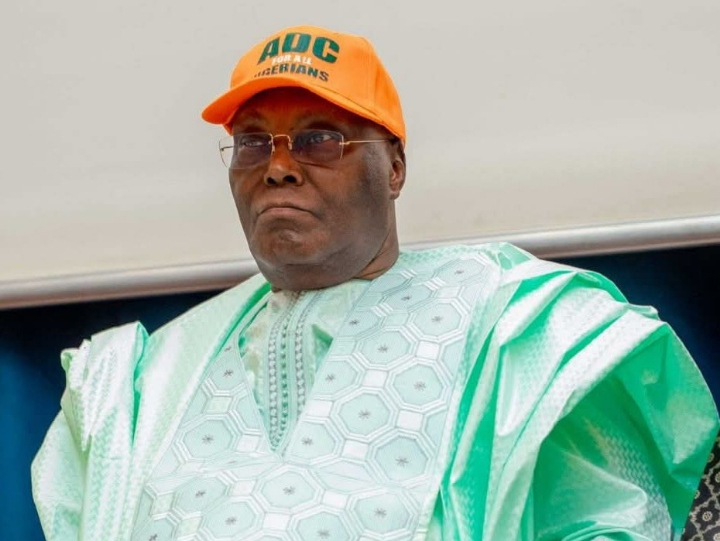
A fresh political storm erupted on Thursday after the Presidency and the ruling All Progressives Congress dismissed former Vice President Atiku Abubakar’s emergence as the African Democratic Congress presidential candidate as inconsequential, describing the opposition coalition behind him as a gathering driven by grievances rather than ideas.
Atiku polled 1,846,370 votes to defeat former Minister of Transportation, Rotimi Amaechi and economist Mohammed Hayatu-Deen, who secured 504,117 and177,120 votes respectively.
The primary election had sparked controversy after both Amaechi and Hayatu-Deen rejected the conduct of the voting process across the 36 states. and that FCT, insisting that the exercise was flawed.
The duo subsequently boycotted the collation and declaration of results.
Reacting, the Presidency said Atiku’s candidacy posed no electoral threat to President Bola Tinubu in 2027, while insisting that Nigerians would judge the next election on performance and not opposition realignments.
The development also triggered backlash with opposition parties warning that Atiku’s renewed ambition could deepen tensions over Nigeria’s delicate power rotation arrangement between the North and South, which has remained a major but unwritten principle shaping presidential politics since 1999.
Although not enshrined in the Constitution, the principle has remained a stabilising factor in the country’s fragile federal structure, often invoked by political parties and elite coalitions to justify zoning of presidential tickets across regions.
Atiku’s emergence as the ADC flag bearer has reopened old wounds in Nigeria’s political architecture, particularly within opposition ranks already struggling with internal fragmentation, ideological incoherence, and competing ambitions ahead of 2027.
The Presidency was first to react, describing Atiku’s candidacy not as a political threat but as a continuation of what it termed a familiar and predictable pattern of presidential ambition that has defined the former Vice President’s political career for over three decades.
Senior Special Assistant to the President on Media and Publicity, Mr Temitope Ajayi, who spoke to The PUNCH, dismissed the coalition that produced Atiku’s candidacy as an alliance driven not by ideology or governance vision but by resentment and exclusion from political power.
He said the opposition bloc lacked a coherent developmental agenda and instead represented a gathering of politicians motivated by personal grievances.
Ajayi said, “Atiku is welcomed. It is a familiar terrain for him. He is a perennial contestant in our presidential race. He has been chasing this presidential ambition since 1992.
“He has been a candidate in three elections of AC in 2007, PDP in 2019 and 2023, and he was an aspirant in 2015, 2011 and 1992. He has been an aspirant thrice and a candidate thrice based on available record.
“By way of that, we can say he is a veteran of the presidential contest. But he doesn’t pose any threat to President Tinubu’s election.”
The presidential aide further argued that the coalition backing Atiku was already fractured before the primary, citing the withdrawal of key political actors such as Peter Obi and former Kano State Governor Rabiu Kwankwaso as evidence of its weakening structure.
He said the opposition alliance had collapsed under the weight of competing ambitions and lacked the ideological foundation necessary to challenge the ruling party.
“They were banking on building a major platform around all the main opposition figures, especially those dissatisfied in PDP, and a few elements in the APC. So, they were hoping to build a coalition around aggrieved politicians, those who left government years ago and still want to remain at the heart of everything.
“Their coalition was not built around any higher purpose goal, any manifesto about national development, but around the egos of aggrieved individuals who feel they should be at the centre of every government.
“They are not contesting anything with Tinubu on ideas, or philosophy, or developmental vision. It’s about: ‘Oh, I was supposed to be a minister or ambassador but I couldn’t, then Tinubu must go,’” Ajayi said.
He further dismissed comparisons between Atiku’s 2027 ambition and former President Muhammadu Buhari’s successful 2015 presidential bid, insisting that the political conditions that led to Buhari’s victory no longer exist.
Ajayi argued that Buhari benefited from a rare consolidation of opposition forces under a single platform, a unity that is absent in the current political landscape.
He said, “Buhari won the election on a unified opposition platform where everybody subsumed their personal ambitions and structures and interests under the collective. But that is not happening here.
“He doesn’t even command the Buhari support base in the North that could have propelled him. Atiku and Buhari are not the same. There is no indices to compare them.”
On internal opposition dynamics, Ajayi added, “With Obi and Kwankwaso gone, Amaechi is aggrieved because he said he rejected the result of the primaries that produced Atiku, who is remaining there? And Atiku is hoping to be a northern candidate. Nigerians are looking for a President of Nigeria, not a President of a region.”
He also criticised opposition narratives around Peter Obi’s political trajectory, arguing that the former Anambra State Governor had never independently secured a competitive party primary.
“That one (Obi) has never won a party (promary) but has always been coronated candidate or had the tickets donated to him. So, Obi cannot face an intra-party contest because he does not have the capacity to win a party primary.
“He ran for governor under PDP but couldn’t get the ticket and went to APGA, where APGA was handed to him based on Ojukwu’s popularity in Anambra State,” Ajayi said.
Atiku, 78, remains one of Nigeria’s most enduring political figures, having contested presidential elections and party primaries across multiple platforms since the early 1990s.
His political journey has spanned the Social Democratic Party era of the aborted Third Republic, the Action Congress in 2007, and the Peoples Democratic Party in both 2019 and 2023, where he lost to Muhammadu Buhari and President Bola Tinubu respectively.
Despite repeated defeats, Atiku has maintained a consistent presence in Nigeria’s presidential contests, positioning himself as a leading opposition figure and coalition builder across multiple election cycles.
His latest emergence under the ADC platform, however, has reignited long-standing debates over zoning, national unity, and political equity, particularly among opposition parties seeking to redefine their electoral strategy ahead of 2027.
SDP, LP kick
The Social Democratic Party and Labour Party were quick to criticise the development, describing Atiku’s renewed ambition as politically insensitive and contrary to the unwritten principles of North-South power rotation.
The SDP reaffirmed its internal zoning arrangement, stressing that its presidential ticket had been deliberately reserved for the South in line with its constitutional provisions.
The party’s National Publicity Secretary, Rufus Aiyenigba, said the party’s decision was rooted in its commitment to fairness, equity, and national cohesion.
He stated, “SDP, as a truly national political party, believes in and will always promote the need to balance power and create equity and entrench a sense of belonging amongst the varied ethnic nationalities and building blocs of the country.
“That is why the party has institutionalised in its constitution the concept of rotating the presidential ticket between the South and North of the country.”
Aiyenigba added that leadership should be determined by competence and capacity rather than ethnicity or geography.
The Labour Party, on its part, took a sharper tone, describing Atiku’s insistence on contesting the 2027 election as provocative in light of prevailing national sentiments around power rotation.
In a statement signed by its National Publicity Secretary, Ken Asogwa, the party said Atiku’s ambition ignored the fragile nature of Nigeria’s political balance.
He said, “While the Constitution undoubtedly grants him the right to contest, morality and political sensitivity ought to guide such ambitions in a fragile federation like ours.”
The LP also raised concerns over internal disputes within the ADC following allegations of irregularities in its presidential primary, suggesting that the coalition party was already facing credibility challenges.
The party further positioned itself as the most viable opposition force ahead of 2027, citing its grassroots structures anchored on organised labour institutions such as the Nigeria Labour Congress and the Trade Union Congress.
Asogwa argued that unlike other opposition parties, its structure was deeply embedded at the grassroots level nationwide.
The spokesman added that while the ADC was battling internal contradictions, the Nigeria Democratic Congress lacked nationwide spread and institutional strength, while the PDP had become weakened by internal crises.
“We therefore urge Nigerians to continue to place their hopes in the Labour Party as the only realistic and credible pathway towards rescuing the country from the stranglehold of the APC government,” he added.
Speaking on the growing debate, the Coalition of United Political Parties’ Publicity Secretary, Mark Adebayo, said the ADC was deliberately positioned to favour Atiku’s ambition, claiming it would be difficult for any aspirant, including Peter Obi, to emerge as the party’s presidential candidate ahead of the former Vice President and his allies.
He said, “There is no crime in running multiple times for any political office. So, even if Atiku has run 100 times, he can still continue to run for as long as he has the energy, health, and resources. There is no law that limits the number of times anyone can run for a particular office.
“I believe it just shows his determination and vision. Even President Bola Tinubu, at the time he wanted to declare for the Presidency in 2022, said it had been his lifelong ambition.”
APC reacts
Meanwhile, the APC also joined the debate, dismissing Atiku’s emergence as the ADC candidate as a reflection of inconsistency and political desperation.
The ruling party insisted that Nigerians would ultimately base their 2027 decision on performance, stability, and continuity under President Bola Tinubu’s administration rather than opposition sentiment or coalition arrangements.
APC Director of Publicity, Bala Ibrahim, maintained that voters would prioritise the Renewed Hope Agenda over what he described as emotional political realignments.
He stated, “Certainly, we are not disturbed that he (Atiku) emerged as a presidential flag bearer. In any case, we are confident Nigerians are going to look at the performance of the party. They are going to look at the performance of the President, and wouldn’t allow sentiment to play any prominent role in their decision-making.
“We are confident Nigerians are going to evaluate the Renewed Hope Agenda of the President alongside the promises made by the party. And we are confident their votes will be in our direction.
“Atiku’s emergence shows inconsistency and failure of integrity,. It shows the failure to stick to agreed terms and stand by promises made. Looking at the sentiment and emotion in the country, everyone will agree that Nigerians will not allow power to shift from the South to the North.”
Atiku camp
In a swift reaction, Atiku’s Senior Special Assistant on Public Communication, Phrank Shaibu, said the Presidency’s attempt to dismiss the emergence of Atiku as inconsequential only betrays its growing nervousness.
Shaibu noted that a government truly confident of its performance would not devote precious time and energy to monitoring and attacking the opposition barely hours after a primary election.
“The truth is that Nigerians themselves — not presidential spokesmen — will determine in 2027 who poses a threat to whom. And today, millions of Nigerians battling hunger, insecurity, unemployment, and economic despair already know that the country cannot continue on this disastrous path,” he stated.
Shaibu further described as dishonest the Presidency’s claim that the ADC coalition was merely a gathering of “aggrieved politicians.”
According to him, what truly fuels the movement is the collective frustration of ordinary Nigerians abandoned by a government that has perfected the art of propaganda while citizens sink deeper into suffering.
“Nigerians are not angry because politicians lost power; Nigerians are angry because families can no longer afford food, businesses are collapsing, farmers cannot safely access their lands, and kidnapping has become a national industry under this administration’s watch,” he added.
“No amount of dismissive rhetoric can erase the fact that this government has presided over one of the harshest periods in the nation’s history.
“The Presidency may pretend not to see the gathering storm, but history has repeatedly shown that governments often mistake silence borne out of suffering for acceptance — until election day delivers a rude awakening.”
Shaibu also clarified his principa’ls visit to Amaechi, at his Abuja residence, less than 24 hours after emerging as the presidential candidate of the ADC.
A political associate of the former VP, Dele Momodu, disclosed details of the visit in a post on Instagram on Thursday, describing it as part of efforts to unite the party after the contentious exercise.
“In an effort to unify party ranks after the ADC presidential primaries, His Excellency Atiku Abubakar and other party leaders visited His Excellency Rotimi Amaechi at his Abuja residence for strategic consultations,” Momodu wrote.
Providing further insight into the meeting, Shaibu said the engagement was aimed at fostering unity and discussing issues affecting the country.
“It was purely a brotherly and statesman-like meeting between two leaders who share a common concern about the worsening condition of the country and the urgent need for patriotic engagement at this critical time in our national life,” he said.
According to him, Atiku also used the opportunity to celebrate Amaechi on his birthday while both leaders exchanged views on the state of the nation.
“His Excellency Atiku Abubakar used the opportunity to felicitate with Chief Rotimi Amaechi on his birthday and also exchange views on national issues, particularly the economy, insecurity, and the broader future of Nigeria,” he added.
Shaibu further stated that discussions centred on the need for collaboration within the party following the conclusion of the presidential primary.
“Atiku emphasised during the meeting that the progress of Nigeria and the collective task of solving the myriad problems confronting the nation are far more important than who won or lost the party primaries. He reminded all stakeholders that, ultimately, they are all winners united by a common objective of rescuing Nigeria and rebuilding hope for Nigerians,” he said.
Political observers, however, described the meeting as an early reconciliation move by the former Vice President to consolidate support within the ADC ahead of what is expected to be a fiercely contested 2027 presidential race.