Connect with us

Politics

Malami’s 2027 gov bid reshapes Kebbi political landscape

Published

on

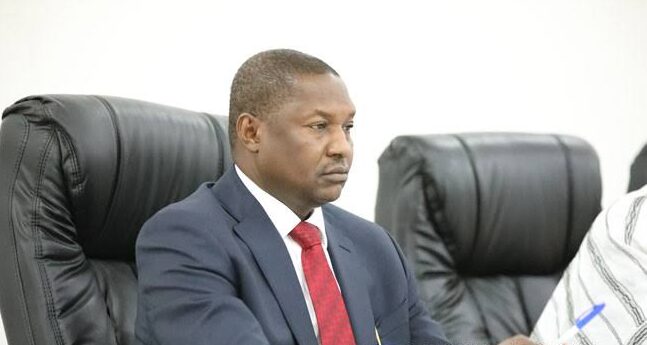
The entry of former Attorney General of the Federation and Minister of Justice, Abubakar Malami (SAN), into the 2027 Kebbi State governorship race, under the African Democratic Congress, has reshaped the political landscape in the North-West state, writes ANIMASAHUN SALMAN

Former Attorney General of the Federation and Minister of Justice, Abubakar Malami (SAN), has formally joined the 2027 governorship contest in Kebbi State, a move that immediately altered political calculations in the North-West state and triggered reactions from government officials, political analysts, and supporters.

Malami, who declared his ambition during an interview on DCL Hausa monitored in Birnin Kebbi, said he would be contesting on the platform of the African Democratic Congress, setting the stage for what many observers now describe as a potentially fierce and unpredictable race.

However, just a week later, the Economic and Financial Crimes Commission reportedly invited him as part of an ongoing investigation into the alleged $490m Abacha loot. The move introduced a major stumbling block to his political ambitions, fuelling speculation about whether the legal scrutiny could slow down his campaign or affect voter perception.

Not deterred, Malami wrote on his X handle: “This is to confirm that I have been invited by the EFCC. As a law-abiding and patriotic citizen, I hereby reaffirm my commitment to honour the invitation. I understand the spirit of accountability and transparency in public service – the principles that I both advocate and champion. Rooted in public service and in the spirit of transparency and accountability, I am committed to sharing with the Nigerian public the developments as they unfold.”

After honouring the EFCC invitation, the former minister wrote: “In line with my undertaking to keep Nigerians updated on my invitation by EFCC, I give glory to Allah for his divine intervention. The engagement was successful, and I was eventually released while on an appointment for further engagement as the truth relating to the fabricated allegations against me continues to unfold.”

Announcing his decision to contest the governorship, the former minister said his decision was driven by worsening insecurity, the collapse of agriculture, and what he called “policy failure” affecting thousands of households across Kebbi.

According to him, the state is in desperate need of “rebuilding,” and he believes he possesses the experience and network required to redirect its development.

“I have agreed to contest, and there is no retreat. God willing, we are going to win. When the time comes, you will see that the people of Kebbi are with us,” Malami declared.

His statement signals the beginning of a long political journey that could reshape the balance of power in a state long dominated by the ruling All Progressives Congress.

Malami’s choice of the ADC immediately attracted attention across the state. As one of the most influential figures in the APC during the late President Muhammadu Buhari administration, his defection to a new party signalled a deep political rift.

See also  See why Bayelsa governor delayed defection to APC

Political analysts say this could fragment the ruling party’s support base, especially in Gwandu Emirate, where Malami’s influence has long been visible.

According to some political commentators, the former minister’s declaration could introduce a three-way contest between the APC, with incumbent Governor Nasir Idris seeking to maintain party dominance; the PDP, which has struggled to regain momentum in the state; and Malami’s ADC, which may draw support from disaffected voters, youth groups, and political blocs dissatisfied with the current administration.

The development also revives long-standing political rivalries dating back to the 2015 and 2019 election cycles, where Malami was instrumental in mobilising federal support for APC candidates.

His decision to break away is therefore seen by many as both a political rebuke of the present government and a calculated attempt to realign political power around his own camp.

Idris

In announcing his candidacy, Malami focused heavily on the state’s security situation, especially persistent banditry in Zuru Emirate, Danko/Wasagu, Fakai, and parts of Yauri, areas that once formed the backbone of Kebbi’s food production.

He lamented that rice mills that operated for two decades had shut down, blaming state and federal authorities for “negligence.”

“Banditry has pushed thousands away from their farmlands. Rice mills that operated for 20 years have closed because of bad policies favouring foreign companies,” he said.

Kebbi’s agricultural decline is already well documented. The state, once celebrated for its partnership with Lagos in the Lake Rice programme, has experienced reduced yields in rice, wheat, millet, and onions due to insecurity and migration from rural communities.

By focusing on these issues, Malami is attempting to position himself as the candidate with both national and local exposure to reverse the trends.

The Kebbi State Government, however, reacted sharply to Malami’s declaration, insisting that his ambition poses no threat to Governor Nasir Idris or the ruling party.

The Chief Press Secretary to the Governor, Ahmed Idris, said the declaration was neither new nor surprising and insisted that only voters would determine who leads the state.

“The floor is open for everyone to contest. Only the people of Kebbi will decide their governor. We have no reason to panic,” he said.

The governor’s Special Adviser on Communication and Strategy, Abdullah Idris Zuru, described the former minister’s announcement as “a product of desperation.”

In a detailed reaction, Zuru challenged Malami to present his track record for public scrutiny.

“Nobody is moved. Nobody sees him as a threat. Let him go back to the grassroots and tell the people what he has done. People now understand their rights. They will not be deceived by empty rhetoric,” he said.

Zuru argued that modern voters no longer follow politicians blindly and that candidates must demonstrate past contributions to local development before seeking the state’s highest office.

“If you want to be governor, show the people your antecedents. Were you a commissioner, a chairman, a philanthropist? What have you done to improve the well-being of Kebbi people?” he said.

See also  Ibadan convention: PDP delegates arrive amid Saraki’s cancellation move

Malami’s supporters, however, insist the government’s reaction reflects insecurity rather than confidence.

A political associate of the former AGF, Dr Abdurrahman Ibrahim, said the declaration was not an act of desperation but a response to widespread calls across the state.

“People from all corners of Kebbi are calling him to contest. He has a track record. He has brought development. Politics is a game of numbers, and Malami has the numbers,” he said.

He said Malami’s decision to leave the APC was mainly due to what they described as “failed campaign promises” by the current administration.

According to him, the former minister initially supported the governor with the belief that he would deliver on his agenda.

“He believed the governor would prioritise the needs of the people. But after the election, the promises changed. People are suffering. Development has stalled. That is why Malami decided to challenge the status quo,” he said.

On government claims that Malami lacks grassroots presence, Dr Ibrahim insisted the opposite was the case.

“If you go to Kebbi, the people will tell you who is mass-oriented. Malami is strategic, highly educated, and capable of driving development. That is why the people want him.”

He described Malami as a realistic candidate with broad acceptance and the capacity to finance and manage a full-scale campaign under the ADC platform.

One of the striking elements of Malami’s declaration is his choice of platform. The ADC has little electoral history in Kebbi State and has never won a governorship election there.

Though Malami’s entry into the governorship race is seen by many as an act that would strengthen the party, the former AGF still faces major challenges, including absence of traditional party structures in rural communities, lack of grassroots mobilisers in key local government areas, limited presence in previous election cycles, strong APC machinery across the state, and historical loyalty to major parties.

The 2027 election cycle may, however, differ from past cycles due to the impact of insecurity, economic hardship, and rising political consciousness.

Early on Monday, the Government Girls Comprehensive Secondary School in Maga town, Danko Wasagu Local Government Area, was attacked by bandits, where the vice principal was killed and 25 girls abducted.

The current trend of insecurity in the state may give Malami a campaign wave to ride on.

Malami’s financial strength, national influence, and personal political network could also compensate for the ADC’s structural weaknesses.

A lecturer at a federal institution in the state, Dr Musa Bello, said Malami’s entry into a smaller party creates a complex race.

“He is banking on personality, not party structure. If he successfully draws major APC blocs, especially in Gwandu and Argungu, then ADC becomes a strong contender. But the burden of building a statewide structure is enormous,” he said.

See also  2027: Peter Obi may be good, but PDP has somebody better – Jerry Gana

Political insiders confirm that Malami played a crucial role in supporting Governor Nasir Idris during the last election. At the time, the former AGF was one of the major forces behind the governor’s emergence.

Their fallout, therefore, marks one of the most significant political breakaways in Kebbi’s recent history.

Sources say the rift widened over policy direction, political appointments, and alleged failure to meet key governance expectations. However, the government insists it owes no explanation.

Malami’s supporters maintain that the governor abandoned core campaign promises, especially regarding security, agriculture, education, and civil service welfare.

This disagreement has now transformed into a full electoral confrontation, with residents expressing their opinions on the candidates.

In Zuru, farmers and traders welcome the former minister’s stance on insecurity, saying any candidate willing to address banditry deserves attention.

In Argungu, some residents recall federal assistance and appointments linked to Malami’s influence while in office.

In Birnin Kebbi, some civil servants express scepticism, saying they prefer candidates with extensive local administrative experience.

A rice miller in Bunza, who simply gave his name as Mohammed, said, “We need someone who understands our struggles. If Malami can bring peace and reopen farms, we will support him.”

However, a trader in Jega, who did not want his name published, offered a different view: “We hear big rhetoric from Abuja. We want someone who has been with us here, not someone who only comes during elections.”

These mixed sentiments reflect a state where voters are increasingly demanding accountability while remaining open to new political alternatives.

With Malami’s entry, the 2027 governorship race in Kebbi is no longer a two-horse contest. The election will now revolve around four key issues: security of lives and farmlands, agricultural revival and economic recovery, performance record of the incumbent administration, and credibility and grassroots acceptance of candidates.

Though the APC still maintains structural dominance, internal cracks and public criticism may weaken its voter base. The ADC is emerging as a new force, buoyed by Malami’s entry. The PDP, though quieter, hopes to benefit from vote splitting between the two major blocs, especially now that the state holds the position of national chairman of the PDP, Tanimu Turaki (SAN).

Malami’s entry has transformed what was expected to be a straightforward governorship succession into a turbulent contest, and in the months ahead, alliances, defections, and political negotiations are expected to further shape the race.

With the development, Kebbi’s 2027 race is now open, competitive, and unpredictable.

Some political watchers of the event in the state, however, suggest that how Malami navigates the legal entanglement with the EFCC probing will be critical in determining whether his political momentum can be sustained.


punch.ng

FOLLOW US ON:

FACEBOOK

TWITTER

PINTEREST

TIKTOK

YOUTUBE

LINKEDIN

TUMBLR

INSTAGRAM

Continue Reading
Click to comment

Leave a Reply

Your email address will not be published. Required fields are marked *

Politics

APC, PDP trade words over Pantami’s political membership status

Published

on

A fresh controversy has erupted in Gombe State over the political status of former Minister of Communications and Digital Economy, Ali Pantami, as the All Progressives Congress and the Peoples Democratic Party laid conflicting claims to his party membership.

The dispute followed Pantami’s emergence as the PDP governorship candidate ahead of the 2027 general elections, after the APC primary election produced Jamilu Gwamna as its candidate.

The Gombe State chapter of the PDP insisted that Pantami had validly resigned from the APC and is now a bona fide member of the opposition party.

The APC, however, maintained that the former minister remains its member because due process was allegedly not followed in effecting his resignation.

Addressing journalists in Gombe on Tuesday, the APC Publicity Secretary, Moses Kyari, said the party’s executive committee in Pantami Ward had earlier clarified that it neither received nor deliberated on any resignation letter purportedly submitted by Pantami.

“As you may recall, 25 out of the 27 members of the ward executive committee publicly stated that they neither saw nor deliberated on any resignation letter purportedly submitted by Professor Ali Isa Pantami.

“They maintained that the claim was merely a fabrication orchestrated without the knowledge or approval of the ward executive committee,” Kyari said.

According to him, the ward chairman, Alhaji Bala Galda, disclosed that the alleged resignation letter was received on May 23, 2026, despite being dated May 19, and was delivered by one Abba Pantami.

“Despite repeated requests, members of the ward executive committee have not been provided with a copy of the said letter,” Kyari stated.

See also  Otti, Labour Party reject Abure’s 2027 nomination forms sale

He argued that under the provisions of the APC Constitution, the Independent National Electoral Commission guidelines and the Electoral Act, Pantami remained an APC member until the prescribed procedures were completed and verified.

“It is, therefore, our position that Professor Ali Isa Pantami remains a member of the APC until all due processes are properly followed and verified,” he said.

Kyari also dismissed claims allegedly made by Pantami during a televised interview on TVC that his defection to the PDP and governorship ambition had the blessing of President Bola Tinubu.

“We categorically reject this assertion. President Bola Ahmed Tinubu is a committed leader of the APC and has consistently demonstrated loyalty to the party. It is difficult to believe that the President would endorse activities that are contrary to the interests and unity of the APC,” he said.

He called on the national leadership of the APC and the Presidency to publicly clarify the issue to prevent misinformation.

“We, therefore, call on the national leadership of the APC and the Presidency to publicly clarify and dispel these claims in order to prevent misinformation and avoid misleading the people,” Kyari added.

However, in a swift response contained in a statement signed by its state Public Relations Officer, Abdulkadir Dukku, the PDP dismissed the APC’s position, insisting that Pantami had fulfilled all constitutional and legal requirements for membership of the opposition party.

“We wish to categorically state that Professor Pantami is a bona fide member of the Peoples Democratic Party, having duly complied with all the constitutional and legal requirements for membership of our party,” the PDP said.

See also  PDP crisis: Wike bloc plans state congresses, national convention

The party further stated that it possessed documentary evidence confirming Pantami’s resignation from the APC.

“The PDP possesses all relevant documents confirming his resignation from his former party, acknowledged by his then ward chairman,” the statement read.

According to the PDP, the APC chairman in Pantami Ward personally acknowledged Pantami’s resignation letter on May 19, 2026.

“The chairman of APC in Pantami Ward acknowledged Pantami’s resignation letter in person on May 19, 2026, and subsequently posted it on social media, where it went viral,” the party added.

The opposition party described the APC’s repeated press briefings on the matter as unnecessary.

“It should be noted that this is the third time the APC has organised a press conference on the same issue, despite the facts being clear and well documented,” the statement said.

The PDP urged the ruling party to focus on preparations for the forthcoming elections rather than what it described as distractions.

“Consequently, we urge the APC in Gombe State to focus on preparing for the forthcoming general election instead of engaging in unnecessary distractions,” it stated.

The party also argued that the Constitution and the Electoral Act guarantee freedom of association.

“If the APC lacks confidence in its candidate, it should address its internal concerns instead of insisting that Professor Isa Ali Ibrahim Pantami must remain in the party.

“After all, the Constitution of the Federal Republic of Nigeria and the Electoral Act guarantee freedom of association,” the PDP said.

It added that the APC still had the opportunity, within the electoral process, to make decisions regarding its candidature if it believed its candidate could not effectively compete against Pantami.

See also  ADC, APC trade words over alleged violence in Ekiti

Reaffirming its stance ahead of the elections, the PDP said it remained committed to issue-based campaigns and providing credible leadership to the people of Gombe State.

“The PDP remains committed to issue-based campaigns and to providing the people of Gombe State with credible leadership, development and good governance,” the statement concluded.

punch.ng

FOLLOW US ON:

FACEBOOK

TWITTER

PINTEREST

TIKTOK

YOUTUBE

LINKEDIN

INSTAGRAM

Continue Reading

Politics

David Mark slams FG after A’Court reverses ADC deregistration

Published

on

Following the Court of Appeal’s decision to reverse the deregistration of the African Democratic Congress and four other parties on Monday, ADC National Chairman Senator David Mark stated the judiciary is on trial and warned the Federal Government against political manipulation.

Stakeholders also called for sanctions against Justice Peter Lifu for flouting a superior court order, as the ADC assures supporters they will remain on the ballot.

Political parties and stakeholders affected by the Federal High Court’s controversial deregistration order welcomed the Court of Appeal’s decision to stay the execution of the judgment.

The Court of Appeal in Abuja had on Tuesday ordered a stay of execution of the judgment that directed the Independent National Electoral Commission to deregister the ADC, Action Peoples Party, Action Alliance, Accord Party and Zenith Labour Party, while delivering a stinging rebuke to Justice Lifu for flouting a May 22 appellate court order restraining him from delivering the ruling.

In a unanimous decision on Tuesday, a three-member panel led by Justice A. B. Mohammed condemned Justice Lifu of the Federal High Court in Abuja for flouting a May 22 order that directed him to suspend proceedings before him, describing his conduct as the gravest form of judicial misconduct.

“The decision of the lower court to proceed with the judgment despite the express order of this court is a brazen violation of the hierarchy of the court and the 1999 Constitution,” the panel held.

The appellate court went further, invoking a Supreme Court precedent to characterise Justice Lifu’s conduct in the harshest terms.

“The decision of the lower court to proceed with the judgment despite the express order of this court is the highest form of judicial impertinence,” the panel declared, adding that the Supreme Court had previously held that a judge who acted in such a manner “is unfit for the bench as it amounts to judicial rascality.”

The court said it had a duty to assert its supervisory authority over lower courts and protect the integrity of the judicial hierarchy.

“Courts are enjoined to protect their integrity. This court has supervisory authority over the trial court. This court has the duty to invoke its powers in ensuring that its orders are obeyed. The application for stay of execution is hereby granted. The enforcement of the judgment is stayed,” the panel ruled.

The Federal High Court in Abuja, presided over by Justice Lifu, had on Monday ordered INEC to deregister the ADC, Accord Party, Action Alliance, Action Peoples Party and Zenith Labour Party, ruling that the five parties failed to meet the constitutional performance thresholds under Section 225A of the 1999 Constitution, specifically, requirements related to securing at least 25 per cent of votes in certain states or winning seats in the 2023 general elections.

Earlier in Tuesday’s proceedings, INEC told the appellate court it was stunned by Justice Lifu’s decision to deliver the judgment, disclosing that the commission only learned of the ruling through media reports rather than any official notification.

INEC’s lead counsel, Mr Haliru Mohammed, told the panel that the commission had been aware of the appellate court’s May 22 order restraining the lower court from delivering the judgment, which had originally been reserved for June 5.

“We were not aware of any notice from the court regarding the delivery of the judgment. We only saw it as breaking news in the media. We therefore do not oppose the application of the appellant to stay the execution of the judgment,” Mohammed submitted.

The commission also aligned itself with the notice of appeal filed by the affected political parties.

Counsel to the ADC, Mr Shuaibu Aruwa, SAN, told the court that Justice Lifu communicated the judgment’s delivery to the party via WhatsApp, a disclosure that drew visible reactions from the bench.

See also  Governorship aspirants shun consensus deal in 10 states ahead of APC primaries

Aruwa described the lower court’s conduct as an invitation to anarchy and urged the appellate court to invoke its disciplinary jurisdiction under Section 6 of the 1999 Constitution to sanction the judge.

“The action of the trial judge calls for swift and extraordinary measures from this court. We have come to the stage where this court should press the reset button.

“We urge this court to take disciplinary steps by immediately suspending that judgment. This court has the power to protect its own integrity. We pray this court suspends the judgment immediately without further delay,” he added.

APC reacts

Reacting to the appellate court’s decision,  the ADC’s National Publicity Secretary, Bolaji Abdullahi, said the ruling offered a measure of hope for the judiciary’s credibility, though he was careful not to celebrate unreservedly.

“It indicates that the judiciary may still redeem itself. We are cautiously delighted but we insist that it shouldn’t have happened in the first place,” Abdullahi said in a telephone interview.

He called on the National Judicial Council to take urgent steps to rid the bench of judges whose conduct brought the institution into disrepute.

“We, therefore, hope that the judicial council will take urgent steps to purge the bench of judges who bring the judicial institution to disrepute,” he said.

The National Leader of the Action Peoples Party, Ikenga Ugochinyere, was more emphatic in his welcome of the ruling, describing it as a vindication of the party’s position from the outset and calling on the NJC to weed out what he termed controversial judges.

“There was no need to panic in the first place, and, so, this ruling is a vindication of our position from the get-go,” Ugochinyere said.

“We call on the NJC to weed out controversial justices who say one thing in the morning and another in the evening. These are the bad eggs giving the judiciary a bad name,” he added.

Ugochinyere raised broader concerns about public confidence in the justice system, warning that judicial inconsistency was eroding citizens’ respect for court pronouncements.

“Court pronouncements are supposed to be respected by citizens, particularly because they come from institutions established by law. But when people begin to hide behind technicalities, it raises concerns about the integrity of those institutions.

“How do we expect citizens to obey court judgments when many people no longer see justice as blind, but rather as something influenced by individuals and personal interests? That is the challenge before us,” the APP leader added.

He also noted that the controversy surrounding Justice Lifu’s ruling had sparked frustration across the country, with some of the anger directed at the presidency.

“This situation has generated a lot of reactions across the country. Many people are directing their frustrations at the President. Perhaps there is a need for greater clarity so that Nigerians understand exactly what is happening,” Ugochinyere said.

He nevertheless described Tuesday’s outcome as a victory for democracy and the rule of law.

“What happened today (Tuesday) is a victory, not just for democracy, but for the rule of law. We are happy because the courts have once again demonstrated their relevance in our democratic process,” he said.

Other parties speak

The Acting National Chairman of the Coalition of United Political Parties,  Peter Ameh, took a philosophical approach in welcoming the ruling, invoking the words of the philosopher Edmund Burke to frame the significance of the appellate court’s intervention.

“The only thing necessary for the triumph of evil is for good men to do nothing,” Ameh said.

He warned that what he described as hostile executive rascality and brazen judicial overreach must not be allowed to stand.

See also  Otti, Labour Party reject Abure’s 2027 nomination forms sale

Also, the ADC presidential candidate, Atiku Abubakar said in a statement posted on his X handle that the ruling was a positive development, noting with particular significance that INEC itself had initiated the application for the stay .

“I welcome the Court of Appeal’s decision to stay the execution of the Federal High Court judgment seeking the deregistration of our great party, the ADC, and four other political parties. It is particularly significant that INEC itself initiated the application for the stay,” he wrote.

Atiku, Mark protest

The former Vice President, Atiku Abubakar also criticised what he described as judicial contradictions in the ongoing legal dispute, warning that such developments had placed the judiciary under intense public scrutiny.

“The disturbing spectacle of judicial contradictions and politically charged rulings playing out in our courts has placed the judiciary under intense public scrutiny. As ADC National Chairman, Sen. David Mark, rightly observed, the judiciary itself is now on trial,” Atiku said.

He warned against any attempt to weaponise the courts against Nigeria’s democratic institutions.

“Any attempt to undermine Nigeria’s hard-won democracy through judicial manipulation is a grave danger to the Republic. If our democracy suffers further injury, history will demand accountability from those entrusted with dispensing justice,” he said.

Following the judgment given by Justice Lifu, the National Judicial Council has been urged to investigate Justice Peter Lifu over his decision to deliver judgment in a case that was already before the Court of Appeal.

The civil society organisation, Tap Initiative for FOR Citizens’ Development, on Tuesday in a statement called on the leadership of the judiciary to immediately investigate Justice Lifu over the judgment.

The call follows concerns over the alleged disregard for the hierarchy of courts and implications such actions could have on the judiciary and Nigeria’s democracy as the country moves closer to the 2027 general elections.

Justice Lifu had on Monday ordered the Independent National Electoral Commission to deregister five political parties over their alleged breach of Section 225(A) of the Constitution.

However, the judgment was reportedly delivered despite an order staying proceedings issued by the Abuja Division of the Court of Appeal on May 22.

The decision has since attracted criticism from several quarters, with critics accusing the judge of undermining democratic principles.

In a statement signed by its Executive Director, Mbasekei Martin Obono, the group urged the NJC to, among other things, “Determine whether the decision was delivered in disregard of pending appellate proceedings and a subsisting order of stay;

“Examine possible breaches of the judicial code of conduct; Take appropriate disciplinary action if misconduct is established; and

Reaffirm the authority of appellate courts and the supremacy of due process within the judiciary”.

The group recalled that the Chief Justice of Nigeria, Justice Kudirat Kekere-Ekun, had consistently emphasised the need for accountability, discipline and ethical conduct within the judiciary.

It disclosed that it had formally petitioned the CJN, in her capacity as Chairman of the NJC, seeking an investigation and possible disciplinary action against Justice Lifu.

According to the group, the petition presents an opportunity to reinforce the principles of accountability and demonstrate that judicial independence is not incompatible with responsibility.

“Tap Initiative expresses grave concern that at the time the said judgement was delivered, there were subsisting appellate proceedings before the Court of Appeal in respect of the same subject matter in Appeal No. CA/ABJ/CV/569/2026. Furthermore, the Court of Appeal had issued an Enrolment Order expressly granting a stay of proceedings in Suit No. FHC/ABJ/CS/2637/2025, being the very proceedings in which the Federal High Court subsequently proceeded to deliver judgment.

“This development raises profound constitutional and procedural concerns, as it appears that a valid order of stay and active appellate proceedings were in force at the material time. If established, this situation would constitute a serious affront to the doctrine of judicial hierarchy and the supervisory jurisdiction of the Court of Appeal within Nigeria’s constitutional order.

See also  See Wike's response to 2027 presidential ambition rumour

“Tap Initiative emphasizes that the integrity of Nigeria’s justice system depends fundamentally on strict adherence to judicial hierarchy, procedural discipline, and respect for appellate authority. Any deviation from these principles risks creating conflicting judicial outcomes, eroding legal certainty, and undermining public confidence in the courts”, he said.

The group stressed that the judiciary remains the last hope of the common citizen, arguing that its legitimacy is sustained not only by constitutional authority but also by unwavering public confidence in its fairness, discipline and respect for the rule of law.

It therefore called on the NJC to treat the matter with the urgency and seriousness it deserves in the interest of justice, democracy and national stability.

Meanwhile, the National Chairman of the African Democratic Congress, Senator David Mark, on Tuesday declared that the Nigerian judiciary, rather than the opposition party, is the institution facing scrutiny over the controversy surrounding the deregistration of the ADC and four other political parties.

Speaking at the ADC Strategic Communications Retreat in Abuja, the former Senate President accused the judiciary of actions capable of undermining public confidence in the nation’s democratic process, while questioning the conduct of Justice Peter Lifu in matters relating to the party.

According to Mark, the outcome of the controversy will test the credibility of the judiciary and the ability of the National Judicial Council to address concerns arising from the case.

“The ADC is not on trial. Rather, it is the judiciary that is on trial and the nation is waiting to see how the National Judicial Council is going to handle this precarious situation,” he said.

The ADC chairman expressed concern over what he described as unprecedented judicial actions, alleging that Justice Lifu ignored an order of the Court of Appeal directing a stay of proceedings in the matter.

He said it was difficult to comprehend how a judge could be involved in actions that appeared to contradict existing court directives.

Mark further alleged that the judge issued conflicting decisions regarding the status of the party within a short period.

“It is strange that a judge can order the Independent National Electoral Commission to pronounce a party dead and in less than 24 hours put the same party on trial,” he said.

The remarks come amid growing political tension over recent legal challenges affecting opposition parties ahead of preparations for the next electoral cycle.

Despite the legal setback, Mark urged party members not to lose confidence in the ADC, insisting that the party would emerge stronger from the dispute.

“Like I have said previously, our members should not worry about the shenanigans of the ruling party. We will go through all these turbulence because we are up to the task. By the time we are through all these, ADC will come out stronger,” he stated.

The former Senate President also accused the ruling All Progressives Congress APC of attempting to weaken opposition forces through distractions, claiming that the governing party was struggling to defend its record in office.

He alleged that the President Bola Tinubu-led government is diverting attention from its challenges by targeting opposition platforms.

Addressing party communicators at the retreat, Mark charged them to craft messages capable of expanding the ADC’s appeal across political divides, including among members of the ruling party.

He challenged the communications team to develop persuasive narratives that would attract more Nigerians to the ADC project.

punch.ng

FOLLOW US ON:

FACEBOOK

TWITTER

PINTEREST

TIKTOK

YOUTUBE

LINKEDIN

INSTAGRAM

Continue Reading

Politics

Obidient movement condemns court order to scrap ADC, four parties

Published

on

The Obidient Movement has condemned a Federal High Court order directing the Independent National Electoral Commission to deregister five political parties, describing the ruling as a threat to political inclusion and democratic participation in Nigeria.

The order, delivered on Monday by Justice Peter Lifu of the Federal High Court, Abuja, directed INEC to delist the African Democratic Congress, Accord Party, Action Peoples Party, Action Alliance and Zenith Labour Party over alleged failure to meet constitutional performance thresholds under Section 225A of the 1999 Constitution (as amended) and the Electoral Act 2022.

The suit was filed by the National Forum of Former Legislators, which asked the court to determine whether INEC is constitutionally bound to deregister parties that fail to meet electoral benchmarks, including winning at least 25 per cent of votes in any state in a presidential election or securing at least one elective office.

Reacting in a statement issued on Tuesday and signed by its National Coordinator, Dr Yunusa Tanko, the Obidient Movement said it was concerned about the implications of the ruling for Nigeria’s democratic space.

The group described itself as “an organic movement driven by the self-sacrifice, commitment, and collective determination of Nigerians who believe that a New Nigeria is Possible,” adding that it is aligned with the political philosophy of Nigeria Democratic Congress presidential candidate, Peter Obi.

It warned that reducing the number of political platforms available to citizens would undermine democratic choice and participation.

According to the statement, “We align strongly with the ideas and principles of His Excellency, Mr. Peter Obi, who has consistently demonstrated a different approach to politics by challenging the dominance of a money-driven political system.”

See also  See Wike's response to 2027 presidential ambition rumour

The movement stressed that democracy must remain open and competitive, arguing that inclusiveness is central to its survival.

It stated: “As believers in democratic values, we are concerned about the deregistration of political parties such as ADC, AA, ZLP and APP.

“A vibrant democracy thrives on inclusiveness, political participation, and the availability of diverse platforms through which citizens can freely express their aspirations and choices.”

The group further said Nigeria’s democratic future must be built on fairness, credible institutions, and stronger citizen participation, rather than restrictions on political actors.

It also reaffirmed its commitment to civic engagement, accountability, and voter mobilisation ahead of future elections, urging Nigerians not to disengage from the political process.

“The future of Nigeria’s democracy must be built on fairness, inclusion, credible institutions, and the active participation of citizens,” the statement added.

The movement encouraged citizens to obtain their Permanent Voter Cards (PVCs), describing voting as a key instrument of democratic power.

“Your PVC is more than a card; it is your voice, your power, and your responsibility. Every election is an opportunity to shape the future we desire,” it concluded.

punch.ng

FOLLOW US ON:

FACEBOOK

TWITTER

PINTEREST

TIKTOK

YOUTUBE

LINKEDIN

INSTAGRAM

Continue Reading

Trending