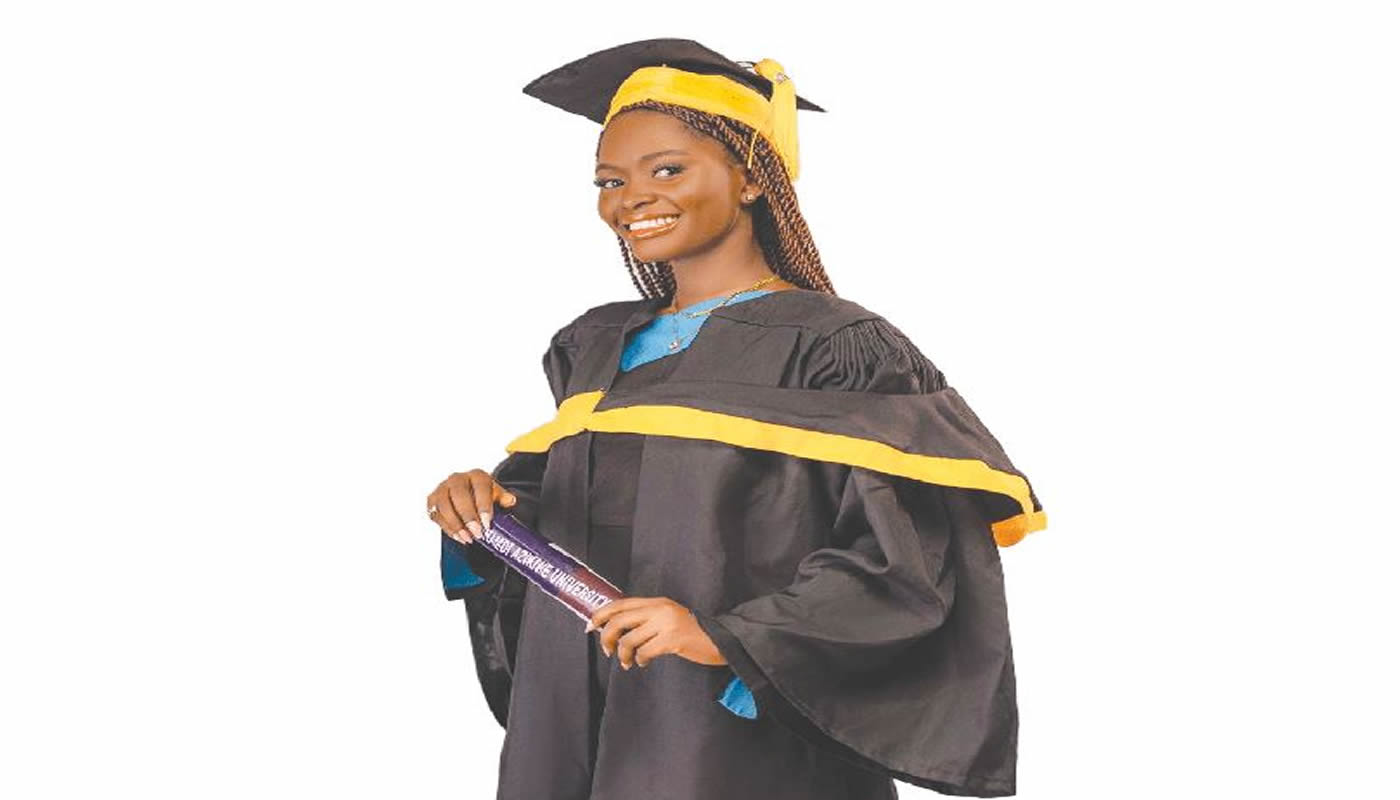
Despite facing intense financial challenges and losing her father in her final year, Chiamaka Obi, a 22-year-old mass communication graduate from Nnamdi Azikiwe University, Anambra State, tells TEMITOPE ADETUNJI how discipline, sacrifice, and unwavering faith helped her achieve first class.
How old are you, and what year did you gain admission?
I’m a fresh graduate of Nnamdi Azikiwe University, from the Department of Mass Communication. I’m 22 years old. I’m a native of Oguta LGA, Imo State, but I currently reside in Awka, Anambra State.
I gained admission in 2021 and completed my studies in 2024. However, my date of graduation was 27th September 2024.
Congratulations on your first-class degree! What was your exact CGPA, and how did you feel when you saw your final result?
My CGPA upon graduation was 4.69. I felt elated, happy, and fulfilled when I saw it.
Can you walk us through your background? What was growing up like?
I was born and raised in Lagos, specifically in Ijegun, Alimosho Local Government Area. I had both my primary and secondary education in Lagos.
I come from a family of six, and I’m the first of four children. Growing up, I had the mentality that, as the first child, I had to be a good example and look out for my younger ones. My dad, when he was alive, was a very strict disciplinarian. He would always sit us down to advise us and discipline us when necessary.
So, I would say proper parental guidance and learning to trust in God in everything I do played a big role in shaping me. As for academics, I’ve always taken my studies seriously since childhood. I was the kind of student who always came first in class. I believe God blessed me with brilliance, but I also worked hard for it.
My mum supported me a lot. She bought me storybooks, enrolled me in summer lessons, and constantly encouraged me to study. So, my journey to academic excellence started from a very young age. I was the best graduating student in my secondary school.
How old were you when you gained admission into the university?
I was 18 when I got admitted.
Mass communication is often seen as a competitive course. Why did you choose it?
I chose mass communication because it aligned with my interests. As a child, I had different dreams — one moment I wanted to be a banker, the next moment, a doctor or a lawyer. At some point, I also saw myself as a newscaster, reading the news on TV.
But I didn’t fully understand what I truly wanted until I got into the university. I’ve always been that outspoken child who loved to talk, do presentations, and speak publicly. During senior secondary school, I explored different fields — commercial, science, and arts — and I was good at all of them.
Eventually, I realised I was more inclined toward the arts, especially because I enjoy talking and couldn’t stand the sight of blood. So, medicine or nursing was definitely out of the question. In the end, I chose arts, and mass communication stood out to me.
When I registered for JAMB, I picked mass communication as my first choice in all the schools I applied to, and thankfully, I got admitted.
What are the misconceptions people have about mass communication?
Some people think it is the easiest of all courses. I always tell my friends and those who are just getting to know me that it’s not about the nature of the course you study. I believe that even if I had chosen a science course, I would still have performed well academically.
The fact that I excelled in mass communication doesn’t mean it’s a simple course. It’s not. I went through a lot. No course is truly easy. From my experience, even people who studied the so-called small or underrated courses found them very challenging.
People have different strengths. I don’t believe that mass communication is an easy course. It’s not for everyone. Even in mass communication, people still fail. It’s a broad course with many branches.
As our education system improves, people will begin to specialise more. Mass communication includes PR, advertising, journalism, broadcasting — you get to experience a bit of everything. But imagine someone entering university knowing they want to study just advertising; they would get much more out of the course.
The misconception isn’t just from the public — it’s from those who haven’t experienced the course firsthand. Mass Communication isn’t easy at all. It’s for bright minds, too.
What would you say were your lowest moments while studying at UNIZIK—academically, emotionally, or financially?
I had a lot of financial challenges. I chose a federal university because I thought it would be less expensive compared to private or state universities, or even studying abroad. But when I got in, I was faced with all sorts of unexpected payments.
At some point, the school fees were doubled. My parents were still trying to get back on their feet financially at the time, so it was tough. We had to pay for everything—even something as small as handouts. It all added up.
Then the biggest blow came in my final year when I lost my dad. That moment shook me to my core. My dad was my main sponsor, and he had been ill for a long time. A lot of money had already gone into trying to get him well. So, when he passed away, everything felt like it was crashing.
It happened during my 400-Level, second semester. I was in the middle of my project when I got the news. I didn’t even know how to move forward. But I just had to. Thank God.
How did you manage the grief and still graduate with a first-class?
Honestly, it was just God. I told myself I had to pull through. A lot of people asked how I was going to cope, especially amidst academic stress and personal loss.
But I kept pushing. The whole situation was beyond my control. I cried a lot—daily. But I reminded myself that I could do it. I had to do it. I had to brace myself and thank God for the people around me. My mum was a huge support system. My friends also stood by me.
I just kept telling myself, ‘You have to do it.’ My dad would have been proud to see me come out strong after everything. And I already had a strong academic record, so I held onto that.
I believe that if you start well—Year 1, Year 2, Year 3—and stay consistent, then all you need is that final push in your last year. I gave it everything in my final year, despite all that happened.
How many hours did you study daily?
I wouldn’t say I studied for a specific number of hours each day. But I was intentional about making studying part of my daily routine. So, while I can’t say I read for four hours every single day, I made sure I studied every day.
During exams, the pressure was intense, but I still didn’t set rigid hours. I just made sure that studying was something I did consistently.
Did you ever fail any test or course, and how did you handle academic disappointments?
I wouldn’t say I failed any course outright, but there were times I got grades I wasn’t happy with.
I got a C once, in my first year, second semester. It was in Introduction to Psychology. I’ll never forget it. I was so disappointed because I had already set a high academic target for myself. I knew that C was going to affect my GPA from the very beginning.
What sacrifices did you make for academic excellence?
I think there were times I had to sacrifice social activities—maybe not all of them, but definitely some. The sacrifices were enormous; you can’t count them all. There were times I had to read instead of being on my phone. Many times, I had to attend lectures rather than relax or socialise.
There were days when my friends were relaxing by the pool, and I would have to carry my backpack and head out to learn something new. Of course, finances played a role. When you don’t have money, you can’t do much—you just focus.
At different points, I gave up social life, leisure time, and even things like being in a romantic relationship because I just felt those things weren’t priorities at the time.
Mass communication also involves practicals—broadcasting, PR campaigns, writing, and so on. How did you balance the theory and practical aspects?
I was able to balance both because I wanted to go beyond the usual. I wouldn’t say I explored the practical side as much as I had envisioned in secondary school, but I did take some extra steps.
For instance, there was a time we were given the chance to go out for interviews, so I went to schools to conduct them. Also, I kept writing to develop myself beyond what we were taught in class. Whenever there were practical opportunities at school, I made sure I participated.
Right now, I’m interning at Anambra Broadcasting Service to help bridge some of the gaps in my practical experience.
Did you ever feel pressured to ‘tone it down’ academically—maybe from friends or classmates, or even family?
No, I didn’t feel that kind of pressure at all. My mum always encouraged me to be the best, to graduate as the best. I stayed focused.
Was there ever a time you considered quitting or switching your course?
Not quitting, but there was a funny time I thought I would go for law after mass communication. I started developing an interest in legal studies from watching movies and reading about law. But it wasn’t that I wanted to drop mass communication—I just thought maybe after graduation, I would pursue Law.
You studied in a public university in Nigeria, where there is poor infrastructure and inconsistent calendars. How did you stay focused and consistent?
I told myself from the start that I would be better. Yes, we experienced strikes. Sometimes you want to study but have to focus on hustling for money instead. Infrastructure was poor, and some lecturers weren’t doing enough, but I made up my mind not to rely solely on what I was taught.
I knew that if I wanted to succeed, I had to go beyond the system. I couldn’t depend on poor structures or inconsistent lecturers. So, it started with a decision, and I took action from there.
Who was the one lecturer—or course—that had the biggest impact on you, and why?
I can’t say I had one favourite course because we had so many, but I loved broadcasting. It sparked something in me. Broadcasting, radio and television speech writing were my favourites. Prof. Chinwe Uzochukwu and Dr Henry Duru encouraged us to do more practical work—visit radio stations, do documentaries. They made us go beyond theory.
What’s your next step? Further education, working in media, or something else entirely?
I’m working in the media already, and I’m also planning to further my education.
If the President of Nigeria gave you a microphone for 60 seconds to talk about education, what would you say?
I would say that we’re doing better than before, but there’s still a long way to go—especially in public schools. Private schools are fine—they have good infrastructure and qualified teachers—but public schools need attention.
The government needs to focus on improving our public education sector. Many great Nigerians have come out of public schools, and they deserve better.
What advice would you give to an average Nigerian student struggling with poor facilities, depression, financial challenges, or fear of failure?
Just hang in there. There’s always light at the end of the tunnel. Whatever you’re going through now will pass. I’ve graduated, so I’m no longer worrying about deadlines or exams.
There were times I cried, felt depressed or unsure, but I made it through. How you manage that pain will determine your success. Don’t put your life on hold. Keep pushing. One day, you’ll look back and realise it was worth it.
What role did your friends or mentorship network play in your success?
A huge role: my family supported me, yes, but my friends were there during my loneliest moments. They provided emotional and sometimes financial support.
There were times we shared what little we had. Sometimes we cried together. They were there for me. I can’t thank them enough.
In all honesty, how did you feel the day you saw your final results?
I was honestly confused. There’s this saying at school that getting a first class is nearly impossible. Some lecturers said it hadn’t happened in our department in years.
I remember texting a friend and saying, “I’m going to get a first class. I don’t know how, but I will.” And I did.
It was a huge achievement for me. Not only did I graduate with a first class, but I was also the best in my department and faculty. I did something people didn’t expect.