In Nigeria’s tertiary institutions, where intellectual discourse and democratic grooming should flourish, Students’ Union Government elections have become war zones. Once envisioned as leadership training grounds, SUGs are now tainted with a chilling trend: killings, kidnappings, shootings, arson, cult-linked reprisals, and voter intimidation.
“It was like war. There were gunshots everywhere. I thought I was going to die,” said Mirabel, a 300-level student in the School of Management Science at Auchi Polytechnic.
What should have been a routine exercise in student democracy descended into chaos on Saturday (July 5, 2025), as the Students’ Union Government election at Auchi Polytechnic, Edo State, spiralled into bloody mayhem.
By sundown, the air was thick with tear gas, rumour, and fear. Several students were reported injured.
Mirabel, her voice trembling, continued, “I was on the field that day when it happened. I was walking back home. I had just finished studying because it was a lecture-free day, when I heard gunshots.
“I didn’t wait to find out what was going on. I ran straight outside the school gate and headed home to Benin. I live off campus, so it was easy for me to pack and disappear.”
What followed was a night of terror that gripped not only the campus community but also the nation.
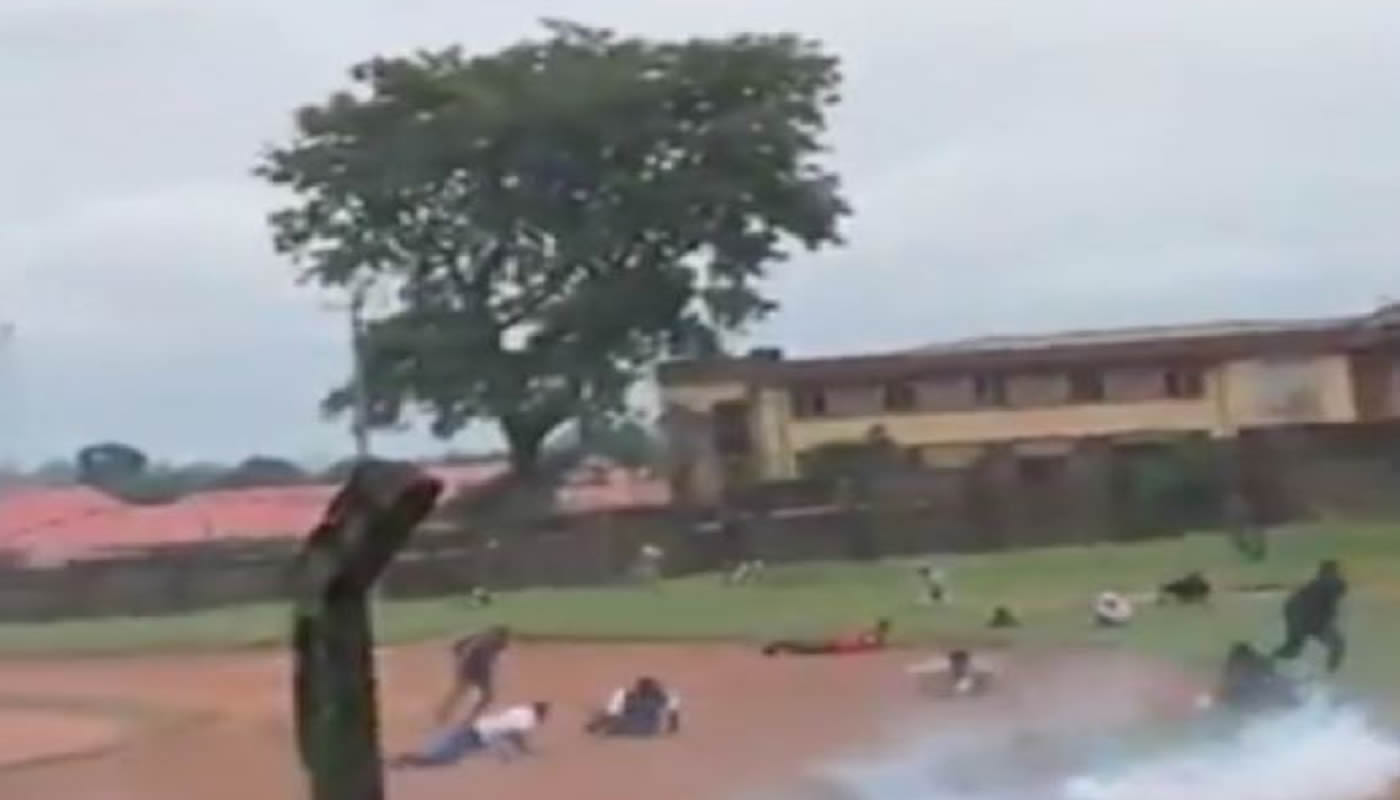
A disturbing video seen by Saturday PUNCH showed dozens of students scaling the institution’s perimeter fence in a frantic bid to escape, while loud bursts of gunfire echoed in the background.
Smoke drifted through the air near the voting venue, lending credence to suspicions that tear gas had been deployed.
Multiple sources who spoke to our correspondent reported seeing boys with sticks and other weapons storming the voting area on that day, intensifying the panic.
The violence, according to them, was triggered by desperation. Supporters of a candidate known on campus as only ‘Voice’, believed to be from the Akpekpe area of Auchi, allegedly became violent when it became clear their candidate was losing.
“The election was peaceful at first,” said Adaeze, a fellow student in the School of Sciences. “But when it became obvious that Voice was trailing another candidate named ‘Verify’, his main opponent, tension started rising.
“Verify had massive support across departments. That didn’t sit well with Voice and his camp.”
What began as murmurs of discontent quickly degenerated into anarchy. According to Adaeze, loyalists of Voice allegedly began raising alarms and calling in reinforcements. “Armed youths stormed the venue.
“They snatched ballot boxes, and I heard gunshots. What I cannot confirm to you is if it was from the boys or from the armed security men who were around the area. In a split second, things degenerated. It became a full-blown stampede. Students were screaming and running in all directions. I escaped by the whiskers,” she said.
Multiple reports from student eyewitnesses had suggested that at least two students may have lost their lives during the incident, though school authorities have so far denied any fatalities.
Social media was awash with videos showing bloodstains on the ground, terrified students weeping, and what appeared to be lifeless bodies being carried away.
The emotional trauma of the night still lingers. Several days after the incident, the campus remains tense.
Many students have reportedly fled, fearing further violence or reprisals.
“There were bodies on the ground,” said a student who requested anonymity. “I saw boys lying motionless after the tear gas. Others were bleeding. It was terrible. I’ve never seen anything like that in my life.”
The Edo State Police Command’s Public Relations Officer, Moses Yamu, when contacted on the day of the attack, said he had not received any formal report on the matter. Meanwhile, the school’s official stance has only deepened the controversy.
“For the avoidance of doubt, no student was shot or killed during the election, which was declared inconclusive due to observed irregularities,” said Dr Angela Egele, Director of the Polytechnic’s Public Relations Division. She added that many of the videos circulating on social media were “doctored”, though she admitted that security operatives were deployed on the day of the election to “ensure the safety of lives and property.”
But eyewitness videos, some verified by Saturday PUNCH, show uniformed men firing sporadically into the air and aiming tear gas at students, who were seen fleeing for cover.
The events at Auchi are not isolated. Across Nigerian universities and polytechnics, the spectre of violence increasingly shadows SUG elections.
What was once viewed as a training ground for future leaders is rapidly turning into a battlefield. Observers say Nigeria’s toxic political culture, marked by desperation, vote-buying, ballot snatching, and brute force, is trickling down into campuses.
“These boys are simply mimicking the behaviour of our politicians: thuggery, ballot snatching, and the use of violence to win elections,” said a Benin-based political analyst, Kelvin Omodamwen. “It’s not just sad. It’s a national emergency.”
On social media, outrage was swift. “This shows how backward Nigeria is in terms of politics. If students can’t conduct a peaceful SUG election, how do we expect them to lead this country tomorrow?” wrote @Candour_Lemuel on X (formerly Twitter).
What really went wrong?
Several students and faculty insiders believe the problem is layered. Beyond the influence of local politics, cult groups, and ethnic loyalties, there’s also a failure of institutional control and student political education.
“SUG elections have become a dirty scramble for power,” said a senior academic staff member who asked not to be named. “These elections are supposed to be about representation and responsibility, but they’ve become a breeding ground for gang recruitment and underground influence.”
Some say the school management’s insistence on denial is itself a problem. “If we can’t be honest about what happened,” a final-year student said, “how are we supposed to fix it?”
There is growing sentiment that student leadership structures must be urgently reformed. Comparisons have been drawn with more peaceful student elections in universities like the University of Ilorin, where campus politics is tightly regulated, and candidates are subject to a rigorous code of conduct.
“Just a 10-month tenure election and there is this much violence?” asked another student from the University of Lagos. “It’s heartbreaking. I cannot believe this. It’s pure madness.”
As it stands, no arrests have been confirmed. The management has promised to investigate, but many students remain sceptical. For them, the trust in the system, academic or political, has already been broken.
Clash after the crown
The University of Ibadan was thrown into confusion this earlier week after what began as a post-election celebration spiralled into violence, leaving at least one student seriously injured and others hospitalised.
This was five months before the Auchi incident.
The fracas, which took place between two of the university’s most prominent male hostels, Independence Hall (commonly known as Indy) and Zik Hall, has cast a shadow over an electoral season that had otherwise proceeded with little disruption.
Eyewitnesses told Saturday PUNCH that the unrest broke out when supporters from Indy Hall staged a victory procession towards Zik Hall in the aftermath of the SUG election. What was meant to be a moment of jubilation quickly turned chaotic, descending into a physical altercation that left a 500-level student badly injured.
Though details remain murky, Students’ Union President, Aweda Bolaji, confirmed the incident in a brief status update via WhatsApp, noting that three students were rushed to the university’s Jaja Clinic for emergency care.
One of them, he added, was undergoing an X-ray to determine the severity of his injuries.
The university community has responded with shock and growing concern. Students, many of whom had hoped for a smooth transition of leadership, now find themselves grappling with the implications of violence, an occurrence that is becoming increasingly common on Nigerian campuses, even in historically calm institutions like UI.
“This is not just about rivalry between halls,” said Olawanle, a student in the Faculty of Arts. “It speaks to the lack of emotional maturity and political tolerance among some of us. We must do better.”
The Media Foundation for West Africa documented multiple incidents of campus journalists being harassed, threatened, and physically assaulted during and after the SUG election.
The escalation peaked on March 7, 2025, when Olanshile Ogunrinu and Oluwasegun Akanni, both Union of Campus Journalists members, were manhandled, had their phones seized, and were physically threatened while covering the forceful removal of a duly elected SRC candidate, Nice Linus, due to prior disciplinary allegations. This intervention by security personnel reflects a pattern of shrinking press freedom at UI.
For a university long regarded as a bastion of intellectual civility, the episode has triggered introspection.
As investigations continue, the university community remains tense, hoping that calm will prevail and that the injured student will recover fully. Meanwhile, the incident stands as a troubling reminder that even in the most elite academic environments, political passion can still boil over into needless violence.
UNIABUJA halts SUG polls over violence
In September 2018, the University of Abuja made a grave decision, one that underscored the intensifying crisis within student politics in Nigerian universities.
The management, citing a surge in campus violence, announced an indefinite suspension of the SUG elections.
The Dean of Student Affairs, Alanana Otaki, signed the official notice, which made it clear: students’ safety was now under threat.
At the core of this suspension was a deadly altercation that erupted in the Old FCDA boys’ hostel on the university’s mini campus in Gwagwalada.
The fallout was tragic; reports confirmed the killing of a 200-level student of Sociology, allegedly linked to election-related tensions.
Although the university attributed the decision to “security challenges within the university and its environs,” students were under no illusion as to what the real issue was. According to Kazeem Ahmad, a student who spoke with Premium Times, “If the election is not suspended, the school may be shut down.”
Another student, who requested anonymity for fear of retaliation, confirmed that the electoral process had become a proxy battleground for cult clashes. As he put it, “The election led to rivalry between cult groups.”
The president of the student union at the time, Bashir Obasanjo, refrained from confirming details, but did urge the administration to provide “adequate security.”
The university advised students to turn their attention to the upcoming second-semester examinations and to report any suspicious activity.
But beneath that calm directive lay a troubled truth: the hallowed idea of student democracy had again been hijacked by violent interests, leaving trails of blood and shattered futures in its wake.
Stray bullets, stolen votes in UNICAL
In August 2018, the University of Calabar’s campus descended into chaos during its SUG elections, leaving three students hospitalised with gunshot wounds, an outcome few had imagined when the polls were announced.
According to eyewitnesses, the day had started with the usual buzz and anticipation. Four candidates—Emmanuel Akobi, Ajang Emmanuel, Ilefa Austin, and Afo Nelson— were on the ballot. But by late afternoon, that buzz had turned to bedlam.
The election, which began with hopeful chants and ballot queues, veered sharply off-course when students discovered that their names were inexplicably missing from the voters’ register. Those disenfranchised were asked to “stand aside,” according to Ekere Sylvanus, a 300-level Political Science student who had volunteered as an observer.
Over 300 students were caught in this limbo, unsure whether they would be allowed to cast their votes. By 3 p.m., the electoral officer, acting on the then-Vice-Chancellor’s directive, announced that the polls closed. Chaos erupted.
Angry chants gave way to shoving. The crowd surged. Amidst the fray, a campus security officer, in an apparent effort to contain the unrest, discharged their weapon. Stray bullets struck three students.
Videos and witness accounts from that day painted a grim picture: bleeding bodies, screams of confusion, and a haunting sense that things had spiralled beyond the remit of student politics.
No statement from the university could erase the memory of that day. The polls were eventually declared inconclusive.
For many, the incident laid bare the deep fractures within student democracy, how easily administrative disorganisation, electoral frustration, and security force missteps could escalate into something far more sinister.
Legacy of tension in campus politics
Student union politics in Nigeria have long been entwined with national political fault lines. In 1978, the Ali Must Go protests, a student-led uprising against fee hikes, spiralled into police violence and fatalities, underlining universities as flashpoints of national dissent.
Similar outbreaks of violence marked the 1989 Anti SAP riots, revealing how student activism could cleave institutions and society alike.
By the late 1990s, university cults had morphed into organised criminal networks.
A tragic instance occurred at Obafemi Awolowo University in 1999, when masked members of the Black Axe confraternity stormed student dorms, killing five and injuring eleven with axes and shotguns.
Across state-run institutions, over 150 students were reported slain in five years due to cult-related violence, targeting dissenters, academic dissent, or extortion refusal.
When SUG elections turn bloody
In recent years, elections meant to nurture student leadership have devolved into spectacles of disorder.
From LAUTECH, where technological voting systems failed to prevent violence, to the Federal University Oye Ekiti June 2025 debacle, where students protested the online-voting system, claiming many were disenfranchised when One-Time Passwords failed to arrive.
This fuelled allegations of manipulation and calls for a rerun of elections.
At its core, SUG election violence reflects deeper crises: unchecked cult influence, fragile institutional management, political interference, and the normalisation of violence in symbolic democracies. Analysts warn that peer-to-peer violence during student politics mirrors broader national political cultures: thuggery, impunity, and weaponised mobilisation.
An educationist and activist, Mercy Yohan-Davidson, links violence to a bevvy of issues.
First, for her, is the cultural commercialisation of student leadership, where union candidacy is linked to control of campus contracts and corporate funding.
She also noted that there was a level of administrative complicity, where management uses infrastructure or intimidation to influence outcomes.
She also noted that many schools had weak electoral institutions, with poorly regulated ICT systems, a lack of oversight, and inadequate civic education.
She said, “We also have the twin issues of social and tribal fault lines, particularly evident in ethnic confrontations, as seen at COE Akwanga in Nasarawa State, where tribal tensions disrupted voting.
“In several campuses, elections proceeded without police or external observers, leading to knife attacks or mob invasions.”
UNIUYO election cancelled amid cult clashes, casualties
The University of Uyo in 2018 cancelled its SUG election after violent clashes, involving suspected cultists, reportedly led to one student’s death and several injuries. Vice Chancellor Professor Enefiok Essien ordered the cancellation following unrest on both the Town and Annexe campuses, where urban rivalries and electoral outrage turned deadly.
Authorities initially halted voting at the Faculty of Social Sciences due to “irregularities and electoral malpractice” declared by the then-Dean of Student Affairs, Dr Aniekan Brown.
Effiong Akpan, of the Faculty of Arts, described how supporters of a leading candidate, alarmed by their candidate’s perceived loss, allegedly mobilised hoodlums to disrupt adjacent faculty polling units.
Ballot boxes were snatched and destroyed across Education, Business Administration, Agriculture, and Basic Medical Sciences. Gunshots were reported, and 10 students were left seriously wounded. Fear and chaos circulated rapidly across campus.
Despite formal denial from some quarters, independent sources confirm the VC annulled the election in response to the crisis. Students reportedly responded to the violence by pelting the aggressors with stones, even as protests grew inside the affected faculties.
Bauchi college election that locked down campus
In May 2017, a year before the UNIUYO incident, the Kangere College of Education in Bauchi State was abruptly shut down by state authorities following an SUG election that descended into violence.
On the election day, tensions grew during campaigning in Kangere town. This prompted the provost and security agencies to urge postponement, which was ignored.
Election materials were distributed without coordination with security officials or university management.
When student protests escalated into road-blocking and vandalism, soldiers were summoned to intervene. Students began throwing stones, prompting soldiers to fire warning shots.
Reports state that some students sustained injuries; one reportedly suffered eye damage.
The military insisted it acted professionally, while NANS demanded a formal investigation into alleged shootings
‘We’re not thugs’, say student leaders
For decades, NANS has styled itself as the unified voice of students across Nigeria’s tertiary institutions.
Yet, its legacy has been tested time and again, especially during elections, when ideology often gives way to brawn. But over the years, it has also been the institution that has taken the moral high ground when things spiralled out of control.
In 2018, for instance, after the management of LAUTECH suspended and expelled 12 students, including the SUG Senate President, for their roles in violent post-election demonstrations, NANS took to the streets.
Members locked the university gate, carrying placards and chanting songs of protest. Their message was clear: students were being victimised for demanding transparency and fairness.
“We are not hoodlums,” one protest leader told reporters. “We want justice, not just for LAUTECH students but for student democracy in Nigeria.”
Speaking on the wave of violence in SUG elections, NANS has continually stressed that students must not engage in any kind of election violence.
A former NANS Vice-President (External Affairs) and Senate President, Mr Akinteye Afeez, said students must not behave like thugs.
“If there are grievances, you can approach the authorities of NANS. Write also to the school authorities. Carrying weapons and fighting each other over something as transient as student elections is not what any right-thinking student should do,” he stressed.
Also condemning the wave of violence across Nigerian campuses, the acting SUG President of the Michael Okpara University of Education, Umudike, Ms Finest Egbe, said she was shocked that students would resort to violence.
“In MOUAU, if you are caught in any form of electioneering violence, you will be rusticated or even expelled. No student should truncate a free and fair democratic process,” she said.
The student leader also advised fellow students to emulate good conduct and set a better example for the outside world to emulate.
“This is an academic environment housing scholars, and there are things we should not be hearing. If you contest an election and you lose, you join hands and build the other person’s administration.
“I was appointed acting President. I was VP. Tomorrow, I will graduate and leave campus. Another person will assume the position. That’s how politics works. It’s not a do-or-die affair. Moreover, students are on campus to pass exams and gain a good grade, not battle for elected office and fight each other when they don’t get there,” she stressed.
Another former Vice President of NANS, Vanessa Otulu, of the University of Benin, condemned the wave of attacks in UI and Auchi Polytechnic, calling for calm.
She described the incidents as a ‘calculated attempt to sabotage student representation’ and demanded that security agencies investigate and prosecute those responsible.
Convention chaos in NANS
Fast forward to 2023, and the theatre of election chaos shifted to Abuja, where the NANS National Convention was marred by violence.
Gunshots rang out at the election venue. Reports alleged that DSS operatives had to intervene, firing warning shots to disperse rampaging youths and restore calm. Student leaders present condemned the bloodletting, insisting that cultists and political proxies had infiltrated their ranks.
One former SUG president, who witnessed the chaos, later wrote in an opinion piece: “The convention was supposed to be a celebration of student intellect and engagement. Instead, it became a marketplace of threats, moneybags, and machetes. We must reclaim our voice from this madness.”
Dons proffer solutions
To understand the urgency behind these calls for change, one must consider the darker undercurrents of campus politics, said a professor of English and Dean, Faculty of Arts, UNIUYO, Akwa Ibom, Joe Ushie.
“In many institutions, SUG elections have long been dominated by shadowy networks, oftentimes fuelled by external political actors or cult groups who see student leadership as a stepping stone to bigger power games. The lines between activism, ambition and anarchy become blurred.
“It’s not just about who becomes president. It’s about who controls budgets, appointments, and influence with state officials. Some people, I am afraid, may be killed for that.
“This toxic ecosystem has forced many genuine student leaders to step back or speak out, risking academic sanctions or even their lives in the process.”
Ushie noted that SUG elections were more than symbolic rituals of leadership.
“For many students, they are training grounds for civic engagement, political literacy, and nation-building. When they are hijacked by violence and fear, democracy itself is devalued.
“The voices of those who speak up matter. In the wreckage of burned offices and abandoned ballot boxes, their courage offers a different narrative, one not of thuggery but of tenacity. Not of chaos, but of conscience.
“We cannot change Nigeria tomorrow if we allow blood to flow today. We either choose ballots or bullets, but not both.”
A senior lecturer in the Department of Political Science, University of Nigeria, Nsukka, Enugu State, Dr Ugwueze Ikechukwu, said these unfolding events demand urgent institutional reflection and action.
“They are symptomatic of the drift of political violence into formative civic spaces like higher education. Robust electoral frameworks, independent oversight, heightened security coordination, and a commitment to democratic norms are no longer optional. These are the essentials to stop the rot and protect campuses as sites of leadership rather than conflict.
“These incidents underscore a deeper trend: Nigerian student elections becoming microcosms of national political violence. These tactics that we see at national campaigns: ballot-box snatching, mass intimidation, mobilised youth thuggery, are now commonplace in university campuses.
“These students are simply mimicking the behaviour of our politicians. It’s not just sad; it’s a national emergency,” he added.
FOLLOW US ON: