President Bola Tinubu on Thursday renewed his push for the creation of state police, revealing that he had assured the United States and European partners that he would implement state police.
He stressed that state police “must happen” as part of efforts to improve internal security and strengthen governance at the subnational level.
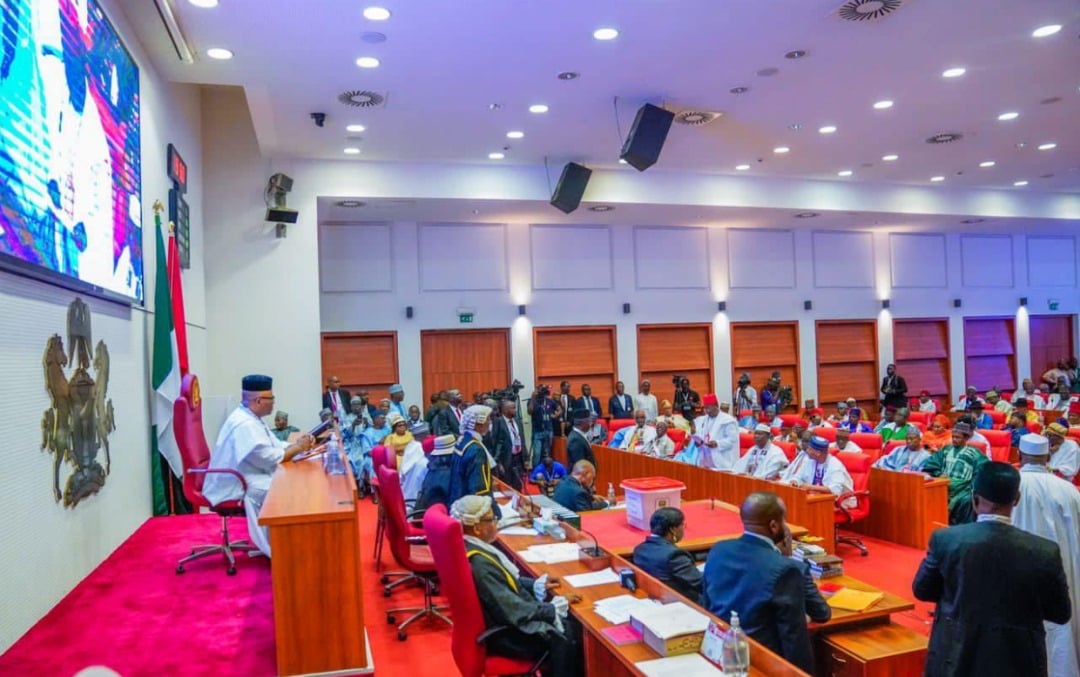
Tinubu spoke at the 14th National Caucus meeting of the APC at the State House Conference Centre, Abuja, where he also insisted that local government autonomy must work in practical terms, urging governors to stop withholding funds meant for council chairpersons.
The President’s comments came amid rising security pressures across the country, renewed calls for decentralised policing, and the push to implement the Supreme Court judgment on local government autonomy and direct allocation to councils.
Tinubu told party leaders that the APC, as the majority party, must show leadership through reconciliation, accommodation, and flexibility at the grassroots level, as he urged governors and other stakeholders to take responsibility for what happens in their states and local governments.
He said he recently held discussions with foreign partners and assured them that Nigeria would move towards state policing, adding that he was confident the APC would deliver the required backing.
“I had a very long discussion with them. US and European partners, and I was bragging to them that we will definitely pass a state police bill to improve security.
“They asked me if I’m confident, and I said, ‘Yes, I have a party to depend on. I have a party that will make it happen,’ and if at this level we fail, God forbid, we will not fail,” Tinubu stated.
The President argued that the responsibility for political reconciliation and internal party cohesion rested with leaders at all levels, stressing that flexibility and tolerance were essential for stability and progress.
He also called attention to the recent Supreme Court judgment on local government autonomy, urging party leaders to support its implementation and use it to strengthen grassroots governance.
According to the President, autonomy would be meaningless if councils were not adequately funded, insisting that allocations meant for local governments must go directly to them.
“Look at the recent Supreme Court judgment, what can we do with it, and how well we can position our country and our party?
“To me, the local government autonomy, it is and must be effective.
“There is no autonomy without a funded mandate; give them their money directly. That’s the truth. That’s compliance of the Supreme Court,” Tinubu insisted.
The President’s remarks on council funding came amid allegations against governors controlling or diverting local government allocations through state joint accounts, a practice long criticised by local government officials and civil society groups as undermining grassroots development.
The President urged party leaders to take leadership “seriously,” arguing that strong governance at the local level would help stabilise communities.
He also offered condolences to Bayelsa State following the death of the Deputy Governor. He commiserated with the people while calling for prayers for Nigeria.
Tinubu further appealed for greater inclusion of women in party leadership and participation, urging stakeholders to “make provisions” that would bring more women into the fold.
Vice President Kashim Shettima warned party leaders that sustaining the APC’s growing dominance across the country would be tougher than attaining it, as he projected confidence ahead of the 2027 general election.
Shettima listed the party’s strength across geopolitical zones and pointed to what he described as expanding influence in states controlled by new entrants and defectors.
He told party leaders that the APC was now better positioned nationally, but stressed that maintaining success required discipline, cohesion and careful management of internal politics.
“I wish to implore all of us to know that to succeed is much easier than to maintain that success. The whole of the South-South region is in the APC fold—the whole of the North Central. Out of the seven states in the North West, five are in the APC. Out of the six states in the South West, four are in the APC. Out of the six states in the North East, four are in the APC. Certainly, we have become a pan-Nigerian party,” said Shettima.
Shettima also reassured governors who recently aligned with the APC, telling them they had found a home in the ruling party.
He singled out some of the governors by name, including Akwa Ibom’s Umo Eno, Bayelsa’s Douye Diri, Rivers’ Siminalayi Fubara, Delta’s Sheriff Oborevwori and Enugu’s Peter Mbah, saying the party leadership would work with them.
The VP said the party was already looking towards 2027 and said more politicians were eager to join the APC, insisting the ruling party would remain dominant.
Meanwhile, Senate President Godswill Akpabio lamented what he described as “organised and orchestrated insecurity” in Nigeria, saying unnamed enemies were deliberately tormenting the country through terrorism, banditry and insurgency.
Akpabio told President Bola Tinubu and other party leaders that the worsening security situation had left many states grieving, while the party leadership must remain united to confront the challenges.
“We are very sad that people have decided to torment Nigeria with very serious, organised and orchestrated insecurity.
“So as we grow, there will be envy, there will be jealousy, and with jealousy comes hatred, and with hatred comes challenges.
“Mr. President, ours in this caucus today is to assure you that we are not only with you, we are also praying for you, praying for you to overcome the challenges of the day, and also praying for Nigeria,” he said.
While commending Tinubu for the release of over 100 children kidnapped recently, the Senate President noted that the caucus aligns with states mourning losses from attacks.
He appealed for the remaining children to be rescued and reunited with their families.
Akpabio said, “We thank the President for the release of over 100 children who were kidnapped very recently, and we pray to God to give him the ability and the enablement to release the remaining children to rejoin their families.
He also disclosed that the Senate had taken “bold decisions” aimed at deterring criminality, including legislative efforts to classify kidnapping alongside terrorism, which he said would make kidnappers liable to the death penalty once Tinubu assents to the bill.
Akpabio further appealed to governors to enforce laws on capital offences such as banditry, arguing that failure to sign execution warrants could embolden convicts who might later escape and return to crime.
He praised the APC’s expanding political reach, saying the party had continued to attract major political figures “steadily” and “without firing a shot,” crediting the National Working Committee under the party chairman, Prof. Nentawe Yilwatda.
He urged party leaders across states to open up opportunities for new entrants, saying the APC must avoid sidelining those joining from other parties.
“Let me appeal to all our leaders that all the political stakeholders coming in from other political parties must be given equal opportunities to thrive. There must not be any discrimination,” he appealed.
For his part, the APC National Chairman, Prof. Nentawe Yilwatda, hailed what he described as a surge in the party’s national acceptance, citing recent high-profile defections, an electronic membership registration drive and plans for a new national secretariat in Abuja.
At the 14th APC National Caucus, his first since emerging as chairman in July, Yilwatda urged stakeholders to rally behind the party’s expansion agenda ahead of planned congresses and the next national convention slated for March 2026.
He told caucus members that the APC leadership was consolidating structures nationwide through a membership drive, while also crediting the President’s leadership with strengthening party cohesion and public confidence.
The APC chairman said the party was growing in strength through what he called Tinubu’s “visionary leadership,” adding that recent political developments, especially defections from opposition parties, reflected the APC’s “pan-Nigerian character.”
He listed a number of governors and political actors he said had recently joined the party, while also claiming that the APC now enjoys an “overwhelming majority” in both chambers of the National Assembly.
Yilwatda said, “Recent political development underscored APC’s pan-Nigerian character, including significant defections that have further expanded our influence, particularly several high-profile individuals and groups who have defected to our party, especially from the opposition parties.
“Notable among them are the governor of Bayelsa State, Governor Diri; the governor of Enugu State, Governor Peter Mbah; the governor of Taraba State, His Excellency, Agbu Kefas; and also the latest one, the governor of Rivers State, Governor Siminalayi Fubara.
“We now have an overwhelming majority in the two houses, both in the Senate and also in the House of Representatives.”
He also announced what he described as an internal organisational milestone: the activation of an electronic membership registration system, which he said would improve transparency, data integrity and internal democracy.
He said training had been conducted at state and zonal levels, and in local governments in “most of the states,” urging stakeholders to support a nationwide rollout and encourage both old and new members to register their supporters. According to him, the registration drive would run through January, with January 30 set as the deadline for members to be registered and ready for congresses.
On party infrastructure, the APC chairman recalled that the last National Executive Committee meeting recommended acquiring land for a befitting national secretariat.
He said the party, “with the help of Mr President, has secured land in Abuja’s Central Business District and an architectural design is underway.”
Yilwatda also drew attention to preparations for local government elections in the Federal Capital Territory, saying the Independent National Electoral Commission had fixed February 21, 2026, for the polls, and that the APC was positioning for victory across the six area councils.
He said the party had activated structures across the FCT and called on leaders to close ranks, mobilise and work collectively for a “resounding victory.”
The APC National Caucus is a high-level strategic meeting of the party’s top leadership.
It typically brings together the President, Vice President, national chairman, members of the National Working Committee, APC governors and other key stakeholders to align on political and organisational issues ahead of broader deliberations at the NEC.
Notably, the six governors elected on the platform of the Peoples Democratic Party who recently defected to the APC were present at the caucus meeting, including Rivers Governor Siminalayi Fubara, Enugu Governor Peter Mbah, Delta Governor Sheriff Oborevwori, Bayelsa Governor Douye Diri, Akwa Ibom Governor Umo Eno and Taraba Governor Agbu Kefas.
The party would reconvene for its National Executive Committee at the State House at 05:00 pm on Friday.
punch.ng
FOLLOW US ON:

FACEBOOK
TWITTER
PINTEREST
TIKTOK
YOUTUBE
LINKEDIN
TUMBLR
INSTAGRAM