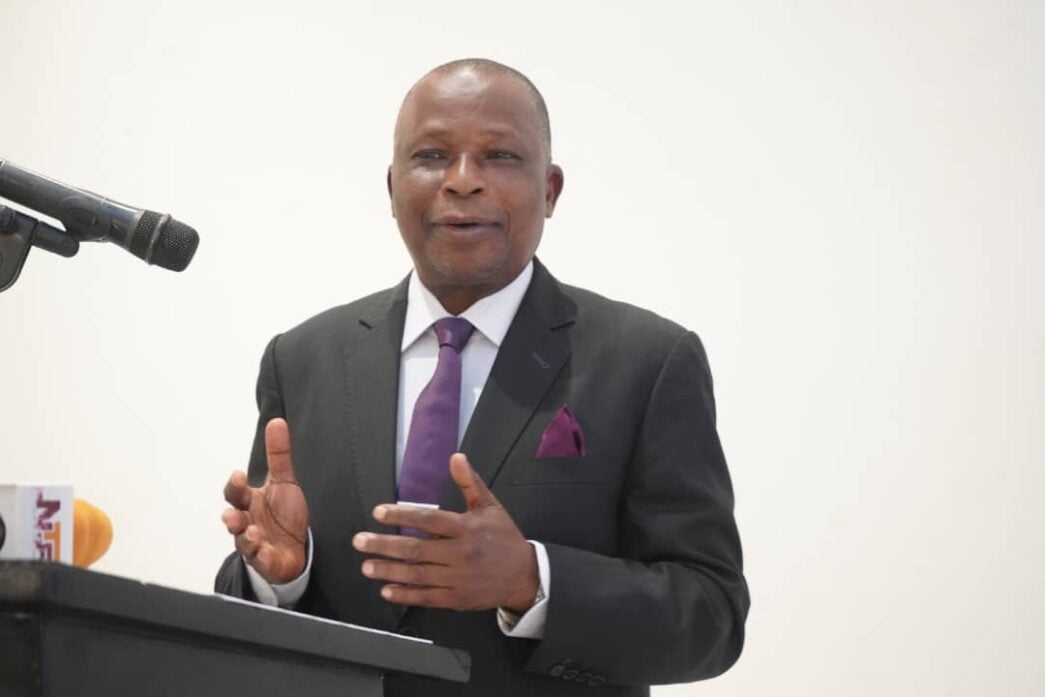
About 5,000 individuals suspected of involvement in terrorism-related activities are currently being held in pre-trial detention facilities across the country.
The large number of detainees has created a significant backlog of terrorism cases.
This was contained in the 2025–2030 Strategic Plan of the National Counter-Terrorism Centre, a copy of which was obtained by this newspaper on Wednesday.
The NCTC disclosed that its legal team, working with the Defence Headquarters and the Federal Ministry of Justice, has been reviewing the files to fast-track prosecutions or dismiss cases lacking sufficient evidence.
“At present, there are approximately 5,000 individuals suspected of having been involved in terrorism-related offences who are being held in pre-trial detention. This has resulted in a significant backlog of cases, and the NCTC legal team has been working with the Defence Staff and the Federal Ministry of Justice to support the review of these case files and, where appropriate, to help to either expedite these prosecutions or to dismiss outstanding charges that have not been sufficiently substantiated to proceed to trial.
‘’NCTC has also been coordinating case hearings held by the Federal High Court sitting both in Wawa Military Cantonment in Kanji, Niger State, and in Abuja,” the document partly read.
The NCTC said in 2024, the support provided through this framework led to the prosecution of 393 terrorism-related cases, resulting in 329 convictions.
This, it added, pushed Nigeria’s conviction rate in terrorism cases to 84 per cent, a sharp increase from 41.5 per cent recorded in 2018.
The NCTC said charges against about 1,200 detainees were reviewed and ultimately dismissed, leading to their release and resettlement into their communities.
“In 2024, the support provided to the Federal Ministry of Justice and the Federal High Court helped to enable the prosecution of 393 new cases, resulting in 329 terrorism-related convictions. Indeed, the conviction rate in terrorism-related cases has increased markedly from 41.5% in 2018 to 84% in 2024.
‘’The charges against a further 1,200 individuals were reviewed and ultimately dismissed, resulting in their release from custody and resettlement back into their communities.”
Also, according to the document, Nigeria is set to introduce DNA profiling into a proposed National Database on Terrorism as part of renewed efforts to strengthen investigations, prosecutions and intelligence-sharing on terrorist groups.
It outlined how biometric data — including DNA — will be used to identify, track and prosecute members of proscribed terrorist organisations.
According to the document, the database will be domiciled within the Office of the National Security Adviser and will serve as a central repository of information on known and suspected terrorists.
“Nigeria currently lacks a central National Database on Terrorism accessible to every agency engaged in the fight against terrorism. The NACTEST (National Counter-Terrorism Strategy) identified the need for such an information-sharing system to be located within ONSA, and NCTC has been tasked by the National Security Adviser with establishing this database as part of NACTEST’s “Identify” and “Implement” work streams.
“The intention is that this database will contain full identifying particulars on known and suspected members of terrorist groups (including, where possible, biometric data and a DNA profile), information on terrorist modus operandi, and intelligence on reported terrorist activity. It will be populated with information and intelligence provided by correctional and detention facilities, law enforcement and security partners, and intelligence recovered and developed by staff from the Directorate of Intelligence.”
Beyond prosecutions, the strategic plan highlights the role of the NCTC’s National Operations Centre, a technology-driven hub designed to support multi-agency counterterrorism operations.
The centre provides real-time intelligence, situational awareness and command-and-control support during major incidents.
The PUNCH reports the planned use of DNA profiling could mark a turning point in Nigeria’s counterterrorism architecture, particularly in tackling repeat offenders, identifying foreign terrorist fighters and dismantling networks that cut across regions.
Turji in panic – Military
The Theatre Commander of the Joint Task Force North West, Operation Fansan Yamma, Major General Warrah Idris, has said notorious bandit leader Bello Turji is currently in panic and confusion as intensified military operations close in on him and other armed group leaders in the North-West.
Idris disclosed this while responding to questions from Defence Correspondents who are on a tour of the operations theatre.
He noted that Turji, who had remained elusive, is now under sustained pressure from coordinated ground operations, human intelligence and technology-driven surveillance.
“Based on the most current intelligence received, Bello Turji, and others are currently in confusion and panic because of the intensity of our current operations. They are relocating after every few hours, every few days, ”he said.
Idris dismissed claims that Turji controls any local government area or villages, describing such assertions as propaganda by terrorists who constantly flee from military forces.
“How does a person who does not have a permanent location control an axis or a local government? I dare Bello Turji to come out and present a single local government that he is controlling,” he challenged the terror kingpin.
He added that Turji and other notorious bandit leaders, including Gwaska, Ado Aleru and Dogo Gide, are being actively pursued across the theatre of operations.
“All things being equal, Bello Turji will soon be history in the North-West region,” Idris said, stressing that leaders of armed groups are being tracked through all available intelligence platforms.
The theatre commander also clarified reports about the alleged planned release of 70 bandits by the Katsina State government, saying there was no official information or directive.
“We have not received any circular, letter or formal information regarding the release of 70 terrorists. What we are hearing are rumours, and we consider them fake news,” he said.
Idris warned against the spread of unverified reports, noting that misinformation, including the use of artificial intelligence-generated content, was becoming rampant.
On regional security cooperation, he said the military has strengthened intelligence sharing with neighbouring countries, including Niger and the Benin Republic, to curb cross-border movements of armed groups such as the Lakurawa terrorists.
He revealed that several Lakurawa fighters were killed last month during operations around the Kamba general area, with weapons and motorcycles recovered.
Idris assured that the military would continue sustained operations against banditry and terrorism, adding that operational challenges are communicated through appropriate military channels rather than disclosed publicly.
“We are ready to work, get more work and look for more work,” he said, expressing confidence that ongoing efforts would yield results.
Turji is widely identified by security agencies as one of the most violent and influential leaders of armed bandit groups in the North-West.
He has been linked to mass killings, kidnappings for ransom, cattle rustling, village raids and arson across rural communities.
An exodus began last Friday after Turji issued threats against settlements around Tidibali in Sokoto State. However, following military intervention in the area, residents who had fled their homes have since returned.
In a related development, the Federal High Court in Abuja on Wednesday issued a bench warrant for the arrest of suspects linked to Turji, following their failure to appear for trial.
Justice Emeka Nwite ordered the arrest after counsel for the Federal Government, David Kaswe, moved an oral application to that effect.
The suspects are Musa Kamarawa, Abubakar Hashimu, also known as Doctor, Samuel Chinedu and Lucky Chukwuma.
When the matter was called for the continuation of the trial, none of the defendants was present in court.
Nwite asked defence counsel, A.M. Lukman, to explain the absence of his clients. Lukman told the court that he had reached out to the first defendant, Kamarawa, who assured him that they would attend court.
The lawyer, however, expressed surprise at their absence. Kaswe informed the court that the prosecution was ready to proceed, adding that witnesses were already in court. He consequently applied for a bench warrant to compel the attendance of the defendants, which the judge granted.
Nwite adjourned the matter until February 24 for the continuation of the trial.
The defendants are standing trial over alleged terrorism-related offences linked to Turji.
The court had, on December 22, 2025, granted an application by the Federal Government to reopen the charge after it was earlier struck out.
The judge, in a ruling, relisted the charge marked FHC/ABJ/CR/633/2024 and fixed January 21 for the hearing.
The charge was struck out on July 8, 2025, for lack of diligent prosecution following an oral application by the defence.
The Federal Government had filed an 11-count terrorism charge against eight defendants, including Turji, who remains at large. Others still at large are Aminu Muhammad and Sani Lawal.
The defendants were accused of providing material support to terrorist groups led by Turji and other bandit leaders, including Kachalla Halilu. They were equally alleged to have supplied illicit drugs, food items, military and police uniforms, building materials and other logistics to terrorist camps in Zamfara, Sokoto and Kaduna States.
In one of the counts, some of the defendants were accused of aiding terrorism by acquiring a military gun truck from Libya and supplying it to Kachalla Halilu at about N28.5m.
They were also accused of providing medical treatment and shelter to Turji after a violent attack in Zamfara State. The offences are said to be contrary to provisions of the Terrorism (Prevention) (Amendment) Act, 2013.
Four of the defendants had pleaded ‘not guilty’ when they were arraigned on December 23, 2024. The court had earlier denied them bail and ordered their remand at the Kuje Correctional Centre.
The prosecution had opened its case and called its first witness before the trial stalled due to the absence of the lead prosecuting counsel, leading to the initial striking out of the charge.
N204bn for security operations
Meanwhile, security agencies in the country are set to spend a total of N204.51bn on operational activities in 2026.
This was contained in the 2026 Appropriation Bill currently before the National Assembly.
The bill was submitted by President Bola Tinubu on December 19 to a joint session of the legislature.
The allocations are intended to support ongoing counter-insurgency efforts, internal security operations, and other national security assignments amid persistent security challenges across the country.
A breakdown of the figures shows that the Department of State Service would receive N30bn as a special operations fund.
Military operations, including Operation Lafiya Dole, now renamed Hadin Kai and other armed forces engagements across the country, account for the largest share with an allocation of N100bn.
The Nigeria Police Force is expected to spend N50bn on operations, while the Nigeria Security and Civil Defence Corps was allocated N15bn for its special operations.
In addition, N9.51bn has been earmarked for security operations overhead costs for the Office of the National Security Adviser.
punch.ng
FOLLOW US ON: