Connect with us

News

Awujale stool battle: Ogun halts process, police storm palace

Published

on

Ogun State government on Wednesday halted the selection process for the new Awujale of Ijebu land, the second suspension in less than a month, with a heavy deployment of security forces at the palace.

Our correspondent at Ijebu Ode observed heavy  presence of  policemen and officers of the Nigeria Security and Civil Defence Corps, following the government’s directive.

The Awujale stool became vacant in July 2025 after the death of 91-year-old Oba Sikiru Adetona, who reigned for 65 years.

In a statement signed by Commissioner for Local Government and Chieftaincy Affairs, Ganiyu Hamzat, the government said the decision to halt the process was to protect public order, safeguard the integrity of the selection, and maintain the prestige of the stool.

He said,“Given the reports at its disposal, the government has elected to act proactively without further delay in the interest of peace, order and good government by halting the process in its entirety. The Fusengbuwa Ruling House should await further directives regarding the selection process.”

Earlier, on December 18, 2025, the state government suspended the process over procedural errors that could trigger litigation.

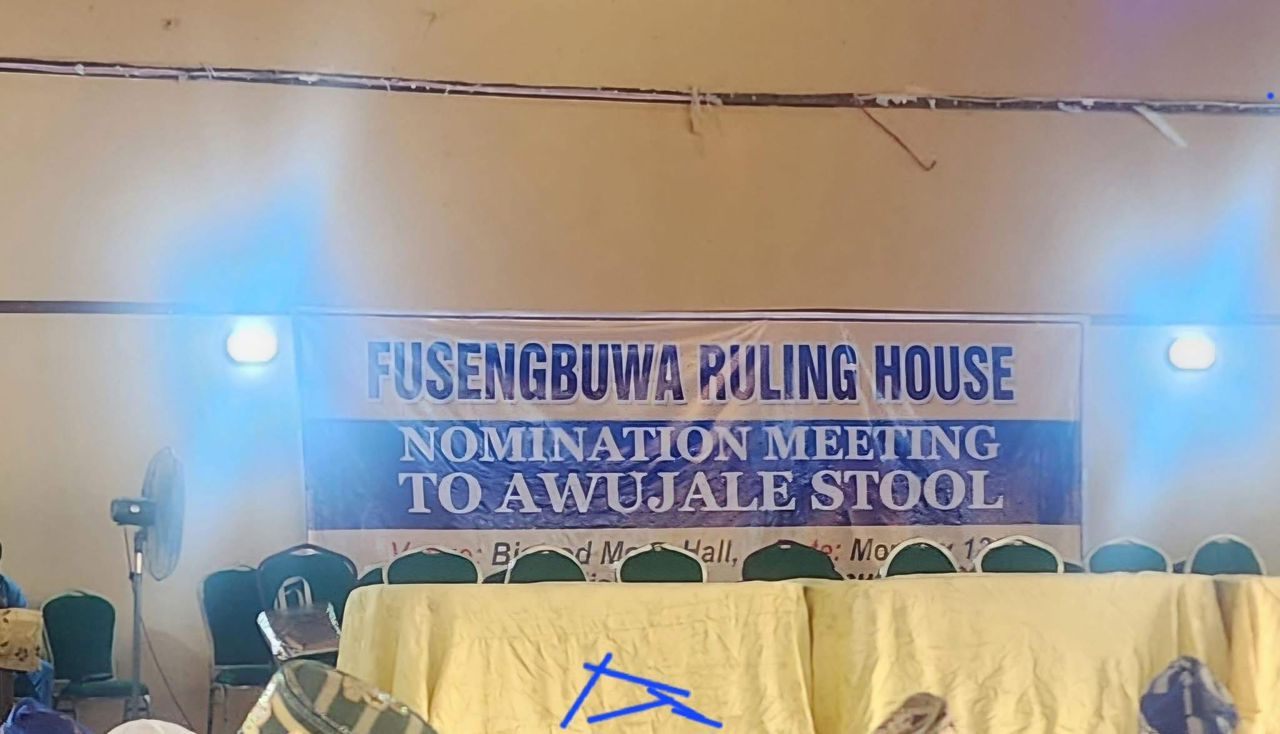
The Fusengbuwa Ruling House had shortlisted 95 contestants—including 94 princes and one princess—during a nomination meeting held at Bisrod Hall, GRA, Ijebu Ode.

The selection process has attracted widespread interest, including from Fuji musician Ayinde, popularly called KWAM1, who had sought an interim injunction at the state high court to stop the selection proces.

On Wednesday, the Regent and head of the Awujale Interregnum Administration Committee, Dr Sonny Kuku,  confirmed that the government had temporarily paused the process.

“Today, we received a message from the government indicating that the process has been temporarily halted. At the moment, we do not know the reason, but we are consulting with them to ensure the process resumes because the general members of the public are waiting for the emergence of the new Awujale,” he said.

See also  Army to establish new training depot in Abakaliki – COAS

“We will do our best to ensure that the process resumes because the general members of the public are waiting for the emergence of the new Awujale.

“The kingmakers cannot say much at this time because we have a very onerous task. We are confident that the government is also interested in ensuring a peaceful outcome. We are consulting with them, and we believe that something will happen soon.”

Speaking on reports suggesting government interference, the regent said that the kingmakers are unaware of any such move and that such reports should be treated as mere speculation.

He added that the kingmakers are fully aware of the weight of their responsibility and would therefore not betray the confidence reposed in them by tolerating any act of imposition.

Kuku further stated: “The government does not sit with the kingmakers during deliberations. We do not work with them directly, and as you know, in situations like this, there are always many rumours.

“We try to separate fact from speculation. If any form of imposition occurs, we will certainly let the public know, because we will not tolerate that. However, that has not happened.”

On the presence of heavy security personnel at the Awujale palace, Kuku said it should not be viewed as an attempt to influence the process, but rather as a measure to inform the public that the selection process has been temporarily halted.

He explained: “The palace is a symbol of the people, and by barricading it, the authorities are making it clear that the process is temporarily in abeyance.

“There is no physical or emotional conflict taking place. We hope the palace will be reopened very soon because we want to avoid any anxiety among the people. Our goal is peace, and that we shall achieve by God’s grace.”

Kuku also said that the kingmakers have not received any of the petitions reportedly written by stakeholders and security agencies regarding the Awujale selection process, which the government cited as the reason for halting it again on Wednesday.

See also  Details Of Nigeria‑US Military Partnership After CPC Redesignation

The regent said: “If such petitions exist, they should be forwarded to us, but we have not received any. That is why we are consulting with the government. Once discussions are concluded, we will make a statement as quickly as possible. There is nothing to worry about.

“As kingmakers, we are handling a very delicate responsibility. Our decisions can affect the lives of the people for centuries to come, so we are being extremely careful about what we do and say. We assure you that we will ensure peace and that the best person emerges as the next Awujale.”

Kuku also dismissed claims that the kingmakers have been compromised or are favoring a particular candidate, saying they are instead working tirelessly to ensure that only the best candidate is selected.

The renowned medical doctor said: “Let me be clear: we have not slept for five days. We are dealing with about 95 applications and over 1,200 documents, scrutinizing them meticulously.

“We are working diligently to ensure we select the best possible candidate. If we were biased, we would not be spending sleepless nights reviewing documents so thoroughly.

“We had planned to continue this process for several more days, and we are prepared for more sleepless nights. The criteria we have developed are meant to produce a leader who truly represents the people and will bring progress to the community.

“We still expect a few more sleepless nights, but for now, we may be able to rest briefly before the process resumes.”

DSS to profile aspirants

On Wednesday, the DSS confirmed that the 95 nominees were scheduled for profiling at their office in Ijebu-Ode. The exercise was planned to follow palace screening and run over several days to cover all nominees. The profiling is part of a comprehensive vetting process for aspirants to the Awujale stool.

See also  Tinubu recalls NTA DG, ED news, reverses fresh appointments

However, the exercise was suspended in line with the state government’s directive halting the Awujale selection process. The DSS stressed that the suspension is a government decision and not an action initiated by the agency.

Aspirant writes Abiodun

A contender to the Awujale stool, Mr. Wasiu Adewale Olasunkanmi Adesanya, formally wrote to the Ogun State Government, urging that the halted process be resumed inclusively, transparently, and fairly.

In a letter dated January 21, 2026, addressed to the Commissioner for Local Government and Chieftaincy Affairs and signed by his counsel, Dr. Wahab Shittu, SAN, Adesanya expressed appreciation to the government for suspending the process “in the interest of peace, order and good governance.”

He maintained that he is a qualified contender by virtue of his descent from the Fusengbuwa Ruling House, tracing his lineage to Princess Anifowoshe, an acknowledged princess of the ruling house. The letter noted that his family has long-standing recognition in Ijebuland’s traditional hierarchy and that Adesanya holds the traditional title of Olori-Omoba of Ijebuland.

He urged the government to ensure that no eligible contender is excluded when the process resumes, adding:

“We respectfully urge the Ogun State Government that, upon the resumption of the Awujale selection process, such process should be all-inclusive, transparent and fair, and should consciously eschew any act or omission capable of excluding or disenfranchising our client. An inclusive process will promote unity within Ijebuland, enhance public confidence, and further entrench the prestige and legitimacy of the Awujale stool.”

The Ogun State Government had earlier halted the process under powers contained in the Obas and Chiefs’ Law of 2021, citing procedural concerns and the need to preserve peace in Ijebuland.

punch.ng

FOLLOW US ON:

FACEBOOK

TWITTER

PINTEREST

TIKTOK

YOUTUBE

LINKEDIN

TUMBLR

INSTAGRAM

Continue Reading
Click to comment

Leave a Reply

Your email address will not be published. Required fields are marked *

News

‘If You’ve Removed Subsidy, Why Still Borrowing?’, Emir Sanusi II Queries Federal Govt’s Fiscal Strategy

Published

on

The 16th Emir of Kano, Muhammadu Sanusi II, has questioned the Federal Government’s continued reliance on borrowing despite the removal of petrol subsidy, warning that poor fiscal discipline could erode the gains of recent reforms.

Speaking in an interview with News Central TV on Friday, the former Governor of the Central Bank of Nigeria (CBN) said while the removal of fuel subsidy and the liberalisation of the exchange rate were necessary, their timing and implementation remained problematic.

“If you’re not paying the subsidy and you’ve got the money, why are we still borrowing and borrowing? What are we borrowing for?

“I have always said the subsidy regime was unsustainable. We cannot continue supporting foreign refineries. We’re an oil-producing country. Keeping refineries open abroad while we’re not doing our own,” Emir Sanusi II said.

He, however, expressed optimism over Nigeria’s shift toward domestic refining, noting that the country has moved from being a major importer of petroleum products to an exporter.

“Today, we have a situation where we have our own domestic refinery. We’re not importing petroleum products. We’re even exporting to Europe, and this is very good for the economy,” he added.

Despite supporting the reforms, Sanusi II raised concerns about sequencing, arguing that policy execution without proper monetary tightening contributed to the naira’s sharp depreciation.

“Artificial exchange rates, especially when you’re printing money, cannot work. There was going to be a devaluation,” he said.

“For me, removing subsidy or liberalising exchange rates, these are good interventions. Were they done at the right time? Those are certain questions.”

See also  Lagos women plan nude protest over ancestral home destruction

He explained that implementing exchange rate liberalisation in a “loose monetary environment” worsened currency instability.

“If you decide to remove subsidy and liberalise exchange rates… before you have tightened money supply, the naira drops to a bottomless pit. That was a timing issue,” he said.

The monarch further challenged the government’s fiscal direction, questioning the rationale behind continued borrowing.

“We’ve removed the subsidy… what we should now see is fiscal consolidation. You cannot remove wastages and continue borrowing,” he said.

His remarks came amid concerns over Nigeria’s rising debt profile. Reports indicated that the Federal Government has increased its 2026 borrowing plan by ₦11.31 trillion, bringing the total to ₦29.20 trillion.

President Bola Tinubu also recently sought Senate’s approval for a fresh $516 million loan to fund the Sokoto–Badagry Superhighway project, further fuelling debate over the country’s fiscal direction.

FOLLOW US ON:

FACEBOOK

TWITTER

PINTEREST

TIKTOK

YOUTUBE

LINKEDIN

INSTAGRAM

Continue Reading

News

FG raises allowances, boosts welfare for civil servants

Published

on

The Federal Government of Nigeria has approved a sweeping increase in peculiar allowances and other welfare benefits for civil servants, in a move aimed at improving take-home pay and boosting morale across the public service.

The announcement was made on Friday by the Head of the Civil Service of the Federation, Didi Walson-Jack, during a press briefing in Abuja, where she outlined key reforms endorsed by the Federal Executive Council.

According to Walson-Jack, the review affects workers under both the Consolidated Public Service Salary Structure (CONPSS) and the Consolidated Research and Allied Institutions Salary Structure (CONRAISS), ensuring a broad-based impact across all cadres.

She said the revised peculiar allowances have been structured to reflect across all grade levels, resulting in a meaningful increase in earnings for both junior and senior officers.

In addition, the government approved an upward review of several key allowances, including duty tour allowance (DTA), estacode, and book allowance. Walson-Jack noted that virtually all allowances listed under the Public Service Rules have now been revised.

A major highlight of the reform is the approval of 100 percent Duty Tour Allowance for civil servants attending approved training programmes, regardless of whether travel is involved.

“Even if you are based in Abuja and attend training within Abuja, you are entitled to full DTA,” she said.

Beyond salary-related adjustments, the government also introduced a new exit benefit scheme for retiring civil servants under the Contributory Pension Scheme. The scheme provides 100 percent of a retiree’s total annual emoluments as an exit package, in addition to their pension, effective January 1, 2026.

See also  Tinubu recalls NTA DG, ED news, reverses fresh appointments

Walson-Jack described the move as a step toward ensuring dignity in retirement, stressing that no public servant should leave service without adequate financial support.

The government also confirmed the operationalisation of the Employee Compensation Scheme, designed to provide financial protection for workers who suffer job-related injuries or death.

The reforms come amid growing calls from labour unions for improved welfare, as rising living costs continue to put pressure on workers. Analysts say the combined measures could significantly enhance financial stability for civil servants and improve overall productivity in the public sector.

punch.ng

FOLLOW US ON:

FACEBOOK

TWITTER

PINTEREST

TIKTOK

YOUTUBE

LINKEDIN

INSTAGRAM

Continue Reading

News

Wiretapping: El-Rufai pleads not guilty, faces fresh charges

Published

on

The Federal Government, on Thursday, expanded the criminal case against former Kaduna State Governor, Nasir El-Rufai, introducing fresh allegations bordering on interference with critical national infrastructure and unauthorised access to classified information.

The new counts are contained in a further amended five-count charge filed on April 13, 2026, before the Federal High Court in Abuja, replacing an earlier three-count charge instituted on February 16, 2026.

At his arraignment on Thursday before Justice Joyce Abdulmalik, El-Rufai, however, pleaded not guilty to all counts after the court granted the prosecution’s request to substitute the initial charge.

The Department of State Services, through its counsel, Oluwole Aladedoye (SAN), told the court that the amended charge significantly revised the allegations against the former governor, urging the court to adopt the new processes.

Unlike the earlier charge, which focused mainly on alleged unlawful interception of communications, the fresh counts introduce a broader national security dimension.

In count one of the amended charge, the prosecution accused El-Rufai of “intentionally and unlawfully interfer[ing] with the communication” of the National Security Adviser, Nuhu Ribadu, describing the communication channel as part of Nigeria’s critical national information infrastructure.

The charge states that the alleged act contravenes provisions of the Designation and Protection of Critical National Information Infrastructure Order, 2024, and is punishable under the Cybercrimes (Prohibition, Prevention, etc) Amendment Act, 2024.

In a separate and newly introduced count, the prosecution alleged that El-Rufai, “without authorisation, intentionally secured access to classified information” relating to Ribadu, including details of his arrest and detention order issued on February 12, 2026.

This count marks a shift from the earlier framing of the case, which was limited to claims of intercepted communications, to a more serious allegation involving breach of classified state information.

The amended charge also retains and restructures earlier allegations. Count four accuses the defendant of unlawfully intercepting the NSA’s communications, while count five alleges that he and others still at large used technical systems that compromised public safety and national security, thereby instilling fear among Nigerians.

See also  Veteran labour activist, Comrade Abiodun Aremu, d!es after hit-and-run in Ota

Part of count four reads, “That you, Mallam Nasir El-Rufai, adult, male, intentionally and without authorisation, intercepted the communications of the National Security Adviser, Nuhu Ribadu, as admitted by you on 13th February, 2026, while appearing as a guest on Arise TV Station’s Prime Time Programme in Abuja… and thereby committed an offence contrary to and punishable under Section 12(1) of the Cybercrimes Act.”

Count five further states, “That you… did use technical equipment or systems which compromised public safety, national security and instilling reasonable apprehension of insecurity among Nigerians… and thereby committed an offence contrary to and punishable under Section 131(2) of the Nigerian Communications Act, 2003.”

The February charge had contained only three counts, focusing on alleged admission of unlawful interception, failure to report individuals involved, and actions capable of undermining public safety.

However, the amended charge introduces two additional counts and separates previously combined allegations into distinct offences, effectively broadening the scope of criminal liability.

Defence counsel, Oluwole Iyamu (SAN), confirmed receipt of the amended charge and did not oppose its substitution.

Following this, the court struck out the earlier charge and proceeded with the fresh arraignment.

After the plea was taken, the prosecution applied for an accelerated hearing, seeking three consecutive trial dates.

The defence objected, arguing that El-Rufai’s access to legal counsel could be affected due to his custody under the Independent Corrupt Practices and Other Related Offences Commission.

The defence also drew the court’s attention to a pending bail application filed on February 17, noting that an earlier missing affidavit had been located.

The DSS informed the court that it was not opposing the bail request.

In another application, the prosecution sought to shield the identities of two witnesses, requesting that their names be replaced with pseudonyms in court records, citing security concerns.

See also  Benue Assembly suspends ex-Speaker Dajoh over Alia impeachment plot

The defence opposed the request, insisting that it violated the defendant’s constitutional right to know his accusers and that no concrete threat had been demonstrated.

Further arguments arose over access to proof of evidence, with the defence urging the court to compel disclosure to enable proper preparation for trial.

The prosecution opposed the application, describing it as procedurally misplaced.

The defence also filed a motion seeking to quash the amended charge, while the prosecution asked the court to dismiss it as lacking merit.

After listening to both sides, Justice Abdulmalik adjourned the matter to May 18, 19 and 20, 2026, for hearing.

Bail bid fails

The PUNCH gathered that the Kaduna State High Court refused El-Rufai’s bail application on the grounds that the seriousness of the allegations against him, as well as concerns over possible interference with investigations, outweighed the arguments advanced for his release.

The ruling was delivered on 21 April 2026 by Justice D.H. Khobo of the Kaduna Judicial Division in Charge No: KDH/KAD/ICPC/01/2026, filed by the Federal Republic of Nigeria through the ICPC.

El-Rufai had approached the court via a motion dated 25 March 2026, seeking bail “either on self-recognisance or upon such liberal terms as the court may deem fit.”

His application, brought under Sections 35(4) and 36(5) of the 1999 Constitution (as amended) and provisions of the Kaduna State ACJL 2017, argued that the offences were not capital in nature and, therefore, carried a presumption in favour of bail.

He further contended that he had strong community ties, fixed addresses, and substantial assets, which, according to him, eliminated any risk of flight.

El-Rufai also told the court he voluntarily returned from Egypt on 16 February 2026 to honour an EFCC invitation, and argued that the amended charge was “fundamentally defective” and “unintelligible.”

He also raised health concerns, claiming he required specialist medical attention.

See also  Army to establish new training depot in Abakaliki – COAS

The ICPC opposed the application through a nine-paragraph counter-affidavit deposed to by Idris Abubakar, insisting that the offences were serious and “economically sabotaging.”

The anti-graft agency argued that the former governor posed a flight risk, adding that there was a likelihood he could interfere with witnesses and ongoing investigations involving other suspects.

It also alleged an incident at the Nnamdi Azikiwe International Airport, Abuja, on 12 February 2026, where El-Rufai allegedly obstructed law enforcement officers.

The ICPC further dismissed his medical claims, stating that no supporting medical report was provided.

In his ruling, Justice Khobo held that the gravity of the nine-count charge, coupled with allegations of interference and obstruction, made bail inappropriate at this stage.

The court stated, “In the instant application, given the gravity of the nine-count charge against the defendant/applicant, the respondent’s credible apprehension regarding the interference with the ongoing investigations linked to other persons still at large… the interest of justice is best served by ensuring the applicant remains available for an accelerated trial.”

The judge also faulted the defence on health grounds, noting, “The applicant in my view has failed to provide sufficient medical evidence to justify the grant of bail on health grounds.”

Consequently, the court held, “Accordingly, the defendant/applicant’s application for bail pending trial fails and is hereby refused.”

Justice Khobo ordered that El-Rufai “shall remain in the custody of the respondent (ICPC) pending the commencement of the trial,” while directing that proceedings be conducted on an accelerated basis.

The court also fixed June 1, 2, 3 and 4, 2026, for day-to-day hearing, following what it described as a consensus between prosecution and defence counsel.

For now, the former governor remains in ICPC custody as the substantive trial awaits commencement.

punch.ng

FOLLOW US ON:

FACEBOOK

TWITTER

PINTEREST

TIKTOK

YOUTUBE

LINKEDIN

INSTAGRAM

Continue Reading

Trending