Connect with us

Lifestyle

No other country sees daily killings like Nigeria – Kukah

Published

on

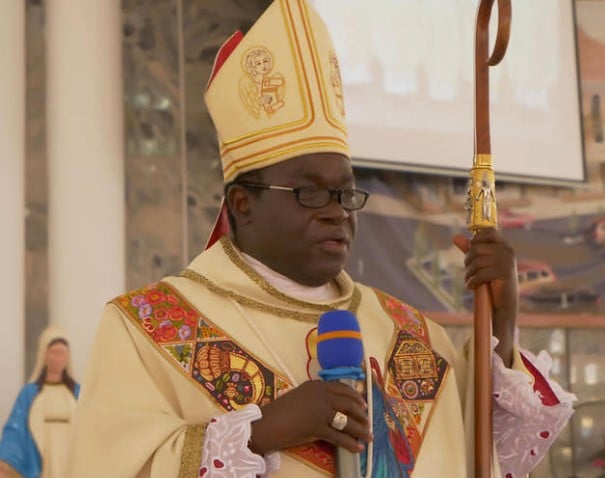
The Bishop of the Catholic Diocese of Sokoto, Most Reverend Matthew Kukah, has expressed concern over the daily killings in Nigeria, describing the situation as unparalleled globally.

Speaking in Yola, Adamawa State, at the launch of a book on Governor Ahmadu Fintiri titled ‘The Man They Could Not Stop’, authored by his former Director General of Media and Communication, Solomon Kumangar, Kukah said the country is divided along religious lines, a situation he said is exacerbated by Western media narratives.

“What is happening in Nigeria cannot happen in Sudan, Cameroon, Niger, Ghana, or any other country in the world,” Kukah said. “There is no other country in the world that 10 people are killed on Monday, 50 on Tuesday, 100 on Wednesday, and the killings go on every week. How can such a country move forward?”

He added, “Only in Nigeria do people die as Christians and Muslims. The Western media is fuelling the killings along religious lines — 20 Christians killed, 30 Muslims killed.”

Kukah called on political and religious leaders to build institutions that unite Nigerians for peace and the country’s development.

He also commended former Chairman of the Independent National Electoral Commission, Prof. Attahiru Jega, for intervening in the 2023 governorship crisis in Adamawa State.

At the event, former Senate President and ex-Kwara State governor, Bukola Saraki, urged Nigerians to prioritise leaders with strong leadership qualities over political affiliations.

“The country can only move forward when the right people are given the chance to pilot its affairs,” he said, adding that Fintiri’s infrastructural footprint shows he is prepared for leadership.

Nassarawa State Governor, Abdullahi Sule, who chaired the ceremony, encouraged Fintiri to join the All Progressives Congress, saying the party’s expansion had reached Adamawa State.

See also  Alhaji Usman Faruk: First Military Governor of North-Western State

“If I come with the APC cap and flag, I would hand it to you today as our new member,” he said.

Governor Fintiri described himself as a “man of destiny,” reflecting on the 2023 elections.

“There were numerous futile shots at stopping me. The 2023 election was just the height of them, and an embarrassing one, not only to the state but to the nation and to democracy globally. In 2023, we saw treachery; we saw assault; we saw the moral compromise of a bankrupt elite masked as patriots. But most importantly, we saw support and resilience of the true Adamawa people and friendships that go beyond the state.”

He continued, “If 2023 had not happened, I wouldn’t have known some people for who they are: pretentious, greedy, opportunistic, and desperate, yet crying the victim and still claiming democratic credentials they are distant from. The sad news is that this clique of pretenders and political puppeteers are still around, shuttling between Yola and Abuja, shamelessly and dangerously hovering around our democracy. We must, as we did in 2023, resist them with our votes and unmask them to the world.”

The book launch was attended by governors of Bauchi, Bala Mohammed; Nassarawa, Abdullahi Sule,, the deputy governor of Oyo, and representatives from Gombe, Borno, Yobe, Taraba, and Plateau states.

Deputy National Vice Chairman (North-East) of APC, Mustapha Salihu, unveiled the book and urged Adamawa residents to continue supporting Fintiri’s developmental projects.

punch.ng

FOLLOW US ON:

FACEBOOK

TWITTER

PINTEREST

TIKTOK

YOUTUBE

LINKEDIN

TUMBLR

INSTAGRAM

Continue Reading
Click to comment

Leave a Reply

Your email address will not be published. Required fields are marked *

Lifestyle

Makoko demolition: When economic interest overrides humanity

Published

on

When American missionary and science teacher, Jack Kyle, arrived in the mega slum of Makoko, Lagos in August 2023, I doubt if he ever thought that one day, his love for slum dwellers and the underserved would never find expression in the area, at least not among the tough-skinned ones living on the dirty lagoon at the backyard of the Ebute Meta area of the mega city. Sixty-year-old Kyle, who left his family of five children and lovely wife in Manhattan, Kansas, United States, didn’t settle in Makoko because of his love for the ghetto, but to be able to add positive values to the lives of these strange fellows in their ‘natural habitat’.

Apart from building a ‘house’ that cost about $4,000 in the community for himself and other volunteers, the American missionary, who defied the opposition of family members back home to embark on this treacherous journey, ensured that, from rainwater, he was able to provide clean water for some residents using solar power. He equally had plans for aquaculture and sewage-to-menthane gas, among other utilities, ignored by the relevant authorities.

At a time in the past, I wondered if the throng of willing donors never had any other locations, orphanages and struggling public schools, apart from this waterfront ghetto, where their supports are much needed both in Lagos and beyond. The little contributions of Kyle and several other Nigerians – individuals and organisations – in helping the slum dwellers in Makoko have sadly gone down the lagoon, where the residents and landlords once had their log houses.

Some years back, a few heads of a few organisations truly took the support of their organisations outside Lagos in order to reach out, no matter how little. A financial institution with its headquarters in Lagos ‘adopted’ a private school in Abuja where the organisation pumped in money like water from a big tap. It wasn’t until the school was involved in a big crisis that the undiscerning minds among us knew that the school actually belonged to the Oga Patapata of the organisation which had adopted the school. A few years later, the chairman of the board took a loan of N120bn to buy a Disco that the Goodluck Jonathan government put on sale, and of course, refused to pay back. And you think such an organisation wouldn’t go under?

See also  How I had twins naturally after 40 years’ marriage — 63-Year-Old midwife

Do you equally want me to tell you about the ‘adoption’ of the private school of the late wife of a living former military president, where the Niger State Government paid the salaries and other expenses of the private institution for years before such brazen impunity was discovered? Could it be because the founder of the school had died? Nigerians love to help in wonderful ways, you know! Let’s go back to Makoko for now, please.

Ever since I noticed this curious settlement from the vantage view of the Third Mainland Bridge, I never ceased to wonder if real humans actually lived in those shanties until it became clear that all manners of fishermen – Ijaws, Beninese, Ghanaians, and their families – had their abode in the Makoko floating slum. You will be dead wrong if you believe the massive ghetto housed fishermen alone. There were schools, a big orphanage, churches, and others, mostly established by private individuals, charitable groups, corporate entities and organisations.

While the location was conducive for the occupation of the residents and providing contents for local and visiting bloggers, it had long been an eyesore. So, the end of this kingdom, if it hadn’t been foretold by some of our self-styled prophets, had been long in coming. The inevitable end came in January courtesy of its demolition by the Lagos State Government, which is not in any way new to demolitions and land reclamation by the way.

In some other parts of the world, pets (and other animals) almost have the same right to life and decent living as their human owners. Imagine driving on a highway (not Nigerian highway o), and you are warned of ‘deer crossing, apply caution’! God helps you if you are unfortunate enough to run into any deer. Imprisonment or deportation beckons or both, depending on your immigration status. In broad daylight, some squirrels deliberately torment your imagination as they playfully jump from one tree branch to another and sometimes take over a small field by your residence. May God deliver you from those deadly thoughts you are entertaining at the moment – in case you are thinking of breaching their ‘animal’ rights.

In our dear country, however, the case is different for a simple reason. We tend to act before we think about the consequences, no matter how fatal the outcome may be. Some of the reactions the Makoko demolition has attracted may sound political, especially from those who seek to reap political capital from this and other sad episodes. The underbelly of this demolition is that we have collectively lost our sense of humanity, not that we have ever prioritised our lives and our living at any time before now.

See also  Phebean Ajibola Ogundipe: The Educator Who Shaped English Learning in Nigeria

It may interest you to know that Makoko isn’t the first slum to be demolished with the same sense of insensitive logic. During the military era, the Maroko slum (now Lekki) was levelled on the orders of then-Col. Raji Rasaki, the military administrator, who acted with ruthless alacrity in 1990. In July 2012, thousands of residents were displaced when a part of the Makoko ghetto was turned upside down. In March 2016, no fewer than 3,000 were sacked in Mosafejo, Ajegunle, allegedly on short notice.

Otodo Gbame, a Lekki waterfront ghetto, suffered the same fate between November 2016 and April 2017, where 30,000 were said to have been evicted, and the shanties housing them were demolished. There were claims that no fewer than 11 lives were lost. Ilubinrin, a neighbourhood of Obalende/Osborne, Ikoyi, wasn’t spared the same year from the reclamation of more land. Ilaje Otumara fell in March 2025, while the Itesiwaju Ajumoni in Oworonshoki followed suit in October, drawing a massive outcry and protests.

Uncle, are you saying the government should have left those squalid settlements to thrive side-by-side with our much-desired megacity, especially when the Makoko slum, which is the focus here, is expectedly illegal in every sense? Not at all! I was taught as far back as my secondary school days that the government holds power in trust for the people, and the same government has a responsibility to protect and provide social services for the people who put them in power.

It then presupposes that the government of the day must ensure that, apart from ensuring that it protects its citizens from any harm under whatever circumstances, adds value to their living standards and must equally incorporate their interests into governance. With the manner in which the Lagos State Government has dispatched these illegal slum residents of Makoko, I bet my social studies teachers might need to revisit their notes or question their own teachers if they are still alive to take their angry questions.

See also  Alhaji Usman Faruk: First Military Governor of North-Western State

I happen to be one of the apolitical Nigerians who have a lot of good words for the Lagos State Government in terms of its forward-looking development strides, no-delay project execution and its consistent security arrangements that have ensured that the state can live in relative peace, especially when compared to other states. But may I ask when it becomes a fashion for a supposedly progressive and responsive government to throw out people and their families into the lagoon, demolish their shelters and their minimal facilities provided by private individuals and groups without any safety valve?

I’m sure you may like to ask why the government should help these distressed families to settle down, even in temporary camps, till they find their feet again. They are human beings created in the image of God as those in power. They are citizens of this great nation (I know some of them are from Ghana, Togo and the Benin Republic) who deserve to be protected and have a right to decent living so that they can put the pieces of their lives together. There are children in ghetto schools and orphanages who also aspire to rise in life and deliver their families from the slum and the stranglehold of poverty. In what ways are their interests protected or considered in these mindless demolitions?

You may equally like to find out how the few lucky ones displaced by previous demolitions have fared in their much-trumpeted new settlements in Jakande (Ajah) and Ikorodu, which are pitiably drops in the ocean? It is no longer news that the state government is pressed for land in all areas, having to contend with the lagoon, the ocean and Ogun State on all sides. These boundaries should not be an excuse to allow economic and political banditry to override our sense of humanity, as if blood does not flow in the veins of our leaders. So, happy land reclamation in pursuit of our megacity!

Continue Reading

Lifestyle

Murtala Muhammed’s simplicity led to his assassination – Daughter

Published

on

Aisha Muhammed, daughter of former Head of State, General Murtala Ramat Muhammed, has said her father’s simple lifestyle and leadership approach contributed to the ease with which he was assassinated.

Muhammed, who is also the Chief Executive Officer of the Murtala Muhammed Foundation, said this while speaking on ARISE News’ Morning Show on Monday.

Reflecting on her father’s leadership style on the 50th anniversary of his assassination, she said the late military leader embodied the values he preached, particularly accountability, responsibility and discipline.

She said her father believed corruption was a “cankerworm” capable of destroying society and did not merely speak against it but lived out his anti-corruption stance through his personal conduct and leadership style.

“I think his (late Muhammed’s) leadership style was clear. He led with clarity. He believed in accountability.

“He believed in responsibility, you know, and then, you know, we’re all very familiar with his anti-corruption stance, you know, and corruption was not something you sort of just talked about.

“He actually literally felt that it was a cankerworm that was going to destroy our society, and 50 years later, look at what has happened.

“But I also think that he felt that you had to embody the leadership, you know, in the way you yourself presented yourself,” Muhammed said.

According to her, Murtala Muhammed deliberately avoided the trappings of power, including heavy security details, motorcades and sirens, insisting on living like the ordinary Nigerian.

This lifestyle, she said, directly contributed to his assassination on February 13, 1976.

See also  Alhaji Usman Faruk: First Military Governor of North-Western State

Aisha Muhammed noted that he was travelling in traffic like every other road user when the attack occurred.

“If you know, my father didn’t go around with motorcades and sirens and a lot of security. Now, there are people who say to me, 50 years later, it must have been quite painful because of the loss, but that was what he embodied.

“So, and that was why it was actually easy to assassinate him, because he didn’t have a whole slew of security with him.

“He was in traffic just like everybody else. In fact, the traffic wardens stopped them, and they stopped, just like everybody else, and that was when the coup plotters came out from behind the sectarian barricade, and then he was shot,” she said.

General Muhammed seized power in a bloodless coup in July 1975, ousting General Yakubu Gowon.


FILE: General Murtala Ramat Muhammed

He was, however, assassinated during an abortive coup on February 13, 1976, barely six months after assuming office as Nigeria’s Head of State.

During his brief 200-day tenure, Muhammed implemented sweeping reforms, including the dismissal of over 10,000 public officials accused of corruption, the creation of seven new states, and plans for a transition to civilian rule.

His administration also initiated the process that led to the relocation of Nigeria’s capital from Lagos to Abuja.

FOLLOW US ON:

FACEBOOK

TWITTER

PINTEREST

TIKTOK

YOUTUBE

LINKEDIN

TUMBLR

INSTAGRAM

Continue Reading

Lifestyle

Adunni Oluwole: The Fearless Yoruba Woman Who Warned Nigeria Against Independence

Published

on

Adunni Oluwole remains one of the most controversial and intriguing figures in Nigeria’s late colonial political history. At a time when nationalist leaders were mobilising the masses for immediate self-rule, Oluwole stood almost alone as a vocal opponent of rapid independence, arguing that Nigeria was not yet prepared for the responsibilities and dangers that would follow the departure of British colonial administration.

Born in 1905 into the family of an Ibadan warrior, Adunni Oluwole’s reputation for fearlessness was rooted in both her upbringing and her temperament. Her early life was partly spent under the care of Bishop Howells of St John’s Church, Aroloya, Lagos, after which she grew up in Mushin. From a young age, she showed signs of independence and creativity. As a youth, she wrote a highly successful play for the Girls’ Guild of St John’s Church, Lagos, which was directed by Herbert Macaulay, one of Nigeria’s foremost nationalists. She later distinguished herself as the only woman to found a professional theatre company in Western Nigeria, using drama as a tool for social and political commentary.

Oluwole rose to national prominence during the General Strike of 1945, a defining moment in Nigeria’s labour and nationalist movements. When the colonial government withheld workers’ salaries, she mobilised women to support the striking workers and personally donated funds to trade unions to help them cope with the crisis. Her actions earned her recognition as a powerful grassroots organiser with strong appeal among ordinary people, particularly women and rural dwellers.

Politically, Adunni Oluwole was a committed unitarist and a fierce critic of the Nigerian political elite. In 1954, she founded the Nigerian Commoners Party, a movement that opposed the rapid transfer of power to Nigerians, which she believed would only replace British colonialism with what she described as “internal colonialism” by indigenous elites.

See also  Tai Solarin: Pioneer of Non-Religious Education in Nigeria

Despite being a woman in a male-dominated political space, she won a seat in Ikirun, in present-day Osun State, during the 1954 Western Region House of Representatives election, defeating candidates from both the NCNC and the Action Group led by Nnamdi Azikiwe and Obafemi Awolowo respectively.

Her views shocked many Nigerians. Among Yoruba-speaking communities, her movement became mockingly known as Egbe Koyinbo Máílò—“The White Man Must Not Go”. Yet her message resonated with sections of the rural population who were already burdened by taxation and wary of elite politics. Oluwole argued that independence, if poorly managed, would lead to dictatorship, corruption and the oppression of the masses.

Her confrontational style brought her into direct conflict with powerful figures. On 25 August 1955, she presented her views at the palace of the Olubadan of Ibadan, where she was publicly insulted and threatened by Ibadan politician Adegoke Adelabu.

Following her banishment from Ibadan, she continued her activism in Akure, staging dramatic public demonstrations in which she tied ropes around her waist and had hired men pull her through the streets as a symbol of the suffering she believed ordinary Nigerians would endure under post-colonial leadership.

Adunni Oluwole died in 1957 from complications related to whitlow, three years before Nigeria attained independence. Though widely dismissed and ridiculed in her lifetime, her warnings have since been revisited by historians and commentators who see in her activism an early critique of post-colonial governance in Nigeria. Today, she is remembered as a fearless woman who dared to challenge the dominant nationalist narrative and paid a heavy personal price for her convictions.

See also  GEN BENJAMIN ADEKUNLE, ONE OF NIGERIA MOST BRILLIANT AND DEDICATED MILITARY OFFICER.....

Source:
– Toyin Falola, The Political Economy of a Pre-Colonial African State: Ibadan, 1830–1900 (and related essays on Yoruba political culture).

– Tekena N. Tamuno, Nigeria and Elective Representation, 1923–1947.

– Nigerian historical archives and secondary literature on late colonial politics in Western Nigeria.

FOLLOW US ON:

FACEBOOK

TWITTER

PINTEREST

TIKTOK

YOUTUBE

LINKEDIN

TUMBLR

INSTAGRAM

Continue Reading

Trending