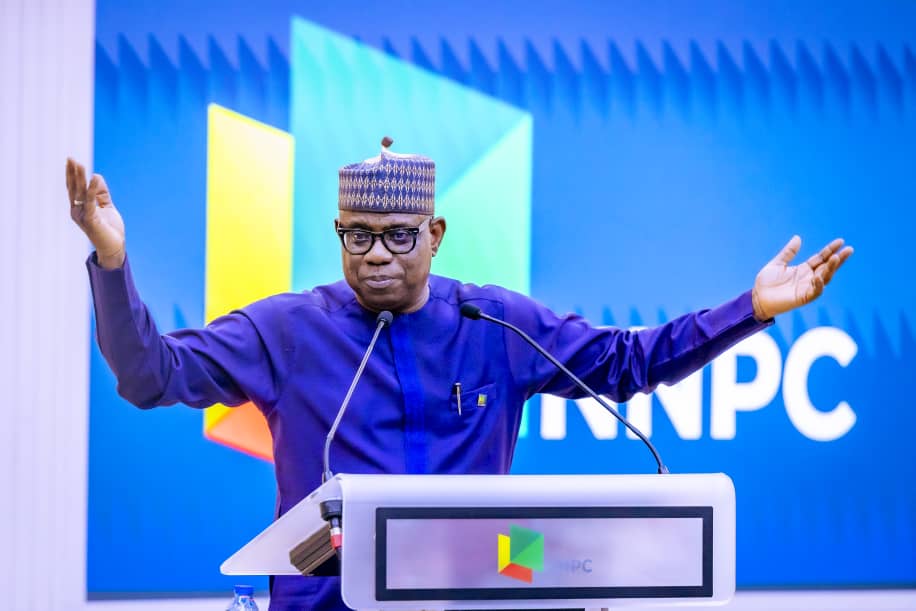
The Nigerian National Petroleum Company Limited, Group Chief Executive Officer, Bashir Ojulari, has lamented the crude and gas production losses resulting from the three-day strike carried out by the Petroleum and Natural Gas Senior Staff Association of Nigeria.
In a letter written to the Nigerian Midstream and Downstream Petroleum Regulatory Authority and Nigerian Upstream Petroleum Regulatory Commission, Ojulari explained that the suspended strike led to 16 per cent oil production and 30 per cent marketed gas losses, while the nation suffered a 20 per cent power supply shortfall.
The national oil company’s letter, dated 29 September 2025 and titled ‘Impact Assessment of ongoing industrial action,’ was also sent to the National Security Adviser and the Director General, Department of State Services.
The industrial action caused by a rift between the union and the Dangote Refinery forced the shutdown of major oil terminals, gas plants and power facilities, leading to the deferment of 283,000 barrels of crude oil per day and 1.7 billion standard cubic feet of gas daily, choking off vital income streams from the country’s two biggest revenue sources.
This came as the leadership of the union announced the suspension of its nationwide strike against Dangote Petroleum Refinery following the intervention of the Federal Government, even as it cautioned that the truce remained temporary and could be revisited if the pending issues were not addressed.
The PUNCH reports that both PENGASSAN and the management of the 650,000 refinery have been at loggerheads.
The rift stemmed from allegations by PENGASSAN that the Dangote Refinery engaged in mass transfers and sackings of union members, while also replacing some Nigerians with foreign nationals, claims the company consistently denied.
The refinery’s management stated that the workforce reorganisation was due to operational requirements and not related to union activities.
The standoff escalated when the union embarked on an industrial action by halting gas and crude oil supplies to the refinery, raising the alarm over potential disruptions to the nation’s energy supply and economic stability.
The Federal Government intervened over concerns about the impact of the dispute, citing the risk of “adverse effects on the economy and energy security,” and convened high-level talks to resolve the impasse.
Detailing the financial losses in the letter obtained by our correspondent on Wednesday, the NNPCL GCEO said industrial action resulted in significant production deferments.
Ojulari disclosed that, within the first 24 hours of the strike, as of September 29, 2025, production deferments stood at 283,000 barrels of oil per day, 1.7 billion standard cubic feet of gas per day, and more than 1,200 megawatts of power generation
According to him, this translates to around 16 per cent of national oil production, 30 per cent of marketed gas, and 20 per cent of electricity supply, with the impacts expected to intensify if the situation lingers.
“As of 29 September 2025 (within the first 24 hours of the strike), production deferments stood at approximately 283 kbpd of oil, 1.7 bscfd of gas, and over 1,200 MW of power generation impact. This equates to around 16 per cent of national oil output, 30 per cent of marketed gas, and 20 per cent of electricity generation. Should the situation continue, the impacts are expected to intensify, posing a material threat to national energy security,” the GCEO noted.
The gas sector also recorded heavy losses during the strike, with about 1.7 billion standard cubic feet per day taken offline. Industry data showed that this volume translates to roughly 1.7 million Mcf of gas daily, which, when converted at 1.037 MMBtu per Mcf, amounts to about 1.76 million MMBtu each day.
He further explained that at least five scheduled critical maintenance activities have been affected, with knock-on effects likely to worsen deferments in subsequent periods. These include the USAN turnaround maintenance, AKPO GT-3 pigging, H2 well tests, annual compressor maintenance and SEPNU EAP IGE.
Ojulari also revealed that about 100,000 barrels per day of crude oil and 1.341 billion standard cubic feet of monetised gas across Joint Venture and Production Sharing Contract assets, which were due to be restored this week, have now been delayed.
Ojulari noted that while a limited number of non-unionised staff were still facilitating crude exports, operations remained heavily constrained.
He warned that ongoing and scheduled lifting operations across the terminals were likely to suffer further financial setbacks in the coming months, raising the risk of demurrage claims by international buyers.
At the Brass Terminal, for instance, the loading of an NNPC cargo that was close to completion was stalled after documentation could not be finalised due to the strike. The delay, he said, had already triggered demurrage costs.
The NNPCL boss stressed that the financial toll was mounting rapidly, with significant revenue losses projected at current deferment levels.
According to him, missed crude lifting and disrupted gas sales were placing the company’s cash flow under “immediate and compounding pressure.”
“It is our considered view that the current industrial action has impacts that extend beyond the Dangote Refinery. The disruptions pose systemic risks to energy supply, personnel and asset security and the wider economy. A sustainable solution is required to prevent such an extensive interruption of the overall energy security infrastructure and to safeguard national energy security and stability,” he concluded.
Meanwhile, the PENGASSAN leadership explained that the decision to temporarily suspend the nationwide strike was taken out of respect for federal institutions and government mediation efforts, stressing that it was not a show of confidence in Dangote.
Osifo said the union was taking the “moral high ground” by bowing to government persuasion despite strong doubts about the sincerity of the Dangote Group.
Speaking at a news conference in Abuja on Wednesday, Osifo stated, “We are only suspending, not calling off this strike. If any part of this agreement is broken, we will not give any warning. We will immediately resume our suspended industrial action.”
He stressed that the industrial action was rooted in the fundamental right of workers to freedom of association, insisting that members joined the union “to secure better welfare and fair pay.”
According to him, PENGASSAN remains unsatisfied with aspects of the communique signed under the supervision of the Ministry of Labour, warning that the union’s patience should not be mistaken for weakness.
Osifo said, “Yes, we understand that Dangote does not respect the rules of engagement. Yes, we understand that Dangote wants to prove that he is always bigger than the rules and above the law. Yes, we understand that today, we still have some members working within the confines of the refinery.
“Yes, today, we still have some members working in some companies within the group. Yes, we know or we believe or we suspect that some of the things that the government has asked Dangote to do, that he’s going to slip in it and won’t do them just as he did to NUPENG. We have our suspicion.
“We truly don’t believe that he will keep to his own side of the bargain. We truly don’t believe that he will live up to expectations. We don’t believe. But because we have respect for institutions, because we have respect for government, because we have respect for processes, and because we have respect for procedures and because of those in government who sat up till almost 4 a.m. this morning to try and resolve this subject, the NEC has decided to listen to them. Even with our mutual suspicion that Dangote will not do what is right, even with our misgivings that the document did not clearly represent what we have asked for.
“But even with the shortcomings in the document, the National Executive Council of PENGGASAN has decided that they will go ahead to take the moral high ground, that we will go ahead to prove to the government that we are extremely patriotic people, that love this country more than any single individual, that we will go ahead to suspend the industrial action that we started on Sunday, 28th day of September 2025.”
He emphasised that the dispute was about the fundamental right of workers to freedom of association and fair pay.
“Remember, we are only suspending and we didn’t call off. We will be monitoring and following closely on any slip on the part of Dangote. If any part of this agreement, or any part of this communique as put up by the Ministry of Labour, is broken, we will not give any notice, we will not give any warning, and we will resume the suspended industrial action immediately.
“We have only suspended the industrial action in respect of the government of the land. As an institution, are we completely happy with what was provided? The answer for us is no,” he noted.
Osifo further dismissed claims that the union embarked on its nationwide strike at the Dangote Refinery because of check-off dues.
He said such suggestions were “laughable” and did not reflect the reality of the dispute.
“Some people asked if it was because of check-off dues that PENGASSAN went on strike. We laughed,” he said. “The salaries being paid to the 800 workers at the Dangote Refinery, if you add all of them together, are less than what 20 of our members earn in companies like Chevron, TotalEnergies or ExxonMobil. So, why should we chase them because of check-off dues?”
He stressed that the workers’ union contributions were too small to motivate such a large-scale industrial action.
“Their salary is meagre. Even if you combine their entire check-off dues, I doubt it amounts to what we collect from the smallest branch of PENGASSAN in the country. So, let’s be serious. This fight is not about dues. It is about the freedom of association and the welfare of our members,” Osifo added.
The PENGASSAN boss explained that workers at the Dangote Refinery willingly joined the union because they wanted improved welfare packages and conditions of service comparable to global oil and gas industry standards.
“They fully subscribed to join PENGASSAN because they want their lives to be better. That is why we accepted them, to raise their conditions of service, their pay, and their rights as workers. Any other narrative is zero,” he said.
Osifo also rejected suggestions that the union’s action could undermine the Dangote investment.
“That we want to kill Dangote’s investment? We laughed. Which investment are we going to kill? Shell has had over 10,000 PENGASSAN members and invested more than $200bn in Nigeria’s oil and gas industry. Chevron, TotalEnergies, and ExxonMobil have invested close to $200bn. Dangote has invested just about $20bn. Did we kill Shell or Chevron? No. We helped them to grow,” he stated.
He emphasised that PENGASSAN members formed the backbone of Nigeria’s oil and gas industry, which contributes more than 90 per cent of the country’s foreign exchange earnings and funds the monthly Federation Account Allocation Committee distribution.
On the truce reached following the Federal Government’s intervention, Osifo stated that the union was not entirely satisfied with the communique signed in Abuja.
“If you see that communique, it was signed only by the government. We were not satisfied with some of its contents. After examining it, we saw several grey areas and loopholes. We raised all our concerns, and the government gave us assurances they would be on top of them,” he explained.
punch.ng
FOLLOW US ON:
FACEBOOK
TWITTER
PINTEREST
TIKTOK
YOUTUBE
LINKEDIN
TUMBLR
INSTAGRAM