Connect with us

Lifestyle

Royal row: Alaafin may publish Supreme Court ruling after 48-hour ultimatum

Published

on

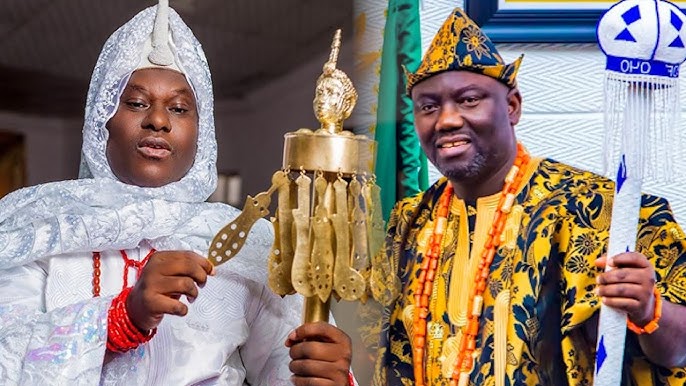
Following the expiration of the 48-hour ultimatum issued to the Ooni of Ife, Oba Enitan Ogunwusi, indications emerged on Wednesday that the palace of the Alaafin of Oyo, Oba Akeem Owoade, was preparing to release the Supreme Court ruling, which, according to it, affirms the Alaafin’s exclusive right to confer chieftaincy titles covering the entire Yorubaland.

This development came on the heels of a series of meetings held by the Alaafin with palace chiefs in Oyo town on Wednesday to deliberate on the next steps.

On Monday, the Alaafin’s media aide, Mr Bode Durojaiye, had demanded that the Ooni revoke the Okanlomo of Yorubaland title conferred on businessman, Dotun Sanusi, within 48 hours.

He also cited the Supreme Court ruling in defence of the Alaafin’s position.

The Alaafin accused the Ooni of exceeding his authority and breaching the apex court’s pronouncement on who could confer titles with the “Yorubaland” designation.

He argued that the Ooni’s powers were limited to the former Oranmiyan Local Government Area, now split into Ife Central, Ife North and Ife South.

With the ultimatum expiring on Wednesday, multiple palace sources told The PUNCH that the Alaafin might unveil the Supreme Court judgment to reinforce his position as the paramount ruler of Yorubaland.

On social media, many Nigerians speculated about the “consequences” hinted at by the palace, even as some urged the Alaafin to caution his aide and withdraw the ultimatum.

Amid the uncertainty, the Atóbaáse of Yorubaland, Babajide Agunbiade, said the Alaafin retained historical and political supremacy among the Yoruba. He advised the monarch to consider legal action to reassert his authority.

In an open letter, Agunbiade stressed that while the Ooni remained revered as custodian of Yoruba spiritual heritage, the Alaafin’s role as paramount ruler was indisputable.

He traced the Alaafin’s authority to the Oyo Empire, whose influence once extended across present-day Yorubaland, Dahomey, Offa and parts of Kogi State.

Agunbiade described recent actions by the Ooni of Ife as “an attempt to undermine the authority and tradition of the Alaafin.”

See also  Obafemi Awolowo - The best president Nigeria never had

Agunbiade wrote, “As the paramount ruler of the Oyo Empire, which historically spanned vast territories including present-day Yorubaland, Dahomey, Offa, and parts of Kogi State, the Alaafin’s jurisdiction and authority are rooted in tradition and law.

The issuance of Yoruba-wide titles is a prerogative reserved for the Alaafin, as the

Emperor and ruler of the Yoruba people.

“This position has been reinforced through various judicial pronouncements, culminating in affirmation by the Supreme Court of Nigeria. The Alaafin’s role as the paramount authority in Yoruba land is not merely a matter of tradition but is also grounded in legal precedent. This is not just a matter of personal prestige but also of preserving the cultural heritage and traditions of the Yoruba people.”

But a legal practitioner, Pelumi Olajengbesi, countered that no Supreme Court judgment or constitutional instrument granted the Alaafin exclusive pan-Yoruba authority.

He said, “With the greatest respect, the oft-cited Supreme Court decision that purportedly vested Alaafin authority now exaggerated must be properly confined to its facts. Judicial pronouncements are case-specific, and no ratio decidendi of that Court has ever declared the Alaafin the sole custodian of Yoruba legitimacy. No statute in any Yoruba-speaking state vests exclusive authority in the Alaafin to confer titles of pan-Yoruba significance, and the Court cannot by judicial fiat extend such jurisdiction.

“The law is clear, history is unambiguous, and jurisprudence is settled. The Ooni of Ife has not usurped power; he has exercised it intra vires—lawfully, historically, and culturally. He remains the ancestral father of the Yoruba nation, and his competence to confer honours symbolic of unity is beyond reproach.”

Olajengbesi urged that the Alaafin be properly advised, noting that Ile-Ife was universally recognised as the cradle of the Yoruba.

“Every student of Yoruba history knows, tradition and scholarship unanimously affirm Ile-Ife as the cradle of existence of the Yoruba people, the primordial seat where Oduduwa, progenitor of the race, laid the foundation of legitimacy from which all kingdoms, including Oyo, derived their authority.

See also  Alhaji Chief Wahab Iyanda Folawiyo: Legacy of Enterprise Faith and Philanthropy

“As a lawyer, I find no legal, historical, or moral defect in the Ooni’s conferment of the title Okanlomo of Oodua on Chief Dotun Sanusi, an illustrious Yoruba son. On the contrary, it is a timely reminder that while empires rise and fall, the foundation of Yoruba identity, the Ile-Ife and the Ooni, remain timeless, indivisible, and unimpeachable. The Alaafin of Oyo should be properly advised,” Olajengbesi added.

Meanwhile, more groups waded into the dispute between Oba Owoade and Oba Ogunwusi, urging restraint and caution against inflammatory remarks that could derail ongoing peace efforts by socio-cultural, political and religious leaders.

The fresh row had erupted on Monday after the Alaafin faulted the Ooni’s conferment of the Okanlomo of Yorubaland title on Sanusi.

Prominent Yoruba figures, including the Aare Ona Kakanfo, Iba Gani Adams; Ifa scholar, Prof. Wande Abimbola; and the Yoruba Council of Elders, had on Tuesday called for restraint and offered to mediate.

On Wednesday, the Yoruba Council Worldwide described the feud as a matter requiring “calm, reflection and unity.”

Its publicity secretary, Charles Adeyemi, urged Yoruba elders, statesmen and culture custodians to mediate constructively and preserve the dignity of both stools.

The council also appealed to citizens, especially youths, on social media, to avoid inflaming tensions.

The YCW statement read, “We also appeal directly to Yoruba sons and daughters, especially the vibrant voices on social media: let us refrain from speaking ill of our monarchs. Instead, let us be advocates of peace, understanding, and reconciliation. Our words carry weight, and in times of tension, they should be used to build bridges, not walls.

“The Alaafin and the Ooni represent eternal symbols of Yoruba civilisation. Their strength and unity are not only crucial for cultural preservation but also for the collective dignity of the Yoruba nation before the world.

“We therefore call for a truce, apology and immediate retraction of the 48-hour ultimatum issued by Bode Durojaiye, spokesman to the Alaafin of Oyo, while we await the convocation of the Yoruba Obas Conference to allow for a peace pact in Yorubaland.”

See also  Saheed Osupa thanks Burna Boy for calling him ‘GOAT’ singer

Similarly, the President, Traditional Region Worshippers Association in Osun State, Dr Oluseyi Atanda, on Wednesday, called on Nigerians to stop using social media platforms to fuel the disagreement between the two monarchs.

Atanda made this call in Osogbo, during events organised to mark the 19th annual Isese Celebrations in the state.

He disclosed that traditionalists in Osun and Oyo States were already mediating and working towards an amicable resolution of the issues.

Atanda said, “It is a warning to all of us that once we don’t do things in the right way, things are likely to fall apart. It is good that it is happening at an early stage. On our part in Osun, the elders are gathering together and trying to make amends.

“The message has also gotten to the leaders in Oyo, too. We have to wade in for everybody to sheath their swords. It is because of social media that we all think this is a new thing.”

Atanda added that clashes between the two stools were not unprecedented, recalling disputes between the late Ooni, Oba Okunade Sijuwade, and the late Alaafin, Oba Lamidi Adeyemi.

He warned bloggers against “fueling fire with petrol,” insisting the row would pass.

“This is not new. It is just because there is social media now. I think we also need to stop this idea of trying to fuel the fire with petrol in order for us to make sales on our blogs. We are all also contributing to the trend that is on the ground now, but I know it will pass,” he said.

Meanwhile, the Think Yoruba First Ogo Adulawo Socio-Cultural Association condemned attempts to distort Yoruba history.

At a press conference in Lagos, its lead legal adviser, Sanwo Oluwatobi, described such claims as “cultural defamation, historical falsification and intellectual misrepresentation.”

FOLLOW US ON:

FACEBOOK

TWITTER

PINTEREST

TIKTOK

YOUTUBE

LINKEDIN

TUMBLR

INSTAGRAM

Continue Reading
Click to comment

Leave a Reply

Your email address will not be published. Required fields are marked *

Lifestyle

Nigeria’s ambassador-designate to Algeria, Lele, dies at 50

Published

on

The Federal Government has announced the death of Nigeria’s ambassador-designate to Algeria, Mohammed Mahmud Lele, who died at the age of 50.

The Ministry of Foreign Affairs disclosed this in a statement issued in Abuja on Wednesday by its spokesperson, Kimiebi Ebienfa.

According to the ministry, Lele died in the early hours of April 19, 2026, in Ankara, Türkiye, after a protracted illness.

The ministry described the late diplomat as a dedicated officer who served the country with distinction.

“The late Ambassador Lele, until his death after a protracted illness, was the Director in charge of the Middle East and Gulf Division in the Ministry of Foreign Affairs.

“Ambassador Lele, a career diplomat, was recently appointed by President Bola Ahmed Tinubu as Ambassador-designate to the People’s Democratic Republic of Algeria, following the Nigerian Senate’s confirmation of his nomination,” the statement said.

Born in Gamawa, Bauchi State, in 1976, Lele studied Economics at Bayero University, Kano, and went on to serve in Nigerian missions in Berlin, Lomé and Riyadh.

“Ambassador Lele was known for his intellectual depth, strategic insight and commitment to the advancement of Nigeria’s foreign policy objectives,” the statement added.

The Permanent Secretary of the ministry, Dunoma Umar Ahmed, who received the remains of the late diplomat at the Nnamdi Azikiwe International Airport, Abuja, described him as “a hardworking, humble and fine officer, who will be sorely missed by the ministry.”

The ministry added that his death “is a monumental loss not only to his immediate family but also to the entire Foreign Service community and the Federal Republic of Nigeria.”

See also  Alhaji Chief Wahab Iyanda Folawiyo: Legacy of Enterprise Faith and Philanthropy

Lele was buried on Wednesday in Kano in accordance with Islamic rites.

The ministry extended condolences to his family, associates, and the government and people of Bauchi State, praying for the peaceful repose of his soul and strength for those he left behind.

Continue Reading

Lifestyle

Governor Amuneke reveals party officials offered him dollars to alter anti-govt skits

Published

on

Comedian Kevin Chinedu, popularly known as Kevinblak, has revealed that officials of a political party offered him dollars to change his satirical skits criticising politicians and governance.

He made the disclosure on Monday in an interview on ARISEtv’s Arise 360 programme, where he spoke about the pressures facing content creators who hold public officials accountable through humour.

Chinedu, known for his character Governor Amuneke, said the approach came at a particularly vulnerable moment, shortly after his wife had a Caesarean section and he was under financial strain.

“They said they were going to change my life, that I’m earning crumbs, you know, give me dollars. They mentioned that my colleagues are in the game and all of that,” he said.

He declined to name the party, saying only that it was “Amuneke’s party”, a reference to the fictional political figure in his skits, and cautioned against any attempt to identify it publicly.

“Don’t mention names, trust me, don’t mention names,” he said.

Despite the financial pressure, the comedian said he turned down the offer, recalling how the officials had tried to lure him to Abuja with the promise of a life-changing sum.

“I had a lot of bills on my head and I just heard come, come to Abuja, let’s change your life. Dollars upon dollars,” he said.

He said he ultimately held firm, guided by a personal code he had maintained throughout his career.

“I looked at it, I said, no, I am who I am. I’ve been here for a long time, and I’ve never been in any illegal thing, and I’ve never been somewhere, you know, I’m doing something because I’m being influenced, because of money.

See also  Chief Michael Ade-Ojo: The Visionary Behind Toyota’s Rise and Elizade University’s Legacy

“If I want to do it, it should be something I’m doing because I want to do it. So, you know, it is what it is,” he said.

When asked whether friends had urged him to accept the money, Chinedu said his inner circle was equally principled, and had themselves been approached and refused.

“I don’t have friends that are easily overwhelmed with money. I have people who have principles because they have, you know, approached them, they themselves. So, we always have that conversation,” he said.

punch.ng

FOLLOW US ON:

FACEBOOK

TWITTER

PINTEREST

TIKTOK

YOUTUBE

LINKEDIN

INSTAGRAM

Continue Reading

Lifestyle

Over 4,600 Nigerian doctors relocate to UK in three years – Report

Published

on

Nigeria’s already fragile healthcare system is facing renewed strain as no fewer than 4,691 doctors have relocated to the United Kingdom since President Bola Tinubu assumed office on May 29, 2023, fresh data from the General Medical Council shows.

The UK GMC is a public official register detailing the number of practising doctors in the UK alongside other details such as their areas of speciality, country of training, among others.

The mass migration represents not just a human resource crisis but a significant economic loss.

With the Federal Government estimating that it costs about $21,000 to train a single doctor, Nigeria has effectively lost at least $98.5m in training investments within less than two years.

The figure put the total number of Nigeria-trained doctors currently practising in the UK to about 15,692, making Nigeria one of the largest sources of foreign-trained doctors in Britain, second only to India.

As of May 28, 2025, official records showed that the number of Nigerian-trained doctors in the UK was a little over 11,000. The figure has grown significantly since then.

The exodus of doctors comes as Nigeria’s doctor-to-population ratio hovers around 3.9 per 10,000 people, far below the minimum threshold recommended by the World Health Organisation.

For many health experts, the numbers confirm what has long been visible: a system gradually losing its most critical workforce.

The Nigerian Medical Association has repeatedly warned that poor remuneration, unsafe working conditions, and inadequate infrastructure are pushing doctors out of the country.

“Our members are overworked, underpaid and exposed to unsafe environments daily. Many are simply burnt out,” the NMA said in one of its recent statements addressing workforce migration.

See also  Alhaji Chief Wahab Iyanda Folawiyo: Legacy of Enterprise Faith and Philanthropy

Similarly, the National Association of Resident Doctors has consistently highlighted the toll on younger doctors, who form the backbone of Nigeria’s tertiary healthcare system.

“Doctors are leaving because the system is failing them—irregular salaries, excessive workload, and lack of training opportunities,” NARD noted during one of its nationwide engagements.

Ironically, the doctor exodus persists even as Nigeria continues to spend heavily on healthcare abroad.

While official foreign exchange data shows only modest spending on medical tourism in recent years, broader estimates suggest Nigerians still spend hundreds of millions of dollars annually seeking treatment overseas.

For instance, a recent report by The PUNCH revealed that foreign exchange outflow for health-related travel by Nigerians surged to $549.29m in the first nine months of 2025, a 17.96 per cent increase from $465.67m in the same period of 2024, according to official data by Nigeria’s apex bank.

A public health expert, Dr David Adewole, noted that the Federal Government’s national policy on health workforce migration, aimed at curbing the growing trend of health professionals leaving the country—commonly referred to as ‘Japa’—is a good initiative, but may not do much to address the fundamental problems of the shortage of skilled healthcare professionals in Nigeria, particularly in rural and underserved areas.

According to him, many of the push factors for health professionals emigrating to greener pastures, like insecurity, emolument and lack of basic amenities like potable water, health facilities, cost of living and constant electricity, persisted.

He stated: “To make healthcare workers stay here, let the salaries be enough so that what you earn will be much more than the multiples of what you need for basic needs, like food, power supply, housing, and so forth.

See also  Major General Henry Edmund Olufemi Adefope (1926–2012)

“People still look at life after retirement. You might have a good policy, but its implementation is the issue. For example, you are retired, and for your retirement package, you don’t need to know anyone for it to be processed promptly.

“Then subsequently, your monthly pension, without pressing anybody, should be paid. Those things are not here.

“And when you go to the hospital abroad, if you tell them that you are in a hurry, you go to your home; they’ll bring the medicines to your doorstep.”

Continue Reading

Trending