Connect with us

Lifestyle

The History of the Yellow Card: How the International Certificate of Vaccination Came to Be

Published

on

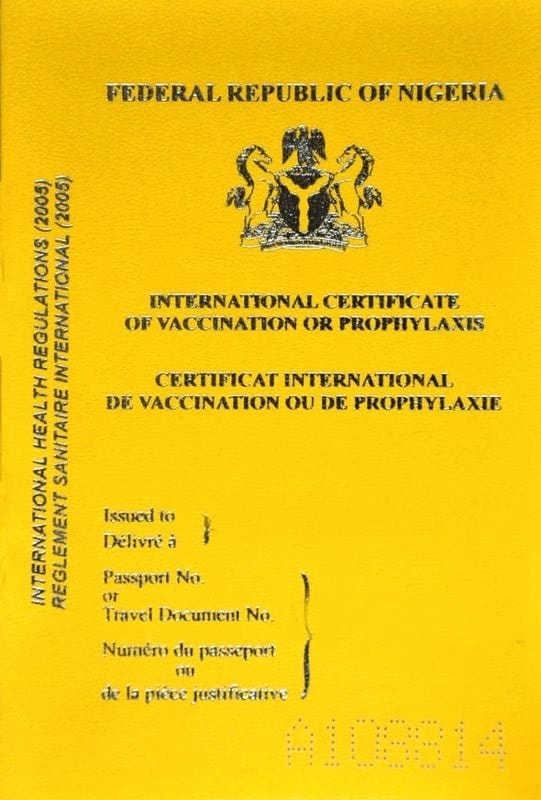
The Yellow Card, officially known as the International Certificate of Vaccination or Prophylaxis (ICVP), is more than just a travel document — it’s a historical symbol of the world’s effort to prevent the international spread of deadly diseases. Its story begins in the early 20th century, when global health authorities realized that infectious diseases could easily cross borders through international travel.

Early Origins: The Fight Against Epidemics

The roots of the Yellow Card can be traced back to the early 1900s, when deadly diseases such as cholera, smallpox, and yellow fever were spreading rapidly across continents through ships and trade routes.

At that time, many countries implemented their own local vaccination or quarantine certificates for travelers and sailors. However, there was noe global standard, which made verification difficult and often led to confusion or fraudulent documents.

This concern led to the creation of the International Sanitary Conferences, where global leaders met to discuss coordinated disease prevention strategies. These conferences laid the foundation for international health cooperation and later evolved into what became the World Health Organization (WHO) in 1948.

Creation of the International Certificate of Vaccination

After the establishment of the WHO, there was a clear need for a standardized, globally recognized vaccination document.

In 1951, the International Health Regulations (IHR) were first adopted. These regulations provided a legal framework for countries to prevent and control the international spread of diseases while minimizing unnecessary interference with global travel and trade.

As part of these regulations, the WHO introduced the International Certificate of Vaccination, popularly known as the Yellow Card because of its distinct yellow color — chosen to make it easily recognizable and hard to counterfeit.

See also  Nollywood Actor, Williams Uchemba Demands Public Execution Of Kidnappers

Focus on Yellow Fever

While the Yellow Card was designed to record multiple vaccines, it became most closely associated with yellow fever — a viral disease transmitted by mosquitoes that can cause severe illness and death.

Yellow fever had a history of devastating outbreaks in Africa, the Americas, and parts of Europe. In the 20th century, it became one of the first diseases for which international vaccination was required for travel, especially to and from endemic regions.

To protect both travelers and destination countries, the WHO mandated proof of yellow fever vaccination for entry into certain countries. This rule made the Yellow Card an essential document for global travelers.

Evolution and Digitalization

Over the decades, the Yellow Card expanded to include vaccines for other diseases, such as cholera, meningitis, and COVID-19 in recent years.

In Nigeria, the Yellow Card was first introduced under the supervision of the Federal Ministry of Health through Port Health Services, which managed vaccination centers at airports, seaports, and border posts.

In 2019, Nigeria launched the e-Yellow Card, a digitalized version embedded with a QR code to verify authenticity and reduce forgery. Travelers can now register online via yellowcard.health.gov.ng, receive their vaccination, and print a verifiable certificate.

The Yellow Card Today

Today, the Yellow Card remains a vital document under the revised International Health Regulations (IHR 2005). It stands as proof that the holder has received vaccinations required for international travel, especially the yellow fever vaccine, which remains valid for 10 years and is recognized globally.

Beyond its use in travel, the Yellow Card also represents a legacy of global cooperation in health — a reminder of how the world came together to fight infectious diseases across borders.

See also  Motorists stranded as flood overruns Lagos communities

Key Historical Milestones

Year Event

1851 First International Sanitary Conference held to control cholera and plague spread.
1948 World Health Organization (WHO) established.
1951 First International Health Regulations adopted; birth of the Yellow Card.
1969 WHO revised IHR to include yellow fever as a mandatory vaccination.
2019 Nigeria launched the e-Yellow Card system.

The history of the Yellow Card reflects humanity’s shared journey toward health security and international cooperation. What began as a simple health record has evolved into a global passport for disease prevention, ensuring that international travel does not compromise global health.

It stands today not just as a proof of vaccination, but as a testament to the world’s determination to safeguard life through science, regulation, and unity.

Sources

1. World Health Organization (WHO) – International Health Regulations (IHR), 1951–2005

2. Federal Ministry of Health, Nigeria – Port Health Services: Yellow Card Portal (yellowcard.health.gov.ng)

3. Centers for Disease Control and Prevention (CDC) – International Certificate of Vaccination or Prophylaxis

FOLLOW US ON:

FACEBOOK

TWITTER

PINTEREST

TIKTOK

YOUTUBE

LINKEDIN

TUMBLR

INSTAGRAM

Continue Reading
Click to comment

Leave a Reply

Your email address will not be published. Required fields are marked *

Lifestyle

Declare Your Lineage – Royal Family Tells Musician KWAM 1 Over His Interest In Becoming Next Awujale Of Ijebuland

Published

on

KWAM 1, in a letter dated December 3, 2025, addressed to the chairman of the Fusengbuwa Ruling House in Agunsebi Quarters, Ijebu-Ode, announced his interest in the stool, describing himself as a “bonafide son” of the ruling house.

The Fusengbuwa ruling house of Ijebu-Ode, next in line to produce the new Awujale of Ijebuland, Ogun State, has instructed Fuji musician Wasiu Ayinde, popularly known as KWAM 1, to confirm his family’s royal lineage to validate his membership in the ruling house.

KWAM 1, in a letter dated December 3, 2025, addressed to the chairman of the Fusengbuwa Ruling House in Agunsebi Quarters, Ijebu-Ode, announced his interest in the stool, describing himself as a “bonafide son” of the ruling house.

KWAM 1 also stated that his candidacy aligns with Ijebu customary law and the Ogun State Chieftaincy Laws.

In an interview with Punch, the Chairman of the ruling house and former National President of the Institute of Chartered Accountants of Nigeria, Abdulateef Owoyemi, said only bonafide members of the family would be allowed to participate in the selection process.

Owoyemi explained that KWAM 1, Olori Omooba of Ijebu land and others interested in the stool have been directed to complete the Fusengbuwa ruling house royal lineage data form.

According to him, the form, which requires contenders to trace their genealogy back seven generations, ensures that only genuine princes from the family can participate, thereby blocking “strangers” from claiming the throne.

He said, “The first step for anyone interested in contesting for the Awujale throne is to declare their lineage by filling the standard Fusengbuwa ruling house royal lineage data form. Once confirmed as a legitimate member of the ruling house, they can then apply for the expression of interest form.

See also  Mohbad’s family demands fresh probe, bars wife from using surname

“We have told him, just like everyone else interested in the Awujale throne, that the first step is to declare his lineage. He will do this by completing the royal lineage data form, showing his full name, which parent and grandparent he descends from, and continuing up to seven generations.

“The completed form will be signed and submitted to the head of the ruling house unit of the Fusengbuwa ruling house, who will affirm that he is a genuine member. Only then will the process move forward.”

Owoyemi emphasised that although the application window for the throne officially closed on December 5, KWAM 1 had been given a five-day extension, which would lapse on December 10.

He noted, “We won’t shut anybody out of picking the next Awujale, but we must ensure that you are a legitimate member of Fusengbuwa. Every right comes with responsibilities. For a royal family, everyone must prove their legitimacy by completing the royal lineage data form.

“When we receive the form, we will review it meticulously. If clarification is needed, we will contact the applicant. We welcome men of influence who will use their influence to enhance the throne, not to claim it, ensuring that what truly belongs to our family is preserved.”

Owoyemi explained that the local government has given them 14 days to select candidates, and the ruling house hopes to have a new Awujale by the second or third week of January 2026.

He added, “The local government has given us 14 days to select candidates, which expires on December 18. After that, the kingmakers have seven days to deliberate and choose one candidate, whose name will be forwarded to the governor.

See also  SAMUEL BILEWU OSHOFFA

“Legally, the government then has 21 days to conduct background checks and security clearance, allowing for objections or protests. After this period, the State Executive Council will ratify the nominee, and the governor will announce the next Awujale, after which coronation rites will commence.

“So, combining the candidate selection, kingmakers’ deliberation, and legal objection period, we are looking at around 42 days. Therefore, we expect the next Awujale to emerge between the second and third week of January.”

FOLLOW US ON:

FACEBOOK

TWITTER

PINTEREST

TIKTOK

YOUTUBE

LINKEDIN

TUMBLR

INSTAGRAM

Continue Reading

Lifestyle

VIDEO: I’m Married But Not In My Husband’s House; I Didn’t Have The Experience Of Living Happily Ever After – Singer Shola Allyson Reveals

Published

on

While speaking about her love life, the 54-year-old who came into limelight with a love album ‘Eji Owuro’, revealed that she is married but not living with her husband.

Sola Allyson, the popular Nigerian gospel singer, has revealed that she is not currently living with her husband.

The musician made this known in her latest interview on Oyinmomo TV.

While speaking about her love life, the 54-year-old who came into limelight with a love album ‘Eji Owuro’, revealed that she is married but not living with her husband.

Sharing her marital experience, the singer said she has never enjoyed the kind of happiness many people describe.

“I’m married, but I’m not in my husband’s house. We live separately. He in his house and I in mine.”

The interviewer asked: “You sang ‘Eji Owuro’, did you experience genuine love from your husband?

She replied, “We lied before. Those older than us didn’t inform us that it’s tough. They made us believe that so long as you both love each other, you will live happily ever after, but it’s a lie.

“That’s not the experience I have. I didn’t have the experience of living happily ever after. I did all I could to make it work.

“Marriage has been a big challenge. I hear people talk about joy in marriage, but I have never experienced it.”

CLICK TO WATCH THE VIDEO

FOLLOW US ON:

FACEBOOK

TWITTER

PINTEREST

TIKTOK

YOUTUBE

LINKEDIN

TUMBLR

INSTAGRAM

See also  Nollywood Actor, Williams Uchemba Demands Public Execution Of Kidnappers
Continue Reading

Lifestyle

VIDEO: Shola Allyson Finally Opens Up, Reveals Why She Does Not Reference Jesus In Her Songs

Published

on

Recall that Allyson, who is regarded as a gospel singer, was dragged on social media in March 2025 for not directly referencing ‘Jesus’ in all her songs.

Shola Allyson, the renowned Nigerian songstress, has opened up on the real reason she avoids mentioning the name of Jesus in all her songs.

Recall that Allyson, who is regarded as a gospel singer, was dragged on social media in March 2025 for not directly referencing ‘Jesus’ in all her songs.

Reacting to her critics in a post on X, the songstress stated that “No one can bully me into joining their darkness that looks like light because indolent souls find comfort in it”.

Finally revealing her reason for not mentioning Jesus in her songs, Shola Allyson on Saturday during her latest interview on Oyinmomo TV, stated that Jesus did not ask her to do PR for him.

She said “I’m not a religious singer. As I am, I have never introduced myself as a gospel singer. My name is Shola Allyson. I’m a singer”.

Interviewer; “Some people said you don’t mention ‘Jesus’ name’ in all your songs”.

She quickly responded “Jesus did not instruct us to mention his name in songs nor did Jesus ask us to do PR for Him”.

CLICK TO WATCH THE VIDEO

FOLLOW US ON:

FACEBOOK

TWITTER

PINTEREST

TIKTOK

YOUTUBE

LINKEDIN

TUMBLR

INSTAGRAM

See also  Nollywood Actor, Williams Uchemba Demands Public Execution Of Kidnappers
Continue Reading

Trending