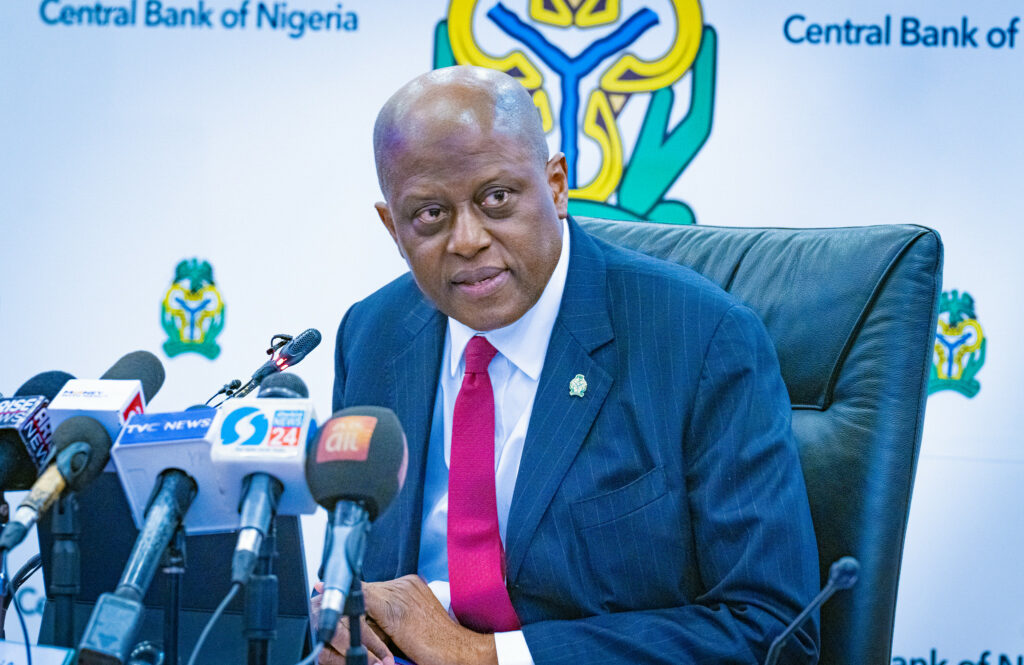
Nigeria’s banking sector has entered a defining moment following the successful completion of a far-reaching recapitalisation exercise, led by the Central Bank of Nigeria under Governor Olayemi Cardoso. With more than ₦4.6 trillion raised by over 30 financial institutions, industry stakeholders say the reform has laid a strong foundation for banks to expand lending, support businesses, and play a central role in achieving the Federal Government’s ambitious $1 trillion economy target by 2031.
What began in November 2023 as a policy announcement has now matured into one of the most consequential financial sector reforms in Nigeria’s recent history. At the time, Cardoso framed the initiative as essential to repositioning the banking system for the scale of economic growth the country seeks.
“The administration has set an ambitious goal of achieving a Gross Domestic Product of $1 trillion,” Cardoso said. “Attaining this target requires sustainable and inclusive growth at a significantly higher pace than current levels.”
Nearly two years later, the recapitalisation programme has reached its March 31, 2026 deadline, ushering in what analysts describe as a new era of stronger, more resilient banks with enhanced capacity to support economic expansion.
Realigned for growth
The recapitalisation policy, formally launched on March 28, 2024, introduced new minimum capital thresholds—₦500 billion for international banks, ₦200 billion for national banks, and ₦50 billion for regional institutions. The 24-month compliance window allowed banks to raise fresh capital through equity injections, rights issues, mergers, and strategic investments.
By the deadline, about 33 banks had collectively mobilised approximately ₦4.65 trillion, with 72.55 percent sourced domestically and 27.45 percent from international investors—an indication of sustained confidence in Nigeria’s financial system.
For many analysts, the reform was not just timely but inevitable. Nigeria’s economic landscape had evolved significantly, with rising inflation, exchange rate volatility, and increasing infrastructure demands exposing the limitations of banks’ existing capital bases.
A report by Deloitte noted that macroeconomic headwinds had eroded banks’ capital adequacy, constraining their ability to support large-scale financing.
“The upward revision will ensure that Nigerian banks have the capacity to take on bigger risks and stay afloat amid both domestic and external shocks,” the report stated.
With larger capital buffers, banks are now better positioned to finance infrastructure projects, support industrialisation, and extend long-term credit to critical sectors such as agriculture, manufacturing, and technology.
The initiative reflects strong coordination among the CBN, the Ministry of Finance, and the capital markets. The benefits are structural and enduring: stability, global competitiveness, and sustained GDP growth. With stronger capital, better risk management, and tighter oversight, Nigerian banks are ready to support individuals, businesses, and our growing economy. Analysts agree that the Central Bank of Nigeria is building a stable, transparent, and resilient financial system that works for you.
According to the CBN, banks that are yet to fully recapitalise remain functional and are in the process of recapitalisation.
Strengthening governance
While the size of capital raised has drawn attention, regulators insist that the reform’s true significance lies in its emphasis on governance, risk management, and accountability. Past recapitalisation exercises, particularly the 2005 consolidation, were criticised for encouraging excessive risk-taking and weak credit discipline, which later contributed to rising non-performing loans.
Determined to avoid a repeat, the CBN introduced sweeping measures to strengthen oversight. These include a revamped credit-risk framework and the establishment of a dedicated compliance structure focused on financial crime supervision, corporate governance, and market conduct.
“We are redesigning the credit-risk framework to enforce stronger governance, greater transparency, and firmer accountability,” Cardoso said. “We are determined to break the boom-and-bust cycle that has accompanied past recapitalisation efforts.”
He further stressed the broader economic implications of the reform. “Sustainable economic growth is unattainable without a resilient financial system. This recapitalisation ensures Nigerian banks can fund the scale of transactions needed to drive a $1 trillion economy.”
Industry observers agree that governance reforms will be critical in ensuring that increased capital translates into sustainable growth rather than heightened financial risk.
Expectation from business and consumers
With the recapitalisation exercise now concluded, attention has shifted to how banks will deploy the raised funds. Across the financial ecosystem, stakeholders are unanimous that the success of the reform will ultimately be measured by its real-world impact.
President of the Bank Customers Association of Nigeria, Uju Ogubunka, said customers expect tangible improvements in service delivery and a reduction in borrowing costs. “The banks have raised significant funds. Now, we expect them to improve service quality and reduce excessive charges,” he said.
Similarly, Aminu Gwadabe, president of the Association of Bureaux De Change Operators of Nigeria, emphasised the importance of affordable credit.
“We need cheaper loans. Big capital should reflect in lower interest rates and financing for productive sectors,” he said. “Banks must also support agriculture to improve food security.”
These expectations reflect long-standing concerns among Nigerian businesses, particularly small and medium enterprises (SMEs), which have struggled with limited access to affordable financing.
For Johnson Chukwu, Managing Director of Cowry Asset Management, the recapitalisation marks only the beginning of the journey.
“Recapitalisation strengthens the balance sheets of banks, but that alone does not guarantee economic growth,” he said. “The key is financial intermediation—ensuring that these funds are deployed to support businesses, infrastructure, and productive activities.”
Chukwu noted that Nigerian banks have historically been risk-averse, often preferring to invest in government securities rather than lend to the private sector. He argued that this pattern must change if the reform is to deliver meaningful impact.
“We need to see a deliberate shift toward lending to MSMEs, manufacturing, agriculture, and other critical sectors. That is where the real impact will come from,” he added.
Global acceptance and investor confidence
The recapitalisation programme has also attracted strong support from international institutions and investors, reinforcing confidence in Nigeria’s financial reforms.
Matthew Verghis of the World Bank described the initiative as a critical step toward unlocking Nigeria’s economic potential.
“A stronger banking system creates the foundation to finance Nigeria’s long-term ambitions—from MSMEs to infrastructure development,” he said.
Domestic rating agency Agusto & Co. echoed this sentiment, noting that many banks met their capital requirements ahead of the deadline—an indication of investor confidence in the sector.
The participation of foreign investors, who accounted for over a quarter of the capital raised, further underscores Nigeria’s attractiveness as a destination for financial investment despite global economic uncertainties.
Stability indicators hold firm
Despite challenging economic conditions, Nigeria’s banking sector has maintained relative stability throughout the recapitalisation process.
According to the CBN, key financial indicators remain within regulatory thresholds. The non-performing loan ratio is below five percent, while the liquidity ratio exceeds the minimum requirement of 30 percent.
Stress tests conducted by the apex bank have also confirmed the system’s resilience, providing reassurance that banks are well-positioned to withstand potential shocks.
Cardoso expressed confidence in the sector’s ability to support economic recovery. “I believe the banking sector is in a strong position to support Nigeria’s economic recovery by enabling access to credit and supporting investment in critical sectors,” he said.
Larger capital bases allow banks to absorb shocks, align with Basel III standards, and maintain financial stability. Improved risk management and governance structures are being embedded sector-wide.
Increased capital enables banks to finance infrastructure, energy, manufacturing, and technology projects that require long-term, high-value funding. The recapitalised sector will better support the renewed industrialisation and export diversification agendas. Stronger balance sheets will enhance credit ratings and reduce systemic risk. The CBN’s recapitalisation aligns monetary policy with the Federal Government’s fiscal growth plans. A sound banking base bolsters policy transmission, liquidity management, and inflation control.
By building banks “fit for purpose” in a trillion-dollar economy, the sector can sustainably finance SMEs, export-oriented firms, and major infrastructure projects. The recapitalisation is expected to anchor financial inclusion and broaden access to credit nationwide.
Recapitalisation and broader reforms
The banking sector reform is part of a broader economic agenda aimed at stabilising the macroeconomic environment and creating conditions for sustainable growth.
Measures such as foreign exchange market liberalisation, removal of petrol subsidies, and fiscal consolidation have been introduced to improve transparency and reduce distortions in the economy.
Economist Abiodun Adedipe said these reforms are already beginning to yield positive results.
According to him, the elimination of arbitrage opportunities in the foreign exchange market and efforts to plug fiscal leakages have created a more competitive and transparent economic environment.
He also highlighted Nigeria’s demographic advantages—including a large, youthful population and rapid urbanisation—as key drivers of long-term growth.
Road to $1trillion economy
As Nigeria charts its path toward becoming a $1 trillion economy, the role of recapitalised banks will be pivotal. Stronger banks are expected to finance infrastructure, support industrialisation, and expand access to credit across sectors. Chukwu emphasised that capital must translate into real economic outcomes. “The real challenge lies in ensuring that stronger balance sheets lead to increased lending and economic activity,” he said.
For now, there is cautious optimism across the financial sector. The successful completion of the recapitalisation exercise has strengthened the banking system and restored investor confidence.
Yet, analysts agree that the journey toward a $1 trillion economy will require sustained policy coordination, macroeconomic stability, and a commitment to inclusive growth.
If effectively harnessed, Nigeria’s newly recapitalised banks could become powerful engines of transformation—lifting businesses, creating jobs, and driving economic expansion.
But as stakeholders repeatedly stress, the true measure of success will not be the trillions raised, but the tangible impact on businesses, households, and the broader economy. The foundation has been laid. What remains is execution.
tribuneonlineng.com
FOLLOW US ON:
FACEBOOK
TWITTER
PINTEREST
TIKTOK
YOUTUBE
LINKEDIN