Connect with us

News

Alleged terrorism: AGF takes over Malami, son’s trial – see why

Published

on

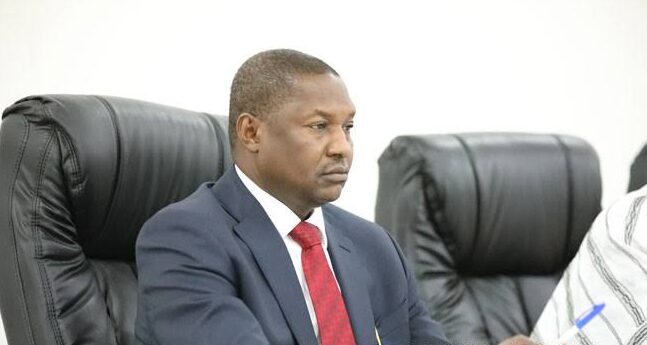
The Attorney-General of the Federation, Lateef Fagbemi (SAN), has assumed control of the prosecution of a former AGF, Abubakar Malami (SAN), and his son, Abdulaziz, over alleged terrorism-related offences and unlawful possession of firearms.

File photo of the Attorney-General and Minister of Justice, Lateef Fagbemi

The development emerged on Wednesday at the Federal High Court in Abuja when the Director of Public Prosecutions of the Federation, Mr Rotimi Oyedepo (SAN), informed the court that the case file had been transmitted from the Department of State Services to the Office of the Attorney-General of the Federation.

“My lord, I was informed by counsel to the DSS that the case file has been transmitted to the office of the AGF,” Oyedepo told the court.

He sought an adjournment to enable the prosecution to review the case file and take an informed decision, adding that a short date would suffice.

“We ask your lordship for a very short date. If we have four days, it will be enough,” he said.

Counsel for the defendants, Mr Adedayo Adedeji (SAN), did not oppose the application but urged the court to strike out the charge if the prosecution failed to open its case on the next adjourned date, alleging lack of diligent prosecution.

Responding, the DPPF described the defence’s proposed application as premature.

Justice Joyce Abdulmalik subsequently adjourned the matter to March 10, 2026, for commencement of trial and directed the prosecution to formally open its case on that date.

The DSS had arraigned Malami and his son on terrorism-related charges, including alleged refusal to prosecute suspected terrorism financiers and unlawful possession of firearms.

In the charge marked FHC/ABJ/CR/63/2026, Malami is accused of knowingly abetting terrorism financing by allegedly refusing to prosecute suspected terrorism financiers whose case files were forwarded to him while he served as Attorney-General of the Federation and Minister of Justice.

See also  Make election rigging difficult — Peter Obi begs Nigerians to get PVC

The defendants were also accused of storing firearms at their residence in Gesse Phase II Area, Birnin Kebbi Local Government Area of Kebbi State, without lawful authority.

Specifically, the prosecution alleged that in December 2025, Malami and his son possessed, without a licence, a Sturm Magnum firearm, 16 live cartridges, and 27 expended cartridges—an act said to be preparatory to terrorism and contrary to the Terrorism (Prevention and Prohibition) Act, 2022, as well as the Firearms Act.

At their first appearance on February 3, the defendants pleaded not guilty to all charges.

On the last adjourned date, the court admitted them to bail in the sum of N200m each, with two sureties in like sum.

They were, however, ordered to be remanded at the Kuje Correctional Centre pending the perfection of their bail conditions.

As part of the conditions, one of the sureties must own landed property in Maitama or Asokoro, Abuja, and deposit the title documents with the Deputy Chief Registrar of the court, alongside a valid international passport.

The sureties were also directed to depose to affidavits of means and submit two recent passport photographs.

Malami and his son were further ordered to surrender their international passports and submit recent passport photographs to the court.

punch.ng

FOLLOW US ON:

FACEBOOK

TWITTER

PINTEREST

TIKTOK

YOUTUBE

LINKEDIN

TUMBLR

INSTAGRAM

Continue Reading
Click to comment

Leave a Reply

Your email address will not be published. Required fields are marked *

News

State police: IG sets up panel to propose framework

Published

on

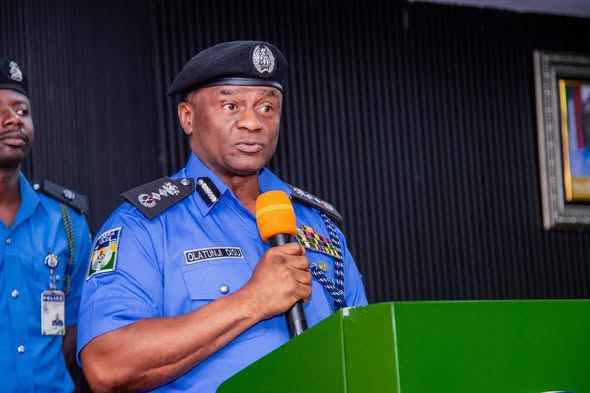
Newly sworn-in Inspector-General of Police, Tunji Disu, on Wednesday inaugurated a committee on the establishment of state police.

As part of ongoing discussions on policing reforms, President Bola Tinubu, had, last Wednesday, during the breaking of fast with senators at the Presidential Villa, Abuja, urged the leadership of the 10th Senate to initiate constitutional amendments to provide for the establishment of state police.

The President said decentralised policing would strengthen security at the grassroots and improve rapid response to threats within states, noting that the current centralised structure required constitutional review to accommodate the proposed reform.

Speaking during the inauguration, Disu said the committee’s task was to examine the concept of state policing as part of efforts to strengthen Nigeria’s internal security architecture and improve community-based policing.

He said the committee would review existing policing models within and outside Nigeria, assess community security needs, propose an operational framework for state police structures, and address issues of recruitment, training, standards, funding, accountability and oversight.

“Among other responsibilities, the committee is expected to review existing policing models within and outside Nigeria, assess community security needs and emerging risks across the country, propose an operational framework for the establishment and coordination of State Police structures, address issues relating to recruitment, training, standards, and resource allocation and develop robust accountability and oversight mechanisms to ensure professionalism and public trust,” he said.

Disu said state police formation could provide localised policing services focused on community safety, conflict prevention, neighbourhood patrols, and early response to emerging threats.

“This collaborative arrangement will encourage specialisation, strengthen professionalism, and ultimately deliver more effective security outcomes for our citizens,” he added.

The steering committee is chaired by Prof. Olu Ogunsakin, Director-General of the National Institute for Police Studies, Abuja, with CP Bode Ojajuni as secretary.

Other members are DCP Okebechi Agora, DCP Suleyman Gulma, ACP Ikechukwu Okafor, CSP Tolulope Ipinmisho and CP Emmanuel Ojukwu (retd.).

Also speaking shortly after his swearing-in as the substantive Inspector-General of Police, Disu disclosed that he had constituted a committee to develop the Nigeria Police Force’s position on the proposed establishment of state police.

He said, “The committee was set up early this morning to look into the issue of State Police from the angle of the Nigeria Police.

See also  Lagos enforce okada ban statewide

“We don’t want it to seem as if others are taking decisions, and we, the most important people concerned, did not do anything. We want to ensure that the best thing is done,” the IG stated.

He emphasised that the police was not opposed to state police, describing it as a partnership rather than a threat to the Force.

“State police has come to stay, and the police should be able to do their own part in making it succeed. The police are not afraid. Our jobs are not being taken. It’s just an issue of partnership,” Disu said.

Disu sworn-in

Disu took the oath of office at 2:53pm on Wednesday following the reading of his citation by the State House Director of Information and Public Relations, Mr. Abiodun Oladunjoye.

The ceremony was witnessed by Vice President Kashim Shettima, cabinet members, and other dignitaries.

Also in attendance were the Secretary to the Government of the Federation, Senator George Akume; National Security Adviser, Nuhu Ribadu; Chief of Staff, Femi Gbajabiamila; Minister of Police Affairs, Senator Ibrahim Gaidam; FCT minister, Nyesom Wike; and Head of Service, Mrs. Esther Walson-Jack.

Disu’s confirmation comes barely a week after President Tinubu appointed him acting IGP following the resignation of Kayode Egbetokun on February 23, 2026.

Ex-officers back committee

A retired Assistant Inspector-General of Police, Ali Amodu, described the Inspector-General of Police’s decision to set up a special committee on state policing as “a right step in the right direction.”

Speaking on the development, Amodu said the committee would provide professional input and advise the Presidency on the proposed decentralisation of the Nigeria Police Force.

“The decision or the thought of the IG in setting up a special committee is a right step in the right direction. The committee will actually provide the thinking, and then they will give advice to the Presidency because it is the police that they want to decentralise. It is good that the authority will want to hear from them,” he said.

He noted that he had canvassed the idea of decentralising the police as far back as 1981 after returning from detective training in the United Kingdom.

Amodu said, “As far back as 1981, I was a young superintendent. I came back from the UK and I actually made a suggestion to the police authority then that they should think of decentralising the police force because I saw the pattern in the UK.

See also  DSS to arraign El-Rufai Feb 25 over alleged cybercrime, security breach

“I said we can moderate our own and make adjustments. I was a very young officer, but the old hands were very angry with me to have said this. I remember my commissioner of police then said, ‘Young man, we sent you to the UK for detective training, and you are coming back thinking they should form a modality on how to decentralise the force.’”

Amodu added that the idea was now gaining traction globally. “The thing is coming to light. Light is shining on that area. It’s happening in many parts of the world,” he said.

According to him, policing differs from military operations because it requires close interaction with local communities.

“The police are not like the army or any arm of the Armed Forces. You work with the people, and people want to appreciate their own person. It is at that time they will be comfortable to even pass information which is needed for policing all over the world,” he said.

He also referenced ongoing legislative discussions on constitutional amendments, noting that the current constitution provides for a single police force.

“Just a few days ago, I heard the Senate President say that before the end of the year they will look into how the Constitution and see if it can be amended because the present Constitution says Nigeria has one police force. So, if we want to decentralise, they must amend that section of the constitution. I think they are working on it. Let’s see how it is going to work out,” he added.

On his part, a former Commissioner of Police, Lawrence Alobi, also backed the constitution of the committee, describing it as a professional and proactive move.

“It’s the right thing to have done because the police affair is all about policing, and police can come and handle police issues effectively,” Alobi said.

He stated that the committee should clearly define the structure and supervisory framework for state police formations.

“The committee should advise on the structure and how the state police would be supervised. Maybe they should be under the AIG in zones or the DIGs would have supervisory roles over them,” he said.

See also  Nigerians languish in prisons as Ethiopia stalls repatriation MoU

Alobi stressed the need to address jurisdictional issues in advance to avoid operational conflicts.

“If the structure is not determined now proactively and it is established, I don’t know the case, but if a case is committed in a state and the suspect is in another state, and the police from one state go there to get the suspect, how will the police in that state treat them when they come? This is something that needs to be determined. It should already be established and practiced,” he said.

He added, “I think the system is running in the right direction and doing the right thing.”

Middle East crisis

Meanwhile, Disu disclosed that the Nigeria Police Force wass closely monitoring Islamic groups with allegiance to Middle Eastern countries following the escalating US-Israel-Iran conflict, warning that developments in the Middle East could trigger repercussions in Nigeria.

“Everywhere in the world, we are aware that is what we call intelligence policing. Our ears are to the ground. We know we have groups of people, different kinds of Islamic sects in Nigeria. We have those who pay allegiance to this eastern part of the world as well,” Disu stated.

He added, “So we know if anything happens in the eastern part of the world, the repercussion will come to us.

“So, we are putting all necessary actions. You can see policemen on patrol, and most importantly, we are talking to them to ensure that they do not take law and order into their hands.”

The IGP’s statement comes amid heightened tensions in the Middle East following US and Israeli airstrikes on Iranian targets over the weekend and Iran’s retaliatory missile attacks on Israeli and American military installations.

Nigeria is home to significant Islamic groups with ideological and sometimes organisational ties to Middle Eastern countries, particularly Iran and Saudi Arabia.

The Islamic Movement in Nigeria, led by Sheikh Ibrahim El-Zakzaky, is known for its pro-Iranian stance and Shia Islamic orientation, while several Sunni groups maintain connections with Saudi Arabia and other Gulf states.

Continue Reading

News

Senator secures presidential approval for 5km access road in Osun

Published

on

The lawmaker representing Osun Central Senatorial District and Chairman of the Senate Committee on Environment, Olubiyi Fadeyi, on Wednesday announced that he secured presidential approval for the construction of a five-kilometre access road spanning key parts of his constituency.

The development, disclosed in a statement issued by his Special Adviser on Digital Media and Publicity, Adekanola Desmond, marks a significant infrastructure intervention expected to boost healthcare access and rural connectivity across the district.

Fadeyi explained that a major component of the project is a one-kilometre access road leading up to the Federal University of Health Sciences Teaching Hospital, Ila-Orangun.

The hospital, which serves residents across Osun and neighbouring states, has in recent times grappled with poor road access, posing serious challenges to patients, medical personnel and surrounding communities.

The senator explained that the remaining four kilometres will link other districts within Osun Central, opening up rural corridors that are vital to farmers, traders and daily commuters.

The intervention is expected to ease the movement of agricultural produce, improve emergency response times and stimulate economic activities in underserved areas.

He said, “This project will transform mobility and healthcare delivery in our region.

“We will conduct the official flag-off ceremony later this March.”

The lawmaker further revealed that preliminary site clearing has commenced at the hospital axis, signalling the imminent take-off of full-scale construction works.

The road project comes amid growing calls for improved infrastructure in Osun Central, particularly around critical public institutions.

Stakeholders have long decried the deplorable state of access routes to health facilities and rural communities, arguing that poor connectivity undermines both service delivery and economic productivity.

See also  Flight fury: Inside story of KWAM 1, Emmason’s pardon

However, Fadeyi maintained that the initiative underscores his commitment to reversing years of infrastructural neglect in the district, especially in areas that directly impact healthcare access and grassroots development.

If completed as scheduled, the project is expected to significantly enhance transportation efficiency and strengthen the link between healthcare services and the communities they serve.

Continue Reading

News

Asylum surge: UK stops study visas for four countries

Published

on

The UK government has imposed an “emergency brake” on study visas for nationals of Afghanistan, Cameroon, Myanmar and Sudan following a sharp rise in asylum claims from individuals who initially entered the country through legal routes.

According to the UK Home Office, the unprecedented move will end sponsored study visas for all four countries and suspend skilled worker visas for Afghan nationals.

The changes will be introduced through an Immigration Rules amendment on 5 March and come into force on 26 March.

The Home Office on Wednesday said the decision followed a surge in asylum claims from people who had entered legally on visas before subsequently applying for asylum.

“An ’emergency brake’ on visas ‌has been ‌imposed for the first time on nationals from four countries following a ⁠surge in asylum claims from legal routes,” DW News reported that ‌the UK Home Office ⁠said.

Nearly 135,000 asylum claims from legal routes

In total, 133,760 people have claimed asylum after arriving legally in the past five years.

Since 2021, almost 135,000 individuals entered the UK on student or other visas before lodging asylum claims.

Home Secretary Shabana Mahmood acknowledged that asylum claims via legal entry routes now make up nearly 40 per cent of all claims.

“In 2025, they accounted for 39 per cent of the 100,000 people who applied for asylum.

“Asylum applications by students from Afghanistan, Cameroon, Myanmar and Sudan increased by more than 470 per cent between 2021 and 2025, making them among the most likely nationalities to claim.

See also  Armed Forces Day: Tinubu, govs celebrate soldiers, fallen heroes

“Applications by students from Myanmar rose sixteen-fold during that period, while claims from Cameroon and Sudan increased by more than 330 percent.

“Between 2021 and the year ending September 2025, the proportion of Afghan asylum claims relative to study visas issued reached 95 per cent,” Essex News’ UK News and Investigation also reported on Wednesday.

Meanwhile, the number of Afghans on work visas claiming asylum is now outstripping the number of visas issued.

Although the government said it reduced student asylum claims by 20 per cent during 2025, those arriving on study visas still account for 13 percent of all claims currently in the system.

Financial pressures, accommodation costs

Many asylum seekers entering through legal routes are being housed at taxpayer expense.

The Home Secretary noted that an above-average proportion of individuals from the four countries are claiming destitution.

She was quoted as saying, “Asylum support currently costs more than £4 billion annually.

“Nearly 16,000 nationals from the four affected countries are supported at public expense, including over 6,000 accommodated in hotels.

“The government says it has reduced the asylum support bill by £1 billion since coming to office.”

A Home Office spokesperson said: “The government is clamping down on visa abuse like this so we can maintain our ability and proud tradition of helping those genuinely in need.”

Legislative changes, asylum rule tightening

The announcement coincides with broader asylum reforms that took effect this week.

Under the new rules, refugee status for adults and their accompanying children will be reviewed every 30 months.

See also  Tinubu brokers peace as Fubara, Wike exit Villa together

Previously, refugee status was granted for five years, after which individuals could apply for indefinite leave to remain and pursue citizenship.

Refugees whose countries are deemed safe will be expected to return home.

Unaccompanied children will continue to receive five years’ leave while a long-term policy is developed.

Those already in the UK will continue to be assessed under the previous framework.

The government confirmed that protection for refugees will be reduced to 30 months from 2 March in an effort to reduce pull factors driving dangerous small boat crossings.

Essex News says the reforms are modelled on Denmark’s system, widely regarded as one of the toughest in Europe.

The Home Secretary is set to introduce new legislation this week and will deliver a speech at the IPPR think tank outlining how the reforms align with British values.

She said: “Britain will always provide refuge to people fleeing war and persecution, but our visa system must not be abused.

“That is why I am taking the unprecedented decision to refuse visas for those nationals seeking to exploit our generosity.

“I will restore order and control to our borders.”

Diplomatic pressure, safe routes

The measures follow the Prime Minister’s decision to adopt what was described as a more hard-edged diplomatic approach to ensure migration rules are respected.

In November, the Home Secretary warned that visas for Angola, Namibia and the Democratic Republic of Congo could be suspended unless those governments agreed to accept the return of illegal migrants.

Four months later, cooperation was secured and return flights commenced.

See also  DSS to arraign El-Rufai Feb 25 over alleged cybercrime, security breach

The government has pledged to expand capped safe and legal routes as an alternative to small boat crossings once order is restored to the asylum system.

Since 2021, Britain has offered sanctuary to more than 37,000 Afghans through two resettlement schemes, while 190,000 visas were granted on humanitarian routes in 2025 alone.

Between 2010 and 2025, the UK resettled the sixth largest number of refugees referred by the UNHCR globally.

Migration remains a central political issue in the UK, with the anti-migration Reform UK party gaining ground in opinion polls.

punch.ng

FOLLOW US ON:
FACEBOOK

TWITTER

PINTEREST

TIKTOK

YOUTUBE

LINKEDIN

TUMBLR

INSTAGRAM

Continue Reading

Trending