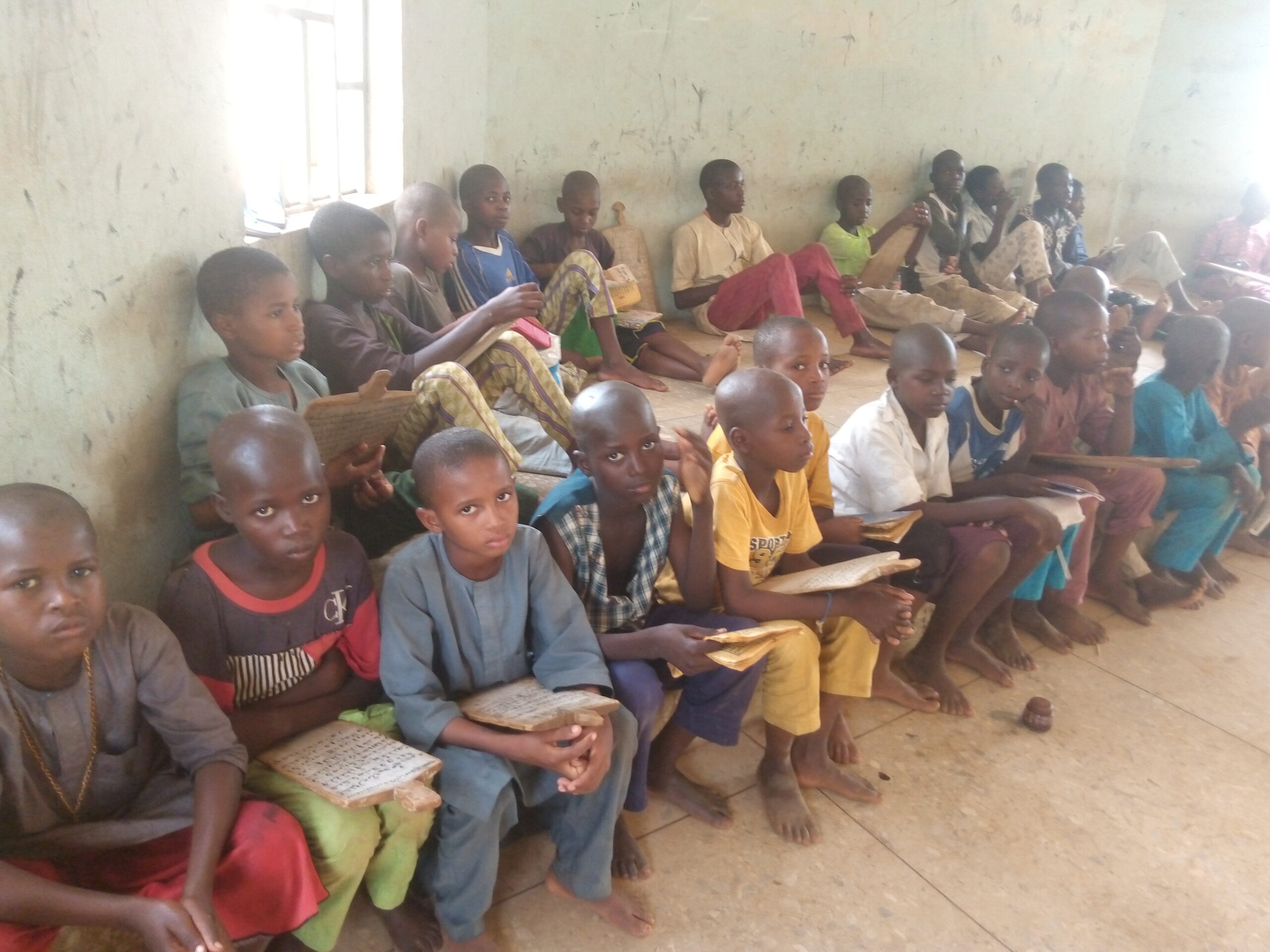
The Federal Government has tightened enforcement measures in Almajiri learning centres nationwide, warning that non-compliance with newly established operational standards will attract sanctions, including closure.
Details of the measures are contained in the National Policy on the Enhancement of Almajiri Education in Nigeria, released by the Federal Ministry of Education last month and obtained by our correspondent on Tuesday.
The policy covers operations and management of all Almajiri learning centres, males and females, across the country.
At the centre of the policy is a set of mandatory standards that all learning centres must meet or risk suspension after a probation period of three to six months.
The framework, to be implemented by the National Commission for Almajiri and Out-of-School Children Education, introduces stricter regulation of the system, long criticised for neglect and abuse.
Under the new rules, all Almajiri centres are required to register with relevant state or local authorities and maintain comprehensive records of learners, including biometric data, to enhance monitoring and accountability.
Operators must also submit periodic reports and allow routine inspections by government agencies.
“Any learning centre that fails to comply with the provisions of this policy shall be given a probation period of three to six months; thereafter, appropriate action shall be taken, such as sanction from operation,” the policy report stated.
It explicitly bans the practice of sending learners to beg on the streets, a long-standing feature of the system.
“Any registered learning centre that sends learners out to beg shall face appropriate action, such as a sanction from the operation,” it added.
In addition, the government has set minimum welfare and health standards.
Learners and facilitators are now required to undergo periodic medical checks at recognised public health facilities, while centres must be linked to nearby healthcare providers and equipped with basic first aid kits.
“New entrants shall have the following basic needs as conditions for enrolment: a minimum of three items of clothing; two pairs of footwear; an eating plate and cutlery; writing materials as applicable or appropriate,” the policy outlined.
Clear age limits have also been introduced, restricting enrolment in day centres to children aged four to 18, while boarding facilities are limited to those between 12 and 18 years.
Adult learners, the policy states, must be taught separately.
To address concerns over poor learning outcomes, the government has mandated a uniform but expanded curriculum.
“Literacy and Numeracy shall be infused into the curriculum of the Almajiri teaching and learning. Relevant digital skills shall be included in the training of the facilitators and learners.”
Infrastructure requirements have also been standardised.
“At least one toilet for a population of not more than 25 Almajiri/Almajira learners. Adequate water supply to the Learning Centre. Learning centre shall be adequately ventilated,” it added.
The policy also introduces gender-sensitive provisions, mandating separate learning spaces for male and female learners.
“There shall be a separate learning space for male and female learners,” it stated, adding that operational guidelines now require centres to adhere to approved academic calendars and open their operations to oversight.
“Learning centres shall open doors for supervision and monitoring by the appropriate LGA, state/FCT or federal authority as may be required.”
Officials said failure to comply with any of these provisions would trigger enforcement actions, stressing that the sanctions regime is designed to compel adherence and eliminate exploitative practices.
The government noted that the reforms build on earlier interventions by the National Commission for Nomadic Education and the Universal Basic Education Commission, but acknowledged that gaps in regulation and implementation have allowed the system’s challenges to persist.
It added that while the policy does not seek to take over Almajiri learning centres, strict enforcement of the new standards is necessary to safeguard learners, improve education quality and address the growing number of out-of-school children linked to the system.
The Almajiri system, which dates back several centuries in northern Nigeria, traditionally involves young boys leaving their homes to study the Quran under the guidance of a Mallam (teacher).
Learners often live with their Mallam or in small communal hostels, relying on alms or contributions from the community for food and basic needs.
Over time, the system has faced widespread criticism for exposing children to poverty, neglect, street begging, and exclusion from formal education.
Previous attempts to regulate Almajiri centres have met with limited success due to inconsistent oversight, inadequate funding, and, in some areas, cultural and religious resistance. Advocates for reform argue that formalising the system, integrating modern education, and enforcing welfare standards are essential to protect vulnerable children and reduce the number of out-of-school youths across northern Nigeria.