Connect with us

Education

Nigeria’s out-of-school crisis demands $345m yearly – Alausa

Published

on

The Federal Government on Tuesday revealed that Nigeria requires an annual investment of $345m to effectively re-integrate and provide essential skills to the approximately 15 million out-of-school children across the country.

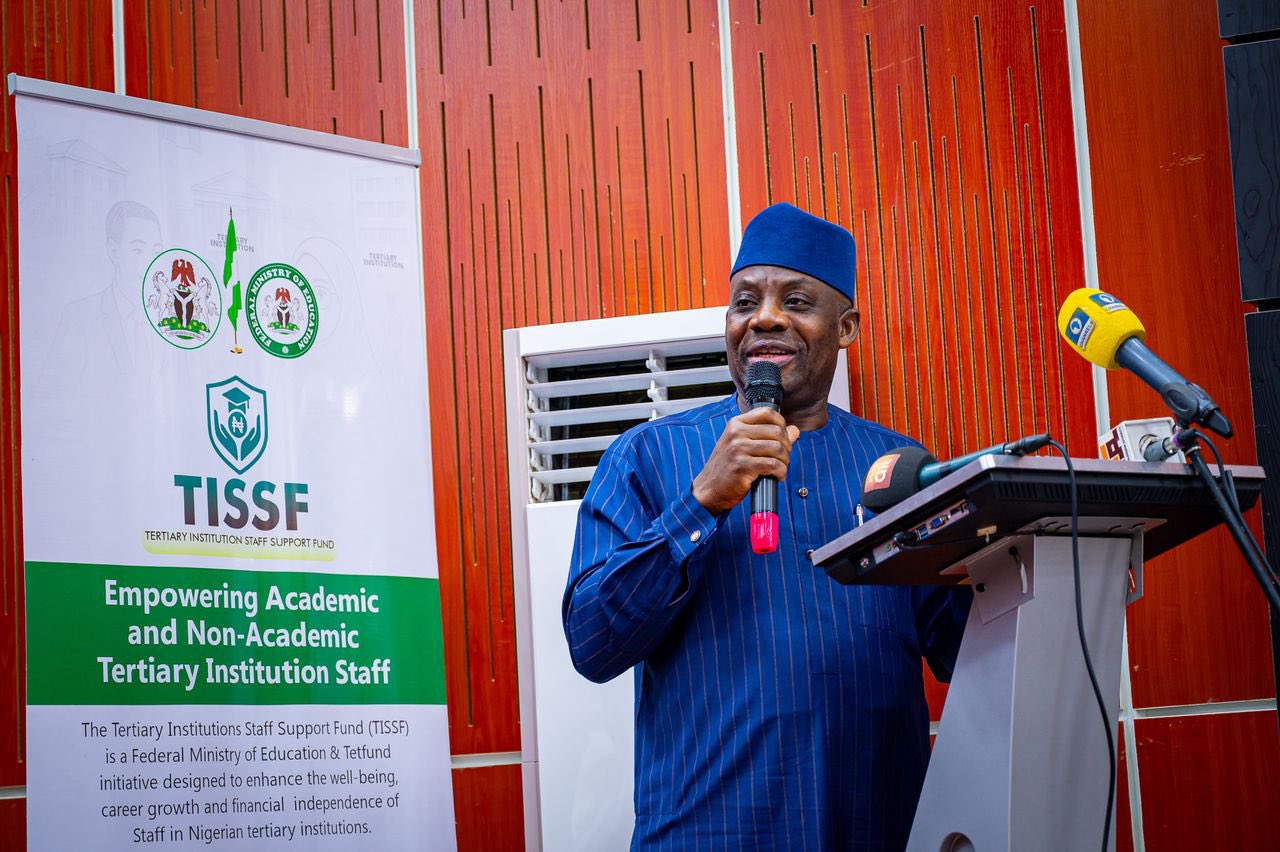
The Minister of Education, Dr Tunji Alausa, made this disclosure during the inaugural Federal Ministry of Education Private Sector Breakfast Convening held in Lagos.

According to the minister, the $345m figure is based on current per capita spending required to address the needs of the 15 million children currently outside the formal school system.

He disclosed that 25 per cent of children aged 5-14 were out of school in the country, with the figure rising to 41 per cent in the North-East and North-West regions.

Alausa emphasised that while the government had made significant strides through the Nigeria Education Sector Renewal Initiative, substantial additional investment is needed to complement public efforts.

“The challenges in the Nigerian education sector present a marked opportunity to increase access, improve quality, and enhance systems,” the minister stated.

He noted that education remains a central pillar of the “Renewed Hope” development plan, which targets a $1tn economy by 2030.

Alausa said to address the challenge of skilled labour, the government had so far disbursed N10.6bn to Technical and Vocational Education and Training centres across the country, and paid N3.4bn to trainees.

He explained that the government received 1.3 million applications for the TVET programme, 160,000 students matched to training centres nationwide and 72,000 students currently enrolled using verifiable biometrics.

The Federal Government has invested over N156bn to rehabilitate 18 medical schools and some engineering schools across the country, according to the minister.

See also  How Edo man sponsored me from Almajiri school to university – Jigawa varsity graduate

“N70bn has been spent on laboratory and technology workshop rehabilitation, and N100bn on new hostels across 50 institutions,” he said.

Alausa also revealed that the government had set up the Student Venture Capital Grant, which is aimed at supporting innovation by Science, Technology, Engineering, Mathematics, and Medicine/Medical Science students.

He added that the Federal Government had set aside N50m equity-free grant, and 65 STEMM students had been shortlisted.

Alausa disclosed that the Federal Government was partnering with the Italian government to organise an educational conference, where $15bn will be raised to fund foundational learning in 90 countries across the world.

“And this conference is going to raise $5bn with another catalytic funding of about N10bn, with a total of $15bn to support foundational learning in 90 countries across the world,” he asserted.

The minister urged private sector leaders to align their resources with national education priorities through the upcoming Education Sector Wide Approach, which promises transparent reporting and strong governance.

The Minister of State for Education, Prof Suwaiba Ahmad, described the convening as a strategic platform to deepen engagement with the private sector.

“Government alone cannot achieve the scale of transformation required. The private sector remains a critical partner in driving innovation, expanding infrastructure, and supporting skills development,” she said.

The ministry highlighted several achievements under the NESRI framework, including: the integration of 1 million children into formal education systems and the training of 1,400 Tsangaya teachers for Almajiri education, the mapping of 32 million students and 221,000 schools across 21 states to improve data and digitisation and the disbursement of N128bn in institutional fees through the Nigeria Education Loan Fund, benefiting over 1.1 million students.

See also  PHOTOS: New Abuja school turns ghost site as Teachers show up once a week, pupils hopeless

To bridge the funding gap, the government is promoting the Global Partnership for Education Multiplier, an innovative tool that matches private contributions 1-to-1 with GPE and partner funds.

Evidence presented at the roundtable suggested that every additional year of schooling in Nigeria leads to a 5.7 per cent increase in earnings and a 6 per cent increase in productivity, underscoring the economic imperative of the proposed investments.


punch.ng

FOLLOW US ON:

FACEBOOK

TWITTER

PINTEREST

TIKTOK

YOUTUBE

LINKEDIN

Continue Reading
Click to comment

Leave a Reply

Your email address will not be published. Required fields are marked *

Education

UNILAG denied me admission on age grounds; then I ended up studying in Nigeria’s best varsity — David Fetuga, Landmark’s second overall best-graduating student

Published

on

David Fetuga is the best-graduating student of the Department of Accounting, Landmark University, Kwara State, for the 2024-2025 academic session. A chartered accountant (ACA) at age 19, he graduated with a Cumulative Grade Point Average (CGPA) of 4.94 on a scale of 5.0, making him the second-best graduating student of the university. In this interview by KINGSLEY ALUMONA, he speaks about his academic feat, Nigeria’s new tax law, among other issues.

Your near-perfect university performance and results show that you are brilliant. Were you this brilliant in secondary school? What were your results like in secondary school, especially in WAEC and JAMB?

The turning point for me came when I was writing my common entrance examinations. My dad decided that I should attempt the exams when I had just concluded primary 3, and I failed woefully. I remember the principal of the secondary school at that time giving a speech on how I had done terribly. However, my parents decided that I stayed home and tried the exam again after a year. It was during this period that my mother ensured that I prayed and fasted as instructed by my spiritual father, Bishop David Oyedepo, with a focus on kingdom advancement prayers and endeavours. This period was also a period of consistent and intense studying. Then, after a year, I took the entrance exam to Covenant University Secondary School and scored 99.5 per cent.

It was then I learnt that if I sought God’s kingdom first, and also studied to show myself approved, that anything was possible, and I could actually do emerge as a star. I continued in this line and won numerous prizes in secondary school. Fast forward to JAMB, where I scored 311 over 400, which was the highest in my school, and I had all distinctions in my WAEC result.

It is believed that those who study accounting love money so much. Was this your thinking when you decided to study the course?

I have heard the stereotype that accounting students love money, but that was not the determining factor for me. Growing up, I always had debates and discussions with my dad as to which course really mattered and aligned with me, as I was always curious and liked solving problems. It was during these conversations that I began to see the uniqueness of accounting, and I gradually began to develop an affinity to the course. Another determining factor was the fact that I loved and appreciated mathematics and calculations. So, the movement of numbers attached to values intrigued me.

See also  UNILORIN to graduate 11,886 students, marks 50th anniversary

Among all the universities in Nigeria, why Landmark University?

Landmark University was never in my plan, and it seemed to me more of a divine intervention. I had chosen the University of Lagos (UNILAG) as my first choice and had gained admission to study accounting there. However, during the screening process, I was informed that I would not be able to continue as I fell short of the required age by only a few days. Everything seemed bleak during this period, and it was almost certain that I was going to stay a year at home.

However, in events that seemed like a miracle, my mother saw a flier stating that Landmark University was still accepting students and that I could still gain admission. What baffled me most in the entire process was how the resources to attend a private university came seamlessly. God blessed my parents in such a way that it can only be seen as a miracle. And that was how I ended up in one of the best universities in Nigeria.

What did you do differently to graduate with a CGPA of 4.94/5.0? And what did it feel like having such a result?

I believe that I was able to attain such a feat with the help of God and by putting his kingdom first. However, any faith that makes God absolutely responsible is an irresponsible faith. I paid my dues through consistent studying, even throughout my ICAN professional exams and school academics. Another factor was the fact that I understood how I assimilated things. I didn’t do things because everyone did them. I also had the best set of lecturers from the Accounting Department of Landmark University. Lastly, I would say that I had good friends.

It felt very good to have such a result, and it’s a testament that God rewards stewardship and hard work. My parents and siblings, as well as my friends, were all proud of me. I felt very good.

In the course of your programme, which area(s) or aspect(s) of Accounting interested you more and why?

In the course of my study, the areas that interested me the most were the generic areas of taxation and auditing, as well as how financial policies and institutions impact the economy of nations. Another part that really drew my interest was the role of artificial intelligence (AI) in accounting and auditing, and how AI is revolutionising the financial sector.

What is your final-year project about, and what are its major findings and its significance to society?

See also  NANS denies involvement in #FreeNnamdiKanu protest

My final year project was on artificial intelligence and audit practice in registered audit firms in Lagos state, Nigeria. The summary and insights from this research show that AI is revolutionising the financial industry and that a modern-day accountant must learn to be conversant with AI and technology to maintain job relevance and uphold their financial duties, as well as provide accurate and reliable information that would allow for sound business decisions and positively impact society at large.

In the course of your undergraduate studies, what would you say were your social, entrepreneurial, and leadership achievements?

The notable achievements in my undergraduate days include contesting and being elected as the president of the accounting association (NUASA LMU chapter).

Other notable events include the fact that, on a personal basis, I love football, and as the president of my association, I was one of the leaders of the team that led my department to win two competitions as we brought the gold trophy home, not once but twice, within my tenure.

This was one of the factors that led to creating a movement and a product that would transform African football, beginning with Nigeria and would standardise and strategically restructure football on this continent as we know it (@baskngr on social media platforms).

Why are most accountants, with their accounting degrees and know-how, not rich? Most even struggle financially,while helping the rich make and protect their money? In this light, what kind of accountant do you want to become, and what kind of impact would you like to make in the financial sector?

At this juncture, I would like to state that being rich is subjective and that some individuals. And, in this case, accountants are satisfied with meeting their basic needs and living a comfortable life. Having said that, a degree in accounting would inform an individual of the technicalities and standards of the financial world, and this alone does not make one rich in a monetary sense. Strategic planning, building structures and the ability to maximise opportunities, as well as problem-solving, all complement each other in becoming rich and not just the technicalities.

I am in the process of becoming an accountant who contributes and adds value wherever I find myself and also puts into perspective my technical background, as well as a strategic outlook to achieve my end goals. I am working towards becoming a key figure in reforming the financial sector of Nigeria to uphold integrity, accountability and forward movement of the economy and the nation.

See also  Experts knock FG for reversing mother-tongue policy in schools

In your LinkedIn bio, you stated that, “I am driven by a strong interest in finance, taxation, audit, and strategic business decision-making.” As someone knowledgeable in tax matters, how would you advise Nigerians on the new tax laws initiated by President Bola Tinubu and effective January 2026?

With the tax reforms introduced under President Bola Tinubu, my advice to Nigerians is to prioritise compliance and financial documentation. Whether individuals or small businesses, proper record-keeping is now more critical than ever.

Citizens should seek credible tax education, understand allowable deductions, and avoid informal practices that could attract penalties. Businesses should endeavour to transition toward structured accounting systems and professional guidance. Compliance is no longer optional in a reform-driven economy; it is a strategic necessity.

If you were to solve three national problems facing Nigeria with your accounting expertise, which problems would they be, and how would you go about solving them?

First, public sector financial mismanagement — by strengthening audit systems and enforcing transparent reporting.

Second, small and medium businesses’ mortality rates — by improving financial literacy and cost management advisory.

Third, tax inefficiency — by promoting simplified tax education and digital compliance systems.

Accounting is not just about figures, but also about providing information to make sound decisions and solve problems.

What advice do you have for common Nigerians on how to grow and manage their money and make better financial decisions this year?

Track expenses diligently. Separate consumption (daily expenses) from investment. Build emergency savings before pursuing high-risk ventures. Avoid debt without a clear repayment structure. Prioritise financial knowledge and application, as applied knowledge equals outstanding financial growth. Financial growth begins with disciplined budgeting and informed decision-making.

If you were given a fully funded postgraduate scholarship to study in any university in the world, which course would you study, at which university, and why?

I would pursue a master’s degree in financial economics or business analytics at the University of Oxford. The institution’s global research strength and policy influence would provide exposure to international fiscal systems and advanced financial strategy. My objective would be to gain insights transferable to emerging economies like Nigeria, particularly in governance and sustainable financial reform.

tribuneonlineng.com

FOLLOW US ON:

FACEBOOK

TWITTER

PINTEREST

TIKTOK

YOUTUBE

LINKEDIN

Continue Reading

Education

Out-of-school children rise to 273m globally – UNESCO

Published

on

The number of children and young people out of school worldwide has climbed to 273 million, the UN Educational, Scientific and Cultural Organisation (UNESCO) has said.

UNESCO, in the 2026 Global Education Monitoring Report released on Wednesday, stated that the number of out-of-school children and young people has risen for the seventh consecutive year.

The report finds that one in six school-age children are excluded from education, while only two in three complete secondary school.

Progress has also slowed across most regions since 2015, with conflict and population growth identified as major drivers.

“Progress in keeping children in school has slowed across almost every region,” the report noted, with sub-Saharan Africa particularly affected.

In conflict zones, the situation is even more acute, with millions more children out of school than official figures capture.

Despite these setbacks, UNESCO highlighted significant gains over the past two decades.

Global enrolment has risen sharply, with “more than 25 additional children accessing school every minute” since 2000.

The report also found that some countries have made remarkable progress, reducing out-of-school rates and expanding access to all levels of education.

However, the report cautioned that no single policy can tackle exclusion.

It urged tailored approaches and sustained investment to ensure all children can learn.

(NAN)

punch.ng

FOLLOW US ON:

FACEBOOK

TWITTER

PINTEREST

TIKTOK

YOUTUBE

LINKEDIN

See also  See how we breach CBT centres’ servers for candidates – Hackers
Continue Reading

Education

FG threatens closure of Almajiri centres violating standards

Published

on

The Federal Government has tightened enforcement measures in Almajiri learning centres nationwide, warning that non-compliance with newly established operational standards will attract sanctions, including closure.

Details of the measures are contained in the National Policy on the Enhancement of Almajiri Education in Nigeria, released by the Federal Ministry of Education last month and obtained by our correspondent on Tuesday.

The policy covers operations and management of all Almajiri learning centres, males and females, across the country.

At the centre of the policy is a set of mandatory standards that all learning centres must meet or risk suspension after a probation period of three to six months.

The framework, to be implemented by the National Commission for Almajiri and Out-of-School Children Education, introduces stricter regulation of the system, long criticised for neglect and abuse.

Under the new rules, all Almajiri centres are required to register with relevant state or local authorities and maintain comprehensive records of learners, including biometric data, to enhance monitoring and accountability.

Operators must also submit periodic reports and allow routine inspections by government agencies.

“Any learning centre that fails to comply with the provisions of this policy shall be given a probation period of three to six months; thereafter, appropriate action shall be taken, such as sanction from operation,” the policy report stated.

It explicitly bans the practice of sending learners to beg on the streets, a long-standing feature of the system.

“Any registered learning centre that sends learners out to beg shall face appropriate action, such as a sanction from the operation,” it added.

See also  UNILORIN to graduate 11,886 students, marks 50th anniversary

In addition, the government has set minimum welfare and health standards.

Learners and facilitators are now required to undergo periodic medical checks at recognised public health facilities, while centres must be linked to nearby healthcare providers and equipped with basic first aid kits.

“New entrants shall have the following basic needs as conditions for enrolment: a minimum of three items of clothing; two pairs of footwear; an eating plate and cutlery; writing materials as applicable or appropriate,” the policy outlined.

Clear age limits have also been introduced, restricting enrolment in day centres to children aged four to 18, while boarding facilities are limited to those between 12 and 18 years.

Adult learners, the policy states, must be taught separately.

To address concerns over poor learning outcomes, the government has mandated a uniform but expanded curriculum.

“Literacy and Numeracy shall be infused into the curriculum of the Almajiri teaching and learning. Relevant digital skills shall be included in the training of the facilitators and learners.”

Infrastructure requirements have also been standardised.

“At least one toilet for a population of not more than 25 Almajiri/Almajira learners. Adequate water supply to the Learning Centre. Learning centre shall be adequately ventilated,” it added.

The policy also introduces gender-sensitive provisions, mandating separate learning spaces for male and female learners.

“There shall be a separate learning space for male and female learners,” it stated, adding that operational guidelines now require centres to adhere to approved academic calendars and open their operations to oversight.

“Learning centres shall open doors for supervision and monitoring by the appropriate LGA, state/FCT or federal authority as may be required.”

See also  My administration’s education investments already yielding positive results — Aiyedatiwa

Officials said failure to comply with any of these provisions would trigger enforcement actions, stressing that the sanctions regime is designed to compel adherence and eliminate exploitative practices.

The government noted that the reforms build on earlier interventions by the National Commission for Nomadic Education and the Universal Basic Education Commission, but acknowledged that gaps in regulation and implementation have allowed the system’s challenges to persist.

It added that while the policy does not seek to take over Almajiri learning centres, strict enforcement of the new standards is necessary to safeguard learners, improve education quality and address the growing number of out-of-school children linked to the system.

The Almajiri system, which dates back several centuries in northern Nigeria, traditionally involves young boys leaving their homes to study the Quran under the guidance of a Mallam (teacher).

Learners often live with their Mallam or in small communal hostels, relying on alms or contributions from the community for food and basic needs.

Over time, the system has faced widespread criticism for exposing children to poverty, neglect, street begging, and exclusion from formal education.

Previous attempts to regulate Almajiri centres have met with limited success due to inconsistent oversight, inadequate funding, and, in some areas, cultural and religious resistance. Advocates for reform argue that formalising the system, integrating modern education, and enforcing welfare standards are essential to protect vulnerable children and reduce the number of out-of-school youths across northern Nigeria.

Continue Reading

Trending