




President Bola Tinubu has demanded at least two permanent seats for Africa on the United Nations Security Council, with veto powers, saying the current structure no longer reflects the distribution of global power.
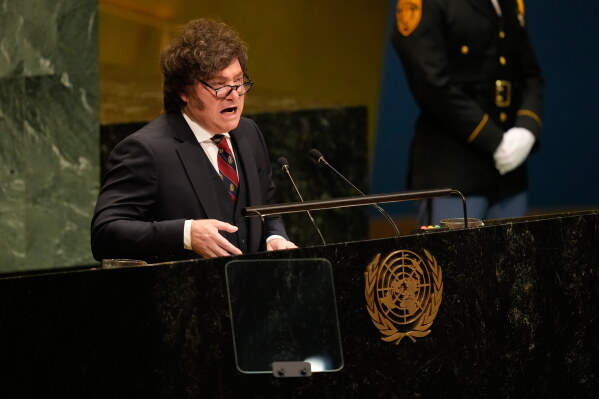
Tinubu made the demand on Thursday in his address to the General Debate of the 81st Session of the United Nations General Assembly in New York.
The President’s address, delivered by Vice President Kashim Shettima, also called for five non-permanent seats for Africa on the Security Council.
He said the reform of the global body must begin with restructuring the Security Council, arguing that Africa could not continue to contribute to the council’s agenda without having permanent representation.
“The reform of this institution must begin with the reconstitution of the Security Council, for the world of 2026 cannot remain captive to the distribution of power in 1945. Africa cannot continue to fill the Council’s agenda while remaining absent from its permanent membership. Nigeria demands, in accordance with the Ezulwini Consensus and the Sirte Declaration, at least two permanent seats for Africa, with all the rights and responsibilities of permanent membership, including the veto for as long as it exists, and five non-permanent seats in total. The authority to speak for humanity carries an obligation to represent it.”
Tinubu said Nigeria was prepared to take on greater responsibility in international peace and security, citing the country’s contributions to peacekeeping and mediation efforts across Africa.
He listed Nigeria’s involvement in Liberia, Sierra Leone, Darfur, Mali and The Gambia, adding that the country continued to advance mediation, democratic governance, counter-terrorism and maritime security through ECOWAS, the African Union and Gulf of Guinea partnerships.
On climate change, the President rejected what he described as a false choice between development and climate action, saying developing countries needed support to industrialise while reducing emissions.
“We reject the false choice between development and climate action. Developing countries must industrialise, eradicate poverty and expand energy access through low-carbon pathways supported by technology transfer, capacity building and climate finance.
“Africa contributes less than four per cent of greenhouse gas emissions, yet bears disproportionate consequences. Nigeria remains committed to the Paris Agreement and an equitable energy transition that reflects historical responsibility and capacity while protecting people’s right to development.”
Tinubu said Nigeria’s Energy Transition Plan was targeting net-zero emissions by 2060 while expanding access to affordable and reliable energy.
He said the plan combined renewable energy, clean cooking and gas as a transitional fuel with climate-smart agriculture and nature-based solutions.
The President also called for international climate finance to be based on equity and shared responsibility.
“Finance must be governed by equity and shared responsibility rather than charity, with international commitments translated into accessible, predictable and adequately funded mechanisms enabling developing countries to pursue climate action without compromising development objectives.”
On artificial intelligence, Tinubu called for responsible deployment of the technology, saying it could be used either for destructive purposes or to improve lives.
“We refuse to surrender our technological future to paranoia. An invention can be destructive or beneficial, depending on the purposes it serves and the judgement of those who use it. A knife can take a life in the hands of an assailant and save one in the hands of a surgeon. We can deploy artificial intelligence to wage war or use it to transform healthcare, education, agriculture, governance and economic productivity.
“Much of the anxiety surrounding AI reflects the distrust we have allowed to grow among us.”
He said Nigeria was investing in digital public infrastructure, broadband connectivity, innovation ecosystems, research institutions and technology entrepreneurship.
Tinubu invited international partners to collaborate with Nigerian youths in directing AI towards development.
“We invite the world to work with our inventive, resourceful and enterprising young people to direct AI towards humanity’s advancement rather than its destruction.”
The President also called for reforms to the international financial system, saying inadequate financing remained one of the biggest obstacles to sustainable development.
“Nigeria therefore calls for reform of the international financial architecture, wider access to concessional financing and debt sustainability frameworks that recognise developmental needs.”
He said Nigeria also supported innovative financing through private capital, blended finance, South-South cooperation and strategic partnerships for sustainable development, climate adaptation and resilient infrastructure.
Tinubu highlighted the African Continental Free Trade Area as an opportunity to strengthen regional value chains, increase intra-African trade and promote industrialisation.
He said Africa must move beyond exporting raw materials and focus on value addition, manufacturing, technological innovation and knowledge-driven growth.
“Our abundant natural resources must become engines of shared prosperity rather than sources of perpetual dependency.”
On security, the President said Nigeria’s experience fighting Boko Haram, ISWAP and other armed groups had shown that military victories alone could not guarantee lasting peace.
“Nigeria’s prolonged struggle against Boko Haram, ISWAP and other armed groups has taught us that military victories require enduring foundations in education, economic opportunity, accountable governance and communities whose rights and dignity are protected. Development cannot take root where violence repeatedly uproots livelihoods, and peace cannot endure where injustice and exclusion replenish the ranks of those who threaten it.”
Tinubu called for greater international cooperation against terrorism, organised crime, cyberattacks and illicit finance.
He also expressed concern about the continuing conflicts in Sudan and other war-torn countries, calling for urgent diplomacy and protection of civilians.
“All parties must uphold international humanitarian and human rights law, protect civilians and facilitate humanitarian access. Negotiated settlements must respect sovereignty and territorial integrity.”
The President said Nigeria remained committed to peaceful dispute settlement under the UN Charter and urged the strengthening of peacekeeping, peacebuilding, mediation and institution-building.
“We place our faith in diplomacy because military victories alone cannot secure lasting peace.”
Tinubu further called for greater recognition of Africa’s contribution to global development, describing the continent as a potential major driver of global growth.
“Developing countries must be recognised as indispensable partners whose contributions to global solutions and shared prosperity extend far beyond their need for assistance.”
He said the UN must evolve to reflect the aspirations of present and future generations, warning that institutions that failed to adapt risked losing their relevance.
Tinubu said Nigeria would continue to support cooperation, dialogue and partnership among nations.
“Nigeria pledges to choose cooperation over confrontation, dialogue over division, hope over fear and partnership over isolation.”
Concluding the address, the President said a reformed UN remained necessary to achieve global peace and sustainable development.
“A reformed, inclusive and effective United Nations is indispensable to the peaceful, just and sustainable world that future generations deserve. Whatever our differences, we must remember that humanity is our oldest citizenship, and peace is the inheritance we owe every child.”
The demand came against the backdrop of renewed calls for reform of the UN Security Council, with UN Secretary-General António Guterres saying Africa’s continued absence from permanent membership was “unjust and indefensible”. Guterres, speaking as world leaders gathered in New York for the 81st session of the UN General Assembly, said the council must be reformed to reflect the present-day global order.
He said, “We must reform the Council so that it reflects today’s world with the legitimacy and effectiveness that today’s challenges demand.”
The 15-member council currently has five permanent members China, France, Russia, the United Kingdom and the United States all of which have veto powers. The African Union has been seeking at least two permanent seats with full privileges, including veto power if the veto is retained, as well as five non-permanent seats.
Guterres has repeatedly backed reforms of global institutions to reflect present-day geopolitical realities. In February, he told African leaders that the absence of permanent African seats on the council was “indefensible”, arguing that the UN system must reflect today’s realities rather than that of 1945.
Source: punchng.com
FOLLOW US ON: