Connect with us

News

Bandits abduct Kwara monarch’s wives, children, attack police station

Published

on

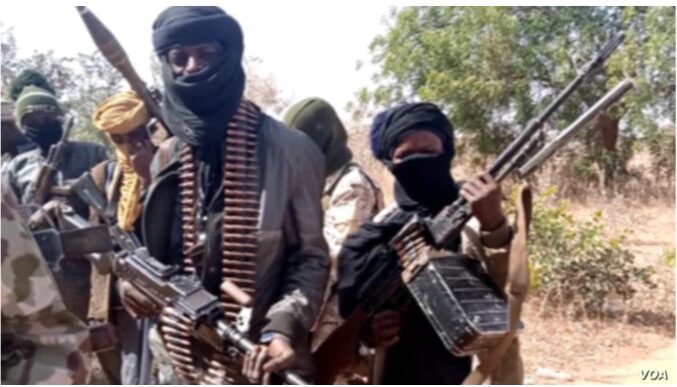
Suspected bandits on Monday launched a coordinated midnight attack on the Yashikira community in the Baruten Local Government Area of Kwara State, burning a section of the emir’s palace and abducting three wives and four children of the traditional ruler, Alhaji Umar Seriki.

The PUNCH gathered that the attack, which occurred between about 12:00 a.m. and 2:00 a.m., saw heavily armed men storm the border town in large numbers, firing sporadically into the air before advancing directly toward the palace and nearby police formation.

Residents said the attackers overpowered local security operatives stationed around the palace and forced their way into the inner sections of the royal residence, where members of the emir’s household were seized.

A resident who spoke to our correspondent on condition of anonymity due to security concerns described the chaos that followed the invasion.

He said, “I just finished communicating with my father right now. In his report, he said three of the wives of the emir and four children were abducted, including some residents of the community.

“People were running in different directions because of the sporadic gunshots. Some sustained injuries while escaping, but we cannot confirm the exact number for now,” the resident said.

Another resident, Tukur Ahmed, said the attackers arrived on motorcycles and moved straight to the palace complex.

“They came on motorcycles and went straight to the palace. They were shooting into the air and broke into the inner quarters where the emir’s wives and children were.

“They took three of the wives and four children, alongside some other residents, before setting the cars on fire and leaving the town,” he added.

See also  Trump says Israel, Lebanon agree to 10-day ceasefire

Sources confirmed that several vehicles belonging to the palace were set ablaze during the raid, causing significant property damage estimated in millions of naira.

The PUNCH also gathered that the emir was not in the palace at the time of the attack.

The Kwara State Police Command confirmed the incident in a statement issued by its spokesperson, Adetoun Ejire-Adeyemi, stating that 10 people were abducted during the coordinated assault.

According to the statement, the attackers struck at about 2:00 a.m., simultaneously targeting the Yashikira Police Divisional Headquarters and the emir’s palace in what the command described as a coordinated and desperate operation.

The police said: “The Kwara State Police Command condemns in the strongest possible terms the cowardly and audacious attack carried out by suspected bandits in the early hours of today, 25/5/26, in Yashikira, Kaiama Local Government Area of Kwara State.

“The armed criminals, in a coordinated and desperate assault at about 0200hrs, simultaneously attacked the Yashikira Police Divisional Headquarters and the Palace of the Emir of Yashikira.

“During the attack, part of the palace was set ablaze, while 10 people were abducted and taken to an unknown destination. However, the attack on the police station was successfully repelled by police operatives on duty.”

Following the attack, the Commissioner of Police, Ojo Adekimi, ordered a full-scale tactical operation involving the military, police, forest guards, vigilantes, and other security stakeholders to rescue the victims and track down the attackers.

The command said rescue operations had already commenced, with security forces combing nearby forests and suspected hideouts.

It assured residents that deployments had been reinforced across vulnerable communities.

See also  Uruguay becomes first in Latin America to legalize Euthanasia

The police also maintained that they would not succumb to intimidation by criminal groups operating in the state, insisting that all operational assets would be deployed to dismantle the attackers’ network and rescue abducted victims.

“The command remains battle-ready and fully determined to confront these enemies of peace with every lawful operational asset and strategy at its disposal.

“We will deploy everything within our operational capacity to smoke them out of hiding, dismantle their networks, rescue all abducted victims, and ensure they face the full wrath of the law,” the statement added.

Kwara North has witnessed a sharp escalation in banditry in recent months, shifting from isolated rural kidnappings to large-scale coordinated massacres, highway ambushes, and repeated attacks on traditional institutions across Kaiama, Baruten, Edu, and Patigi LGAs.

During this period, armed groups intensified operations across forest corridors linking Kwara to neighbouring states, targeting rural settlements, commuters, farmers, and security formations.

Major incidents included deadly raids on communities in early 2026, mass abductions along highways, attacks on military and police bases, and the February 3, 2026, Woro and Nuku massacre in Kaiama LGA, which marked one of the deadliest episodes in the region’s recent history.

LG bans vigil

The Chairman of Ekiti Local Government Area of Kwara State, Gabriel Awelewa, has ordered an indefinite suspension of vigil in worship centres in local communities across the council area.

The order was sequel to the gunmen attack on Ori-Oke Ajaiye, near Ikerin-Opin during a vigil, leading to the death of three persons and abduction of 15 others.

“Based on the recommendation from the council’s security advisory team, Awelewa urged religious bodies in outlying areas to relocate services to community centres within towns and villages, and limit day services to a maximum of two hours,” the statement signed by the Chief Press Secretary to the council chairman, Dada Sunday, stated.

See also  Spanish PM’s wife denies embezzlement allegations in court

It noted that the council chairman was particularly disturbed that the church continued to hold night services in an isolated area despite repeated warnings issued to religious bodies through the Christian Association of Nigeria and the League of Imams.

“Faith cannot be practised at the expense of life. We have consistently advised churches and mosques in isolated areas to stop holding vigils. Worship is meant to edify and protect, not expose people to avoidable danger.

“Security is a shared responsibility. Our people must choose prudence over ritual when the environment is unsafe. No prayer is more valuable than human life,” the statement quoted the chairman as saying.

Awelewa described the midnight raid as “a painful reminder that insecurity thrives where communities are unguarded, and warnings are ignored.”

He noted that the location of the church on a hill, far removed from residential areas, made early intervention from security personnel impossible.

“Help could not come quickly because the congregation was isolated. That is a reality we must confront honestly,” the statement added.

The chairman assured that the council would work with the state government and security agencies to secure the immediate rescue of the abducted worshippers and strengthen surveillance around vulnerable communities.

punch.ng

FOLLOW US ON:

FACEBOOK

TWITTER

PINTEREST

TIKTOK

YOUTUBE

LINKEDIN

INSTAGRAM

Continue Reading
Click to comment

Leave a Reply

Your email address will not be published. Required fields are marked *

News

Police comb forest after terrorists abduct NECO students in Borno

Published

on

The Borno State Police Command has deployed security operatives to Lassa community in Askira/Uba Local Government Area following the abduction of an unspecified number of students writing the National Examinations Council examinations by suspected terrorists.

PUNCH Online had earlier reported that the attackers stormed the school at about 9 a.m. on Monday, shooting sporadically before abducting students and women selling food items within the school premises.

Confirming the deployment to PUNCH Online, the spokesperson for the Borno State Police Command, Nahum Daso, said security operatives confronted the attackers, preventing a larger-scale abduction.

“Around 9 a.m. in the morning, ISWAP attacked Lassa Day Secondary School. They shot sporadically. An unspecified number of students have been abducted.

“Security forces confronted them. For now, we have an unspecified number of students who were abducted. The CP deployed the Area Commander in Askira/Uba. They are currently combing the bush,” Daso said.

The Special Adviser to Adamawa State Governor, Ahmadu Fintiri, on Media and Strategy, Mr Solomon Kwamagar, a resident of Lassa, also confirmed the incident to PUNCH Online on Monday morning.

He disclosed that the attackers arrived on motorcycles and invaded the school.

“Today is Lassa market day. I was informed that they came through the market on motorcycles and went to Government Day Secondary School, Lassa. They shot and killed one teacher and took away all the students who were in their classrooms,” he said.

Kwamagar added, “Lassa in Borno State is predominantly inhabited by my people, the Margi. We are in both Adamawa and Borno states. I am from Lassa, but I chose to reside in Madagali Local Government Area of Adamawa State.”

See also  Residents flee from Oyo village after bandit attack

He further said, “I’m still making contacts to ascertain the total number of students and teachers who were kidnapped from the school.”

Earlier, the President of the Borno South Youth Alliance, Samaila Kaigama, told PUNCH Online that the attackers wore military and forest guard uniforms.

“Yes. There was an attack on students writing NECO exams. The terrorists came around past nine. They passed the military checkpoint. They wore military and forest guard attire. They shot sporadically,” he said.

Kaigama said one teacher was killed while another sustained gunshot injuries.

“They killed one teacher from Chibok. They shot another, but not dead yet. They also kidnapped some students and women selling on the school premises. The numbers are not yet out,” he said.

When contacted, the Chairman of Askira/Uba Local Government Area, Mada Saidu, declined to comment.

“I am very busy now. We are in a situation,” he said.

Efforts to obtain comments from the state Commissioner for Information and Internal Security, Usman Tar, were unsuccessful as he neither answered calls nor responded to messages.

However, residents who spoke to PUNCH Online claimed that two teachers and one student were killed during the attack.

“They killed two teachers and one female student. The student was shot in her mouth,” a resident who requested anonymity said.

On May 16, PUNCH Online reported that 42 students and pupils were abducted after suspected Boko Haram terrorists attacked Mussa Primary and Junior Secondary School in Askira/Uba Local Government Area.

The senator representing Borno South, Ali Ndume, had said the abductees comprised four students of Government Day Secondary School, 28 primary school pupils and 10 children abducted from their homes.

See also  Adeleke reduces work hours for Osun civil servants, see why

punch.ng

FOLLOW US ON:

FACEBOOK

TWITTER

PINTEREST

TIKTOK

YOUTUBE

LINKEDIN

Continue Reading

News

NASS sends state police bill to 36 states’ assemblies

Published

on

The National Assembly is set to transmit the Constitution Alteration Bill seeking the establishment of state police to the 36 state Houses of Assembly this week, marking the next critical stage of one of Nigeria’s most far-reaching security reforms.

The development comes days after the Senate passed the landmark constitutional amendment, with lawmakers now racing to secure the approval of at least 24 state legislatures before the bill can be transmitted to President Bola Tinubu for assent.

Chairman of the Senate Committee on Media and Publicity, Yemi Adaramodu, disclosed the development in an exclusive interview with The PUNCH on Sunday, saying all the necessary arrangements had been concluded for the transmission.

According to him, the state legislatures and governors were already awaiting the bill following consultations held ahead of its passage by the National Assembly.

“The bill for the creation of state police will get to the states this week. The states’ speakers have met and are awaiting the bill from the National Assembly.

“The state governors are expecting it too, even with their presence in the Senate chamber when the bill was being considered and passed,” Adaramodu said.

The planned transmission signals the beginning of the final constitutional hurdle for the proposed amendment, which requires endorsement by not less than two-thirds of the 36 state Houses of Assembly in line with Section 9 of the 1999 Constitution before it can become law.

Momentum has continued to build behind the proposal since the Senate approved the amendment after a clause-by-clause consideration of the report presented by the Senate Committee on the Review of the Constitution, chaired by Deputy Senate President Barau Jibrin.

The legislation seeks to establish a dual policing structure that will empower state governments to establish and maintain police services within their jurisdictions while preserving the constitutional responsibilities of the Nigeria Police Force over national security matters such as terrorism, border security, cybercrime, arms trafficking and other federal offences.

To address longstanding concerns over possible abuse by state governments, lawmakers incorporated several safeguards into the bill, including provisions prohibiting state police authorities from targeting individuals or groups for criticising governments and empowering the Federal Government to intervene in cases involving threats to national security, breakdown of public order or violations of fundamental human rights.

See also  Uruguay becomes first in Latin America to legalize Euthanasia

The proposed reform has received unprecedented backing from governors, speakers of state legislatures and major political stakeholders across the country.

The Conference of Speakers of State Legislatures in Nigeria had earlier endorsed the bill, with its Chairman and Speaker of the Delta State House of Assembly, Emomotimi Guwor, assuring Nigerians that all state houses of assembly would give the proposal diligent consideration.

Several governors have also welcomed the amendment, describing it as a timely response to worsening insecurity across the federation.

Among them, Benue State Governor, Hyacinth Alia, described the Senate’s passage of the bill as a landmark step towards strengthening Nigeria’s security architecture, arguing that state police would possess a better understanding of local terrain and community dynamics, thereby improving intelligence gathering and response to criminal activities.

Similarly, the Forum of Progressive Speakers of State Legislatures under the All Progressives Congress pledged to facilitate speedy ratification in APC-controlled houses of assembly while promising robust oversight mechanisms to ensure professionalism and respect for human rights.

The Labour Party also threw its weight behind the proposal, describing the Senate’s action as a significant milestone in the quest to strengthen internal security through community-based policing.

Though it acknowledged concerns over possible abuse by governors, the party expressed confidence in the constitutional safeguards embedded in the amendment.

The proposal also attracted opposition from the Peoples Redemption Party, which questioned the timing of the initiative and urged Nigerians to reject it, arguing that the current administration lacks the credibility to oversee such a fundamental restructuring of the country’s policing system.

Despite the reservations expressed by critics, the planned transmission of the bill to the states this week is expected to trigger deliberations across the 36 Houses of Assembly, where lawmakers will conduct public hearings, stakeholder engagements and legislative scrutiny before voting on the constitutional amendment.

If at least 24 state assemblies endorse the proposal, it will pave the way for President Bola Tinubu’s assent, potentially ending decades of debate over the decentralisation of policing and ushering in what many stakeholders believe could be the most significant reform of Nigeria’s internal security architecture since the return to democratic rule in 1999.

See also  Adeleke reduces work hours for Osun civil servants, see why

Meanwhile, the Senate on Sunday defended the passage of the state police bill, insisting that its passage, which 84 senators supported, is a response to Nigeria’s worsening security challenges.

The upper chamber said the bill emerged from years of consultations, public engagements, and broad national consensus, stressing that it would be wrong to delay the proposal for political calculations ahead of the 2027 general election.

The position comes amid growing debate over the constitutional amendment bill, with supporters arguing that decentralising policing will improve security at the grassroots, while critics fear that state police could be abused by governors to intimidate political opponents.

Defending the Senate’s decision in a statement issued by his media office on Sunday, the Leader of the Senate, Opeyemi Bamidele, said the proposal was “purely a child of necessity and not of political expediency as well as a product of national consensus and not of cynicism.”

He maintained that the establishment of state police had become a matter of urgent national importance that should not be sacrificed because of anyone’s political ambition.

According to him, the process leading to the passage of the bill did not begin recently but evolved through extensive constitutional review engagements involving key stakeholders across the country.

Despite some dissenting views, Bamidele said observations had shown that Nigerians largely welcomed the passage of the bill with the belief that it would significantly improve security at the sub-national level.

He said, “The state police proposal was part of memoranda submitted to the Senate Ad hoc Committee on the Review of the 1999 Constitution. The memorandum had been subjected to a rigorous process and multi-tiered consultation across the federation due to its sensitive nature.

“During this process, the National Assembly broadly consulted the executive, the Nigeria Governors’ Forum, the Conference of Speakers of the State Legislatures of Nigeria and the leadership of the Nigeria Police, among others.

“In July 2025, the National Assembly conducted public hearings in all geopolitical zones, and the participants overwhelmingly approved it.

“At each level of our consultation, nearly all stakeholders embraced the State Police Bill in the light of stark realities we are facing today.”

The Senate Leader said the Nigerian Police actively contributed to the drafting of the constitutional amendment by offering recommendations that helped lawmakers build safeguards against potential abuse of state police by political actors.

See also  Tinubu Redeploys Fani-Kayode To South Africa, Enang To Germany

According to him, those recommendations formed part of accountability and oversight mechanisms embedded in the legislation to ensure that state police operate within constitutional limits.

He added that the willingness of the Nigerian Police to support the proposal underscored its strategic importance in addressing insecurity at the local and state levels.

Beyond the contributions of the police hierarchy, Bamidele said the bill was subjected to extensive debates in both chambers of the National Assembly before its eventual passage.

He noted that support for the legislation cut across party lines.

He said: “Even though the APC is the majority, there are members of opposition parties – PDP, ADC, NDC and Labour Party – that exercised their discretion in favour of the Bill, mainly in the national interest and not on a parochial basis.

“In the Senate, for instance, 84 out of 109 members voted clause by clause in support of the Bill. This accounted for 77.06 per cent approval at the Senate alone.”

Bamidele argued that security should transcend political affiliations, noting that countries facing security threats often unite behind reforms aimed at strengthening national safety.

Globally, he said, security “is a collective public good that benefits citizenry across ethnic, political and religious divides.

“Political actors elsewhere always throw off their togas of partisanship and parochialism to support initiatives that will boost and reinforce national security.”

He, therefore, urged opposition parties to contribute constructive ideas that would strengthen peace and stability across the federation rather than oppose initiatives solely on political grounds.

Bamidele also challenged opposition parties and leaders to come forward with ideas that would deepen the peace and stability of the federation.

“Even when they disagree on some grounds, they are under obligations to provide credible and useful ideas that can make our nation better and greater. Unfortunately, they have not passed this critical test of opposition democracy,” Bamidele said.

punch.ng

FOLLOW US ON:

FACEBOOK

TWITTER

PINTEREST

TIKTOK

YOUTUBE

LINKEDIN

Continue Reading

News

Chaos as flooding shuts Lagos airport temporary terminal

Published

on

There was chaos at the temporary terminal of the Murtala Muhammed International Airport, Lagos, on Sunday after heavy rainfall caused severe flooding at the facility.

The departure hall, boarding gates, airline temporary offices, and other sections of the makeshift terminal were submerged. The situation forced the Federal Airports Authority of Nigeria to shut the terminal abruptly, as airlines operating from the facility could no longer process passengers.

As a result of the flooding, airlines, including Air France-KLM, Ethiopian Airlines, and Fly Gabon, were relocated from the terminal. According to officials, the terminal’s powerhouse was also flooded, forcing the authorities to switch off electricity.

Consequently, all airlines operating from the facility were moved to Terminal Two of the MMIA. FAAN officials alleged that the flooding was caused by blocked drainage channels, which they attributed to the Chinese company currently reconstructing the old international terminal.The incident came just months after FAAN shut the old MMIA terminal for a major reconstruction project estimated to cost more than N600bn. A few months ago, a fire also broke out at the old terminal, damaging parts of the facility.

Sources said the ongoing reconstruction of the old terminal by the Chinese contractor has caused several disruptions at the airport.

Reacting to Sunday’s flooding, FAAN spokesperson Henry Agbebire confirmed the incident, attributing it to the ongoing construction work at the airport.

According to Agbebire, the construction temporarily affected the drainage system, resulting in flooding. He said, “It was the construction works that affected the drainage. And for operational reasons, we have moved airlines operating from that terminal to Terminal 2, and the development has not really affected their operations.

See also  Tinubu Redeploys Fani-Kayode To South Africa, Enang To Germany

“There were no cancellations at all. We have taken immediate action to fix that problem to the extent that it doesn’t happen again. You can rest assured of that.”

punch.ng

FOLLOW US ON:

FACEBOOK

TWITTER

PINTEREST

TIKTOK

YOUTUBE

LINKEDIN

Continue Reading

Trending