Connect with us

News

State police bill lands in state assemblies

Published

on

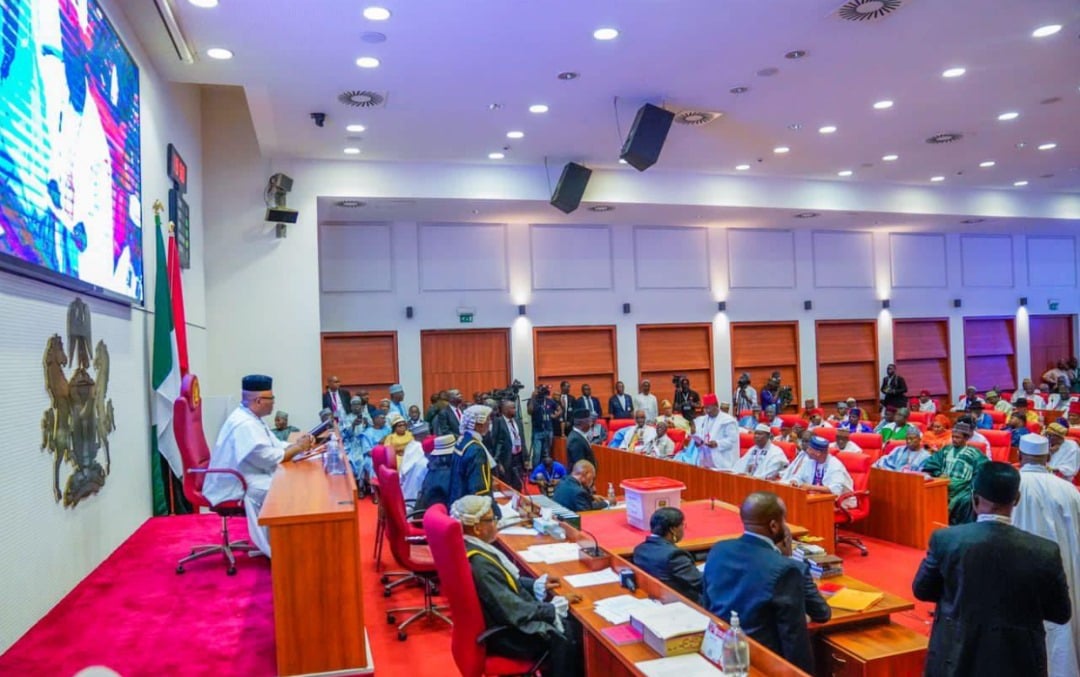
Nigeria on Wednesday moved closer than ever to establishing a state police force after the Senate passed the controversial Constitution Alteration Bill seeking to decentralise policing, shifting the battle for the landmark reform to the 36 state Houses of Assembly where at least 24 legislatures must endorse the proposal before it can become law.

The passage of the bill by the Senate marks a major breakthrough in a debate that has dominated Nigeria’s security discourse for decades and comes amid worsening insecurity across several parts of the country, including terrorism, banditry, kidnapping, communal violence and organised criminal activities.

The legislation, which seeks to establish state-controlled police services alongside the existing Nigeria Police Force, was approved after senators secured the constitutionally required two-thirds majority through a manual voting process adopted following technical glitches that affected the chamber’s electronic voting devices.

With both chambers of the National Assembly now backing the proposal, attention has shifted to state assemblies, whose approval will determine whether Nigeria finally abandons its long-standing exclusive federal policing structure.

The proposed amendment is widely regarded as one of the most consequential constitutional reforms undertaken since the return to democratic rule in 1999.

At the centre of the reform is a provision empowering governors to appoint Commissioners of Police for their respective states, subject to confirmation by state Houses of Assembly.

Under Clause 17 of the proposed constitutional amendment, “while the Federal Police Service will continue to be headed by the Inspector-General of Police, each State Police Service shall be headed by a Commissioner of Police appointed by the governor and confirmed by the legislature of the state.”

The development effectively creates a dual policing structure in which state police formations would operate concurrently with federal police authorities.

The Senate approved the bill after considering the report of the Senate Committee on the Review of the Constitution presented by Deputy Senate President and committee chairman, Barau Jibrin.

The bill’s provisions were first considered at the Committee of the Whole before lawmakers adopted them and proceeded to a final vote.

Leading debate on the legislation, Senate Leader, Senator Opeyemi Bamidele, described the proposal as a carefully designed framework aimed at balancing local policing autonomy with national cohesion.

“The bill is intended to retain the Nigeria Police Force for federal policing duties while providing for the establishment of state police services in states that choose to adopt them,” he stated.

Bamidele explained that the proposed structure clearly delineates the responsibilities of the federal and state police services.

According to him, state police would be responsible for enforcing state laws, maintaining public safety and public order, preventing and detecting crimes within their jurisdictions, protecting lives and property and carrying out other local policing duties.

On the responsibilities of the federal police, Bamidele noted that the federal police would be in charge of protecting federal institutions, counter-terrorism, organised crime, cybercrime, border security, arms trafficking, interstate criminal activities and other national security matters.

The Senate Leader also clarified the conditions under which federal police authorities could intervene in security situations within states.

He explained that intervention would only occur where there “is outright breakdown of public order at a specific subnational entity; when state police are incapable of functioning; when there is serious violation of fundamental rights; when there is an established record of electoral intimidation and when national security is under threat.”

According to him, such intervention would require written authorisation from the President and Commander-in-Chief and would remain subject to Senate oversight and judicial review.

Safeguards

The delineation of powers was one of several safeguards introduced by lawmakers to address long-standing concerns that governors could abuse state police formations for political purposes.

Indeed, fears that state police could become instruments of intimidation against opposition figures, critics and civil society groups have historically been one of the strongest arguments against decentralised policing.

To address such concerns, senators inserted explicit anti-abuse provisions into the constitutional amendment.

One of the key safeguards adopted by the Senate provides that “a state Commissioner of Police shall not arrest, detain, investigate or deploy force against any person, political party or group merely for criticising the government except in accordance with the law.”

See also  Tinubu vows safe return of abducted Oyo teachers, pupils; read details

The provision is expected to serve as a constitutional shield against politically motivated arrests and abuse of power.

In addition, lawmakers proposed that the National Assembly should retain powers to prescribe minimum national standards relating to recruitment, training, vetting, promotion, discipline, use of force, firearms, complaints procedures, accountability mechanisms, data management and professional conduct for state police services.

Bamidele said the proposed framework generally seeks “to balance local policing autonomy with national cohesion, accountability with operational effectiveness and federal oversight with state responsibility.

“The bill provides robust safeguards against abuse, preserves federal authority where necessary, protects constitutional rights and creates a modern policing framework capable of addressing contemporary security challenges.”

The state police proposal has remained one of the most contentious constitutional issues since the advent of the Fourth Republic.

Successive administrations, constitutional conferences, security experts and governors have repeatedly canvassed the idea, arguing that Nigeria’s highly centralised policing arrangement has become increasingly inadequate for a federation of more than 200 million people.

Supporters argue that officers recruited locally would possess a better understanding of their environment, language, culture and security dynamics, thereby improving intelligence gathering and crime prevention.

They also contend that state governments, which already spend billions of naira supporting federal security agencies, should have greater control over policing within their territories.

Critics, however, warn that powerful governors could deploy state police to settle political scores, intimidate opponents and influence elections.

These fears have often stalled previous attempts to amend the Constitution.

Wednesday’s Senate approval therefore represents a major political milestone.

The significance of the exercise was evident in the unusual voting process adopted by lawmakers.

The Senate was initially expected to deploy electronic voting for the constitutional amendment exercise.

However, technical glitches affecting some voting devices forced lawmakers to abandon the plan and resort to manual voting.

Moving a motion on the floor, Bamidele argued that every senator must be given an opportunity to participate in the historic vote.

He said, “Rather than go by way of electronic voting, which obviously now will disenfranchise a few or some of our colleagues whose machines are not working, I am moving that we allow every distinguished senator to answer his or her father’s name by doing manual voting.”

Senate President Godswill Akpabio endorsed the proposal.

“For transparency, and the need for the constituents to know where you stand on every issue, it is good for us to go into manual voting,” Akpabio said.

Following the adoption of the motion, senators were called individually to publicly declare their positions during the clause-by-clause consideration of the constitutional amendment bills.

To facilitate the process, the Senate suspended the relevant provisions of its Standing Rules through a voice vote.

The exercise attracted top government officials and governors who observed proceedings from the gallery.

Among those present were Kaduna State Governor, Senator Uba Sani; Ogun State Governor, Dapo Abiodun; Ondo State Governor, Lucky Aiyedatiwa; and the Chief of Staff to the President, Femi Gbajabiamila.

Their presence underscored the enormous political and security implications of the proposed reform.

Ex-cop backs bill

Outside the National Assembly, support for the bill also came from retired Assistant Inspector-General of Police, Aare Tunji Alapinni, who described state police as an opportunity to strengthen grassroots security and revive community policing.

Speaking during an interview on Frontline, a current affairs programme on Eagle 102.5 FM, Ilese-Ijebu, Ogun State, Alapinni urged Nigerians to embrace the initiative.

“I’m not saying it has failed. It has not failed. But people are clamoring to see that things could be better. There’s always room for improvement in anything. So, if there’s room for improvement, there’s room for state police. That’s the way I look at it,” he said.

According to him, Nigeria’s security challenges require fresh approaches.

“The security situation, in the country calls for doing same thing in a different manner and I think the introduction and the clamour for state police is a welcome development, nothing ventured, nothing gained. If we explore it and see how it works, no matter what, we stand to benefit from it. Forget about the pros and the cons. We have lived over the years with entry policing,” he said.

See also  Presidency closes public submissions on state police today

Alapinni dismissed concerns that issues relating to funding and training could halt the reform.

“The issue of funding and lack of training or retraining has been part of the malaise that has been affecting the constitutional responsibility of policing in the country.

“Whether funding or no funding, we have to look at it from the angle of what can we do to make police solid. And I think the present inspector-general of police is trying to do his best by giving directives and that’s okay,” he stated.

The retired police chief argued that one of the greatest benefits of state policing would be the revival of community intelligence networks.

“Twenty years ago, if a stranger comes into town, people walking around would notice that this man is a stranger and the community will watch him. That’s part of the things we have lost. Those are the things we want to gain with community policing,” he said.

Amotekun

Similarly, the Western Nigeria Security Network, popularly known as Amotekun, has disclosed that the South West is well positioned for a seamless transition to state policing.

While declaring full operational readiness for the much-anticipated security reform, the chairman of Amotekun commanders in the region, Adetunji Adeleye, stressed that the decentralisation of Nigeria’s security architecture remains the most viable solution to the country’s insecurity challenges.

Established in 2020 by the six South-West governors, Amotekun has operated as a regional security initiative designed to complement the efforts of the Nigeria Police Force in tackling crimes such as kidnapping, banditry, and armed robbery, among others.

Adetunji, who is the commander of the corps in Ondo State, cited the success of the Amotekun initiative as evidence that community-based security frameworks are more effective in identifying and apprehending criminals at community and state levels.

He said, “On the issue of state policing in the last couple of years, the position of the Council of Amotekun Commanders of the South West has always been that state policing remains the only viable solution to the present insecurity in the country because it’s easier, especially by adopting the Amotekun initiative, to identify criminals.

“That is why you find out that this year alone we have arrested and prosecuted well over 500 suspected criminals, and in so many of those cases we’ve been vindicated. Some of them are serving their various jail terms.

“So, I think it is a giant stride in the right direction, adopting state policing as a way of decentralising the security architecture of the country.”

“As per our readiness, as far as the southwest is concerned, we are ready to adjust and conform to whatever is put in place to ensure the smooth takeoff of state policing.”

Also, a former Speaker of the Ondo State House of Assembly, Jumoke Akindele, success of Amotekun in Ondo State is enough justification for state police to kick off in Nigeria.

She said, “As for the quest to have the requirement of state police entrenched in our Constitution, suffice it to say that methinks that the success of the Amotekun Corps of Ondo State is the strongest case for state police in Nigeria.”

Houses of Assembly

For all the excitement surrounding the Senate vote, the legislation still faces perhaps its toughest test.

Under the Constitution, no amendment can take effect without approval by at least two-thirds of the country’s state legislatures.

This means no fewer than 24 Houses of Assembly must endorse the state police proposal before it can be transmitted to President Bola Tinubu for assent.

The next phase is therefore expected to trigger intense consultations among governors, lawmakers, security stakeholders and political actors across the federation.

Should the proposal secure the required endorsements, Nigeria would be on the verge of implementing one of the most transformative security reforms in its history.

See also  ‘Military lacks power to forcefully recruit Nigerians’

For supporters, state police represent a long-awaited solution to a growing national security crisis.

For critics, the challenge remains ensuring that constitutional safeguards are strong enough to prevent abuse.

Either way, the debate has now left the National Assembly and moved to state capitals, where 24 assemblies hold the key to the future of state policing in Nigeria.

Also, the Director-General of the Development Agenda for Western Nigeria Commission, Seye Oyeleye, has described the passage of the state police bill by the National Assembly as a major step towards tackling Nigeria’s security challenges, saying it is not a “silver bullet” but would significantly improve policing across the country.

Oyeleye, who welcomed the development, said decentralising policing would strengthen security architecture by bringing law enforcement closer to local communities.

Speaking with The PUNCH on Wednesday, Oyeleye said, “State police is not the silver bullet to our security challenges. There is no silver bullet for now, but it will go a long way,” he said.

According to him, Nigeria’s current centralised policing system is no longer adequate for a country of over 230 million people with diverse security concerns.

“We are a country of 230 million people with different ethnic groups. One-size-fits-all policing is no longer adequate,” he said.

He argued that many communities remain vulnerable because of the absence of nearby security personnel, noting that in some areas, the nearest police presence is several hours away.

“Some of these places where bandits invade to kill people do so because they know there is no security presence. In some communities, the nearest police station is three hours away. When states have their own police forces, they will know the critical areas and where to deploy officers, and people will feel more secure,” he added.

The DAWN Commission boss said state police would also increase the country’s policing capacity, estimating that if each of the 36 states recruited an average of 5,000 officers, Nigeria would gain about 180,000 additional policemen.

He maintained that the bill marked a significant milestone in Nigeria’s journey towards true federalism.

“Today is a momentous day and an epochal day for Nigeria. For those who have been clamouring for true federalism over the years, this is a great day,” he said.

Oyeleye noted that while governors are constitutionally recognised as chief security officers of their states, they have little operational control over policing because commissioners of police take directives from Abuja.

“We keep calling governors the chief security officers of their states, but that is only on paper. The state commissioner of police still takes orders directly from Abuja, even though state governments provide vehicles, equipment and other logistics for the police,” he said.

He commended President Bola Tinubu for supporting the establishment of state police despite years of opposition by previous administrations.

“One has to congratulate President Bola Tinubu for being bold enough to go down this route. The reality of Today is totally different from what it was in the 1970s and 1980s when we could get away with a single police force,” he said.

On concerns that governors could abuse state police, Oyeleye said appropriate safeguards could be built into the system and strengthened through future amendments where necessary.

“There have to be safeguards, and if we discover areas that require improvement, they can always be amended. In this age of technology and modern communication, the chances of governors misusing state police are quite remote,” he said.

He cited the operations of the South-West Security Network, Amotekun, saying no governor in the region had been accused of abusing the outfit since its establishment about six years ago.

Asked whether Amotekun should be merged with the proposed state police structure, Oyeleye declined to express a personal opinion, saying the decision rests with the South-West governors.

“I would not like to pre-empt my principals, so I will leave that to the state governors,” he said.

punch.ng

FOLLOW US ON:

FACEBOOK

TWITTER

PINTEREST

TIKTOK

YOUTUBE

LINKEDIN

Continue Reading
Click to comment

Leave a Reply

Your email address will not be published. Required fields are marked *

News

Governors spend N512bn on travels, offices

Published

on

Thirty-three state governments spent at least N512.10bn on Government Houses, Governors’ Offices and travel and transport in the first six months of 2026, an amount about 4,713 times higher than the combined six-month salary of Nigeria’s 36 governors, an analysis of state budget implementation reports has shown on Monday.

The analysis showed that while a governor’s stated monthly salary of N503,000 translates to N3.018m over six months, the combined six-month salary of all 36 governors would amount to just N108.65m.

Against this, the available records showed that N420.01bn was identified under Government House, Governor’s Office and related executive administration expenditure, while another N92.09bn was spent under travel and transport budget heads.

The combined amount stood at N512.10bn. The six-month salary of all 36 governors, therefore, represented only 0.02 per cent of the identified expenditure on executive offices and travel.

The figures offers a striking contrast to the ongoing debate over the official salaries of Nigerian governors.

Delta State Governor, Sheriff Oborevwori, recently said his monthly salary was N503,000, arguing that some senior civil servants, including permanent secretaries earned N900,000 monthly, more than state governors.

But an analysis of the cost of maintaining the offices occupied by governors shows that their salaries represent only a fraction of the wider public expenditure and perks associated with the offices.

While the personal salary of a governor may appear modest compared with the salaries of some senior public servants, the analysis shows that the wider cost of maintaining the executive office runs into hundreds of billions of naira.

The figure is not the personal income of governors. Government House and Governor’s Office budget heads cover a broad range of official expenses, including administrative operations, staff, protocol, maintenance, official residences, utilities, security-related activities, state functions and other expenditure required to run the executive arm of government.

Similarly, travel and transport spending covers official local and foreign trips, transportation and related expenses across the wider state public service.

However, the figures provide an indication of the enormous public cost attached to maintaining the structures surrounding the offices of state governors and the larger fiscal question on the  total public cost of maintaining the office and the administrative structures around it.

The analysis is based on available Budget Implementation Reports for the first and second quarters of 2026, using the largest identifiable Government House, Governor’s Office or executive administration expenditure line in each state, alongside the general travel and transport expenditure head.

See also  Tinubu vows safe return of abducted Oyo teachers, pupils; read details

Abia, Adamawa, Bauchi, Bayelsa, Borno, Cross River, Ebonyi, Ekiti, Enugu, Gombe, Imo, Jigawa, Kaduna, Kano, Katsina, Kogi, Kwara, Lagos, Nasarawa, Niger, Ogun, Ondo, Oyo, Plateau, Sokoto, Taraba, Yobe and Zamfara had the complete data. Comparable data were unavailable for Edo, Osun and Rivers.

For comparison, available records for the first half of 2025 showed N465.07bn spent under Government House, Governor’s Office and similar executive administration heads, while N92.73bn was recorded for travel and transport. The combined figure stood at N557.80bn.

This means that, based on the states and budget heads for which comparable data were available, the first-half 2026 expenditure was about N45.70bn lower, representing a 8.19 per cent decline, compared with the corresponding period of 2025.

Government House and Governor’s Office expenditure accounted for the larger share of the spending.

The amount fell from N465.07bn in the first half of 2025 to N420.01bn in the corresponding period of 2026, representing a reduction of N45.05bn or 9.69 per cent.

Travel and transport spending, however, was largely unchanged. Available records showed that states spent N92.09bn on travel and transport in the first six months of 2026, compared with N92.73bn in the same period of 2025.

This represented a marginal decline of about N643.66m, or 0.69 per cent.

The figures suggest that while spending under Government House and executive administration heads moderated in the available records, the cost of official travel remained broadly stable.

Commenting on the development, a development economist, Aliyu Ilias, said the enormous cost associated with maintaining executive offices showed why it was misleading to focus only on a governor’s basic salary without taking into account the wider expenses and privileges attached to the office.

He argued that executive offices in Nigeria had become excessively expensive to maintain, partly because political office holders had significant influence over how the institutions under their control were structured and funded.

“Ordinarily, anything that has to do with executive office in Nigeria appears to be much more expensive because they actually direct how it works there. And with the docile state assemblies we have, who always concur, it is clear that our democracy is very expensive because of the way we maintain their offices, and that is why it is very juicy.

See also  Male hawker crushed to death in Lagos road crash

“Some even want to go as far as borrowing money to win an election and, when they enter office, they believe they are going to repay the money. So, it is not correct to say that a Permanent Secretary is earning better than a governor when you isolate the governor’s salary without adding the other travel perks and expenses attached to the office.

“The governor just wanted to be sensational. But with the addition you have done, it shows that they are taking the bigger cheque from the spending arising from the high income that the state is generating,” Ilias said.

A state-by-state analysis of the 2026 Government House or Governor’s Office expenditure, Kogi recorded the highest amount at N65.34bn, followed by Ogun with N45.26bn and Lagos with N45.04bn.

Kano recorded N25.87bn, while Ekiti spent N25.22bn and Cross River recorded N23.92bn.

Bayelsa recorded N22.99bn, Imo N19.43bn and Enugu N16.20bn.

At the lower end of the available records, Oyo recorded about N1.95bn, Sokoto N2.20bn, Kwara N2.59bn and Abia N2.78bn.

Kogi’s figure alone represented more than 15 per cent of the identifiable Government House and Governor’s Office expenditure captured in the 2026 dataset.

On travel and transport, Plateau recorded the highest identifiable expenditure at N10.11bn in the first six months of 2026.

Lagos followed with N8.23bn, while Taraba recorded N5.16bn.

Niger spent N4.45bn, Ekiti N4.41bn, while Bauchi recorded N3.75bn and Yobe N3.68bn.

Oyo recorded one of the lowest identifiable amounts at N667.52m, while Kano recorded N626.95m.

The figures also showed wide variations in expenditure patterns between 2025 and 2026.

For example, Kogi’s Government House and Governor’s Office expenditure increased from N51.99bn in the first half of 2025 to N65.34bn in the corresponding period of 2026. This represented an increase of about N13.34bn, or 25.66 per cent.

Bayelsa’s identifiable spending rose from N14.48bn to N22.99bn, an increase of N8.51bn, or 58.75 per cent.

Cross River’s expenditure increased from N9.91bn to N23.92bn, representing a rise of about N14.01bn, or 141.37 per cent.

Ekiti, which had no comparable 2025 figure in the dataset provided for this analysis, recorded N25.22bn in the first six months of 2026.

See also  New tax regime: What’s true, what’s not

Other states, however, recorded significant reductions.

Ogun’s identifiable Government House and Governor’s Office expenditure declined from N49.83bn in the first half of 2025 to N45.26bn in 2026, a reduction of N4.57bn, or 9.17 per cent.

Kano’s expenditure fell from N28.84bn to N25.87bn, representing a decline of about N2.98bn, or 10.32 per cent.

Niger recorded a smaller decline from N13.13bn to N14.15bn, although the available figures show an increase of about N1.02bn, or 7.74 per cent, underscoring the differences in spending patterns across the states.

Lagos recorded one of the most significant increases in the available data, with identifiable spending rising from N25.86bn in 2025 to N45.04bn in 2026, an increase of about N19.18bn, or 74.16 per cent.

The Revenue Mobilisation Allocation and Fiscal Commission is constitutionally responsible for determining the remuneration of governors and other political office holders. The existing remuneration framework remains in force while a broader review is being processed by the relevant authorities.

In recent weeks, RMAFC said its review of remuneration for executive and legislative office holders had reached an advanced stage, with proposed legislation expected to be considered by the National Assembly.

The spending also comes at a time when state governments have received significantly higher allocations from the Federation Account following the Federal Government’s economic reforms.

An analysis of Ministry of Finance data previously showed that N47.25tn was shared through the Federation Account between 2023 and 2025 alone, accounting for more than half of the N93.13tn distributed over the nine years from 2017 to 2025.

The sharp increase in revenues has intensified public scrutiny over whether the additional resources flowing to states are being translated into better infrastructure and public services.

The records reveal a huge gap between the official salaries of governors and the actual cost of maintaining the executive structures around their offices.

While the basic pay of a governor may appear modest, it represents only a fraction of the public funds required to run Government Houses, Governors’ Offices and official travel. The broader question, therefore, is not simply how much governors earn as salaries, but how much it costs taxpayers to maintain the offices they occupy.

Source: punchng.com

FOLLOW US ON:

FACEBOOK

TWITTER

PINTEREST

TIKTOK

YOUTUBE

LINKEDIN

INSTAGRAM

Continue Reading

News

PHOTOS: Despite Court Warrant, Sunday Igboho Allegedly Stops Police From Arresting Tani Olohun In Ibadan

Published

on

A disturbing incident in Ibadan has raised serious questions about the conduct of the Nigerian Police and the circumstances surrounding the alleged attempted arrest of a traditionalist,Tani Olorun, reportedly over his longstanding religious disagreements with some Islamic clerics in Kwara State.

According to accounts circulating about the incident, a Toyota Hiace bus allegedly arrived at the traditionalist’s residence in Ibadan with four men believed to be police officers. Two were reportedly dressed in police uniform while the other two were in mufti.

What immediately raised suspicion was that the vehicle allegedly had no visible number plate, while the men reportedly failed to produce police identification when requested by the resident’s wife and neighbours. As the situation attracted a crowd, concerns grew that what was being presented as an arrest could instead be an unauthorised attempt to forcibly remove the man from his residence.

The situation reportedly took an even more dramatic turn when Chief Sunday Igboho arrived at the scene and intervened, insisting that the men follow proper police procedures.

The intervention reportedly stopped the attempted removal and the men were ordered to return to their ilorin base.

But the bigger question remains:

Why would security personnel travel all the way from Kwara to Ibadan to remove a traditionalist from his home under circumstances that allegedly failed to meet basic standards of police identification and due process?

The controversy is particularly sensitive because Tani Olorun has reportedly had longstanding disputes with some Islamic clerics over religious issues. He was previously arrested in Kwara following allegations that he defamed an Islamic cleric and reportedly spent a prolonged period in detention before his release.

See also  Tinubu vows safe return of abducted Oyo teachers, pupils; read details

His subsequent outspoken criticism of religious teachings and defence of traditional African religion have reportedly continued to generate controversy.

This is where Chief Sunday Igboho’s confrontation with the Kwara State Commissioner of Police becomes significant.

Igboho was reportedly heard questioning why the Kwara Police Command[b] appeared to have the resources and urgency to pursue a controversial religious-related arrest in Ibadan, while communities in Kwara continue to complain about kidnapping, banditry and insecurity, including attacks allegedly affecting ordinary citizens and traditional rulers.[/b]

His message was essentially this:

If the police can travel from Kwara to Ibadan to arrest a traditionalist over a religious dispute, why has the same urgency not been demonstrated in confronting the kidnappers and bandits terrorising Kwara communities?

That question deserves a serious answer.

The Nigerian Police Force must not allow legitimate law enforcement to be confused with intimidation, religious persecution or extra-judicial abduction. If an individual is wanted for an offence, the police should identify themselves properly, present the appropriate documentation and follow established legal procedures.

No Nigerian citizen should be secretly taken away from his home under questionable circumstances.

And if this was indeed a legitimate arrest, then the authorities should explain clearly what offence was alleged, what warrant or lawful authority was relied upon, why officers travelled from Kwara to Ibadan, and why the operation reportedly generated such serious concerns about its legitimacy.

Chief Sunday Igboho’s intervention has therefore brought an important issue to the public space:

Law enforcement must protect Nigerians from kidnappers—not create circumstances in which Nigerians begin to fear that the police themselves may come to take them away.

See also  Court Grants Bail To Sowore, Ejimakor, Nnamdi Kanu’s Brother, Others

The allegations surrounding this incident should be thoroughly investigated, and the public deserves transparency.

Security must never become a tool for religious vendetta. Justice must never be selective. And an arrest must never look like a kidnapping.

FOLLOW US ON:

FACEBOOK

TWITTER

PINTEREST

TIKTOK

YOUTUBE

LINKEDIN

INSTAGRAM

Continue Reading

News

US plans mass visa revocation for asylum seekers — Report

Published

on

The United States government is planning to revoke the business and tourism visas of as many as 200,000 foreigners who have sought or are seeking asylum in the country, in what could become the largest mass visa revocation in US history.

The planned action targets holders of B1 and B2 visas issued between 2016 and 2026 who entered the US as short-term visitors but subsequently applied for asylum, according to documents obtained by the Associated Press and two US officials, as reported by the agency on Monday.

The State Department is expected to begin announcing the revocations in the coming weeks in coordination with the Department of Homeland Security.

State Department spokesman Tommy Pigott confirmed the planned action but said the number of affected people could change.

“We are coordinating with DHS to identify and revoke the nonimmigrant visas of foreigners who have come to the United States claiming to be short-term visitors, but then file for asylum to stay here permanently,” Pigott said.

He added that “the number of revocations remains dynamic” and that the action would be carried out “on a rolling basis.”

The revocations would not automatically lead to immediate deportation, according to the officials. People with pending asylum applications would instead lose their B1 or B2 status while their cases are considered.

Deputy Secretary of State Christopher Landau defended the proposed policy, arguing that visitor visas should not be used as a route into the US asylum system.

“Asylum isn’t supposed to be a loophole to circumvent immigration law,” Landau said in a post on X.

See also  Petrol battlefield: ICPC plans NMDPRA boss probe after Dangote petition

B1 visas are generally issued for business travel, while B2 visas cover tourism, family visits and medical treatment. Applicants are required to demonstrate that they intend to return to their home countries.

What it could mean for Nigerians

The proposed revocation could affect Nigerians among other foreign nationals, although the US government has not disclosed how many Nigerians may be involved in the 200,000 figure.

Nigerians have historically accounted for a significant share of African asylum applications in the US. According to UNHCR figures previously reported by The PUNCH, 2,827 Nigerians applied for asylum in the US in 2024.

Between 2022 and 2024, US immigration courts granted asylum to 1,372 Nigerians, while 1,534 applications were denied.

For Nigerians currently holding B1 or B2 visas who have applied for asylum, the development could mean losing their visitor status and facing closer scrutiny of their immigration cases. It also signals a tougher environment for Nigerians seeking to use short-term US visas as a pathway to remain in the country.

Source: punchng.com

FOLLOW US ON:
FACEBOOK

TWITTER

PINTEREST

TIKTOK

YOUTUBE

LINKEDIN

INSTAGRAM

Continue Reading

Trending