Connect with us

News

Senate backs death penalty for kidnappers, informants, others

Published

on

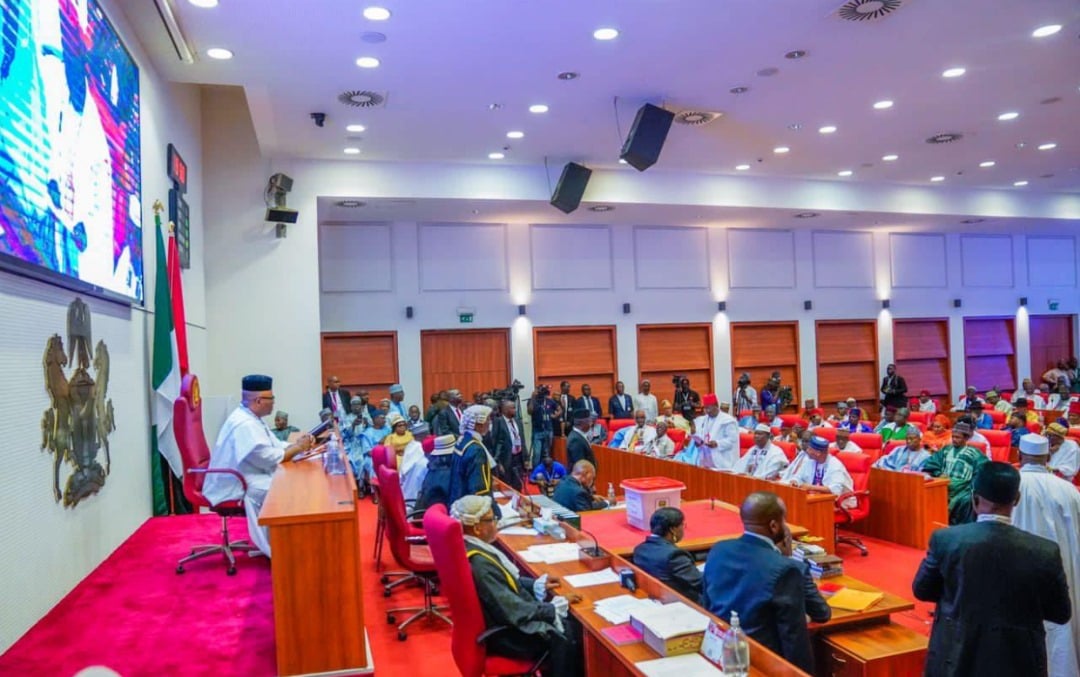
The Senate on Wednesday moved to tighten Nigeria’s anti-kidnapping laws by pushing for the death penalty for kidnappers — and anyone who finances, enables, or provides information to them — as lawmakers debated amendments to the 2022 Terrorism (Prevention and Prohibition) Act.

The proposal, sponsored by the Leader of the Senate, Opeyemi Bamidele, seeks to classify kidnapping, hostage-taking, and related crimes as terrorism, giving security agencies wider powers to track, disrupt, and prosecute criminal networks across the country.

The debate dominated Wednesday’s plenary, drawing contributions from key senators including Adams Oshiomhole, Orji Uzor Kalu, and Minority Leader Abba Moro.

The session was presided over by Senate President Godswill Akpabio.

After hours of deliberation, the Senate unanimously approved the amendment bill for further legislative work and referred it to the Committees on Judiciary, Human Rights and Legal Matters (lead committee), National Security and Intelligence, and Interior.

The committees are expected to report back within two weeks.

Leading debate on the bill, Bamidele said the purpose was to “designate kidnapping, hostage-taking and related offences as acts of terrorism and prescribe the death penalty for such offences without option of fine or alternative sentence.”

He warned that kidnapping had evolved into “coordinated, commercialised and militarised acts of violence perpetrated by organised criminal groups.”

“Kidnapping has instilled widespread fear in communities; undermined national economic activities and agricultural output; interrupted children’s education; bankrupted families forced to pay ransom; overstretched our security forces, and claimed countless innocent lives,” the Senate leader lamented.

See also  Family - Peju Ogunmola’s son didn’t die from bathroom fall

According to him, the patterns of brutality associated with kidnapping “now carry all the characteristics of terrorism,” making it necessary to treat the offence under the counter-terrorism framework.

Bamidele added that the bill would empower security agencies with “broader operational authority, intelligence capabilities, and prosecutorial tools” to pursue terrorists and their enablers.

He stressed that the death penalty would apply not only to kidnappers but also to “their informants, logistics providers, harbourers, transporters, and anyone who knowingly assists, facilitates, or supports kidnapping operations,” adding that “attempt, conspiracy or incitement to kidnap attracts the same penalty.”

“Nigerians are kidnapped on highways, in schools, in homes, on farms and in markets,” he said. “This is not a mere crime. It is terrorism in its purest form.”

Backing the amendment, Oshiomhole criticised deradicalisation programmes for terror suspects, arguing that many offenders returned to crime.

“We should not continue with deradicalisation programmes again,” he said. “No more de-radicalisation. If you are caught and convicted for acts of terrorism, then the penalty should be death.”

Kalu also supported the bill, insisting that informants and sponsors of kidnappers must “face the consequence.”

“Nigerians have suffered at the hands of kidnappers. Young girls have been raped. Women have become widows for no reason. This must not continue again,” he said.

Senate Minority Leader Moro described the bill as “a unanimous decision of the Senate,” noting that it was necessary to impose capital punishment “with the hope that kidnappers will face the penalty.”

Senator Victor Umeh, in his contribution, condemned the rising trend of abductions and the killing of victims even after ransom payments. He said financial institutions aiding such crimes must also be scrutinised.

See also  Group mobilises for voter registration in Plateau

Last week, the Senate took a similarly tough stance as it debated a motion following the November 18 attack on Christ Apostolic Church, Eruku, in Ekiti LGA of Kwara State, where gunmen killed two worshippers and abducted 38 others.

Although all victims were later rescued, lawmakers said the incident exposed the spread of insurgent cells into the South and worsening insecurity in rural communities.

The debate stemmed from a motion by Senator Yisa Ashiru titled ‘Urgent Need to Address Escalating Insecurity in Kwara, Kebbi, and Niger States and Strengthen National Security Frameworks.’

Senators also raised concerns over rising school abductions, which have led to shutdowns in parts of Kebbi, Niger, Kwara, and all 47 Federal Unity Colleges nationwide.

The latest amendment effort signals a tougher legislative push as insecurity — particularly kidnapping for ransom — continues to devastate communities across the country.

punch.ng

FOLLOW US ON:

FACEBOOK

TWITTER

PINTEREST

TIKTOK

YOUTUBE

LINKEDIN

TUMBLR

INSTAGRAM

Continue Reading
Click to comment

Leave a Reply

Your email address will not be published. Required fields are marked *

News

At least 66 die after Colombian military transport plane crashes

Published

on

A Colombian military plane carrying 125 soldiers and crew members crashed on takeoff early Monday, killing at least 66 people and injuring dozens of others, officials said.

The C-130 Hercules aircraft went down shortly after departure from Puerto Leguizamo, near the southern border with Ecuador and Peru, strewing burning wreckage on the jungle floor.

A military source told AFP that 58 soldiers had died, along with six air force personnel and two police officers.

The updated toll came shortly after the local government secretary Carlos Claros told RCN television that 33 people had died, and that efforts were being made to treat and evacuate dozens of others injured.

He added that investigators were probing the cause of the crash.

The border area where the plane went down has been the scene of heavy military activity in recent weeks, as the Colombian and Ecuadoran militaries try to tackle drug-running cartels and militias.

AFP images from the scene showed civilians clambering around the broken tail of the aircraft, marked FAC 1016, as smoke and flames billowed above the trees.

Defence Minister Pedro Sanchez expressed his “deep sorrow” over the disaster, saying it was too early to determine the cause of the crash.

“It is a deeply painful event for the country. May our prayers bring some measure of comfort,” Sanchez said.

General Carlos Fernando Silva Rueda said that 114 troops were aboard and 11 crew members, travelling from Puerto Leguizamo to an Amazon outpost nearby.

“The airport is small and there are several difficulties” hindering the evacuation of bodies and the injured, Jhon Gabriel Molina, governor of the Putamayo region, said in a Facebook video.

See also  Nigeria deports 42 Chinese and Philippine nationals convicted of cybercrimes and ponzi schemes

– ‘Horrific accident’ –

Locals in the area recounted hearing a loud bang.

“I felt an explosion in the air and, when I looked up, the plane was flying close to the house on my plot,” said Noe Mota, a farmer.

Colombia’s President Gustavo Petro shared footage showing the aircraft attempting to gain altitude before plummeting down.

He described the crash on X as a “horrific accident” and emphasized a need to modernise Colombia’s military hardware, though he did not specifically link the crash to the plane’s condition.

The crash is the second by a C-130 Hercules, a four-engine turboprop built by Lockheed Martin, in South America in under a month.

A Bolivian military cargo plane carrying banknotes crashed while landing near La Paz on February 27, leaving at least 24 people dead.

Renowned for its ability to operate from makeshift airstrips, it is widely used by militaries around the world.

AFP

punch.ng

FOLLOW US ON:

FACEBOOK

TWITTER

PINTEREST

TIKTOK

YOUTUBE

LINKEDIN

Continue Reading

News

Prepare for heavy rain, firm urges farmers

Published

on

Farmers across Nigeria have been urged to prepare for heavy rain and not to rush into full-scale planting despite the recent onset of rainfall

The Founder of Global Initiative for Nigeria Development, Micheal Ale, gave this advice in a statement released in Ibadan, the Oyo State capital, on Monday.

He noted that the current rains being experienced in parts of the country may not translate into the sustained rainfall needed for optimal agricultural yield.

PUNCH Online reports that the Nigerian Meteorological Agency and the Federal Government have earlier issued warnings to farmers against early planting following recent “deceptive” rains in February and early March 2026.

They said the early rainfalls are not considered the official start of the rainy season and pose a risk of crop failure due to potential drought.

Ale, in a statement on Monday, linked the emerging irregular rainfall pattern to broader global disruptions.

He said, “While early rains often signal the start of the planting season, farmers should exercise caution as climate variability and global energy disruptions could alter rainfall consistency.

“Farmers should not be deceived by the current rain. What we are witnessing may not be stable enough to support planting cycles, and premature farming activities could lead to poor harvests.

“Weather patterns indicate intermittent rainfall mixed with periods of intense heat. Let me use this occasion to advise farmers across the country to prepare for heavy rain and not to rush into full-scale planting despite the recent onset of rainfall.”

This inconsistency, Ale noted, could lead to reduced productivity, especially for smallholder farmers who rely heavily on predictable seasonal cycles.”

See also  FG prioritises infrastructure in N87.31bn aviation budget

He stressed that women and rural farmers remain the most vulnerable, as erratic rainfall could limit access to farms and reduce yields, thereby worsening food security challenges.

He urged farmers to adopt climate-smart practices, including delayed planting, irrigation planning and close monitoring of weather forecasts, to mitigate potential losses.

The development expert also called on the Federal Government to intensify support for the farmers through early warning systems and agricultural advisories, noting that failure to respond proactively could deepen food insecurity in the coming months.

“The signals are clear; this is not just about rain, but about stability. Without consistency in rainfall, productivity will decline, and the impact will be felt across the food chain”, Ale urged.

punch.ng

FOLLOW US ON:

FACEBOOK

TWITTER

PINTEREST

TIKTOK

YOUTUBE

LINKEDIN

Continue Reading

News

Nasarawa governor reveals why governors met Tinubu in Lagos

Published

on

Nasarawa State Governor, Abdullahi Sule, has explained that the recent gathering of governors in Lagos was primarily to brief President Bola Tinubu on pressing security concerns and to strategise ahead of the All Progressives Congress convention.

Sule spoke on the sidelines of his investiture ceremony as Patron of the Nigerian Institute of Public Relations in Abuja on Monday.

He said, “First, let me apologise to our dear good people of Nasarawa, particularly our leaders, that this event is being held here in Abuja instead of our state. The reason was  the tight schedule we had.

“We were willing to come to Nasarawa State. But yesterday, you were aware that most of the governors were in Lagos to meet with Mr President.

“After having lunch, we had a lengthy meeting, especially on areas of security, which we presented before the President.

“Also, we had our usual lengthy meetings of governors late into the night in preparation for our APC convention. The meeting lasted until after 2 am today.”

The governor said the tight schedule forced a last-minute change of venue for his investiture ceremony from Lafia to Abuja.

“So I realised it was going to be difficult to make it to Lafia. So I pleaded with them if they could have the meeting here, and they agreed that we could have the investiture here in Abuja. And I’m happy that our dear friend decided to donate the building for the meeting,” he added.

The PUNCH had reported that governors elected on the platform of the APC convened in Lagos on Sunday for a high-level meeting ahead of the governorship primaries scheduled for next month.

See also  Shettima presides over NEC meeting in Abuja

The meeting, held at Eko Hotel in Victoria Island, followed an earlier visit by the governors to Tinubu at his Ikoyi residence.

Although 31 governors were expected, 21 governors turned up as of 9:40 pm

The session was presided over by the Chairman of the Progressive Governors’ Forum and Imo State Governor, Hope Uzodimma, while Lagos State Governor, Babajide Sanwo-Olu, hosted.

Other governors in attendance included Mai Mala Buni (Yobe), Dapo Abiodun (Ogun), Sheriff Oborevwori (Delta), Lucky Aiyedatiwa (Ondo), Bassey Otu (Cross River), Agbu Kefas (Taraba), AbdulRahman AbdulRazaq (Kwara) and Monday Okpebholo (Edo).

Also present were Umo Eno (Akwa Ibom), Sule (Nasarawa), Siminalayi Fubara (Rivers), Usman Ododo (Kogi), Francis Nwifuru (Ebonyi), Caleb Mutfwang (Plateau), Abba Yusuf (Kano), Umaru Bago (Niger), Peter Mbah (Enugu), Namadi Umar (Jigawa), Dikko  Radda (Katsina) and Douye Diri.

Speaking further at the investiture, Sule highlighted the role of leadership and innovation in national development, while expressing admiration for the institute.

“I have always wanted to know what the NIPR is all about, and discover that it promotes innovation. This is why I believe that leadership is one of the things required for Nigeria to excel, because all the potential is there.

“So, I developed a special interest in NIPR because of the fact that they are promoting, nurturing and looking at leadership. So my first recognition in NIPR was at their 60th anniversary. They found me worthy to receive the Institute’s Leadership Prize.

“This is different from leadership awards that we receive every day because when you talk about a prize, you are looking at something similar to the Nobel Peace Prize, O’Brien and, of course, the Zik Prizes, which I’m happy to have received as a governor in this project. So awards are usually given in recognition of some kind of performance,” he stated.

See also  Dr Ahmed Audi retires as NSCDC CG, marks end of tenure

Earlier, President and Chairman of the NIPR Governing Council, Ike Neliaku, described Sule as a visionary leader whose support for the institute has been impactful.

He said, “This exercise is not futile. It is an improvement of our status, particularly to play our role as monitors of trends. We have been monitoring what is going on in Nasarawa State.

“Your Excellency, we acknowledge you as a leader of considerable vision and foresight. We deeply appreciate you, the people and government of Nasarawa State, for your immense support of the Nigeria Institute of Public Relations.

“For the record, you accepted to partner with the institute. As a matter of fact, you brought out your chest to take the bullets for Nigeria to excel in two most significant global relations projects in 2026.”

Neliaku also cited improvements in the state’s governance perception ratings.

“In that independent study, among all the other six states of the federation, Nasarawa State had a weak score of 30.4 per cent overall.

“We drew your attention to this result and went further to highlight areas of shortcomings in your administration. I recall your face very clearly. You did not show anger as some would want to.

“But in your characteristic humble nature, you explained the challenges you faced at the time with funding and promised to take decisive steps.

“Distinguished royal fathers, ladies and gentlemen, His Excellency did exactly what he said he was going to do.

“I am delighted to say that the perception survey that was done recently saw Nasarawa rise from 30.4 per cent in 2024 to 83.6 per cent in 2026,” he stated.

Continue Reading

Trending