Connect with us

News

Big diplomatic overhaul: Tinubu’s 65 envoy picks brace for Senate storm

Published

on

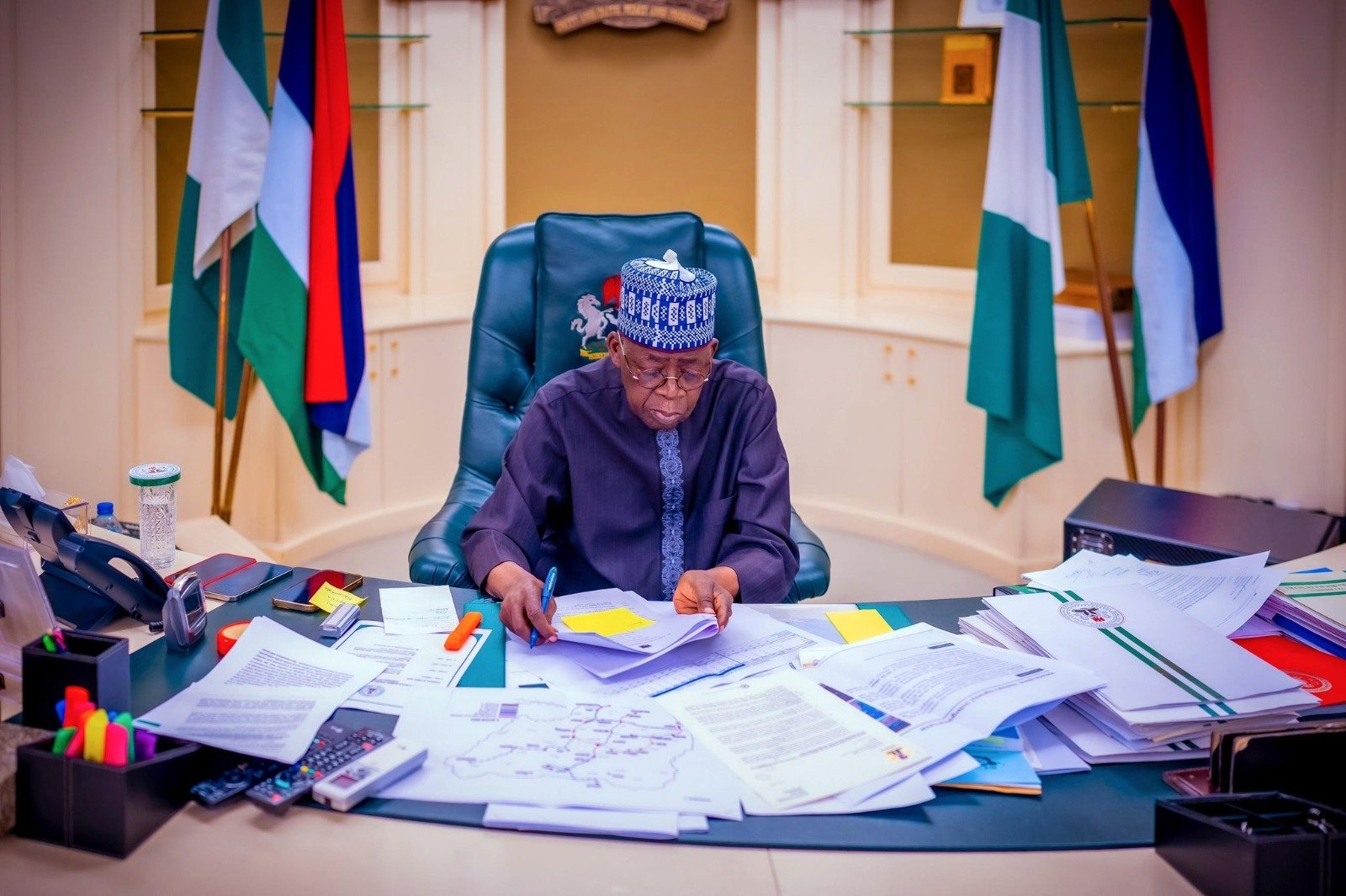
President Bola Tinubu’s 65 ambassadorial nominees will face rigorous Senate grilling next week as part of their confirmation process.

Three notable opposition senators, who spoke on condition of anonymity, said the screening would not be ‘business as usual,’ hinting at plans to put several of the nominees on the spot.

‘’Our current situation requires seasoned and knowledgeable men and women who can represent and defend Nigeria’s interests before the international community. Ambassadorial position is not all about political patronage or job for the boys and this is why we would ensure that those who would represent Nigeria at the foreign missions are patriotic individuals who have integrity,’’ a ranking senator noted.

Another lawmaker said the nominees would be properly grilled to ensure they are ‘’fit for purpose.’’

On Thursday, the Senate received the President’s request for the confirmation of the nominees, one of the administration’s largest diplomatic submissions yet.

The request, read during plenary by Senate President Godswill Akpabio, contained two lists: 34 career ambassadors and high commissioners and 31 non-career nominees.

The latest transmission came less than 24 hours after lawmakers began screening an initial set of three nominees earlier forwarded by the President.

Citing Section 171 (1), (2) and (4) of the 1999 Constitution, Tinubu urged the upper chamber to “consider and confirm expeditiously” 15 career ambassadors and 17 non-career ambassadors.

“I am pleased to present for confirmation the list of the 32 ambassadorial nominees for the positions of career ambassadors, non-career ambassadors and high commissioners,” the letter partly stated.

Notable career diplomats on the list include Ambassadors Sulu-Gambari Olatunji Ahmed (Kwara), Ahmed Mohammed Monguno (Borno) and  Maimuna Ibrahim (Adamawa).

Prominent non-career nominees include former Chief of Naval Staff and ex-Rivers State military administrator, Vice Admiral Ibok-Ete Ibas (retd.)from Cross River; former presidential aide and ex-senator, Ita Enang (Akwa Ibom); and former Chief of Army Staff, Lt. Gen. Abdulrahman Dambazau (retd.),  from Kano.

See also  UK to bar eligible visitors without ETA from February 25

Akpabio referred the list to the Senate Committee on Foreign Affairs with a one-week deadline to conclude screenings and submit its report. ‘’The committee is to report back to us in one week,” he said.

On Wednesday, the Senate commenced the screening of Kayode Are (Ogun), Aminu Dalhatu (Jigawa) and Ayodele Oke (Oyo), who were earlier nominated by the President. The committee chairman, Senator Sani Bello, disclosed that Oke used the session to address and clear allegations previously levelled against him.

The report on the three nominees is expected to be presented to the full Senate in the coming days, even as lawmakers begin processing the newly transmitted list.

The staggered submissions appear to be part of the administration’s phased strategy to fill critical diplomatic positions ahead of an anticipated major shake-up in Nigeria’s foreign missions.

List of nominees

The career ambassadors are: Amb. Ezenwa Chukwuemeka (Abia); Maimuna Ibrahim (Adamawa); Monica Ogochukwu (Anambra); Ambassador Mohammed Mahmoud Lele (Bauchi); Endoni Sindo (Bayelsa); Ambassador Ahmed Mohammed Minguno (Borno); Jane Adams Okon Michael (Cross River); Clark Omeruo Alexandra (Delta); Chimma Geoffrey Davies (Ebonyi); Oduma Yvonne Ehinose (Edo); Wasa Segun Ige (Edo); Ambassador Adeyemi Adebayo Emmanuel (Ekiti); Ambassador Onaga Ogechukwu Kingsley (Enugu); Magaji Umar (Jigawa); Mohammed Saidu Dahiru (Kaduna); AbdulSalam Abus Zayat (Kano); Shehu Barde (Katsina); Aminu Nasiu (Katsina); Abubakar Musa Musa (Kebbi); Mohammed Idris (Kebbi); Bako Adamu Umar (Kogi); Sulu-Gambari Olatunji Ahmed (Kwara); Ramata Mohammed (Lagos); Shaga John Shama (Nasarawa); Salau Hamza Mohammed (Niger); Ibrahim Danlami (Niger); Adeola Ibrahim Mopelola (Ogun); Ruben Abimbola Samuel (Ondo); Akande Wahab Adekola (Osun); Adedokun Esther (Oyo); Gedagi Joseph John (Plateau); Luther Obomode Ayokalata (Rivers); Danladi Yakubu Yaku (Taraba); and Bello Dogondaji (Zamfara).

The non-career ambassadors include: Senator Grace Bent (Adamawa); Senator Ita Enang (Akwa Ibom); Nkechi Linda Okocha (Anambra); Mahmud Yakubu (Bauchi); Philip K. Ikurusi (Bayelsa); Paul Oga Adikwu (Benue); Vice Admiral Ibok-Ete Ibas (retd.) (Cross River); Abasi Braimah (Edo); Erelu Angela Adebayo (Ekiti); Barr. Olumilua Oluwayimika Ayotunwa (Ekiti); Ifeanyi Ugwuanyi (Enugu); Chioma Ohakim (Imo); Lt. Gen. Abdulrahman Bello Dambazau (retd.) (Kano); Tasiu Musa Maigari (Katsina); Alhaji Abubakar Sanusi Aliyu (Kogi); Olufemi Pedro (Lagos); Barr. Mohammed Ubandoma Aliyu (Nasarawa); Senator Jimoh Ibrahim (Ondo); Ambassador Joseph Sola Iji (Ondo); Fani-Kayode (Osun); Professor O. Adewole (Osun); Florence Ajimobi (Oyo); Lola Akande (Oyo); Professor Nora Ladi Daduut (Plateau); Yakubu N. Gambo (Plateau); Chukwujinka Okocha (Rivers); Haruna Abubakar (Sokoto); Jerry Samuel Manwe (Taraba); and Adamu Garba Talba (Yobe).

See also  Makinde, Ladoja fault Fayose over alleged dethronement plot

However, a report claimed that Talba died about five months ago. The PUNCH could not verify this claim as of press time.

With the fresh batch of nominees, the Senate Foreign Affairs Committee faces a packed week of screenings aimed at clearing the backlog of ambassadorial postings critical to Nigeria’s representation abroad.

Two-year diplomatic vacuum

Tinubu’s delay in nominating ambassadors had sparked concern over Nigeria’s diplomatic presence. The nearly two-year wait was attributed partly to financial constraints.

Government officials said many embassies were in disrepair and required refurbishment before new envoys could resume.

The Federal Government earmarked N53bn in the 2024 budget to renovate 103 foreign missions, covering chanceries, staff quarters, ambassadors’ residences, office furniture and vehicles. Still, sources estimated that almost $1bn would be required to fully fund Nigeria’s 109 missions and clear accumulated arrears.

While the Presidency said the delay was meant to ensure the selection of the right candidates, critics argued that political wrangling and regional balancing were the real causes.

Experts warn that the prolonged diplomatic gaps weakened Nigeria’s influence in international forums, reduced its ability to protect citizens abroad and may have cost the country economic opportunities.

Security analysts also note that the absence of ambassadors could expose Nigeria to security threats that are better addressed through diplomatic channels.

The submission of 65 nominees is now seen as a crucial step toward restoring Nigeria’s diplomatic footprint worldwide.

Atiku slams Tinubu

Former Vice President Atiku Abubakar criticised President Tinubu’s nomination of the immediate past chairman of the Independent National Electoral Commission, for an ambassadorial post.

See also  ‘If I don’t give you electricity, don’t vote for me again’ – ADC reminds Tinubu of failed promise

Atiku said that if he were President of Nigeria, he would never nominate a past INEC chairman as an ambassador.

In a statement posted on his X handle on Thursday, he said he would not consider such a move, insisting it would send the wrong signals to the public and undermine trust in the electoral system.

“Let me state without ambiguity: under no circumstance would I, as President of the Federal Republic of Nigeria, nominate the immediate past INEC Chairman for an ambassadorial position,” the former VP wrote.

Tinubu submitted Yakubu’s name as part of a list of 32 ambassadorial nominees to the Senate for confirmation on November 29.

However, Yakubu’s nomination has sparked debate, stemming from the fact that his tenure at INEC ended only a few weeks ago and that he presided over the 2023 general elections, which ushered in Tinubu as President.

According to Atiku, appointing the ex-INEC chairman to a diplomatic position would raise “serious concerns” and risk being interpreted as a reward for the conduct of one of Nigeria’s most disputed elections.

“It presents terrible optics for an administration already struggling with credibility. It sends the wrong message to the current @inecnigeria leadership; that partisan, compromised, or poorly executed elections may ultimately be rewarded.

“And most importantly, it is morally indefensible for an umpire at the centre of one of the most disputed elections in our history to become a beneficiary of its outcome,” he said.

Atiku further noted that such a nomination undermines efforts to strengthen Nigeria’s democracy and restore public trust in institutions.

punch.ng

FOLLOW US ON:

FACEBOOK

TWITTER

PINTEREST

TIKTOK

YOUTUBE

LINKEDIN

TUMBLR

INSTAGRAM

Continue Reading
Click to comment

Leave a Reply

Your email address will not be published. Required fields are marked *

News

FG secures $11.4bn World Bank loans in three years

Published

on

President Bola Tinubu’s administration has secured $11.40bn in loan approvals from the World Bank in just about three years, putting it on course to surpass the total amount approved under former President Muhammadu Buhari’s eight-year administration, an analysis of data obtained by The PUNCH from the World Bank has shown.

The analysis showed that the World Bank approved loans worth $11.40bn for Nigeria between June 2023 and June 2026, compared with $14.59bn approved during Buhari’s presidency from May 2015 to May 2023.

The latest figure means Tinubu’s administration has already secured about 78.2 per cent of the total World Bank financing approved during Buhari’s two terms in office and requires another $3.19bn in approvals to exceed that record.

The data further showed that World Bank loans approved under Tinubu have already surpassed those listed under Buhari’s first term by more than $5.8bn. According to the World Bank data, projects approved under Buhari’s first term amounted to about $5.56bn.

Using the figures contained in the World Bank database, Tinubu’s current approvals exceed the Buhari first-term total by about 105 per cent.

However, of the $11.4bn approved under Tinubu, only $2.32bn had been disbursed as of the latest update on the World Bank website, leaving $8.41bn available for disbursement. This represents a disbursement rate of about 20.3 per cent.

By comparison, projects approved during Buhari’s administration have recorded much higher implementation levels. Out of the $14.59bn approved during his presidency, $11.94bn had been disbursed, while $1.53bn remained available.

The figures translate to a disbursement rate of about 81.8 per cent, reflecting the fact that many of the projects have either been completed, are in repayment or are approaching completion.

The World Bank portfolio under Tinubu has been concentrated largely in economic reforms, education, healthcare, agriculture, energy, digital infrastructure, financial inclusion and social protection.

The single largest approval came in June 2024, when the World Bank approved a $2.25bn financing package comprising the $1.5bn Nigeria Reforms for Economic Stabilisation to Enable Transformation Development Policy Financing and the $750m Nigeria Accelerating Resource Mobilisation Reforms Programme-for-Results.

According to the World Bank, the financing was designed to support Nigeria’s economic reform programme, strengthen macroeconomic stability, improve domestic revenue mobilisation and protect poor and vulnerable households during the implementation of reforms.

The World Bank said the package was intended to support the Federal Government’s ongoing reforms, including exchange rate reforms, fiscal consolidation, and measures aimed at strengthening public finances.

The World Bank data showed that the RESET programme has been fully disbursed, while the ARMOR programme had recorded disbursements of $280.55m, leaving $469.45m available.

The reform package attracted public attention because it coincided with the implementation of major economic reforms, including the removal of the petrol subsidy and the liberalisation of the foreign exchange market, both of which contributed to sharp increases in inflation and the cost of living.

The World Bank has consistently maintained that the reforms are necessary to restore macroeconomic stability and place public finances on a more sustainable path, although several labour unions, civil society groups and opposition politicians have criticised the pace of the reforms and their impact on households.

Another major addition to Tinubu’s World Bank portfolio came on June 29, 2026, when the bank approved the Nigeria Actions for Investment and Jobs Acceleration programme. The programme consists of two facilities worth $500m and $750m respectively, bringing total financing under the initiative to $1.25bn.

Announcing the approval, the World Bank said the financing formed part of its new Country Partnership Framework for Nigeria covering 2026 to 2032. According to the bank, the framework aims to support private sector-led growth, improve job creation, expand energy access, strengthen digital infrastructure, and improve agricultural productivity.

Agriculture also accounts for a significant share of the approvals under Tinubu. In March 2026, the World Bank approved a $500m credit for the Nigeria Sustainable Agricultural Value-Chains for Growth project.

See also  Renowned Author Chimamanda Ngozi Adichie loses one-year-old son after brief illness

The bank said the project is expected to improve agricultural productivity, strengthen value chains, increase market access for smallholder farmers and create employment opportunities across participating states. The facility had yet to record any disbursement, according to the World Bank data.

In December 2024, the bank also approved three separate credits worth $357m, $57m and $86m for the Rural Access and Agricultural Marketing Project Scale-Up, bringing total financing under the programme to $500m. The facilities were still awaiting disbursement.

The power sector has also remained one of the largest recipients of World Bank financing under Tinubu. In June 2023, shortly after the inauguration of the administration, the World Bank approved $750m for the Power Sector Recovery Performance-Based Operation through separate facilities of $301m and $449m.

The World Bank data showed that the facilities had disbursed $28.10m and $41.24m, respectively. In December 2023, the bank approved another $750m for the Nigeria Distributed Access through Renewable Energy Scale-up Project. The project comprises three facilities worth $350m, $250m, and $150m.

The World Bank said the programme is expected to provide new or improved electricity access to about 17.5 million Nigerians through distributed renewable energy solutions. The data showed that only the $350m facility had recorded disbursement, amounting to $97.71m, while the remaining two facilities had yet to record any drawdown.

In September 2024, the World Bank approved another $500m for the Sustainable Power and Irrigation for Nigeria Project. According to the World Bank, the project is designed to improve dam safety, strengthen irrigation infrastructure, and increase hydropower generation in selected locations across the country.

The World Bank data showed that $33m had been disbursed under the project, leaving $467m available. Nigeria’s power sector has remained one of the most heavily financed sectors by the World Bank over the past decade. However, implementation challenges have also persisted.

The PUNCH earlier reported that the Federal Government and the World Bank agreed to cancel about $717m in undisbursed financing under the Power Sector Recovery Operation following changes in implementation arrangements and unmet programme conditions, including reforms linked to electricity tariffs and sector financing.

Education and healthcare also account for a substantial portion of Tinubu’s World Bank borrowing. In September 2023, the World Bank approved the $700m Adolescent Girls Initiative for Learning and Empowerment project. The project had recorded a disbursement of $148.35m, while $558.22m remained available.

The Nigeria for Women Programme Scale-Up Project, approved in June 2023, received $500m. The World Bank data showed that $109.62m had been disbursed, while $393.67m remained available.

The World Bank expanded its support for Nigeria’s human capital development in September 2024 with the approval of three major projects valued at $1.5bn. The projects comprised the $500m Nigeria Human Capital Opportunities for Prosperity and Equity Governance programme, the $500m Primary Healthcare Provision Strengthening Programme and the $500m Sustainable Power and Irrigation for Nigeria Project.

According to the World Bank, the HOPE programmes are expected to improve access to quality basic education and primary healthcare services while strengthening governance and accountability in the delivery of public services. An analysis of the World Bank data showed that implementation of the projects remains at an early stage.

The HOPE Governance project had recorded disbursement of $3m out of the approved $500m, leaving $497m available. The Primary Healthcare Provision Strengthening Programme had disbursed $75.35m, while $424.65m remained available. The Sustainable Power and Irrigation Project had drawn $33m, leaving $467m yet to be disbursed.

Combined, the three projects had received disbursements of $111.35m, representing about 7.4 per cent of the approved financing.

The World Bank also approved another package of projects in March 2025 covering education, community resilience and nutrition. The package included the $500m HOPE for Quality Basic Education for All project, the $500m Community Action for Resilience and Economic Stimulus Programme, and the $80m Accelerating Nutrition Results in Nigeria 2.0 project.

The financing was intended to improve education quality, support vulnerable households, and address malnutrition among women and children. The World Bank data showed that none of the projects had recorded any disbursement as of the latest update.

See also  Jonathan considers comeback for 2027 as court hears eligibility suit today

Financial inclusion and digital infrastructure also featured prominently in the Tinubu administration’s World Bank portfolio. In December 2025, the World Bank approved the Fostering Inclusive Finance for MSMEs in Nigeria project comprising a $400m International Bank for Reconstruction and Development facility and a $100m International Development Association credit.

The bank said the project is expected to expand access to finance for micro, small and medium enterprises, strengthen financial institutions and mobilise private capital. Neither component had recorded any disbursement.

In October 2025, the World Bank approved the $500m Building Resilient Digital Infrastructure for Growth project to improve broadband connectivity and digital infrastructure across Nigeria.

The bank said the project would help increase broadband penetration, improve digital public infrastructure and support digital inclusion. The project remained at the effective stage with no disbursement recorded.

The World Bank also approved $250m for the Health Security Programme in Western and Central Africa, Nigeria Phase II, in September 2025 to strengthen disease surveillance and emergency preparedness following lessons from the COVID-19 pandemic. The facility was listed as signed and had yet to record any disbursement.

A sectoral analysis of the Tinubu administration’s World Bank portfolio showed that economic reforms, power, agriculture, education, healthcare and social protection account for the bulk of the financing approved since June 2023.

By comparison, Buhari’s World Bank borrowing was spread across fiscal reforms, electricity, agriculture, social investment, education, health, erosion control, mining, water resources, livestock development, business reforms, and COVID-19 response.

An analysis of annual approval trends showed that Tinubu’s administration has averaged about $3.7bn in World Bank approvals per year since assuming office in May 2023. By comparison, Buhari’s administration averaged about $1.82bn annually over eight years.

The figures indicate that World Bank financing approvals have accelerated under the current administration, although implementation remains at an earlier stage than projects approved during the previous administration.

The PUNCH recently reported that Nigeria’s debt to the World Bank rose by $2.08bn in one year to $19.89bn as of December 31, 2025, according to an analysis of external debt stock data released by the Debt Management Office.

The figure represents an 11.7 per cent increase from the $17.81bn owed to the global lender as of December 31, 2024. The World Bank debt comprises loans from the International Development Association and the International Bank for Reconstruction and Development.

The IDA provides concessional grants and loans to low-income countries, while the IBRD provides financial products and policy advice mainly to middle-income and creditworthy developing countries.

DMO data showed that Nigeria’s IDA debt rose from $16.56bn in 2024 to $18.51bn in 2025, an increase of $1.94bn or 11.73 per cent. IBRD exposure also increased from $1.24bn to $1.38bn, representing an increase of $141.84m or 11.41 per cent.

The increase means World Bank loans accounted for 38.36 per cent of Nigeria’s total external debt stock of $51.86bn as of the end of 2025.

Reacting to the rising World Bank commitments to Nigeria, Lagos-based economist Adewale Abimbola said loans from multilateral institutions such as the World Bank are largely concessionary, with interest rates typically below market levels and longer repayment tenors.

He noted that the critical question is not whether Nigeria should be borrowing, but whether the loans are structured and deployed effectively. “If it’s concessionary and tied to viable projects with medium-term revenue prospects, I don’t think it’s a bad idea,” Abimbola explained. “Borrowing isn’t bad; what matters is utilisation.”

See also  Makinde, Ladoja fault Fayose over alleged dethronement plot

He stressed that the economic impact of such loans depends on how well they are channelled into projects that can generate sustainable growth, strengthen revenue, and improve public services over time.

Development economist and CEO of CSA Advisory, Dr Aliyu Ilias, expressed strong reservations about Nigeria’s rising debt profile in light of the World Bank’s fresh commitments.

While acknowledging that borrowing is not inherently bad for an economy, he questioned the rationale for taking on more debt at a time when the government claims to have higher revenues.

According to him, the impact of the current borrowing spree is being felt in reduced public service delivery, particularly in capital expenditure, as debt servicing now consumes a significant portion of available revenue.

He warned that this crowding-out effect limits job creation, fuels inflation, and worsens Nigeria’s foreign-exchange imbalance, with the naira trading at historically low levels.

He argued that given the claimed revenue surpluses, the Tinubu administration should not have needed to borrow within its first two years in office, let alone at the scale currently being witnessed.

Economist and CEO of the Centre for the Promotion of Private Enterprise, Dr Muda Yusuf, said that borrowing should always be backed by sound economic reasoning and clear development priorities. Yusuf emphasised that the key issue is debt sustainability, which depends primarily on the country’s revenue capacity to service its obligations.

Without strong cash flow to meet repayment schedules, he warned, Nigeria risks falling into a vicious cycle of borrowing to service existing loans, thereby perpetuating fiscal vulnerability. He said it is essential that projects funded by loans directly support the economy’s capacity to repay.

According to him, Nigeria should be cautious with foreign loans due to the exchange rate risks they pose, noting that domestic debt is generally easier to manage. He stressed that a disciplined approach to debt sustainability will be crucial for Nigeria to avoid long-term fiscal distress.

Responding to an enquiry by The PUNCH recently on the delay in loan disbursements, the Senior External Affairs Officer at the World Bank, Mansir Nasir, noted that funds for projects financed by the institution were not disbursed at once but in instalments, depending on the nature of the project and financing instruments.

“Projects financed by the World Bank run for a certain time, which varies depending on the specific project. The total amount of the project is not disbursed as a one-off, but rather in instalments depending on the financing instruments—e.g., IPF or PforR—which require certain milestones for specific disbursement values.

“If you look at the portal, you will see the specific disbursement timelines and values,” Nasir added. He further stated that before a new project can begin disbursement, it must meet certain agreed conditions between the Federal Government and the World Bank.

The Minister of Finance and Coordinating Minister of the Economy, Taiwo Oyedele, recently faulted Nigerians, especially analysts and commentators, for criticising government borrowing without considering the purpose, cost and expected returns of such debt.

Oyedele said, “When analysts go on TV and join the populist view to accuse the government of borrowing, you are doing a disservice. The relevant question is never simply how much debt.

“It is always debt for what and at what cost, against what return, and repaid on what terms. A nation, a state, or a business that borrows to finance a productive asset generating returns above the cost of that capital is not behaving recklessly; it is behaving rationally.”

punch.ng

FOLLOW US ON:

FACEBOOK

TWITTER

PINTEREST

TIKTOK

YOUTUBE

LINKEDIN

Continue Reading

News

Senate meets Tuesday as fake agency budget row deepens

Published

on

The Senate is expected to address the controversy surrounding the N1.3bn allocation to the controversial Presidential Foreign Intervention Promotion Council in the 2026 Appropriation Act as plenary resumes on Tuesday.

This is as The PUNCH gathered that a forged appointment letter bearing a falsified signature of the Chief of Staff to the President, Femi Gbajabiamila, was accepted at the Civil Service Headquarters without adequate verification, securing Prince Adeniyi Adeyemi Mathew an office at the Federal Secretariat Complex in Abuja and giving the controversial agency the appearance of government legitimacy for over a year.

Multiple sources in the Presidency and the civil service with first-hand knowledge of the scandal, who spoke to The PUNCH on condition of anonymity due to the sensitivity of ongoing proceedings, said the scandal would have been nipped in the bud save for bureaucratic safeguards that failed at multiple points in the Budget Office, the House of Representatives, and the Civil Service Headquarters.

The sources argued that the failure to properly scrutinise the appointment letter cascaded into the controversial Presidential Council ensnaring diplomatic missions, government ministries, the National Assembly and private individuals.

The PUNCH gathered that the N1.3bn controversial allocation was approved without Adeyemi or any official of the council appearing before the Senate Committee on Establishment and Public Service to defend the budget.

A National Assembly source told one of our correspondents Sunday that the entry was made through a backdoor arrangement.

“It was not brought in as a stand-alone item. It was done collectively with others that came in directly from the Presidency. So there was no defence or oversight.

“But I understand the Senate leadership will address the controversy on Tuesday to douse the growing tension and alleged complicity by any of its presiding officers,” the official said.

Meanwhile, sources in the Presidency and civil service provided a detailed account of how the fraud circumvented the bureaucratic safety checks through the undetected forgery.

“The mistake came from several areas, the House of Representatives, the Head of Service, the Budget Office. Most of them did not do due diligence. But you see where you can’t readily blame all of them is what we call grundnorm. There is a foundation. The appointment letter was fake. It was invalid.

“In government, the way it runs is that it is the President, not the Chief of Staff, who appoints. The letter of appointment is then issued by the SGF,” a Presidency source told one of our correspondents.

Explaining the constitutional process which Adeyemi’s allegedly forged letter violated, the source argued, “Everyone who has ever been appointed by this President passed through a specific process. If your parastatal is directly under the Presidency, the SGF makes a memo to the President and the President approves the memo.

“The SGF then issues you a letter of appointment. For those in ministries, he minutes it to the relevant minister, who minutes it to the Permanent Secretary, who then gives it to the appointee. With that letter, you can enter the government payroll.

“The Chief of Staff has never appointed anyone at that level. All DGs and Permanent Secretaries, their appointments are from the President.”

A highly placed civil servant who claimed to have reviewed the document after Adeyemi’s arrest explained that he (Adeyemi) exploited the bureaucratic blind spot.

“Where Adeniyi scammed everyone was that he forged a letter with the signature of the Chief of Staff, which was not even his signature because it was forged. It was not Gbajabiamila’s signature. The Chief of Staff cannot make such an appointment.

“Adeniyi took that fake letter, falsely signed by Gbajabiamila, to the civil service headquarters and said ‘please refer to my appointment letter attached.’ He arranged his terms of reference where he stated that he needed an office.

See also  Renowned Author Chimamanda Ngozi Adichie loses one-year-old son after brief illness

“The problem is, the President’s letter to the SGF or minister is not usually attached to such documentation, you are just expected to attach the appointment letter. But they were supposed to know that the Chief of Staff doesn’t appoint anyone. That was the loophole,” the official revealed.

The source further explained that said when Adeyemi was allocated an office space at the Federal Secretariat, every subsequent element of the alleged fraud became self-sustaining.

“Once you have an office there, it confers a very high level of legitimacy on you. You can meet big guests there. He had a letterhead and even a website. Once he established that office at the Federal Secretariat, every other thing followed. Nobody tried to do the needful anymore until someone raised the alarm,” said the official.

The official also confirmed that the office was locked up following Adeyemi’s initial arrest and reallocated to another official. However, he continued to operate away from the secretariat.

“The man was still running the scam after he left the secretariat, but he doesn’t use that place anymore,” the source said.

A second Presidency source said the fraud was first detected by officials of the Nigerian Investment Promotion Commission, who noticed that the fictitious council was encroaching on their statutory mandate.

“The issue first came up from the NIPC in October last year. It started like inter-agency rivalry. That was how they saw it at the time because this fake agency was now overlapping into the mandate of the NIPC. The following day, it was taken to the Chief of Staff, who said he doesn’t know the person, and then he was the one who alerted the DSS.

“At one of the meetings about this issue, the Chief of Staff swore that he has never met the man and doesn’t even know him. And that his conscience is clear. The Chief of Staff didn’t take it lightly. He followed up until Adeniyi was arraigned in court and put on bail,” the insider said.

The source acknowledged that the prosecution lost momentum after the initial arrest, saying, “You know, when no one follows the case bumper to bumper, it can become very slow at the police. It was since October last year and when it resurfaced in June, I was surprised, because I believed it had been dealt with.

The official further revealed that several civil servants had independently identified the operation as fraudulent, stating, “Many civil servants already flagged it as a scam and it was their report that was used to alert the authorities. Some even thought that the case would unravel itself.”

A third source explained how Adeyemi may have secured a budget allocation for the council despite no formal budget defence.

According to the official, “The National Assembly, the turnover of members is quite high. Many of the people who are knowledgeable about some of these things may be gone. So a new person responsible for that committee on treaties may not really know what is happening. No one is blaming all the people there. But there needed to be due diligence which wasn’t done.

“He probably knows someone in the National Assembly and told them ‘please allocate something to us too.’ So it appeared like a government organisation that had a letterhead, an office and other things.

“All of these things, especially the fake appointment letter, conferred legitimacy on him. The whole problem stemmed from that oversight. People have been asking how he found his way into the budget.”

See also  Makinde, Ladoja fault Fayose over alleged dethronement plot

The source added that Adeyemi’s bail conditions had since been violated.

“The police is supposed to pick him up again. He ran foul of his bail conditions. He was actually arraigned in court. There is a big document on him from the police,” said the official.

Meanwhile, the N1.3bn budget allocation to the PFIPC has drawn reactions from civil society organisations and opposition parties, some of whom demanded that the President’s Chief of Staff steps down.

SERAP, HEDA demand disclosure

The Socio-Economic Rights and Accountability Project, in a Freedom of Information request dated July 4, 2026, signed by Deputy Director Kolawole Oluwadare, asked Senate President Godswill Akpabio and Speaker Tajudeen Abbas to release certified copies of all documents concerning the consideration and approval of the N1,302,978,784 allocation in the 2026 Appropriation Act.

SERAP also requested records identifying members of the National Assembly committees that considered the allocation, the names and official designations of all public officers who appeared before the committees to defend the provision, and clarification on whether the allocation was in the executive’s original bill or inserted during the legislative process.

“Nigerians have a right to know whether public funds were appropriated for an entity that was not lawfully established and, if so, how this occurred. Nobody has a more sacred obligation to obey the law than those who make the law,” the organisation stated.

It warned that it would institute legal proceedings if the information was not released within seven days.

The Human and Environmental Development Agenda similarly called for a full public inquiry, with its chairman, Olanrewaju Suraju, stating: “If the Presidency maintains that the PFIPC does not exist, Nigerians deserve to know how an allocation for the council found its way into the 2026 Appropriation Act. The public has a right to know who proposed the allocation, the government institutions that processed and approved it, and whether any public funds have been released or committed.”

‘You have become the scandal itself,’ Atiku knocks Tinubu

Former Vice President Atiku Abubakar, through his SSA on Public Communication, Phrank Shaibu, intensified criticism of the Tinubu government, describing the PFIPC controversy as symptomatic of a recurring governance pattern.

Atiku said, “There is an old African saying that when a man’s roof leaks every rainy season, neighbours stop blaming the clouds and begin to question the strength of the house itself. Nigeria has sadly arrived at that point.

“The issue is no longer one scandal or another. The issue is the pattern. And when scandals become a pattern of governance, the inevitable conclusion is this: you are no longer managing scandals; you have become the scandal itself.”

He said the controversy offered President Tinubu an opportunity to demonstrate transparency by ordering an independent investigation.

“The countdown has already begun. Nigerians expect answers, not evasions. The presidency still has five days left to tell Nigerians who created this phantom organisation, who authorised its activities, and who must be held responsible. Silence cannot become the official response to a scandal of this magnitude,” he said.

PDP faction, CDHR demand probes

For its part, the Tanimu Turaki-led Peoples Democratic Party faction described the scandal as confirmation of what it called reckless governance.

It said, “If the Presidency’s account is correct that Prince Matthew is an impostor, then it means the Federal Government is so porous and vulnerable, an admission that the country has been brazenly defrauded because institutional gatekeepers entrusted with protecting our collective patrimony are either grossly incompetent or thoroughly distracted from the responsibilities of governance.”

See also  PHOTOS: 37-year-old man rescued from well in Oyo

The Committee for the Defence of Human Rights called on Gbajabiamila to voluntarily step aside pending independent investigation, with National President Yinka Folarin and National Secretary Idris Afees jointly signing the statement.

“The allegations on both sides are grave. While the Federal Government alleges forgery, impersonation, fraudulent operation of bank accounts and misrepresentation, the defendant has levelled equally weighty allegations of bribery and abuse of office against one of the country’s highest-ranking public officials. If either set of allegations is proven, it represents a serious assault on the integrity of public institutions,” the statement said.

Kwankwasiyya demands answers on budget

The Kwankwasiyya Movement, through spokesperson Dr Habibu Sale Mohammed, said the matter had gone beyond one individual.

It argued “This is no longer about one man. It has become a question of public accountability. If the council never existed, how did it find its way into the national budget? Who proposed and approved the allocation? Which government offices processed the documentation? Was any public money released or committed? If official documents were allegedly forged, how were they used for such a long period without detection?”

The Deputy Spokesman of the House of Representatives, Philip Agbese, urged Nigerians to allow the courts determine the controversy.

Agbese said, “The issue is being handled legally and I think we should all be patient. Nigerians will get to know in detail what transpired, and anything short of that at this material time will not help us.”

Senior lawyers dismiss calls to charge Gbajabiamila

Senior lawyers who spoke to The PUNCH on Sunday dismissed calls for Gbajabiamila to be charged alongside Adeyemi, saying such calls were based on sentiment rather than established facts and proper criminal procedure.

Bankole Akomolafe, SAN, founding partner at Bank-Akomolafe, SAN & Co said, “The issue of joining a person in a criminal matter, in the instant case, is not done on sentiments or emotions. Somebody is claiming that the Chief of Staff is aware of fraud.

“I do not believe that such an amount would have been transmitted by cash, that on its own would be a crime.

“So I want to assume that a transfer was made, electronic transfer. He should be able to publish the statement of account. It is not something that should be difficult to prove.”

He added, “How are we sure that the allegation is not a vendetta to say ‘I will make sure I rubbish you?’ People can allege anything. Let us see something concrete before we come to that suggestion that the person should be charged. Mere allegations are not enough.”

Another senior lawyer, Sampson Erugo, questioned why only Adeyemi had been formally charged, arguing that many others who facilitated the scheme should also be probed.

Erugo argued, “I wonder why the hurry in the trial of one person in this scandal. For there to be a budget, there is an office for the agency, and so many issues, meaning that so many people are involved. They have an office at the National Secretariat, they have accounts with the CBN. Why should they rush to charge one man? A lot of people should answer for their roles in the scam.”

Adeyemi is due to appear before the Federal High Court in Abuja on July 27, 2026, alongside two accomplices identified only as Femi and Anu who remain at large.

punch.ng

FOLLOW US ON:
FACEBOOK

TWITTER

PINTEREST

TIKTOK

YOUTUBE

LINKEDIN

Continue Reading

News

IMF report: Tinubu’s govt breaks silence on alleged missing N8trn

Published

on

The Federal Government has dismissed claims that over ₦8 trillion was spent outside the 2025 budget, insisting that all public expenditures were made within Nigeria’s constitutional and legal framework.

In a statement issued on Sunday by Taiwo Oyedele, Minister of Finance, the government said reports alleging that about two percent of Nigeria’s Gross Domestic Product, GDP, estimated at over ₦8 trillion, was spent outside the approved budget were based on a misrepresentation of the International Monetary Fund’s, IMF, 2026 Article IV Consultation Report.

The ministry maintained that the Federal Government does not operate a “shadow budget” or spend public funds without legislative approval.

It explained that under Sections 80 to 83 and 162 of the 1999 Constitution, all public funds can only be withdrawn and spent in accordance with the Constitution and laws passed by the National Assembly. According to the ministry, government expenditure is undertaken through duly enacted Appropriation Acts, Supplementary Appropriation Acts and other statutory authorisations.

The ministry added that multi-year capital projects are implemented under existing laws and approved capital rollovers where applicable, stressing that such projects should not be interpreted as spending outside the budget.

It further argued that allegations of secret spending lacked evidence, saying anyone making such claims should identify specific projects allegedly executed without appropriation or legal authority.

“It is inaccurate to suggest that trillions of naira have been secretly spent outside legislative approval. Such allegations should have identified the specific projects purportedly executed without appropriation or legal authority and present credible evidence in support of the claim. To be meaningful, assertions of this magnitude must be supported by verifiable facts rather than conjecture,” Oyedele said.

See also  Tinubu revokes pardon for Sanda, 140 high-profile inmates

The ministry also clarified that Nigeria’s public finance system includes statutory transfers, first-line charges and intervention mechanisms established by Acts of the National Assembly. These include statutory allocations to development commissions and agencies, revenue collection costs retained by designated agencies, separate capital budgets for some agencies and the Federal Capital Territory, special interventions for national priorities such as security and infrastructure, as well as debt servicing obligations.

According to the ministry, these expenditures are lawful, publicly disclosed and subject to oversight, audit and accountability mechanisms, although their presentation in fiscal reports may differ from their appearance in the annual Appropriation Act due to international reporting standards.

The government also rejected suggestions that the reported ₦8 trillion represented an increase in the country’s fiscal deficit, explaining that fiscal deficits are determined by the relationship between total government revenue and expenditure rather than the financing mechanism used for approved projects.

It stated that the IMF’s observations were primarily about the comprehensiveness, timing and presentation of fiscal reporting rather than the legality of government spending.

The ministry noted that President Bola Tinubu had already asked the National Assembly to harmonise multiple and overlapping budgets into a single framework while presenting the 2026 Appropriation Bill on December 19, 2025.

It added that the administration remained committed to prudent fiscal management, transparency and accountability, citing ongoing reforms in budget credibility, revenue administration, digitalisation of government financial processes and treasury management.

The statement urged Nigerians to base public debate on verified facts and an accurate understanding of the country’s fiscal framework, warning against misrepresenting technical observations as evidence of unlawful expenditure.

See also  Makinde reveals location of Oyo abducted pupils, teachers

FOLLOW US ON:

FACEBOOK

TWITTER

PINTEREST

TIKTOK

YOUTUBE

LINKEDIN

INSTAGRAM

Continue Reading

Trending