

Connect with us

Business

Nigeria, UAE Ports Group Sign Landmark MoU On Maritime Development

Published

on

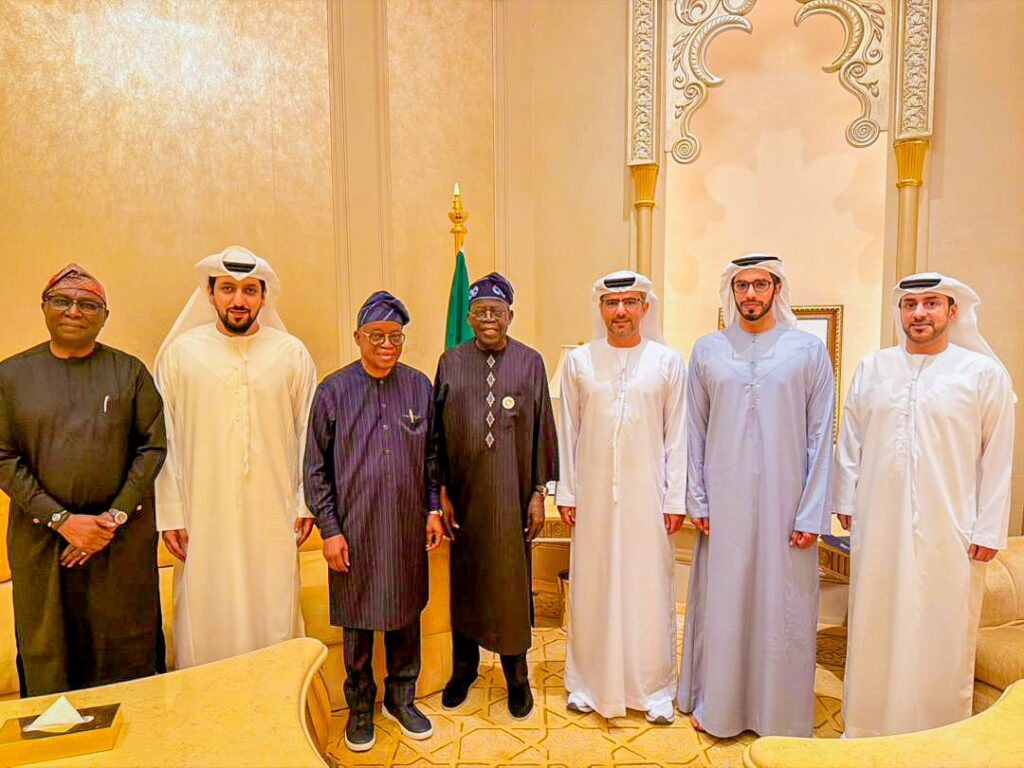
Nigeria’s Federal Ministry of Marine and Blue Economy and Abu Dhabi Ports Group have signed a landmark Memorandum of Understanding (MoU) aimed at strengthening cooperation in ports development, maritime logistics, and digital transformation.

The agreement, signed on the sidelines of the recently concluded Abu Dhabi Sustainability Week, marks a major milestone in Nigeria–UAE economic relations and underscores both nations’ commitment to advancing mutual trade and investment interests.

Minister of Marine and Blue Economy, Adegboyega Oyetola, led the Nigerian delegation, while the chairman of Abu Dhabi Ports Group, H.E. Mohamed Hassan, represented the Group’s management team. The Director General/Chief Executive Officer of the Nigerian Maritime Administration and Safety Agency (NIMASA), Dr. Dayo Mobereola, was also in attendance.

According to a statement issued by Osagie Edward, deputy director and head of Public Relations at NIMASA, the MoU “forms part of broader trade and investment engagements between the Federal Republic of Nigeria and the United Arab Emirates.”

Following the signing, the Nigerian delegation briefed President Bola Tinubu, on the strategic importance of the partnership, which is expected to catalyse growth in Nigeria’s maritime and blue economy sectors.

The agreement, which had been under consideration for more than two decades, is seen as a renewed commitment by both countries to deepen economic ties, enhance port infrastructure, and promote sustainable development within the maritime industry.

FOLLOW US ON:

FACEBOOK

TWITTER

PINTEREST

TIKTOK

YOUTUBE

LINKEDIN

TUMBLR

INSTAGRAM

See also  Poor Nigerians, others to get tariff relief with the Electricity Act
Continue Reading
Click to comment

Leave a Reply

Your email address will not be published. Required fields are marked *

Business

One week to deadline, banks in last-minute rush for Recapitalisation

Published

on

Banks are in a last-minute push to meet the Central Bank of Nigeria’s recapitalisation deadline, with the apex bank expected to make a major announcement this week as the March 31, 2026, cut-off approaches.

Findings by The PUNCH indicate that most lenders have substantially met the new capital requirements, while a few institutions are resolving final regulatory and structural issues ahead of the deadline.

Top officials of the CBN said the regulator would provide an update on the exercise on Tuesday or Wednesday, amid expectations that the process will largely conclude within the stipulated timeline.

The recapitalisation exercise, introduced in March 2024, requires banks to meet new minimum capital thresholds of up to N500bn for international commercial banks, as well as lower thresholds for other licence categories.

Speaking at the end of the 304th Monetary Policy Committee meeting in Abuja, the CBN Governor, Olayemi Cardoso, expressed confidence that the process would be completed within the deadline, while acknowledging that a few institutions were still finalising their plans.

“And quite frankly, I expected to conclude within that stipulated time. It is expected,” he said.

He added, “There are other institutions that are still finalising their plans and evaluating a range of strategic options. And there’s time, which, of course, includes consolidating where appropriate.”

Cardoso disclosed that the banking sector had already mobilised significant capital under the exercise. “As of February 19, 2026, total verified and approved capital raise stands at N4.05tn,” he said.

He further stated that, “Of this, N2.90tn, which is 71.6 per cent, has been mobilised domestically, with $706.84m, which is N1.15tn, representing 28.33 per cent foreign.”

See also  Net reserves jump 772% to $34.8bn in two years

He said the mix of domestic and foreign participation reflected strong investor confidence in the sector. “This balance, in my view, represents a mix of domestic and foreign, which signals broad investor engagement and confidence in the sector,” he added.

Despite the progress recorded, investigations showed that a few banks are yet to complete the process, largely due to delays affecting the merger process of two institutions, though there are indications that the issues may be resolved within the week.

There are also uncertainties around three banks under regulatory intervention, with the final capital position dependent on ongoing supervisory actions and possible support arrangements.

The CBN had earlier clarified that three banks under regulatory intervention are being treated as special cases and are not expected to follow the same sequence as other institutions in the recapitalisation process.

Cardoso acknowledged this category of banks during his remarks, noting that “The other group that I think I would be remiss not to mention are the institutions which are currently undertaking regulatory intervention with certain legal and structural considerations that have naturally influenced the sequencing of their recapitalisation actions.

“In other words, it’s unreasonable to expect that they would follow the same sequence as those that really and truly two and a half years ago, when we made this announcement, have had ample time in which to do a lot of the things they are doing.

“We remain the Central Bank of Nigeria, actively engaged with all relevant stakeholders to ensure that they have an orderly and credible outcome while maintaining financial stability.”

See also  Nigerian Stock Market Soars with N27Tr Gain

He also reassured depositors about the safety of funds in such institutions. “Depositor funds in these institutions remain secure, and operations continue under close supervisory and regulatory oversight of the central bank,” he said.

Financial analysts say the recapitalisation exercise has exceeded expectations, especially given initial concerns about the size of the capital gap.

The Head of Financial Institutions Ratings at Agusto & Co, Ayokunle Olubunmi, told The PUNCH on Sunday that the recapitalisation exercise had recorded strong progress across the banking sector.

“I think the recapitalisation exercise has been a success thus far,” he said. “When the exercise started, a lot of people were sceptical. Even those who were optimistic were scared because the gap seemed to be huge.”

He noted that domestic investors played a major role in the capital raise. “The bulk of the funds were actually from the domestic economy… that’s the interesting part,” he said.

Olubunmi added that most of the banks yet to be formally cleared had already raised the required funds and were only undergoing regulatory verification. “It’s not that they are still in the market looking for funds. The funds are with the CBN. They’re just providing documentation for the CBN to certify it,” he said.

He further explained that the three banks under regulatory intervention were being handled differently by the regulator. “Those ones… are special cases… we can’t really benchmark them with others,” he said.

According to officials, while about three banks are outstanding in terns of meeting the target, two of the bank are expected to complete their merger process this week.

See also  Fuel scarcity looms as NUPENG begins nationwide strike Monday

The third bank is also expected to meet the recapitalisation threshold this week.

punch.ng

FOLLOW US ON:

FACEBOOK

TWITTER

PINTEREST

TIKTOK

YOUTUBE

LINKEDIN

Continue Reading

Business

Airlines under pressure after jet fuel surges 100%

Published

on

There are indications that airfares may jump in the coming weeks following the hike in the cost of aviation fuel, commonly referred to as Jet A1, a development that is already putting pressure on airline operations and signalling higher ticket costs for passengers.

The spike in JetA1 price is largely due to the crisis in the Middle East, which has slowed the production and movement of crude oil across countries, worsening the operational cost of domestic carriers.

Checks by our correspondent with airlines showed an astronomical increase in the operating cost of airlines, particularly caused by the spike in aviation fuel, which has become the dominant cost driver in recent weeks.

At the time of filing this report, aviation fuel, which was sold between N900 and N995 before the Middle East crisis commenced, has jumped to between N2,500 and N2,700, depending on the airport of delivery, sharply raising the cost burden for operators.

Operators said they were monitoring developments, stressing that an increase in airfares was imminent, with strong indications that the prices of air tickets might double if the current trend persists.

Aviation fuel remains the single highest component of airline operations, accounting for about 30 to 35 per cent of total operational costs, a figure that industry players say is rising rapidly under current market conditions.

Airline sources said the price of the product had remained unstable since February 28, 2026, when the war started in Iran, changing about five times since that time, further complicating planning and pricing decisions.

See also  FG to invest N12bn in digital research projects — Minister

The spokesperson for United Nigeria Airlines, Chibuike Uloka, challenged the Federal Competition and Consumer Protection Commission to urgently engage domestic airline operators over the sustainability of current ticket pricing amid rising operational costs.

The FCCPC recently accused airlines of price fixing, with special attention on five unnamed airlines. This was, however, dismissed by the airline operators.

Uloka noted that despite aviation fuel prices soaring beyond N2,000 per litre, many carriers had continued to maintain fares at around N195,000, raising concerns about how long such pricing could be sustained under prevailing economic conditions.

He, however, warned that the situation could deteriorate further if fuel prices get to N3,000 per litre, stressing that not all airlines would be able to remain in operation under such pressure, a development that could further shrink capacity and push fares even higher.

He said, “Honestly, this is a very good time for FCCPC to come out and ask operators how they have been able to sustain flight tickets at N195,000 despite the increase in aviation fuel crossing N2000 and above. They should please ask how operators have kept on with operations? These are hard times. But most definitely, the current prices can’t be sustained for long periods.

“If this continues the way it is, because the way we are now, the price is also getting to N3000 per litre, and if it eventually gets to N3000, not all operators will be able to fly. And the ones that will be able to fly will not be Father Christmas. What we are asking now is not even profit, but at least to be able to operate optimally. Aviation has become a daily necessity because people must be able to move from one place to another. But FCCPC must be able to come out now and ask operators how we are faring.”

See also  UN deputy chief urges countries to prioritise economic opportunities for women

The PUNCH understands that Nigeria has been unable to produce enough crude oil for the Dangote Petroleum Refinery, forcing the indigenous refining company to import crude.

Crude prices have jumped from $65–$69 to about $112 per barrel as of the time of filing this report, further worsening the cost of aviation fuel and pushing airlines closer to inevitable fare adjustments.

This effect has also upped gantry prices, with operators warning that sustained increases will ultimately be transferred to passengers through higher ticket fares.

Industry expert, Samuel Caulcrick, projected an imminent rise in airfares, attributing it to the growing burden of operational costs on airlines, which is increasingly being driven by the surge in aviation fuel prices.

He explained that current market conditions suggest that operating expenses have surged significantly, with aviation fuel now accounting for about 45 per cent of total airline costs, making it the single largest cost component in the sector and leaving operators with little choice but to adjust fares.

Caulcrick noted that the shift in cost structure marks a departure from previous years when maintenance expenses dominated airline spending. However, the persistent increase in the price of Jet A1 fuel has altered the dynamics, placing greater financial pressure on operators and inevitably influencing ticket pricing across the industry.

He stated, “Before now, the highest component of airline operation was maintenance, but that has changed with the continuous rise in the prices of Jet A1. In those days when aviation fuel was less costly, the maintenance cost was higher, but now fueling has taken over.

See also  Iran strikes Israel, Gulf nations as oil prices fluctuate

“If that component goes up, it will definitely affect the prices of every seat. But we should expect the airfares to go up by 20 to 25 per cent in the coming days.”

punch.ng

FOLLOW US ON:

FACEBOOK

TWITTER

PINTEREST

TIKTOK

YOUTUBE

LINKEDIN

Continue Reading

Business

Fuel Subsidy Was Big Scam – Ex-Minister Of Science and Technology, Ikoh Says

Published

on

Ikoh made this statement at the inauguration of Renewed Hope Ambassadors in Bende, Umuahia South, and Umuahia North LGAs of Abia State.

Former Minister of Science and Technology Henry Ikoh has described Nigeria’s past fuel subsidy regime as a massive scam that benefited a select few while leaving the wider population at a disadvantage.

Ikoh made this statement at the inauguration of Renewed Hope Ambassadors in Bende, Umuahia South, and Umuahia North LGAs of Abia State.

He equally declared that recent economic gains across states have vindicated President Bola Tinubu’s decision to scrap the controversial subsidy, insisting the move has unlocked unprecedented resources for sub-national governments.

According to him, the policy shift had fundamentally altered Nigeria’s fiscal landscape.

The former minister noted that the end of subsidy payments has dismantled a long-standing system in which a few oil merchants became overnight billionaires at public expense, freeing up funds that are now driving visible development nationwide.

“Fuel subsidy was a big scam. A handful of individuals cornered resources meant for Nigerians. Today, that leakage has been blocked, and the impact is clear – states have more money, and development is accelerating,” Ikoh stated.

He argued that many states, once crippled by debt burdens, can now meet salary obligations without borrowing, while others pay a minimum wage of N100,000.

Ikoh pointed to improved federal allocations, noting that states now receive multiples of their previous earnings, enabling investments in infrastructure and social services.

FOLLOW US ON:

FACEBOOK

TWITTER

PINTEREST

TIKTOK

YOUTUBE

LINKEDIN

See also  UN deputy chief urges countries to prioritise economic opportunities for women
Continue Reading

Trending