
Connect with us

News

Nationwide alert: FG warns of five-day flooding in 19 states

Published

on

The Federal Government has forecasted heavy rainfall over a five-day period that may trigger flooding across 19 states and 76 locations.

The warning, issued on Tuesday by the National Flood Early Warning Systems Centre of the Federal Ministry of Environment, called on stakeholders and residents to take urgent precautionary measures.

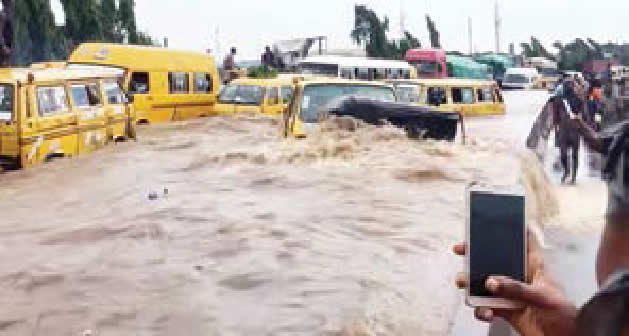
This comes as devastating floods struck Ogun and Gombe states on Tuesday, with other states — including Lagos, Plateau, Anambra, and Delta — also affected by the disaster.

According to the centre’s flood prediction obtained by our correspondent, the affected areas are expected to experience rainfall likely to cause flooding from August 5 to August 9, 2025.

The predicted states and locations are Akwa-Ibom (Edor, Eket, Ikom, Oron, Upenekang); Bauchi (Tafawa-Balewa, Azare, Jama’are, Kari, Misau, Jama’a); Ebonyi (Abakaliki, Echara, Ezilo); Cross-River (Ogoja Edor, Obubra); Nasarawa (Keana, Keffi, Wamba); Benue (Agaku, Buruku, Gboko, Igumale, Ito, Katsina-Ala, Ugba, Vande-Ikya); Kaduna (Jaji, Kafancha, Birnin-Gwari, Zaria) and Katsina (Bindawa, Bakori, Daura, Funtua).

Others are Kebbi (Bagudo, Birnin-Kebbi, Bunza, Gwandu, Jega, Kalgo, Kamba, Kangiwa, Shanga, Ribah, Sakaba, Saminaka, Yelwa, Gauri-Banza); Kano (Bebeji, Gezawa, Gwarzo, Kano, Karaye, Tundun-wada, Wudil, Kunchi); Niger (Kontagora, Rijau, Ringim); Plateau (Mangu); Taraba (Donga, Takum); Jigawa (Diginsa, Gumel, Dutse, Gwaram, Hadejia, Miga); Yobe (Machina, Potiskum); Zamfara (Anka); Sokoto (Sokoto, Wamakko); Borno (Biu); and Gombe (Bajoga).

Flooding in Nigeria has become a yearly occurrence that claims lives and destroys many properties. Last year, 31 states were reportedly affected by flooding, causing hundreds of deaths, injuring thousands of others and affecting 1.2 million.

On September 10, 2024 the Alau Dam collapsed, causing floods in Borno State, killing at least 150 people, displacing 419,000 others and causing the community to submerge 70 per cent.

The country has experienced a series of flooding events that caused property damage, fatalities, injuries and displacement this year. The deadliest flood so far this year was in May that reportedly killed at least 200 people with thousands displaced in Mokwa, Niger State.

The floods, triggered by intense rainfall and exacerbated by a dam collapse, caused widespread destruction and severely impacted the community’s access to essential services.

While Mokwa was the most severely affected area, other parts of Nigeria also experienced flooding in 2025. The flooding affected multiple states, including Rivers State – where torrential rains caused floods and landslides that buried homes and swept people away in the city of Okrika, killing at least 25 people – and put millions of people at risk.

In April, at least 13 people were killed in Kwara State and Mokwa, including three people on a canoe that capsized on a flooded river, and rice fields were destroyed after flooding triggered by the routine water release from the Jebba Hydroelectric Power Station dam affected 30 communities.

Recently, the National Economic Council approved the release of intervention funds to support nationwide flood mitigation and response efforts.

NEC approved the disbursements of N3bn each to the 36 states and the Federal Capital Territory; N1.5bn to the Federal Ministry of Budget and National Planning; N1.5bn to the Federal Ministry of Environment; N1.5bn to the Federal Ministry of Water Resources and Sanitation; and N10bn to the National Emergency Management Agency.

In a dashboard released last Friday by NEMA, it showed that no fewer than 165 persons have died, 82 missing and 119,791 persons have been affected by this year’s flooding.

The agency also stated that 138 persons sustained various degrees of injuries, 43,936 displaced, 8,594 houses affected and 8,278 farmlands destroyed across 43 Local Government Areas in 19 States.

According to the agency, children and women were mostly affected.

191 dead – NEMA

Meanwhile, a new report from the National Emergency Management Agency has revealed that in 2025, no fewer than 191 lives have been lost to the floods that have ravaged parts of the country, while 94 people remain missing.

The report obtained by our correspondent on Tuesday showed that Niger State recorded the highest number of fatalities, with 163 deaths, followed by Adamawa State, where 26 people lost their lives. One death each was reported in Borno and Gombe states.

The data further indicated that, so far this year, the floods have affected 134,435 people across 20 states and 47 local government areas.

The affected states include Abia, the Federal Capital Territory (Abuja), Adamawa, Akwa Ibom, Anambra, Bayelsa, Borno, Delta, Edo, Gombe, Imo, Jigawa, and Kaduna. Others are Kano, Kogi, Kwara, Niger, Ondo, Rivers, and Sokoto.

See also  Northern insecurity troubling me the most- President Tinubu

Additionally, 48,056 people have been displaced, while 239 injuries have been reported. The floods have also damaged 9,499 houses and affected 9,450 farmlands.

NEMA’s dashboard also revealed that among those affected are 27,121 men, 41,539 women, 60,071 children, 5,704 elderly persons, and 1,874 persons with disabilities.

In 2024, the floods affected 5,264,097 individuals, displacing 1,243,638 people across 35 states and 401 local government areas. The disaster resulted in 1,237 deaths and left 16,469 individuals injured.

Also, 116,172 houses were destroyed, and 1,439,296 hectares of farmlands were affected, further worsening the economic and humanitarian impact of the flooding across the country.

Ogun, Gombe ravaged

Parts of Ogun and Gombe states were ravaged by floods on Tuesday following heavy rainfall that began Monday night and lasted into the early hours of Tuesday.

At Redemption City, along the Lagos-Ibadan Expressway in Mowe, Ogun State, The PUNCH observed that residents, schoolchildren, and visiting church members attending the Redeemed Christian Church of God annual convention were trapped for hours as floodwaters submerged parts of the area.

One of the worst-hit areas was Estate 15, where some vehicles were completely submerged. Stranded residents had to abandon their cars and resorted to using canoes as a temporary means of transportation.

In response, RCCG officials deployed Type D school buses to help ferry people in and out of the premises.

“I was trapped inside the RCCG camp this (Tuesday) morning and couldn’t leave for work until a special luxurious bus provided by the church came to pick me and others,” a resident, Tunde, told The PUNCH.

It was same scenario at the OPIC area of the state, where the floods disrupted activities and destroyed properties.

In Gombe, the sExecutive Secretary, State Emergency Management Agency, Haruna Abdullahi, says no fewer than four persons died from flood, windstorms and rainfall.

He disclosed that about 278 households comprising individuals and farmlands were affected.

Abdullahi said, “The last incident was in Kwami, Dukku, Billiri, Gombe, Yalmatu-Deba, Akko Local Government Areas.

“We received report of four dead persons, two from Gombe Local Government Area, one from Dukku and another in Kwami LG. About 278 households were affected mostly windstorm and flooding of farmlands, and some houses. Mostly the deaths were caused by cracked walls.”

Other states

A night of relentless rainfall plunged parts of Lagos into crisis on Monday, as flash floods swept through residential and commercial areas, stranding thousands and crippling economic activity in Nigeria’s largest city.

The rain, which began late Sunday and intensified through the early hours of Monday, overwhelmed drainage systems and turned streets into rivers across both Lagos Mainland and Island.

By dawn, neighbourhoods such as Ijede in Ikorodu, Lekki, Surulere, Agege, Ajegunle, Alimosho, and Eti-Osa were inundated. Viral videos from Ijede showed families waist-deep in floodwater, wading through what were once roads. In one emotionally charged clip, a barefoot woman in Oko Ope cried out in Yoruba for government intervention, describing how her home had been overrun, “The water is everywhere. We can’t even go inside. We’ve lost everything.”

Traders at major markets were forced to abandon shops as floodwaters invaded stalls, damaging goods. Commuters were left stranded for hours, with major roads waterlogged and transport systems disrupted across the metropolis.

On social media, the hashtags #LagosFlood and #IjedeTragedy trended as residents posted photos of submerged vehicles, flooded living rooms, and schools under water, renewing calls for a long-term solution to Lagos’s perennial flooding crisis.

Despite repeated promises from state officials over the years, the combination of poor urban planning, blocked drainage systems, and unregulated construction in water-prone zones continues to leave Lagos vulnerable to seasonal flooding.

In Delta State, residents of Sapele and Oko communities began experiencing heavy flooding as of Monday. Some residents have already started relocating after parts of their communities were submerged.

Victims of the flood lamented the damage to property and disruption of their daily lives, appealing for immediate intervention from the government.

The Delta State Commissioner for Environment, Mr. Jamani Ejiro, visited Sapele for an on-the-spot assessment and expressed sympathy for the affected residents. He assured them of the state government’s readiness to respond promptly to alleviate their suffering.

See also  SEE FULL LIST: Ambassadors-designate nominated by Tinubu

In Oko community, located in Oshimili South LGA, residents described the annual flooding as a recurring menace and called for a lasting solution.

“We are tired of this yearly trauma. We need drainage systems, not just empty promises,” one resident said.

In a related development, the Delta State Government has established six fully-equipped IDP camps in anticipation of widespread flooding, Ejiro announced on Tuesday.

Speaking to journalists, Ejiro said the proactive measure was in response to the Nigerian Meteorological Agency’s prediction of heavy rainfall and possible flooding in several parts of the state.

According to him, the IDP camps — located in Kwale, Ozoro, Patani, Bomadi, Uto-Jeremi, and Asaba — have been strategically sited in high-risk flood-prone areas to provide timely shelter and support for affected residents.

“These camps are fully equipped with modern facilities, including sick bays, security units, kitchens, and other essential amenities to ensure the safety and comfort of displaced persons,” the commissioner stated.

Ejiro further disclosed that the state government has constituted a Flood Disaster Management Committee led by the Secretary to the State Government, Dr. Kingsley Emu. The committee, he said, is tasked with working closely with community leaders to sensitise residents in flood-prone communities on the need to relocate when necessary.

“Our goal is to ensure that lives are not lost due to preventable causes. When the need arises, we will evacuate affected residents to these designated camps,” Ejiro assured.

The announcement comes as several communities across Nigeria, including in Delta State, continue to suffer the devastating impact of seasonal flooding.

In Diggi town, Bunza Local Government Area of Kebbi State, a three-hour downpour displaced dozens of residents and left several homes underwater.

Eyewitnesses say the flood surged in from nearby unregulated waterways. “It came like a monster,” a resident said. “People lost everything within minutes.”

The Kebbi State Government directed its emergency agency and local authorities to provide immediate relief. Items including food, bedding, and medical supplies are already being mobilised, according to Ahmed Idris, Chief Press Secretary to the Governor.

Community leaders have urged citizens to keep drainages and waterways clear and are calling on NGOs, wealthy individuals, and corporate bodies to assist in recovery efforts.

In Bauchi State, the Bagel community in Dass Local Government Area suffered severe flooding, leaving many residents homeless. At least 13 houses were destroyed by the flood.

The Special Assistant on Media to the Chairman of Dass LGA, Yusuf Makama, confirmed the incident. He noted that Chairman Mohammad Jibo had visited the community, assessed the extent of the damage, and promised to provide relief materials.

“He appealed to the state and federal governments, as well as NGOs, to come to the aid of the victims,” Makama said.

In Shimankar District, Shendam LGA of Plateau State, a violent rainstorm on Sunday left a trail of destruction, affecting at least 50 homes, two primary schools, and a worship centre in Menkaat community.

Affected residents who spoke to The PUNCH in Jos on Tuesday described the extent of the destruction as “overwhelming.”

“We’ve been hit seriously. Our homes, schools, and places of worship were all destroyed,” said Lawrence Longwalk, a local resident. Another victim, Mrs. Akwe Hannatu, added, “We lost everything. Our home was destroyed, and we have nowhere to go.”

Though the State Emergency Management Agency has reportedly been alerted and plans to visit the area, residents say they are yet to receive tangible relief.

In Imo State, the National Emergency Management Agency confirmed that 27 villages in Oguta Local Government Area had been submerged by floodwaters. Seven villages in Ohaji/Egbema LGA, including Olokwu, were also affected, along with flash floods reported in parts of Owerri West LGA, such as Oforola, Avu, New Owerri, and the Akachi area.

A farmer, Amanze Okoro, told The PUNCH that he and his family had to relocate temporarily to their in-laws’ home in Owerri. “We had no choice. Our farm and house were completely taken over by water,” he said.

In Rivers State, continuous rainfall has led to flash flooding in parts of Port Harcourt and Obio/Akpor LGAs. Areas affected include Amaechi Drive in GRA, Odili Road, and the Obi Wali axis of Rumuigbo.

Environmental rights activist and Executive Director of Youths and Environmental Advocacy Centre, Dr. Fyneface Dumnamene, urged the government to declare a state of emergency in the flood-prone areas.

See also  Tambuwal fights back over N189bn EFCC probe

“Flash floods are now a regular occurrence. What we need is emergency drainage clearing, community sensitisation, and immediate government action. We can’t stop the rain, but we can prevent the suffering,” Dumnamene told The PUNCH in a phone interview.

With more rain predicted in the coming weeks by the Nigerian Meteorological Agency, residents across the country are bracing for further hardship. Environmental experts warn that without proactive infrastructure investment, emergency preparedness, and community education, Nigeria will continue to suffer the devastating consequences of seasonal flooding.

States prepare

In Katsina State, following NiMet’s prediction of possible floods in Daura, Jibia, Funtua, and Bakori LGAs, the state government has designated primary and secondary schools as temporary shelters.

Binta Hussaini Dangane, Executive Secretary of the State Emergency Management Agency, said local emergency committees have been trained across the 34 LGAs to respond promptly to any flood emergencies.

“The government has procured food and non-food items, while awareness campaigns are ongoing,” she said, urging residents to avoid dumping refuse in waterways and to clear blocked drainages.

Despite heavy and sustained rainfall in Bayelsa State, flood control efforts — especially in Yenagoa — have so far prevented severe flooding.

Officials credit ongoing desilting of natural drainage channels and reconstruction projects like the culvert at Osiri Road in Ekeki. Head of the Bayelsa Flood and Erosion Control Directorate, Chief Walson Omusu, said the state remains “ready and proactive.”

The Sokoto State Emergency Management Agency and the National Emergency Management Agency have commenced a joint flood damage assessment across multiple communities in the state following days of torrential rainfall that caused widespread destruction.

Assessment teams visited the most affected local government areas — Yabo, Shagari, and Tureta — where hundreds of residents have been displaced, homes washed away, and farmlands submerged.

In Yabo LG, floodwaters ravaged entire communities such as Shiyar Hegin-Rafi, Shiyar Sarkin Fawa, Shiyar Ubandoma, Shiyar Ubandawaki (Garkar Audu), and Kofar-Bai. Six rooms belonging to one Muhammadu Dan Nanuwa were completely destroyed, while 89-year-old Malam Bango Altine lost five rooms. The palace of the Sarkin Kabin Yabo also suffered significant damage.

In Shagari LG, more than 10 communities, including Lambara, Kambama, Jaredi, Kajiji, and Lokoko, were affected. Vast farmland in Illela-Chofal was submerged, raising fears of food insecurity. Local officials, led by disaster desk officer Ibrahim Abubakar, reported extensive destruction of crops and homes.

In Tureta LG, floods on July 23 and 25 displaced over 250 people across Inwala, Shiyar DanDile, and Lambar-Tureta. Two women were injured in a building collapse, while the home of a Federal Road Safety Corps official, Salisu Muhammad, was among those damaged. Tureta LGA Chairman, Hon. Aliyu Abubakar, blamed poor drainage systems for the disaster.

SEMA and NEMA say the data collected will guide relief distribution and long-term flood mitigation efforts. Temporary shelters have already been set up for displaced families, and officials pledged continued collaboration to strengthen infrastructure and drainage.

Despite flood warnings by NiMet and NIHSA, Kano State has not recorded any significant flooding as of early August. Authorities have, however, cautioned residents in flood-prone communities downstream of the Tiga, Challawa, and Bagauda dams to stay alert.

Similarly, the Nasarawa State Emergency Management Agency (NASEMA) confirmed that no part of the state has yet been flooded. Officials said they had launched sensitisation campaigns and prepared temporary shelters in Doma, Lafia, Toto, Awe, and Obi LGAs.

In Kaduna, there have been no reports of flooding despite consistent rainfall. The state emergency agency remains on alert as August and September typically see peak flooding. Authorities are monitoring dam levels and weather forecasts to ensure swift response.

The Benue State Emergency Management Agency also confirmed that no flooding has been reported. Officials are, however, prepared to respond if necessary.

While Edo State has yet to record major flooding this year, communities near the River Niger — including Udaba Odemokpa — remain on the edge as heavy rains are expected in September.

In Benin City, areas like Tomline along Lagos Road frequently flood after rainfall. Traders say blocked drainages continue to disrupt businesses.

FOLLOW US ON:

FACEBOOK

TWITTER

PINTEREST

TIKTOK

YOUTUBE

LINKEDIN

TUMBLR

INSTAGRAM

Continue Reading
Click to comment

Leave a Reply

Your email address will not be published. Required fields are marked *

News

NLC plans protest over the following reasons…

Published

on

The Nigeria Labour Congress has announced plans for a nationwide protest on Thursday, 17 December 2025, to demand urgent government action on a series of pressing national crises, including escalating insecurity, the deteriorating tertiary education system, the ongoing health sector strike, and concerns over political interference in the Labour Party.

The announcement followed the union’s National Executive Council meeting, held at the NLC Sub-Secretariat in Yaba, Lagos, on Thursday, 4 December 2025.

In the communiqué released after the meeting, the NEC expressed “very serious concern” over the worsening security situation in the country, citing the abduction of 24 girls from a boarding school in Kebbi State on 17 November 2025, during which two staff members were killed.

The NEC condemned the withdrawal of security personnel before the attack, describing it as a “dastardly and criminal action” and warning that “the surge in kidnappings targeting school children in Nigerian schools has reached an alarming level and requires immediate action by the Nigerian government.”

Approximately 139 million people are living in poverty in Nigeria as of 2025, according to the World Bank’s Nigeria Development Update report released in October 2025. This figure represents about 61-62 per cent of Nigeria’s total population, indicating a sharp increase from previous years and highlighting that poverty has deepened despite ongoing economic reforms.

The NLC called on the Federal Government to take immediate steps to protect schools, particularly those in remote or high-risk areas, and demanded a full investigation and prosecution of all individuals responsible for lapses in security.

See also  'Settle the war or face Tomahawks': Trump issues new warning to Russia

The NEC also expressed deep concern about the ongoing crisis in Nigeria’s tertiary education sector. University infrastructure continues to deteriorate, teaching and research resources remain outdated, and staff allowances are often unpaid.

The NLC criticised the Federal Government’s use of divide-and-rule tactics, which it said undermined unity among unions and stalled negotiations. The union urged the government to halt these strategies and implement a fair and uniform remuneration framework for all categories of university workers, while recognising the peculiarities of different professional groups.

The NEC reviewed the ongoing strike by the Joint Health Sector Unions, which began on 14 November 2025. The union expressed concern over the withdrawal of nurses from the industrial action and warned that if negotiations with the Federal Government failed, the NLC and all its affiliates would join the strike in full solidarity.

In addition, the NEC directed the revival of the Labour–Civil Society Coalition, originally formed under the leadership of Comrade Adams Oshiomhole, to strengthen collaboration between labour organisations and civil society in addressing national issues.

The union also addressed concerns regarding the Labour Party, noting that it had been hijacked by mercantile interests, particularly through the conduct of members of the Nenadi Usman-led Caretaker Committee.

The NLC resolved to withdraw its members from these committees and to begin building coalitions with political parties whose ideologies align with working-class principles, while continuing to engage with the Labour Party where possible.

The body concluded that the planned mass mobilisation on 17 December 2025 is necessary to draw attention to the failures of the government in addressing insecurity, economic hardship, industrial disputes, and political integrity.

See also  Nollywood actress Omotola Odunsi is dead

The union reaffirmed its commitment to protecting workers’ rights, improving living and working conditions, and defending Nigerian citizens. It called on all workers and citizens to remain united, steadfast, and resolute in the collective struggle to safeguard national stability and promote socio-economic justice.

punch.ng

FOLLOW US ON:
FACEBOOK

TWITTER

PINTEREST

TIKTOK

YOUTUBE

LINKEDIN

TUMBLR

INSTAGRAM

Continue Reading

News

Nigeria must address poverty, insecurity to stop coups in W’Africa – Falana

Published

on

Senior Advocate of Nigeria Femi Falana says Nigeria cannot lead regional efforts against coups without first addressing internal drivers of instability.

He made this position known as West Africa confronts another round of military takeovers.

Speaking on Channels Television’s Politics Today on Tuesday, the human rights lawyer said Nigeria must confront socioeconomic and political conditions that fuel unrest.

“If we want to have political stability in Nigeria, you must address the crisis of the economy, address poverty, tackle illiteracy, and curb insecurity of lives and property,” he said.

Falana said civic freedoms must be strengthened and warned against treating criticism as a crime.

“You must show that the political space will not shrink as it is now. You have a shrinking of the political space, and that must stop. There must be freedom of expression.

“You cannot be charging people with all manner of offences for expressing their views about the affairs of their country,” he said.

He also urged the Independent National Electoral Commission to widen participation.

“More importantly, INEC must open the political space and allow ideological political parties to be registered to challenge the status quo. Right now, INEC is not prepared to open the political space,” he said.

Falana said many citizens are “unhappy” with current policies and argued that democratic leaders in Africa frequently constrain the opposition.

According to him, Nigeria must avoid practices that weaken pluralism.

“Nigeria clearly has its job cut out. If you want to stop coups, you must allow political pluralism in Nigeria.

See also  Media icon, MKO’s wife, Doyin Abiola dies at 82

“You cannot have a situation where the country is moving towards a one-party state, and you want to export democracy. Nigeria has to put its house in order to align with political pluralism” he asserted.

He added that credible elections depend on competitive opposition, saying ruling parties across Africa often render rivals “impotent” through direct or indirect restrictions.

Asked if more coups should be expected, Falana said, “It won’t be the last. I’m familiar with the political terrain. Once you put opposition leaders in jail, send them into exile, or kill them, you cannot have political stability.”

Citing similar trends in Benin Republic, he urged Nigeria to “show leadership in stabilising the region.”

His remarks follow Sunday’s failed coup attempt in Benin, during which soldiers led by Lt. Col. Pascal Tigri seized the state television station in Cotonou and announced President Patrice Talon’s removal.

The uprising was quashed within hours by Nigerian troops and the ECOWAS standby force.

Authorities said several people were killed, at least 14 suspects were arrested, and Tigri remains at large. The plotters cited grievances over security, military promotions and restrictions on political freedoms linked to the 2026 election.

The African Union, United Nations, European Union and ECOWAS condemned the coup.

Meanwhile, the Nigerian Senate has approved President Bola Tinubu’s request to deploy troops to Benin Republic.

Continue Reading

News

Insurgency: FG, Saudi Arabia sign five-year military pact

Published

on

Nigeria and the Kingdom of Saudi Arabia have signed a five-year Memorandum of Understanding aimed at strengthening defence and military cooperation between both countries.

The agreement, announced by the Minister of State for Defence, Dr. Mohammed Bello Matawalle, seeks to deepen collaboration in key security areas, including “military training, intelligence sharing, defence production, and joint operations.”

The minister’s Special Assistant on Media, Ahmed Dan Wudil, disclosed this in a statement on Tuesday, titled, ‘Nigeria, Saudi Arabia sign five-year defence, military cooperation agreement’.

According to the statement, “the memorundum will remain in force for term of five years and may be renewed for a similar period.”

“The MoU shall enter into force on the date of the last written notification, exchanged between the parties through diplomatic channels.

“The memorundum may be terminated at any time, by giving a written notice to the other party at least three months prior to the intended of termination.”

Wudil described the pact marks a major step in expanding bilateral ties and addressing emerging security threats facing Nigeria and the wider region.

“Dr. Matawalle signed the MoU on behalf of the Federal Republic of Nigeria, while Saudi Arabia’s Minister of Defence for Executive Affairs, Dr. Khaleed H. Al-Biyari, signed for the Kingdom,” the statement said.

The Ministry of Defence described the partnership as timely and strategic, saying it aligns with Nigeria’s ongoing efforts to strengthen security collaboration with global partners.

“This agreement reflects our commitment to strengthening international partnerships for sustainable security development,” the statement noted.

See also  'Settle the war or face Tomahawks': Trump issues new warning to Russia

“With this collaboration, we are confident that the current security challenges in some parts of the country will be addressed more effectively.”

The pact is expected to enhance Nigeria’s operational capacity and facilitate joint initiatives and deeper defence cooperation between both nations over the next five years.

It comes at a time when Nigeria confronts heightened surgency and international scrutiny over decades-old killings.

punch.ng

FOLLOW US ON:

FACEBOOK

TWITTER

PINTEREST

TIKTOK

YOUTUBE

LINKEDIN

TUMBLR

INSTAGRAM

Continue Reading

Trending