Connect with us

Lifestyle

Ajibike Ogunyemi: The Osogbo Sculptor Bridging Tradition and Modernity

Published

on

Exploring the life and art of Ajibike Ogunyemi, a leading Nigerian sculptor whose metalworks preserve Yoruba spirituality through contemporary expression.

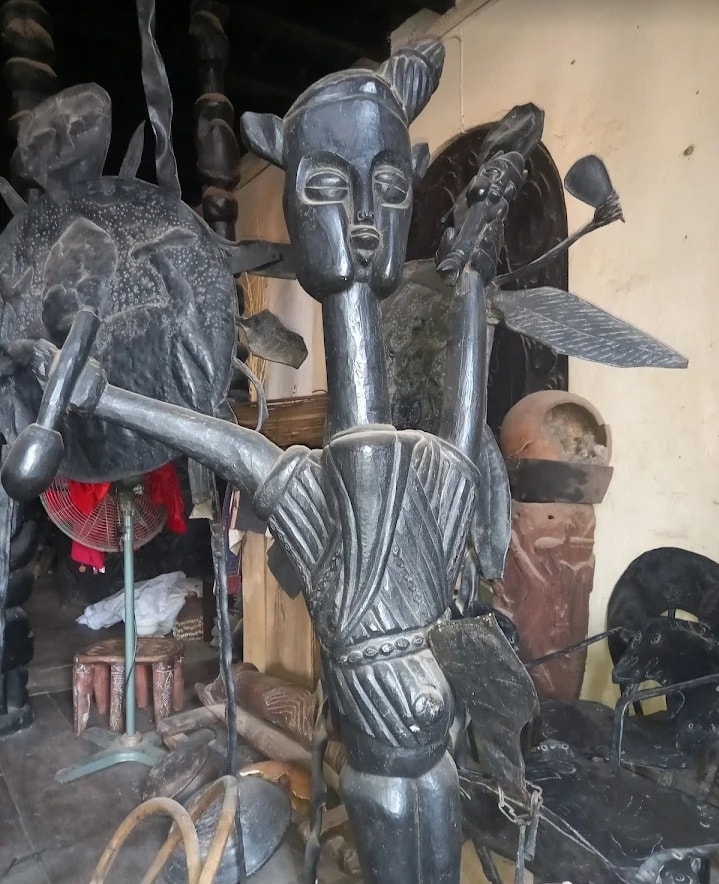
The image depicts a striking metal sculpture created by Ajibike Ogunyemi, one of Nigeria’s most respected contemporary sculptors. A native of Osogbo, Osun State, Ogunyemi is widely known for his mastery of metalwork and his connection to the New Sacred Art movement, which blends traditional Yoruba spirituality with modern artistic innovation. His works embody the living relationship between art, religion, and identity in southwestern Nigeria.

Early Life and Cultural Background

Ajibike Ogunyemi was born and raised in Osogbo, a historic Yoruba city celebrated for its rich cultural traditions, craftsmanship, and devotion to the goddess Osun, the deity of fertility, love, and rivers. Growing up in such an environment, Ogunyemi was surrounded by a thriving community of artists, carvers, and craftsmen inspired by Yoruba cosmology.

His artistic journey began under the influence of the Osogbo art movement, a collective of Nigerian artists who redefined African art during the mid-20th century. This movement was notably influenced by Austrian artist and priestess Susanne Wenger, who, along with local collaborators, revitalised the Osun-Osogbo Sacred Grove through sculpture, painting, and shrine design. Ogunyemi’s deep appreciation for Yoruba spirituality and his natural skill in metalwork positioned him as one of the heirs to this enduring legacy.

The New Sacred Art Movement

Ogunyemi’s association with the New Sacred Art movement is central to his identity as an artist. Founded in the 1960s by Susanne Wenger (Adunni Olorisha) and a circle of Yoruba artists, this movement sought to restore and preserve the sanctity of Yoruba religious sites, especially the Osun-Osogbo Grove — now recognised as a UNESCO World Heritage Site.

See also  Why Chief Obafemi Awolowo picked an Igbo man as running mate in 1979 presidential election

The group’s members, including artists like Adebisi Akanji, Buraimoh Gbadamosi, and Jimoh Buraimoh, dedicated their craft to creating sculptures that depict Yoruba deities (Orisha) and mythological scenes. Ogunyemi emerged as one of the prominent sculptors of the second generation of this movement, known for his bold use of metal as a primary medium.

His works often feature symbolic forms inspired by Yoruba cosmology — serpents representing transformation, birds symbolising divine messages, and human figures embodying ancestral spirits.

Artistic Style and Medium

Unlike earlier Yoruba sculptors who primarily used wood, Ajibike Ogunyemi is known for his innovative use of metal. His sculptures often feature welded iron sheets, rods, and recycled materials, shaped into elaborate forms that reflect both spiritual and environmental awareness.

The choice of metal not only represents strength and durability but also connects to Yoruba notions of Ogun, the god of iron and war. In many of his works, Ogunyemi subtly references this deity, celebrating the spiritual power of metal as both a creative and protective force.

Through texture, scale, and rhythm, his sculptures evoke a sense of movement and ritual energy — as if the figures themselves are engaged in eternal dance with the divine.

Connection to Yoruba Religion and Symbolism

Ogunyemi’s art draws deeply from Yoruba mythology, where every creation embodies a link between the physical and spiritual worlds. His pieces are not merely decorative; they are ritual instruments designed to maintain the balance between humanity and the gods.

Many of his sculptures are installed within the Osun-Osogbo Sacred Grove, where they serve as guardians of shrines, paths, and altars. These works continue the Yoruba tradition of sacred art — not confined to galleries but integrated into daily worship and community life.

See also  Here are some top African rulers who promoted African unity and Africanism

By reimagining traditional forms in modern materials, Ogunyemi ensures that Yoruba spirituality remains relevant in the 21st century.

Legacy and Influence

Ajibike Ogunyemi’s contribution to Nigerian art goes beyond aesthetic innovation. His work symbolises the continuity of Yoruba culture amid rapid modernisation. Through his sculptures, he has bridged generational and cultural gaps, ensuring that sacred Yoruba symbols remain alive in the global art scene.

He has exhibited his work both locally and internationally, contributing to Nigeria’s growing reputation in contemporary art. Many of his pieces are preserved in museums, galleries, and spiritual sites, particularly in Osogbo, where his artistic journey began.

Ogunyemi is often described as one of the spiritual successors of Susanne Wenger, continuing her mission to protect and celebrate Yoruba sacred spaces through art.

References

1. UNESCO World Heritage – Osun-Osogbo Sacred Grove

2. Drewal, Henry John. Yoruba Ritual: Performers, Play, Agency. Indiana University Press, 1992.

3. National Commission for Museums and Monuments (Nigeria) – Artists of the Osogbo School.

4. African Arts Journal, Vol. 35, No. 2 (2002) – The Osogbo Artists and the Sacred Grove Tradition.

FOLLOW US ON:

FACEBOOK

TWITTER

PINTEREST

TIKTOK

YOUTUBE

LINKEDIN

TUMBLR

INSTAGRAM

Continue Reading
Click to comment

Leave a Reply

Your email address will not be published. Required fields are marked *

Lifestyle

Declare Your Lineage – Royal Family Tells Musician KWAM 1 Over His Interest In Becoming Next Awujale Of Ijebuland

Published

on

KWAM 1, in a letter dated December 3, 2025, addressed to the chairman of the Fusengbuwa Ruling House in Agunsebi Quarters, Ijebu-Ode, announced his interest in the stool, describing himself as a “bonafide son” of the ruling house.

The Fusengbuwa ruling house of Ijebu-Ode, next in line to produce the new Awujale of Ijebuland, Ogun State, has instructed Fuji musician Wasiu Ayinde, popularly known as KWAM 1, to confirm his family’s royal lineage to validate his membership in the ruling house.

KWAM 1, in a letter dated December 3, 2025, addressed to the chairman of the Fusengbuwa Ruling House in Agunsebi Quarters, Ijebu-Ode, announced his interest in the stool, describing himself as a “bonafide son” of the ruling house.

KWAM 1 also stated that his candidacy aligns with Ijebu customary law and the Ogun State Chieftaincy Laws.

In an interview with Punch, the Chairman of the ruling house and former National President of the Institute of Chartered Accountants of Nigeria, Abdulateef Owoyemi, said only bonafide members of the family would be allowed to participate in the selection process.

Owoyemi explained that KWAM 1, Olori Omooba of Ijebu land and others interested in the stool have been directed to complete the Fusengbuwa ruling house royal lineage data form.

According to him, the form, which requires contenders to trace their genealogy back seven generations, ensures that only genuine princes from the family can participate, thereby blocking “strangers” from claiming the throne.

He said, “The first step for anyone interested in contesting for the Awujale throne is to declare their lineage by filling the standard Fusengbuwa ruling house royal lineage data form. Once confirmed as a legitimate member of the ruling house, they can then apply for the expression of interest form.

See also  PHOTOS: 85-year-old Bayelsa woman "Ego Na Money" buried in Coca-Cola bottle-shaped casket

“We have told him, just like everyone else interested in the Awujale throne, that the first step is to declare his lineage. He will do this by completing the royal lineage data form, showing his full name, which parent and grandparent he descends from, and continuing up to seven generations.

“The completed form will be signed and submitted to the head of the ruling house unit of the Fusengbuwa ruling house, who will affirm that he is a genuine member. Only then will the process move forward.”

Owoyemi emphasised that although the application window for the throne officially closed on December 5, KWAM 1 had been given a five-day extension, which would lapse on December 10.

He noted, “We won’t shut anybody out of picking the next Awujale, but we must ensure that you are a legitimate member of Fusengbuwa. Every right comes with responsibilities. For a royal family, everyone must prove their legitimacy by completing the royal lineage data form.

“When we receive the form, we will review it meticulously. If clarification is needed, we will contact the applicant. We welcome men of influence who will use their influence to enhance the throne, not to claim it, ensuring that what truly belongs to our family is preserved.”

Owoyemi explained that the local government has given them 14 days to select candidates, and the ruling house hopes to have a new Awujale by the second or third week of January 2026.

He added, “The local government has given us 14 days to select candidates, which expires on December 18. After that, the kingmakers have seven days to deliberate and choose one candidate, whose name will be forwarded to the governor.

See also  Why Chief Obafemi Awolowo picked an Igbo man as running mate in 1979 presidential election

“Legally, the government then has 21 days to conduct background checks and security clearance, allowing for objections or protests. After this period, the State Executive Council will ratify the nominee, and the governor will announce the next Awujale, after which coronation rites will commence.

“So, combining the candidate selection, kingmakers’ deliberation, and legal objection period, we are looking at around 42 days. Therefore, we expect the next Awujale to emerge between the second and third week of January.”

FOLLOW US ON:

FACEBOOK

TWITTER

PINTEREST

TIKTOK

YOUTUBE

LINKEDIN

TUMBLR

INSTAGRAM

Continue Reading

Lifestyle

VIDEO: I’m Married But Not In My Husband’s House; I Didn’t Have The Experience Of Living Happily Ever After – Singer Shola Allyson Reveals

Published

on

While speaking about her love life, the 54-year-old who came into limelight with a love album ‘Eji Owuro’, revealed that she is married but not living with her husband.

Sola Allyson, the popular Nigerian gospel singer, has revealed that she is not currently living with her husband.

The musician made this known in her latest interview on Oyinmomo TV.

While speaking about her love life, the 54-year-old who came into limelight with a love album ‘Eji Owuro’, revealed that she is married but not living with her husband.

Sharing her marital experience, the singer said she has never enjoyed the kind of happiness many people describe.

“I’m married, but I’m not in my husband’s house. We live separately. He in his house and I in mine.”

The interviewer asked: “You sang ‘Eji Owuro’, did you experience genuine love from your husband?

She replied, “We lied before. Those older than us didn’t inform us that it’s tough. They made us believe that so long as you both love each other, you will live happily ever after, but it’s a lie.

“That’s not the experience I have. I didn’t have the experience of living happily ever after. I did all I could to make it work.

“Marriage has been a big challenge. I hear people talk about joy in marriage, but I have never experienced it.”

CLICK TO WATCH THE VIDEO

FOLLOW US ON:

FACEBOOK

TWITTER

PINTEREST

TIKTOK

YOUTUBE

LINKEDIN

TUMBLR

INSTAGRAM
See also  Why Chief Obafemi Awolowo picked an Igbo man as running mate in 1979 presidential election
Continue Reading

Lifestyle

VIDEO: Shola Allyson Finally Opens Up, Reveals Why She Does Not Reference Jesus In Her Songs

Published

on

Recall that Allyson, who is regarded as a gospel singer, was dragged on social media in March 2025 for not directly referencing ‘Jesus’ in all her songs.

Shola Allyson, the renowned Nigerian songstress, has opened up on the real reason she avoids mentioning the name of Jesus in all her songs.

Recall that Allyson, who is regarded as a gospel singer, was dragged on social media in March 2025 for not directly referencing ‘Jesus’ in all her songs.

Reacting to her critics in a post on X, the songstress stated that “No one can bully me into joining their darkness that looks like light because indolent souls find comfort in it”.

Finally revealing her reason for not mentioning Jesus in her songs, Shola Allyson on Saturday during her latest interview on Oyinmomo TV, stated that Jesus did not ask her to do PR for him.

She said “I’m not a religious singer. As I am, I have never introduced myself as a gospel singer. My name is Shola Allyson. I’m a singer”.

Interviewer; “Some people said you don’t mention ‘Jesus’ name’ in all your songs”.

She quickly responded “Jesus did not instruct us to mention his name in songs nor did Jesus ask us to do PR for Him”.

CLICK TO WATCH THE VIDEO

FOLLOW US ON:

FACEBOOK

TWITTER

PINTEREST

TIKTOK

YOUTUBE

LINKEDIN

TUMBLR

INSTAGRAM

See also  Video - Sunday Igboho Arrival | Massive Welcome for Yoruba Nation Activist
Continue Reading

Trending