


Connect with us

News

Tinubu to meet Council of State, police on insecurity

Published

on

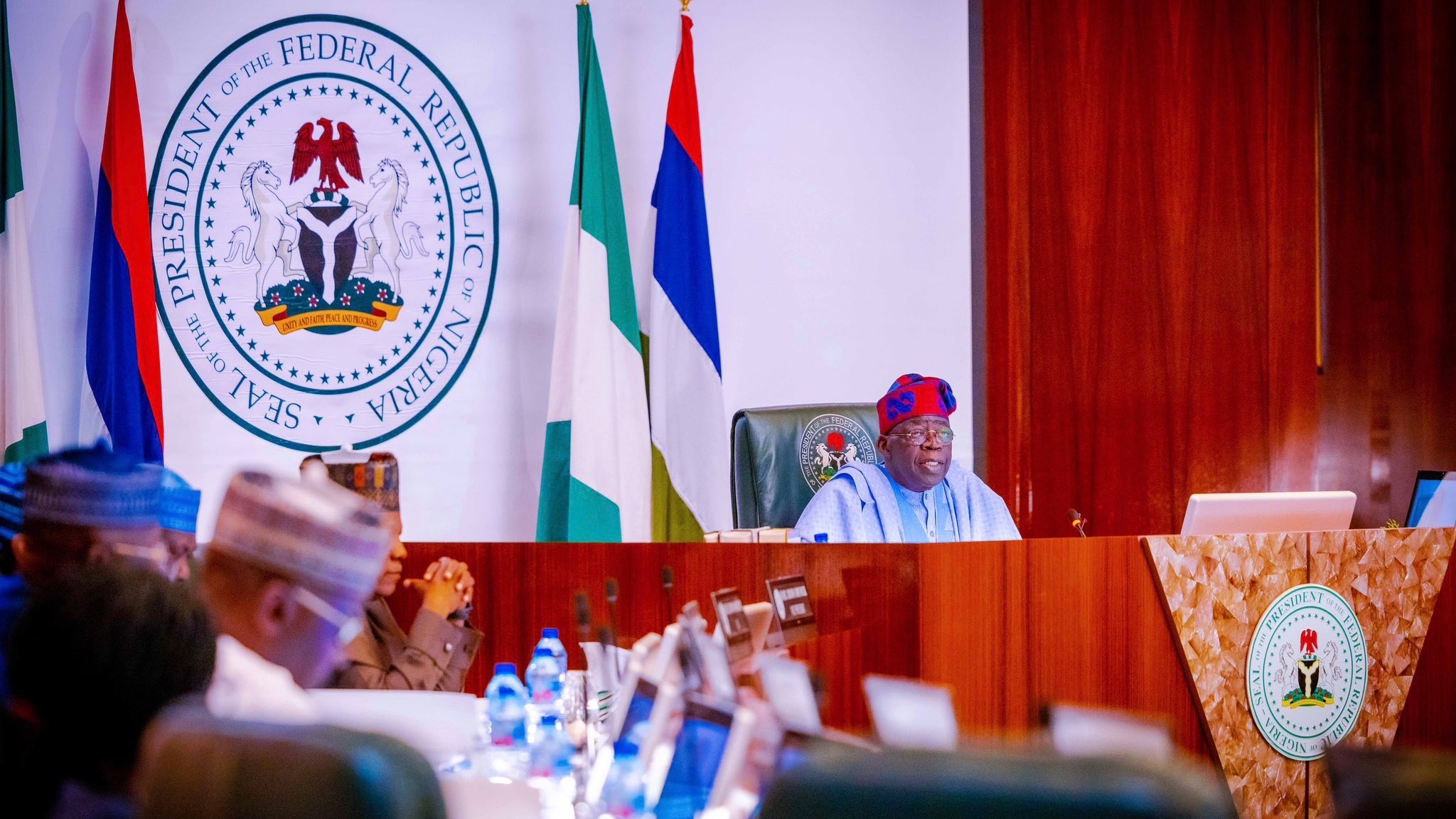
PRESIDENT Bola Tinubu has summoned a meeting of the Council of State and the Police Council for Thursday, October 9, 2025, to deliberate on the escalating insecurity across parts of the country and other pressing national issues.

The strategic sessions, to be held at the Council Chambers of the Presidential Villa, Abuja, underscore the President’s renewed commitment to strengthening Nigeria’s security architecture and restoring public confidence amid rising security concerns.

According to a statement on Monday by the Permanent Secretary, Cabinet Affairs Office, Dr. EmansoUmobong, the Secretary to the Government of the Federation, Senator George Akume, has formally invited members of both councils to participate either physically or virtually.

The statement read, “The meetings aim to discuss matters of national importance and key issues affecting national security and policing. The Council of State meeting is scheduled for 1:00 p.m., while the Police Council meeting will hold at 2:00 p.m.”

The Council of State, chaired by the President, is an advisory body comprising former Presidents, former Heads of State, former Chief Justices of Nigeria, state governors, and the Attorney-General of the Federation. It provides counsel on major policy matters, including national security and appointments.

The Police Council, on the other hand, oversees the organisation, administration, and operational control of the Nigeria Police Force, including the appointment and discipline of senior officers.

Presidency sources told The PUNCH that the meetings would review the nation’s security situation, evaluate ongoing military operations, and consider fresh measures to tackle banditry, kidnapping, and communal violence in some northern and central states.

See also  Is Trump correct on Nigeria?

The planned sessions will also coincide with deliberations on key political and administrative matters, including the expected nomination of a successor to the outgoing Chairman of the Independent National Electoral Commission.

The meetings come just after President Tinubu’s return to Abuja on Monday evening from a 10-day working visit to Lagos, where he held a series of engagements with investors, development partners, and political stakeholders.

His aircraft, a San Marino-registered BBJ T7-NAS, landed at the Presidential Wing of the Nnamdi Azikiwe International Airport at 6:55 p.m., according to a statement by the State House media office.

While in Lagos, the President met with leading business figures, including Global Infrastructure Partners CEO, Bayo Ogunlesi, and Metis Capital Partners Chairman, Keem Belo-Osagie, where discussions centred on expanding investment in infrastructure, energy, and logistics — sectors critical to economic diversification and job creation.

He also hosted the Secretary-General of the International Maritime Organisation, Arsenio Dominguez, alongside Minister of Marine and Blue Economy, Adegboyega Oyetola, to discuss developing Nigeria’s blue economy as “a viable alternative to fossil energy.”

Before returning to Abuja, Tinubu toured several states, including Oyo, Imo, and Plateau, for national events and engagements, during which he reiterated his administration’s focus on unity, security, and inclusive development.

At a funeral in Jos for the late mother of APC National Chairman, Prof. Nentawe Yilwatda, the President reaffirmed his commitment to religious harmony, saying, “My mission is to unite this country and ensure its prosperity. Progress is being made on both fronts.”

Thursday’s Council of State meeting will be the second under Tinubu’s administration and is expected to set the tone for renewed intergovernmental coordination in addressing the country’s multifaceted security challenges.

See also  Tinubu’s New Year message (Full Text)

punch.ng

FOLLOW US ON:

FACEBOOK

TWITTER

PINTEREST

TIKTOK

YOUTUBE

LINKEDIN

TUMBLR

INSTAGRAM

Continue Reading
Click to comment

Leave a Reply

Your email address will not be published. Required fields are marked *

News

Confusion hits trial of suspected coup plotters

Published

on

There are indications that the Federal Government is undecided on the mode of trial for the officers alleged to have plotted a coup against President Bola Tinubu.

Saturday PUNCH gathered that the Federal Government has not given instruction on whether the suspects should be court-martialled or arraigned in a regular court.

According to credible sources, the confusion stems from concerns that the offence was committed under a democratic government, not in a military administration where erring officers could have been arraigned in military courts.

In October 2025, the military arrested 16 senior officers, including one Brigadier General, a Naval officer, and Air Force personnel, but the authority denied that it had something to do with the coup plot.

However, the Defence Headquarters, on January 26, admitted that the officers were indeed arrested for their involvement in a coup plot.

The DHQ Director of Defence Information, Maj. Gen. Samaila Uba, said the suspects would be arraigned before “relevant military judicial panels to face trial in line with the Armed Forces Act” and other applicable service regulations.

Apart from the military officers, about 24 other suspects were arrested in connection with the plan to topple Tinubu’s administration.

However, since the presentation of the report, the military has remained silent on the trial of the suspects.

Undecided judicial process

Saturday PUNCH learnt from top military officers that the silence was due to indecision on how to prosecute the suspects.

The officers, who spoke on condition of anonymity because they were not authorised to speak on the matter, confided in Saturday PUNCH that while the leadership preferred to court-martial the indicted officers, the Presidency was not convinced that a military court was appropriate for the arraignment.

See also  PHOTOS: Burial details released for three brothers who di£d in the Great Nigeria Insurance House fire

One of the officers at the Defence Headquarters, who is knowledgeable about the investigations said, “We (the military leadership) are waiting for the President’s directive on the constitution of the court-martial panel.

“The DHQ had earlier announced that the indicted officers would be court-martialled in line with our rules. But there are some people, including government officials at the federal level, arguing that a court martial is not appropriate.

“But I think there is a clarification here. Only the military officers will be court-martialled. We have our system. We have our ways of doing things. The civilians will be taken to a regular court; they are not part of us.”

Similarly, a top military officer at the Nigerian Army headquarters told one of our correspondents that investigations had been concluded and that the indicted officers would be arraigned ‘very soon.’

“They will be arraigned very soon. Investigations have been concluded; that was why the DHQ came out to present a report on the coup plot. Whoever is yet to be arrested cannot run forever,” he said.

Asked whether the suspects would be arraigned in a regular court or court-martialled, the officer said, “I don’t know. I am not in a position to determine which court to approach. However, this is not from us (military authority), and I am yet to confirm it. I think some people are pushing for the indicted officers to be arraigned in a civilian court. That is left for the President to decide. He is the Commander-in-Chief of the Armed Forces.”

A senior official in the Federal Ministry of Justice also said the AG’s office had yet to decide the court in which the suspected coup plotters would be arraigned.

See also  Presidential order fails to curb soaring drug prices

He said there was “confusion” over the arraignment process, explaining that it required a careful approach.

“Nothing has been concluded. The AG’s office is central to the trial, whether it is a court-martial or a regular court.

“There is, indeed, confusion because this is the first time a coup attempt would be made under a civilian government. Previous coups occurred under military regimes, and they had their ways of handling such matters.

“We cannot rush to any court; we need to establish that the court has jurisdiction to handle the matter,” the official, who spoke on condition of anonymity because of the sensitivity of the matter, said.

Court-martial decision will be nullified – Falana

Meanwhile, human rights lawyer and Senior Advocate ofNigeria, Femi Falana, said any decision by a military panel would be nullified if the government proceeded with a court-martial for the suspected coup plotters.

Falana, who spoke with Saturday PUNCH, said a military panel had no jurisdiction to try the suspects, insisting that they could only be tried at a Federal High Court.

He said, “A court martial has no jurisdiction. If they go ahead with a court martial, the decision will be set aside. It happened in the Second Republic, when Mandara was taken to the Federal High Court, which had no jurisdiction at the time. He was freed by the Supreme Court. If you go to the wrong court, the case will be thrown out.

“We are in a civilian government; you can’t go to a court martial. They are not trying to overthrow a military dictator but a civilian President. Even throughout the military regime, no coup plotter was taken to a court martial because it is not covered by the Armed Forces Act. They were usually taken to special tribunals created by decrees for the trial of coup plotters. Those decrees have been repealed, and we are left with the Constitution.

See also  Terrorists dare Trump, kill scores

“The Constitution states that treason and treasonable felony shall be tried in the Federal High Court. You can’t go to any other court. The Constitution is superior to the Armed Forces Act.”

Falana also faulted the continued detention of the suspects, arguing that they should have been arraigned in court.

He added that the military ought to have released other suspects since it had announced that 16 officers were already indicted in the attempted coup.

“They claim that 16 have been indicted. Why are they still detaining about 40 people? If you say you have indicted 16, then you must release the others who are still being detained.

“The military authorities are operating under a constitutional government, not under a military dictatorship. It is wrong to continue detaining the other suspects. Even for those who have been indicted, by now they should be made to face justice. You can’t keep them indefinitely since October last year.

“Under the Constitution, they cannot be detained for more than three months. They should have been arraigned, especially after the investigation report was released, instead of trying them in the media and leaking snippets of the report. That amounts to a media trial, which is not permitted under the Constitution.”

punch.ng

FOLLOW US ON:

FACEBOOK

TWITTER

PINTEREST

TIKTOK

YOUTUBE

LINKEDIN

TUMBLR

INSTAGRAM

Continue Reading

News

UK to replace paper documents with eVisas from February 25

Published

on

Visitors to the United Kingdom who require a visa will no longer receive physical documents from February 25, 2026.

The UK Visas and Immigration announced this in an X post on Friday.

According the official UKVI, travellers will now be issued an electronic visa, or eVisa, which must be viewed via a UKVI account before travel.

“From 25 February 2026 visitors to the UK, who need a visa, will get an eVisa only. Create your UKVI account and view your eVisa, before you travel to the UK,” the statement read.

The UK government explains that an eVisa is “a digital record of your identity and immigration status – for example the type of visa you have or if you have indefinite leave to remain (settlement) in the UK – and the conditions of your status, for example if you’re allowed to work or study in the UK.”

It added that eVisas are replacing physical immigration documents, noting, “Biometric residence permits (BRPs) have already been replaced by eVisas. They will also replace biometric residence cards (BRCs) and wet ink stamps or vignettes (stickers) in passports.”

Travellers will typically receive an eVisa “when you successfully apply for a visa or other type of permission to be in the UK.”

Once issued, users can “view your eVisa and get a share code to prove your immigration status, for example when you get a new job or rent a home,” and can travel after adding passport or travel document details.

According to the UK government, accessing the eVisa requires a UKVI account.

“You can set up a UKVI account if you do not already have one. You do not need to pay to set up a UKVI account or access your eVisa,” the UK govenrment website confirmed.

See also  Tinubu’s New Year message (Full Text)

punch.ng

FOLLOW US ON:

FACEBOOK

TWITTER

PINTEREST

TIKTOK

YOUTUBE

LINKEDIN

TUMBLR

INSTAGRAM

Continue Reading

News

Averting pandemic amid global funding crisis

Published

on

Far away from another pandemic, it seems. Earlier this month, the World Health Organisation issued its latest alarm about the deteriorating state of global health financing – a stark new reality as the world stands on the brink of a renewed pandemic threat.

At the opening of the WHO Executive Board in Geneva on February 2, the Director-General Tedros Ghebreyesus, told health ministers and diplomats that sudden and severe cuts to bilateral aid “have also caused huge disruptions to health systems and services in many countries,” describing 2025 as “one of the most difficult years” in the agency’s history.

Indeed, the recent tragic death of renowned soprano singer, Ifunanya Nwangene, following a snake bite in her Abuja apartment—reportedly worsened by the unavailability of snake antivenom—has reignited concerns about the far-reaching consequences of inadequate healthcare funding in Nigeria.

According to WHO data, an estimated 4.6 billion people worldwide still lack access to essential health services, and 2.1 billion face financial hardship because of health costs.

Pandemics have repeatedly reshaped human history, exposing the strengths and weaknesses of societies while testing public health systems, economies, and governance structures.

They are not only medical emergencies but also social and economic crises that disrupt daily life, strain institutions, and deepen existing inequalities.

The rapid spread of infectious diseases across borders highlights how interconnected the modern world has become, making preparedness, surveillance, and timely response essential.

The COVID-19 pandemic is a recent and striking example of how devastating a global health crisis can be. It exposed gaps in healthcare funding, particularly in low- and middle-income countries where access to testing, vaccines, and treatment was limited.

See also  Gumi Speaks On Call To Arrest Him Over His Statements On Banditry

Outbreaks such as Ebola in West Africa between 2014 and 2016 demonstrated how fragile health systems, misinformation, and delayed responses can worsen the toll of a pandemic.

Together, these examples underscore the importance of sustained investment in healthcare, public trust, and international cooperation to reduce the impact of future pandemics.

Meanwhile, a projected shortage of 11 million health workers by 2030 — more than half of them nurses — threatens the very backbone of pandemic prevention, detection and response.

These unsettling projections come amid a backdrop of dramatic shifts in international health financing. In January, the United States formally withdrew from the WHO, ending a role it has played for decades.

The US had previously been one of the largest contributors to the WHO’s budget, covering nearly a fifth of its funding. Its exit forced the agency to revise its finances, including planning for a 21 per cent budget reduction in the 2026–27 cycle, and to make staff and programme cuts across regions.

The ripple effects are already visible. WHO surveys conducted in 2025 across 108 low- and middle-income countries showed that funding cuts reduced key services, including maternal care, vaccination, emergency preparedness and disease surveillance, by up to 70 per cent in some settings. This is alarming.

Even more troubling, 70 per cent of countries reported disruptions to health emergency preparedness and response, and 66 per cent to public health surveillance, during the same period, according to WHO rapid assessments.

These disruptions translate directly into lives at risk. On the malaria front, recent WHO reports show that investments which once helped prevent more than 2 billion cases and nearly 13 million deaths are now jeopardised as planned preventive campaigns and distributions of insecticide-treated nets are delayed or derailed.

See also  Presidential order fails to curb soaring drug prices

These dips in global health aid, especially from major donors, could lead to millions of additional cases and deaths from tuberculosis and other infectious diseases over the next decade.

The lessons COVID-19 vividly echoed to the world are that pathogens do not respect borders. The Nigerian government needs to turn this funding crisis into an opportunity for investment in research and development to develop local production and standardisation of life-saving medicine.

In Nigeria, the federal and state governments need to invest in resilient health systems, from community clinics to national laboratories. There should be cuts in wasteful government spending, tackling the entrenched culture of corruption and developing the country’s healthcare system.

punch.ng

FOLLOW US ON:

FACEBOOK

TWITTER

PINTEREST

TIKTOK

YOUTUBE

LINKEDIN

TUMBLR

INSTAGRAM

Continue Reading

Trending