Connect with us

News

Senate approves Tinubu’s request to deploy troops in Benin

Published

on

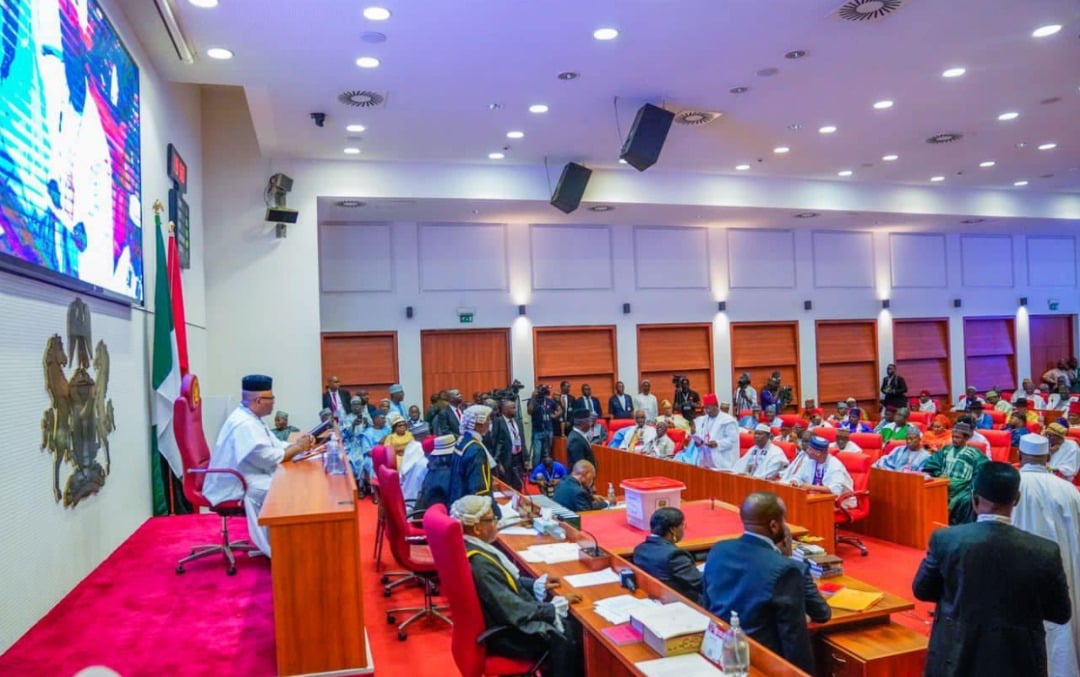
The Senate has given its approval for President Bola Tinubu’s request to send Nigerian troops to the Republic of Benin as part of efforts to help restore calm and stability after last weekend’s attempted military takeover.

The endorsement was announced on Tuesday by Senate President Godswill Akpabio during plenary, following a review of the president’s letter in the Committee of the Whole, in accordance with Section 5, Part II of the Constitution, Channels reports.

Lawmakers voted unanimously to support the deployment, effectively granting parliamentary authorisation for the regional security mission.

Akpabio hailed the resolution as timely, stressing that unrest in any neighbouring country could easily destabilise the wider region.

“An injury to one is an injury to all,” he stated.

He added that Nigeria has an obligation to stand with its partners under the Economic Community of West African States framework.

The Senate is expected to immediately forward its formal approval to Tinubu.

Tinubu, in his letter to the upper chamber, had requested permission for the deployment, noting that Nigeria bears a historic responsibility to assist Benin under existing ECOWAS security arrangements. He warned that the situation requires “urgent external intervention” to prevent further deterioration.

The attempted coup in Benin occurred on Sunday when a faction of soldiers identifying themselves as the “Military Committee for Refoundation” appeared on national television to declare that they had resolved that “Mr Patrice Talon is removed from office as president of the republic”.

The move was swiftly contained, as Benin’s loyal military forces pushed back and reclaimed control.

See also  Coup controversy: Military tracks N45bn in NDDC

“The regular army is regaining control. The city (Cotonou) and the country are completely secure. It’s just a matter of time before everything returns to normal. The clean-up is progressing well,” sources close to Talon said.

Following the failed takeover, ECOWAS announced plans to deploy its standby force.

“After consultation among members of the Mediation and Security Council at the level of Heads of State and Government, the Chair of ECOWAS Authority of Heads of State and Government has ordered the deployment of elements of the ECOWAS Standby Force to the Republic of Benin with immediate effect,” the bloc stated.

“The Regional Force shall be made up of troops from the Federal Republic of Nigeria, the Republic of Sierra Leone, the Republic of Côte d’Ivoire, and the Republic of Ghana.

“The Force shall support the Government and the Republican Army of Benin to preserve constitutional order and the territorial integrity of the Republic of Benin”.

punch.ng

FOLLOW US ON:

FACEBOOK

TWITTER

PINTEREST

TIKTOK

YOUTUBE

LINKEDIN

TUMBLR

INSTAGRAM

Continue Reading
Click to comment

Leave a Reply

Your email address will not be published. Required fields are marked *

News

Kwara varsity begs gov for overhead bridge due to multiple accidents

Published

on

The Kwara State University has appealed to the state governor, AbdulRahman AbdulRazaq, to construct an overhead bridge along the Shao/Malete Road to reduce accident rates on the busy route to the institution.

The university Vice Chancellor, Prof. Jimoh Shaykh-Lukman, made the plea on Tuesday during the institution’s pre-convocation press conference in the Malete area of the state.

While commending AbdulRazaq for heeding the call to promptly repair the Malete road to ease movement, he said the Federal Government’s intervention on the expressway has not mitigated the dangers.

He said, “Some commercial and even articulated vehicles drive against the traffic in a bid to cut down on the distance to drive to make the turn.

“This constitutes a major hazard for all users of that road. We urge our visitor, Gov. AbdulRazaq, to use his good office to facilitate a flyover bridge fAor safe crossing of the express road.”

He also requested extensions to the existing intra-campus road network for ease of access to facilities.

“Road infrastructure is beyond the ability of the university, and this is why we call on our proprietor, Gov. AbdulRazaq, to intervene in this area,” Shaykh-Lukman said.

Speaking on the forthcoming 13th Convocation Ceremony, the vice chancellor said 8,119 degrees will be awarded on Dec. 13.

He said 7,618 earned a first degree while 501 bagged postgraduate degrees.

The VC added, “There are 82 1st Class honours, 1,986 2nd Class Uppers, 4,195 2nd Class Lowers, and 1,355 3rd Class graduands.

“At the postgraduate level, there are 75 PhDs and 426 Master’s graduands.”

See also  Ibom Air bans ‘unruly passenger’ for life after airport row

He highlighted the academic progress recorded in the institution over the past year, with the Osi and Ilesha-Baruba campuses now operational.

“Both staff and students of the faculties in the two campuses have been integrated in these communities with lectures and research activities ongoing for the 2025/2026 session.

“This has facilitated the spread of the institution to other parts of the state with the expected socio-economic benefits to the communities hosting them.

“With 81 undergraduate and postgraduate programmes in the three campuses now, we have maintained our success rate in the accreditation status of programmes,” the VC concluded.

punch.ng

FOLLOW US ON:
FACEBOOK

TWITTER

PINTEREST

TIKTOK

YOUTUBE

LINKEDIN

TUMBLR

INSTAGRAM

Continue Reading

News

Edo final-year student dies in sign-out motorcade crash

Published

on

A yet-to-be-identified final-year student of Ambrose Alli University, Ekpoma, Edo State, has lost his life in a road crash after he and some other students embarked on a motorcade parade to celebrate the completion of their final examinations.

PUNCH Metro learnt on Tuesday from a Facebook user, Inside Edo, that the accident occurred on Monday shortly after the students finished their final examination.

Inside Edo disclosed that the vehicle had attempted to overtake another before losing control and ramming into a truck.

The post read, “A tragic accident has occurred at Ujoelen, close to the primary school, resulting in the death of a newly graduated student of Ambrose Alli University, Ekpoma.

“According to eyewitnesses, the crash happened during an attempted overtaking by one of the vehicles involved.

“The risky manoeuvre reportedly led to a loss of control, causing the fatal incident. Residents who were nearby rushed to the scene, but the victim could not be saved.”

Similarly, the News Agency of Nigeria reported that the students were said to have been driving recklessly before crashing into a stationary truck.

The deceased was said to be part of a convoy made up of fresh graduates of the university.

NAN reported, “He was reportedly part of a convoy of fresh graduates who took to the highway on Monday shortly after their signing-out activities.

“Witnesses said the group drove recklessly and failed to observe basic safety rules during the celebrations.

“The tragedy occurred when the deceased attempted to overtake a moving truck but collided with a stationary vehicle parked along the road.”

See also  Ibom Air bans ‘unruly passenger’ for life after airport row

Efforts to get the reaction of the Edo State Sector Commander of the Federal Road Safety Corps, Cyril Mathew, proved abortive, as the official number available on the FRSC directory was not reachable at the time of filing this report.

Meanwhile, NAN reported that Mathew later confirmed the incident, adding that one person died while five others were injured in the crash.

“The students, after writing their last paper, took to the road in a convoy.

“In the process, one of them overtook another vehicle and rammed into a stationary truck,” NAN quoted Mathew as saying.

punch.ng

FOLLOW US ON:
FACEBOOK

TWITTER

PINTEREST

TIKTOK

YOUTUBE

LINKEDIN

TUMBLR

INSTAGRAM

Continue Reading

News

Benin: ECOWAS fears coup surge, Senate okays Nigerian troops deployment

Published

on

The Senate on Tuesday approved President Bola Tinubu’s request to deploy Nigerian troops to the Republic of Benin as part of a rapid regional peace mission aimed at restoring democratic order after an attempted coup in the neighbouring country.

The Senate’s approval comes as the Economic Community of West African States expressed worry over the security and political challenges eroding democracy in the sub-region during the 55th Session of the Mediation and Security Council at the ministerial level in Abuja on Tuesday.

Benin Republic was thrust into turmoil on Sunday after soldiers operating under the Military Committee for Refoundation seized the state-owned television station in Cotonou and announced the removal of President Patrice Talon.

The mutineers, led by Lt. Col. Pascal Tigri, claimed to have deposed the government, raising urgent security alarms across the sub-region.

Loyalist forces, however, regained control after a brief standoff, aided by the rapid mobilisation of Nigerian troops.

The Presidency described the intervention as proof of President Tinubu’s resolve to safeguard constitutional order in West Africa and prevent another democratic collapse within the ECOWAS region.

The Senate granted Tinubu’s request following the consideration of the President’s letter in the Committee of the Whole, after Senate President Godswill Akpabio read the communication during plenary.

In the letter, Tinubu—who also chairs ECOWAS—urged lawmakers to endorse the deployment to “help restore governance” in Benin, where a faction of soldiers had attempted to topple President Patrice Talon.

But the chamber erupted into a rare open disagreement among senior lawmakers shortly after the Senate assented to the request.

Deputy Senate President and First Deputy Speaker of the ECOWAS Parliament, Senator Jibrin Barau, opened the floor with effusive praise for the President’s swift intervention.

He declared, “Democracy is the best form of government. All ECOWAS members are proud of what the president did. Mr President is a true democrat and showed leadership. We will support and stand by him.”

His remarks, however, immediately drew objections from former Bayelsa State governor, Senator Seriake Dickson, who insisted the matter ought to be debated openly.

“I actually felt there is a need for lawmakers to debate this action,” Dickson protested.

Akpabio promptly shut down the suggestion, insisting the Senate had already given its consent.

“We have given the president consent. Every person was in agreement. All the senators are aware and wouldn’t have given consent if otherwise,” he ruled.

He added that the Senate’s position was unanimous, stressing that Tinubu acted in the interest of national and regional security.

“Whatever the president has done, the Senate is in total agreement. That means he is also protecting the borders of the Federal Republic of Nigeria. The president is not going to war.”

See also  #FreeNnamdiKanu: Protest wave hits Abuja, paralyses S’East states

Former Edo State governor, Senator Adams Oshiomhole, backed Akpabio’s position and reinforced the argument that the matter had been concluded.

“Mr President, we unanimously consented to it, including Senator Dickson. It is not up for debate. He has acted well and in good faith. The Senate has endorsed and sealed it. Therefore, it cannot be opened.”

Senate Leader Opeyemi Bamidele also weighed in, providing the legal justification for the Senate’s action.

“The standing order says that in the event of a threat or national security, Mr President can intervene and seek the consent of the Senate within seven days,” he explained.

He thanked senators for acting swiftly. “We believe democracy should not be endangered in Africa.”

Dickson later clarified that he did not oppose the approval but insisted ECOWAS must also address governance deficits that often trigger coups.

“Mr President has done the right thing because democratic institutions are collapsing around us. But it has to be done the right way,” he said.

Dickson added, “We must also warn the leaders of the nations around us to stem the tide and run good governance and popular government in accordance with the constitution they run.”

Senator Jimoh Ibrahim described Nigeria’s intervention as consistent with its long-standing leadership role on the continent.

“Peace is not the opposite of war and war is not the opposite of war… Nigeria is also in line to intervene to save democracy among its close neighbours,” he argued.

He added, “I think this action is quite commendable. President Tinubu is a liberal and democrat.”

Akpabio later expanded the historical context, recalling Nigeria’s roles in Liberia and South Africa.

“Nigeria went into Liberia when it was late. That was why we lost so many soldiers. But we are glad peace was eventually restored. In South Africa, we supported the end of apartheid and brought a lot of South Africans to Nigeria to support our brothers and sisters in Africa.

“But the swiftness of this action is why the Senate gave its consent. I think it is commendable,” he noted.

Addressing the 55th Session of the Mediation and Security Council at the Ministerial level in Abuja on Tuesday, the President of the ECOWAS Commission, Dr Omar Touray, warned about escalating political instability and security threats across the region.

Addressing ministers, diplomats and senior officials, Touray painted a picture of West Africa’s political climate, citing recent developments as evidence of a deteriorating environment.

The commission’s president described ECOWAS as facing an average of high risk across its member states.

“Events of the last few weeks have shown the imperative of serious introspection on the future of our democracy and the urgent need to invest in the security of our community.

See also  Customs intercept N48.5m cannabis, seize N220m contraband in Kaduna

“As you would have seen in the memoranda before you, the country-by-country analyses of our member states show different risk levels across our community, from high to medium, with an average of high risk for our community, thereby demanding immediate and concerted action.

“The risk factors are: the persistence of military interventions (Guinea-Bissau and the Republic of Benin just days ago) and non-compliance with transition norms in Guinea, as we face a military leader turning into a civilian leader;

“Growing erosion of electoral inclusivity across multiple states; expanding influence of terrorists and armed groups and criminal networks threatening regional stability; and increasing geopolitical pressures affecting member states’ diplomacy and cohesion,” he explained.

Among the most concerning developments, he emphasised that “Elections have become a major trigger of instability in our community.”

Several ECOWAS states, such as Guinea, Benin, The Gambia and Cape Verde, are headed into elections in the coming months, raising concerns about electoral tensions and constitutional violations.

Touray also cited recent attempted coups and ongoing negotiations with the Alliance of Sahel States, stressing the urgent need for a united regional response to terrorism and cross-border criminal networks.

Declaring the situation unprecedented, Touray warned, “Faced with this situation, Excellencies, it is safe to declare that our community is in a state of emergency.”

He urged that sessions of the Mediation and Security Council be convened more frequently over the next year, insisting that ECOWAS must “pool our resources to confront the threats of terrorism and banditry, which operate without respect for territorial boundaries.”

He outlined key priorities requiring constant ministerial oversight, including managing the crisis in Guinea-Bissau, ensuring peaceful transitions, addressing growing political exclusion and protecting regional unity amid external pressures.

The ECOWAS commission president also highlighted worsening humanitarian conditions across West Africa, referencing recent UNHCR data. He noted that “as of October 2025, approximately 7.6 million individuals are forcibly displaced across the region,” including over 6.5 million internally displaced persons.

Still referring to the data, the largest displaced populations are found in Nigeria, Burkina Faso, Niger and Mali, while countries such as Niger, Mali, Nigeria, Côte d’Ivoire and Togo host the highest numbers of asylum seekers.

Touray stressed, “We must therefore take decisions and actions that will reverse this trend.”

Despite the daunting challenges, Touray pledged ECOWAS’s continued commitment to the region’s citizens.

“Let me assure our community citizens that we will not rest on our oars. We will continue to work harder to promote a peaceful, stable and stronger region for the overall benefit of community citizens,” he noted.

See also  Delta reviews dress code for civil servants, bans bushy beards, artificial nails

He called on member states to uphold constitutional norms and maintain unity: “Let us all remain committed to preserving regional unity, advancing peace and upholding the community’s constitutional convergence principles.”

He praised President Bola Tinubu for his prompt military response in the Benin Republic following the failed coup attempt.

Concluding his address, he welcomed new ministerial representatives attending for the first time.

“May I extend a warm welcome to the new Ministers of Defence of Nigeria, Rtd. General Christopher Musa, and Foreign Affairs of Cabo Verde, José Luis Livramento, who are joining today for the first time,” he concluded.

In his remarks, Sierra Leone’s Minister of Foreign Affairs and Chair of the Council of Ministers, Timothy Kabba, urged West African leaders to take decisive action to protect democratic governance in the region amid recent political instability.

Kabba highlighted the fragility of democracy in West Africa, pointing to recent political crises in Guinea-Bissau and Benin.

“The recent coup in Guinea-Bissau and the attempted coup in the Benin Republic are sobering reminders of the fragility of our democratic gains,” Kabba said.

He detailed Sierra Leone’s diplomatic efforts, noting that he and a high-level delegation visited Guinea-Bissau on December 1, 2025, to engage with the military leadership and political stakeholders.

“His Excellency’s engagement helped ease tensions and opened the door for continued dialogue under ECOWAS’s guidance.

“These actions reflect our collective position. ECOWAS cannot and will not accept this development. They undermine everything our community stands for, and they threaten the peace and security of our citizens,” he explained.

The minister stressed the urgent need for practical outcomes from the summit.

“The discussions we have today must move beyond just reaffirming principles. They must generate decisions that offer real hope and strengthen the credibility of our institutions.

“Our people no longer have patience for commitments that remain unpaid. They expect us to confront these challenges with seriousness, unity and purpose,” Kabba said.

The meeting of the Mediation and Security Council precedes the gathering of ECOWAS Heads of State and Government, who are expected to deliberate on the Council’s recommendations amid mounting pressure to restore stability in a deeply troubled region.

West Africa is facing escalating political instability and security challenges, with several ECOWAS member states experiencing coups, attempted coups and fragile political transitions.

Mali, Niger and Burkina Faso remain under military rule, while Guinea-Bissau recently joined this group following a military intervention. On Sunday, an attempted coup in the Benin Republic was foiled, further highlighting the fragility of democratic governance across the region

Continue Reading

Trending