Connect with us

News

Kwara massacre: Survivors traumatised after deadly attack in Woro, soldiers occupy deserted community

Published

on

At about 5pm on a dark evening penultimate Tuesday, motorcycles began streaming into Woro. By nightfall, gunfire echoed through its narrow streets, homes were ablaze and residents were fleeing into surrounding forests. Today, soldiers patrol the empty settlement, but fear — not security — defines daily life in the agrarian community left shattered by one of the deadliest attacks in recent memory, DARE AKOGUN and TOHEEB OMOTAYO report

Armoured Personnel Carriers now stand where children once played at dusk. At the entrance to Woro in Kaiama Local Government Area of Kwara State, soldiers in combat gear stop the few vehicles daring enough to approach the once-bustling agrarian settlement.

Police officers man inner checkpoints, rifles slung across their shoulders, eyes fixed on the tree lines stretching into thick forests that link Kaiama, Baruten and the Benin Republic. Despite the heavy security presence, Woro remains deserted.

No smoke rises from cooking fires. No traders display grains and vegetables along the federal road that cuts through the settlement. Mud houses that survived the flames stand with doors ajar, abandoned in haste.

Many others have been reduced to blackened skeletons, their zinc roofs twisted by heat. Days after the February 3, 2026 attack that left more than 200 residents dead, fear has outweighed assurances provided by security patrols.

“The people are afraid to return to Woro after experiencing such a tragic incident,” Comrade ZulQharnain Shero Musa, Special Assistant to the Chairman of Kaiama Local Government Area, told The PUNCH. “Many of them feel the place is still not safe despite the military presence.”

Survivors are scattered across neighbouring communities — in Kaiama town, Baruten and parts of Niger State. At the Wawa Internally Displaced Persons camp in Borgu LGA of Niger State, families shelter under makeshift structures.

Relief materials have begun to arrive, including bags of rice and maize, mattresses, clothing and medical supplies. Officials were seen distributing food items to women and children, many still visibly shaken.

But relief supplies cannot silence the trauma of that evening.

“It was a dark Tuesday night for us in Kaiama,” Musa said. “What happened was painful and devastating. Around 5pm, the assailants came.”

He said the attack followed weeks of tension after unknown men reportedly visited Woro under the guise of religious outreach.

“They came to preach a strange doctrine that does not align with Islam or Christianity,” Musa said. “They tried to force it on the people, but the community rejected it. We told them they could practise their religion, but not impose it.”

See also  UK to replace paper documents with eVisas from February 25

According to him, a letter delivered in January to the village head had raised concerns.

“The Emir read it and forwarded it to the DSS and the palace of the Emir of Kaiama. We do not know how the attackers found out that the letter had been shared,” he added.

By Tuesday evening, survivors said the men returned in overwhelming numbers.

“They came two on each motorcycle — hundreds of them,” Musa recalled. “They were armed with sophisticated weapons. There was no security presence nearby.”

A 22-year-old survivor, Aliyu Abdul Hamid Jogodo, popularly known as Omo Salka, said the attackers moved through the town without resistance.

“The attackers stormed Woro and went straight to the Emir’s palace,” he said. “They began shooting indiscriminately, killing people and burning shops.

“They killed many of my friends. One of them was Malam Buhari, whose death I will never forget. They also kidnapped my friend’s mother and killed my boss’s brother, Dr Muhammad Yusuf, the officer in charge of the Woro Primary Health Care Centre. The pain is unbearable.”

Another resident, Abdulrasheed Taofiq, 30, gave a similar account.

“They came into the town on many motorcycles and headed directly to the village head’s house,” he said. “After that, they began gathering people and setting houses and shops on fire. Gunshots were everywhere. There was no way out.”

What followed, according to multiple accounts, was a coordinated assault.

“They cordoned off the village and moved from house to house,” Musa said. “They brought people out, tied their hands behind their backs and executed them.”

The Emir’s palace was also attacked.

“They went to the Emir’s house, brought out his children and one of his wives. They executed the children and kidnapped the second wife. By about 6pm, the house was set ablaze,” Musa said.

A 35-year-old resident identified simply as Tunde offered further clarification.

“The Emir has two wives,” Tunde said. “The first wife was not at home when the attackers stormed the palace. The second wife was kidnapped. They killed all his children and burnt his house.

“The Emir was not at the palace during the attack. He was outside Woro when the assailants arrived.”

Sources confirmed that the monarch survived and is currently in hiding in Kaiama town after his palace was razed. Efforts to speak with him were unsuccessful.

For residents attempting to flee, the federal road became another danger zone.

“Motorists on the busy road were stopped. People inside vehicles were attacked and killed,” Tunde said.

See also  PHOTOS: Ghanaians rush to ‘Noah’s Ark’ as prophet predicts Christmas Day flood

Our correspondent saw a burnt commercial truck conveying sacks of maize and guinea corn along the road.

Explaining the incident, Tunde said the vehicle stepped on a landmine while attempting to enter Woro.

“The bomb was buried on the road and was not noticeable. The explosion was massive and delayed the Army’s rescue efforts,” he said. “The soldiers had to retreat to a nearby village. The vehicle was burnt to ashes.”

As the attack unfolded, survivors reported seeing an aircraft overhead.

“A white helicopter flew over the village. It circled and left without intervening. After it left, the killings continued from about 6pm to 8pm,” Musa said.

He added that when another aircraft, believed to be military, later returned, the attackers retreated into the forest, only to re-emerge under cover of darkness.

“They came out again at night,” he said. “The killings continued until about 2am.”

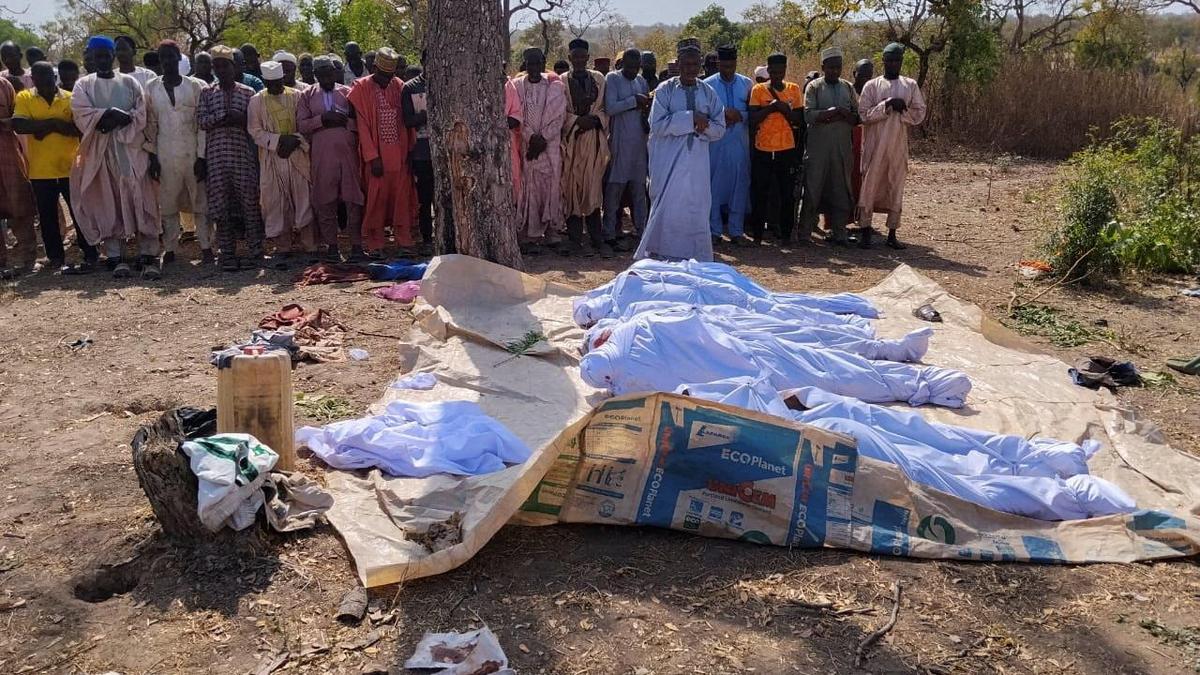
By dawn, the scale of the massacre began to emerge. As of Friday, more than 200 bodies had been buried in mass graves at different locations.

“First it was 30, then 68, then 75,” Musa said. “Later it rose to 162. Now the number recorded is over 200. Some bodies were recovered days later.”

Survivors believe the figure may be higher.

“From what we are seeing and hearing, the number could be more than 300,” Aliyu said.

Abdulrasheed gave an even higher estimate. “Between two days ago and now, we counted 321 bodies in the community,” he claimed.

Musa said more than 100 people were abducted during the attack.

“Over 100 people were kidnapped, and there have been no traces of them,” he said. “During search operations, more bodies have been found in the bush.”

Another survivor, who requested anonymity for security reasons, said the attackers disguised themselves.

“They dressed like soldiers and wore full armour. There was even a woman among them carrying ammunition,” she said. “We did not suspect anything at first.”

She recalled seeing them pass her shop along the Kaiama-Woro road.

“Minutes later, we heard gunshots. That was when we realised they were not soldiers. Everyone started running.”

Some of her relatives were abducted.

“My seven-year-old stepsister, who has a chronic illness, was taken during a family event in Woro. Another sister was also abducted. I do not know how the little one will survive in the forest,” she said.

She also recounted the ordeal of a trader popularly known as “Iya Bag.”

“They tried to break into her house but failed. They set it on fire, thinking everyone inside was dead. The family escaped through a back window, but she lost everything,” she said.

See also  El-Rufai released from ICPC custody following his mum's demise

The violence reportedly spread to neighbouring Nuku village. Even days later, residents said they heard distant gunshots in the early hours of Thursday, fuelling fears that more victims were killed in the surrounding forest.

Aliyu described how he survived.

“When the shooting started, I ran into the bush. I stayed there until morning before returning,” he said.

Abdulrasheed also recounted his escape. “I ran into a nearby house and hid,” he said.

Both men said nearly all residents had fled.

“Almost everyone has left,” Aliyu said. “People packed what they could carry and fled.”

Hospitals in Kaiama and New-Bussa have continued to treat injured survivors. A source familiar with the situation said many victims were in serious condition but responding to treatment.

The Inspector-General of Police, Kayode Egbetokun, has sent a delegation to the area as part of ongoing security and assessment operations. Security has since been reinforced across the Kaiama axis, with soldiers patrolling adjoining roads and border communities.

Yet the deserted homes reflect a deeper crisis — trust in safety has not returned.

“There is illegal mining in the forest,” a community member who requested anonymity said. “The group known locally as the Mahmuda terrorists have built houses there. Farmers can no longer go to their fields.”

Woro’s farmlands, once the backbone of its economy, now lie untended. Dry-season crops remain unharvested, and livestock have either strayed or been stolen.

For many families, returning would mean confronting both trauma and the destruction of their livelihoods.

At the IDP camps in Wawa and other host communities, displaced residents gather in prayer. Children cling to their mothers, while men speak quietly about relatives still missing.

“We have never seen anything like this,” Musa said.

Aliyu appealed for urgent intervention. “The government should assist our community with security and relief materials. We are pleading for help,” he said.

Abdulrasheed added, “Security agencies should remain in the community and support those whose homes and property were destroyed.”

In Woro, fresh graves dot the outskirts of the village. The scent of burnt timber lingers in the dry air as security operatives continue their patrols.

Until the abducted return and residents regain confidence to rebuild, Woro remains not only under guard, but in mourning.

Continue Reading
Click to comment

Leave a Reply

Your email address will not be published. Required fields are marked *

News

El-Rufai returns to ICPC custody

Published

on

A former governor of Kaduna State, Nasir El-Rufai, has been returned to the custody of the Independent Corrupt Practices and other related Commission (ICPC).

El-Rufai, who left custody on March 27, 2026, following the death of his mother, was re-arraigned on Tuesday.

Earlier, the court had adjourned his application for bail till March 31, 2026.

But, on Tuesday, he first appeared at the Kaduna State High Court for a separate charge filed against him by the ICPC.

The absence of the second defendant stalled the hearing, which was then adjourned to 10 April 2026.

Subsequently, he was taken to the Federal High Court, Kaduna, which was scheduled to hear his application for bail today, Wednesday.

Shortly after the court’s proceedings, the former governor was returned to the ICPC custody pending the continuation of his trial on Wednesday.

Daily Trust reports that the chieftain of the African Democratic Congress (ADC) was taken to the court amid tight security, less than 24 hours after he received dignitaries over the death of his mother, Hajiya Ummar El-Rufai.

Confirming the adjournment of the bail application to one of our correspondents on Tuesday, El-Rufai’s Counsel, Upong Akpan, a Senior Advocate of Nigeria, said the hearing on the bail application would determine his client’s fate temporarily.

Akpan, who did not go into details, expressed confidence that the former governor would regain his freedom in due time.

“I’m sorry, I can’t talk now, we are in the middle of work. I have to go and file responses. The hearing of the bail application has been adjourned till tomorrow,” he told Daily Trust.

See also  UK to replace paper documents with eVisas from February 25

Charges against El-Rufai

El-Rufai is standing trial before the Federal High Court on a 10-count charge bordering on alleged conversion and possession of public property, as well as money laundering.

The charges include: alleged unlawful receipt of about N289.8 million as severance allowance above-entitled benefits; alleged receipt of $320,800 through multiple deposits into a domiciliary account; alleged receipt of $155,800 and $305,300 from separate individuals; and alleged receipt of smaller dollar deposits from different persons at various times.

He denied all allegations levelled against him.

What happened in court

In the court, the Defence Counsel filed a motion, urging the presiding judge, Justice Rilwan M. Aikawa, to recuse himself from the case on grounds of alleged bias and a pending petition.

However, another motion was subsequently filed to withdraw the earlier request seeking the judge’s recusal.

The prosecution also filed a counter-affidavit opposing the bail application, which contributed to the adjournment.

Earlier, El-Rufai, who was arraigned before a Kaduna State High Court sitting in Kawo before Justice Darious Khobo on separate charges, was scheduled to be docked alongside his co-defendant, one Amadu Sule, but the latter was absent in Court over reported ill-health.

Specifically, ICPC said the duo were being arraigned over allegations that border on abuse of office, fraud, intent to commit fraud and conferring undue advantage.

It was gathered that the case, with charge number KDH/KAD/ICPC/01/26, was adjourned to April 10, 2026, for further hearing. The anti-graft agency had earlier explained that both charges were filed on March 18, 2026.

Specifically, armed personnel of the police, DSS and Kaduna State Vigilance Service were deployed to strategic locations, while major roads, including Ali Akilu Road, witnessed heavy traffic due to movement restrictions.

See also  Tell Nigerians real reasons for sacking service chiefs – ADC to Tinubu

Journalists were barred from covering the proceedings, as the prosecuting counsel, Dr Osuobeni Ekoi Akponimisingha, declined to speak to the media.

Similarly, the Defence counsel, Ubong Akpan (SAN), also declined to comment at the State High Court.

The spokesman of the ICPC, John Odey, could not be reached last night when contacted, as calls to his mobile phone did not connect.

punch.ng

FOLLOW US ON:

FACEBOOK

TWITTER

PINTEREST

TIKTOK

YOUTUBE

LINKEDIN

Continue Reading

News

Kinsmen seek justice for son thrown from four-storey building

Published

on

The kinsmen of 42-year-old Emeka Okafor are demanding justice following his death, after he was allegedly thrown down from a four-storey building.

South-East Punch learnt that the deceased died after the tragic fall from the fourth floor of the property located along Afubera Street, Odoakpu, near Onitsha, in Onitsha South Local Government Area of Anambra State.

He was said to have died in the early hours of Friday.

The incident happened after the deceased was allegedly accused of stealing some boxer shorts belonging to his employer, who owns the property.

The kinsmen of the deceased subsequently raised a delegation from Ogboji community in the Orumba South Local Government Area of Anambra State, where the deceased hailed from, to the Central Police Station in Onitsha to demand justice over the gruesome killing of Okafor.

The delegation was led by the President General of the community, Ndubuisi Nwaedozie; Regent of Ogboji Community, Dr Kay Anyacho, as well as other members of the community, including some of the family members of the deceased.

During the visit on Monday, an Assistant Commissioner of Police, ACP Olusegun Kayode, on behalf of the CPS Division, assured members of the delegation that the matter would not be swept under the carpet, adding that investigations have commenced.

Kayode appealed to the people not to take the law into their own hands, noting that some suspects have been arrested and the case transferred to the State Criminal Investigations Department, in Awka for further and proper investigation.

See also  UK to replace paper documents with eVisas from February 25

He urged the media to liaise with the state Police Public Relations Officer, for proper briefing on the matter, as he was not authorised to speak with the media.

Speaking to journalists amid tears shortly after meeting with the police, the junior brother of the deceased, Sunday Oguejiofor, alleged that his elder brother was gang-killed after being accused of theft.

Oguejiofor said, “He was the manager in the said property, he also resided in the building and was also employed by the owner to supervise his factory. Some parts of the building is being used as a factory.

“He called me two weeks ago that the wife of his employer has been threatening to deal with him for no justifiable reason before the unfortunate incident happened.

“I was at home when I received a call some days ago that my brother has died after he was thrown down from the fourth floor of the building. Only for me to arrive at the vicinity to meet his lifeless body. His head was tied with a piece of cloth, suggesting his face was covered before they threw him down.

“He was falsely accused of stealing boxer shorts from the factory he supervised, I learnt some of the workers beat him and locked him up for three days before he was thrown down from the fourth floor of the building around 3am that fateful day.

“He was 42-years-old. He was not yet married. I am begging the Police and other concern authorities to come to our aid, we want justice for our late brother.”

See also  PHOTOS: Ghanaians rush to ‘Noah’s Ark’ as prophet predicts Christmas Day flood

Other members of the delegation, who spoke, insisted that Okafor was falsely accused, beaten and thrown to his death from the four-storey building.

The President General, Ogboji Development Union, Nwaedozie, said what the community wants is total justice for the late Emeka Okafor.

Nwaedozie said, “We urged the police authorities not to sweep the matter under the carpet because we are very much interested in this case. We can’t afford to lose a young promising man of 42-year-old just like that. Justice must be served. We want those behind this to face justice. The incident is shocking and painful.”

Other members of the delegation included the Councillor Representing Ogboji Ward, Ikechukwu Nwokoye; the APGA councillorship candidate for Ogboji Ward, Ernest Uba; the Chairman OTU, Onitsha branch, Nze Obinna Okafor; Patron, OTU, Onitsha Branch, Nze Arinze Nwokoye; Onyebuchi Sunday, Kenechukwu Orajiaka, and siblings of the deceased, Sunday Oguejiofor and  Enuma Okafor.

The spokesman for the Anambra State Police Command, SP Tochukwu Ikenga, said major suspects have been arrested and investigations is ongoing.

Ikenga said an autopsy will be conducted for other necessary findings and actions.

He said, “There are so many comments going viral that are aiding the investigation, some allegedly said the victim was killed by those who employed him. While others said the deceased attempted to escape by jumping down from the building after being locked in a room; and so many other testimonies from some witnesses at the scene.

“I can assure you that the police are working with all the information to make sure we ensure justice is served. The case is under investigation. But the suspects are in custody.”

punch.ng

FOLLOW US ON:

FACEBOOK

TWITTER

PINTEREST

TIKTOK

YOUTUBE

LINKEDIN

Continue Reading

News

INEC chair urges stronger laws to safeguard democracy

Published

on

The Chairman of the Independent National Electoral Commission (INEC), Prof Joash Amupitan (SAN), has called for a more robust and adaptive legal framework to address emerging governance challenges in Nigeria’s fast-evolving digital landscape.

Amupitan made the call on Tuesday while chairing the 47th Founders’ Day Lecture of the Nigerian Institute of Advanced Legal Studies, held at the Ayo Ajomo Auditorium, University of Lagos.

The lecture was themed: “Civic Participation, Rule of Law and Accountable Governance in a Digital Era.”

He stated that technological advancement has significantly altered governance structures globally, stressing the need for Nigeria’s legal and institutional frameworks to keep pace in order to safeguard democratic processes.

“We are living in a time when technology is fundamentally reshaping governance.

“From digital platforms that amplify citizens’ voices to tools that enhance transparency, technology is creating vast opportunities for participation and accountability,” Amupitan said.

He, however, warned that the digital space also presented serious risks.

“We are confronted with misinformation, digital manipulation, data breaches and concerns around artificial intelligence. These developments test the resilience of our legal system,” he added.

The INEC boss emphasised that innovation must not outstrip regulation.

“Technological advancements must not outpace regulation or undermine democratic institutions. Nigeria needs a forward-looking legal framework that promotes transparency while preserving the integrity of governance,” he stated.

Reflecting on the significance of Founders’ Day, Amupitan described it as both a moment of reflection and a call to action.

According to him, institutions remain relevant not merely by their history but by their responsiveness and impact.

See also  ‘A former Head of State will die in 2026’ — Pastor Oladele

He commended NIALS for bridging the gap between legal theory and practice, urging it to intensify its engagement with emerging digital governance issues.

“As the leading centre of legal scholarship, NIALS must continue interrogating new issues, generating evidence-based insights and guiding the development of adaptive legal frameworks,” he said.

Delivering the keynote lecture, Senior Advocate of Nigeria, Mr Theodore Maiyaki, stressed the importance of civic participation while cautioning that technology could undermine democracy if not properly regulated.

He noted that digital transformation has redefined how societies interact and govern.

“Citizens no longer participate only through town halls or ballot boxes, but through hashtags, petitions, online campaigns and virtual communities,” he said.

Describing the digital era as both enabling and disruptive, Maiyaki warned that tools designed to expand access to information could also fuel misinformation, manipulation and surveillance.

“Technology can strengthen democracy or weaken it; empower citizens or control them. That is why safeguards are essential in any democratic system,” he said.

He stressed that civic engagement must go beyond elections. “Governance is not the exclusive domain of elected officials. Citizens must engage continuously. Democracy collapses when public voices go silent,” he added.

Maiyaki also expressed concern over declining elite participation in Nigeria’s political processes, particularly during party congresses, and called for greater commitment to democratic engagement.

On the rule of law, he maintained that it must translate into tangible benefits for citizens.

“It must go beyond theory and elite discourse to deliver functional schools, hospitals, jobs and basic amenities,” he said, noting that delays in justice delivery and perceived political interference had eroded public trust.

See also  UK to replace paper documents with eVisas from February 25

He called for stronger safeguards in digital governance, including enhanced data protection, cybersecurity, and transparency in the deployment of artificial intelligence.

“Digital innovation must strengthen transparency, not obscure it, because accountability is a public trust,” he stated.

In his remarks, the Dean of the Faculty of Law, University of Lagos, Prof Abiola Sanni (SAN), advocated closer collaboration between the faculty and NIALS to advance legal scholarship.

“We are committed to building productive linkages with NIALS, drawing inspiration from global models,” he said.

Sanni highlighted ongoing developments within the faculty, including improved infrastructure, digital libraries and modern lecture facilities, expressing optimism that they would enhance academic excellence and professional training.

Earlier, the Director-General of NIALS, Prof Abdulqadir Abikan, reiterated the institute’s commitment to supporting governance through research and policy engagement.

He traced the institute’s origin to the 1966 Nigerian Association of Law Teachers conference and paid tribute to past leaders whose contributions shaped its growth.

According to him, NIALS has continued to provide policy support in key areas such as criminal justice, environmental law, anti-money laundering and consumer protection.

He disclosed that a recent MacArthur-funded project produced policy bulletins, case digests and 23 draft court rules.

Abikan added that the institute trained 972 participants across 31 capacity-building programmes in 2025.

He acknowledged challenges, including inflation, staff attrition and infrastructure constraints, but noted ongoing efforts to address them.

He also announced the recovery of the institute’s property at Dolphin Estate after a protracted 16-year legal dispute.

The Director-General appealed to the Attorney-General of the Federation, Mr Lateef Fagbemi (SAN), for support in completing the institute’s permanent headquarters in Abuja.

See also  VIDEO: Lagos begins probe as ambulance hits woman during Lagos marathon

Among dignitaries present at the event were Obi Prof Epiphany Azinge (SAN), the Asagba of Asaba; Lagos State Attorney-General and Commissioner for Justice, Mr Lawal Pedro (SAN); Justice Hakeem Oshodi; and Justice Modupe Nicole-Clay.

punch.ng

FOLLOW US ON:

FACEBOOK

TWITTER

PINTEREST

TIKTOK

YOUTUBE

LINKEDIN

Continue Reading

Trending