Connect with us

Business

Nigeria, UK seal £746m deal to redevelop Tin Can, Apapa ports

Published

on

Nigeria and the United Kingdom have signed a £746 million export finance deal to support the redevelopment of Lagos’ Apapa and Tin Can Island port complexes.

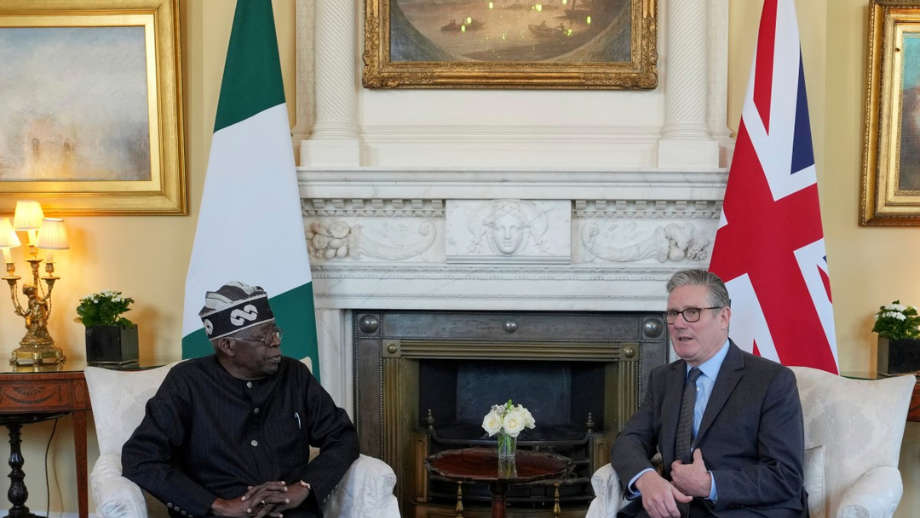
UK Prime Minister Keir Starmer stated this during a bilateral meeting with President Bola Tinubu at 10 Downing Street on the second day of the Nigerian leader’s historic state visit to Britain.

“Today is the opportunity to take that to another level with the agreements that we’ve been able to reach on exports, and I think that shows we can go even further than we’ve already gone,” he stated.

Tinubu, in his remarks, revealed that Nigeria is currently undergoing “very strong reform of the economy” and linked the terrorism challenges facing West Africa to climate change conflict.

“We need more trade agreements and economic relationships that we build between nations. Nigeria is currently going through a very strong reform of the economy,” Tinubu said.

The President described Nigeria as facing significant challenges, stating, “The largest country in West Africa, and on the continent, is challenged by terrorism coming from the conflict of climate change.”

Tinubu emphasised that both countries face global economic challenges, noting, “Currently, the entire world is challenged. Nigeria is not immune. Britain is not immune.”

He said the discussions focused on the “economic welfare of the people and how we can work together to improve livelihood” amid economic volatility.

The President affirmed that Thursday’s bilateral discussions would address what Britain can do to “accelerate the friendship, partnership and collaboration” between both nations.

See also  Fuel Supply Rises 25% As Dangote Delivers 40m Litres Of Petrol Per Day – NMDPRA

On his part, Starmer described the visit as historic, noting it was the first inward state visit for 37 years by a Nigerian leader.

“The long and shared history between our countries is obvious and much valued, as is the people-to-people contact and engagement that enriches lives here in the United Kingdom,” he said.

He noted that both countries already collaborate on economy, defence, and security matters but expressed determination to deepen the partnership.

“Today is the opportunity to take that to another level with the agreements that we’ve been able to reach on exports,” he stated.

Speaking before the meeting,  Tinubu said discussions with the UK government would focus on “trade, economic cooperation, and shared challenges — including security and climate change.”


The Minister of Marine and Blue Economy, Adegboyega Oyetola, also said the port redevelopment would strengthen Nigeria’s role in regional trade.

He said, “This project will strengthen Nigeria’s position as a leading maritime hub in West and Central Africa.”

PUNCH Online reports that Tinubu’s state visit to the UK began on Wednesday, following an invitation from Their Majesties King Charles III and Queen Camilla at Windsor Castle.

The visit also includes plans to sign a Memorandum of Understanding to deepen trade and investment ties between the two countries.

Tinubu was accompanied by a high-profile delegation, including Senate President Godswill Akpabio; Attorney General and Minister of Justice, Prince Lateef Fagbemi; Minister of Solid Minerals, Dele Alake; Minister of Information and National Orientation, Idris Mohammed; and Minister of State for Foreign Affairs, Ambassador Bianca Ojukwu.

See also  Tinubu, US AFRICOM chief hold security talks in Abuja

Other members of the delegation include Minister of Finance and Coordinating Minister of the Economy, Wale Edun; Minister of Industry, Trade and Investment, Dr. Jumoke Oduwole; Minister of Culture and Creative Economy, Hannatu Musawa; Minister of Communications and Digital Economy, Bosun Tijani; Minister of Defence, Gen. Christopher Musa; National Security Adviser, Malam Nuhu Ribadu; and Director-General of the National Intelligence Agency, Mohammed Mohammed.


punch.ng

FOLLOW US ON:

FACEBOOK

TWITTER

PINTEREST

TIKTOK

YOUTUBE

LINKEDIN

Continue Reading
Click to comment

Leave a Reply

Your email address will not be published. Required fields are marked *

Business

Ikeja Electric reveals why Lagos is experiencing persistent power interruptions

Published

on

Ikeja Electric Plc has explained why Lagos is experiencing persistent power interruptions, linking the situation to reduced electricity allocation from the national grid.

In a statement posted on its official X handle on Friday, the electricity distribution company apologised for the outages and said the supply constraints were affecting several areas within its coverage.

“We sincerely regret the ongoing power supply challenges currently affecting some areas within our network due to reduced power allocation from the grid,” the company said.

To manage the shortfall, Ikeja Electric said it had introduced controlled rationing of supply, explaining that the step was necessary to maintain system stability and ensure fair distribution.

“As part of efforts to maintain grid stability and ensure equitable distribution of available power, temporary load shedding is being implemented across affected feeders and locations,” it stated.

The company also said it was engaging stakeholders in the power value chain to improve supply and limit the impact of the disruptions.

The development comes as electricity shortages persist across Lagos and other parts of the country, largely linked to gas supply issues affecting power generation nationwide.

The situation has continued despite recent efforts at the state level to reduce reliance on the national grid.

tribuneonlineng.com

FOLLOW US ON:

FACEBOOK

TWITTER

PINTEREST

TIKTOK

YOUTUBE

LINKEDIN

INSTAGRAM

See also  Banks sent pretty ladies to woo me for deposits – Otedola
Continue Reading

Business

Keyamo settles FG, Bi-Courtney’s long concession dispute

Published

on

In a landmark development for Nigeria’s aviation sector, the Minister of Aviation and Aerospace Development, Festus Keyamo, has successfully brokered a historic settlement between the Federal Government and Bi-Courtney Aviation Services Limited, bringing to a close a protracted dispute spanning over two decades.

The resolution of the long-standing disagreement surrounding the Murtala Muhammed Airport Terminal 2 (MM2) was formally approved by the Federal Executive Council (FEC), marking a significant turning point in Nigeria’s aviation history.

According to a statement by Tunde Moshood, under the terms of the negotiated settlement, Bi-Courtney has agreed to write off the N132 billion Supreme Court judgment debt previously owed by the Federal Government. In addition, the company has relinquished the exclusivity clause tied to the MM2 concession and has handed back the Murtala Muhammed Airport Terminal 1 (MM1) to the Federal Government.

In return, the Federal Government has restored to Bi-Courtney the rights to complete and operate the long-stalled hotel and conference centre project on a mutually beneficial revenue-sharing basis.

Furthermore, plans are underway to relocate regional flight operations to MM2, with provisions for apron expansion to accommodate increased traffic where necessary. This strategic move ensures that the Federal Government begins to earn immediate revenue from the revitalised arrangement.

Described as a “win-win” outcome for all parties, the agreement unlocks the full commercial and operational potential of MM2, positioning it as a central hub for regional aviation. It also clears longstanding encumbrances that have hindered broader infrastructure development, including the proposed Lekki International Airport project.

Additionally, the deal aligns with forward-looking reforms in the aviation sector, including plans to establish a private-sector-driven aircraft leasing company aimed at supporting Nigerian airlines with access to modern fleets under competitive terms.

See also  NDIC seeks stronger CIBN collaboration on emerging risks

Keyamo commended all stakeholders for their commitment to dialogue and national interest, emphasising that the resolution reflects the Federal Government’s dedication to fostering a conducive environment for investment, efficiency and growth in the aviation industry.

“Special recognition is also due to Wale Babalakin, Chairman of Bi-Courtney Aviation Services Limited, who is a distinguished Senior Advocate of Nigeria and member of the Inner Bar. With the Honourable Minister, they both leveraged their professional relationship and shared commitment to national development to achieve this breakthrough.

“This milestone agreement signals a new era of collaboration between the public and private sectors and underscores the administration’s resolve to remove legacy bottlenecks, enhance infrastructure, and reposition Nigeria as a leading aviation hub in Africa,” the statement said.

tribuneonlineng.com

FOLLOW US ON:

FACEBOOK

TWITTER

PINTEREST

TIKTOK

YOUTUBE

LINKEDIN

INSTAGRAM

Continue Reading

Business

Airlines struggle as losses hit N150bn in two months

Published

on

Airline Operators of Nigeria have raised alarm over losing N150bn within two months, even as ground handling companies threaten further action over about N9bn in outstanding debts.

A member of the Board of Trustees of the Airline Operators of Nigeria, Roland Iyayi, said airlines had lost over N150bn in just two months, stressing that operators were nearing breaking point.

“Airlines have bled over N150bn in two months. Where is the money going to come from? It’s gotten to a point where nobody can threaten anybody any longer,” he said.

Iyayi warned that the survival of ground handling companies depends largely on the existence of airlines, adding that the current standoff could have dire consequences.

He said, “If airlines don’t exist, they don’t have a business. Nobody cares about the airlines; everybody wants to collect money. We’ve made up our minds now that whatever anybody wants to do, they can continue, but I can guarantee you that at the end of the day, everybody will come to their knees. You can’t force anybody to come up with what they don’t have.

So that’s where we are right now.”

He further cautioned that any disruption to airline operations would ultimately hurt all stakeholders in the sector. He added, “They threaten, the same way a few marketers are saying cash and carry. So let’s see what happens by the time airlines stop flying, whether they have any business.

“There’s no way airlines can do anything regarding any debt, simply because it has become very difficult to survive. Airlines are struggling to survive. So anybody threatening airlines now to say, ‘Oh, if you don’t pay up, we’ll cut services,’ without the airlines, you don’t have any business. So if you make it seem like you are doing the airlines a favour, no, it’s the other way around. Without the airlines, you can’t be where you are.

See also  NDIC seeks stronger CIBN collaboration on emerging risks

“What are we meeting for? To make promises we can’t keep? If anything at all, the airlines have to survive first before the ground handling companies can even have any future as a business,” he added.

However, the Chairman of the Aviation Ground Handling Association of Nigeria, Olaniyi Adigun, said the association was considering its next line of action in line with labour laws.

“What we intend to do is to come out with a press conference, and according to Nigerian law, we have our own strategy, which we are meeting together, and we are going to state our next move. Although some of them (airlines) have started, the majority have not. But that does not call off the strike,” he said.

Adigun added that the association might escalate its action if airlines fail to meet its demands within the stipulated timeframe.

“However, you know in the labour law, when you give a seven-day notice, and if you don’t meet up, you can give a three-day notice. So that’s the labour law; we are trying to look at that.

“But we have our minds set. We are just following the law. So after the expiration of seven days, if we don’t hear from them, we have our own strategy. We will be having a meeting on Thursday. So let’s wait for the outcome of the meeting,” he said.

Meanwhile, another member of the Airline Operators of Nigeria, who spoke on condition of anonymity due to the lack of authorisation to speak on the matter, urged caution, warning that the timing of the dispute could worsen the country’s fragile economic situation.

See also  Bulk fuel buyers dump middlemen for direct Dangote supply

“This is not even the right time for anybody to be attacking the airlines or for the people that are attacking each other, because this is a difficult time for them. So I don’t think this is the right time to do that. It’s a very sensitive period,” the source said.

The source warned that the collapse of airlines would trigger widespread consequences across the country. “As a nation, we cannot afford for our airlines to go down now because it’s going to create a lot of problems. There are a lot of problems we cannot afford. We’re in a very, very difficult position as a nation.

“If airlines go under, there will be an uproar in this country. So we have to be very careful. So I think the ground handlers will need to be patient and find a way to meet with the airlines, get into a dialogue because dialogue is the only way forward,” the source added.

The development follows an earlier report by The PUNCH that a fresh crisis was brewing in the aviation sector after ground handling companies threatened to suspend services over more than N9bn owed by domestic airlines, raising fears of widespread flight disruptions across the country.

The ground handlers, under the umbrella of the Aviation Ground Handlers Association of Nigeria, had issued a seven-day ultimatum to airline operators, warning that failure to settle the outstanding debts could force them to withdraw critical services essential to flight operations.

The association noted that the lingering indebtedness had placed significant financial strain on its members and affected their operational capacity, adding that repeated efforts to recover the funds had yielded little progress, with airlines’ payment commitments largely unmet.

Continue Reading

Trending