Connect with us

News

Inflation, insecurity still major challenges despite reforms – FG

Published

on

The Federal Government on Tuesday acknowledged that inflation and insecurity remain major challenges facing Nigerians, even as it defended the economic reforms introduced by President Bola Tinubu’s administration over the past three years.

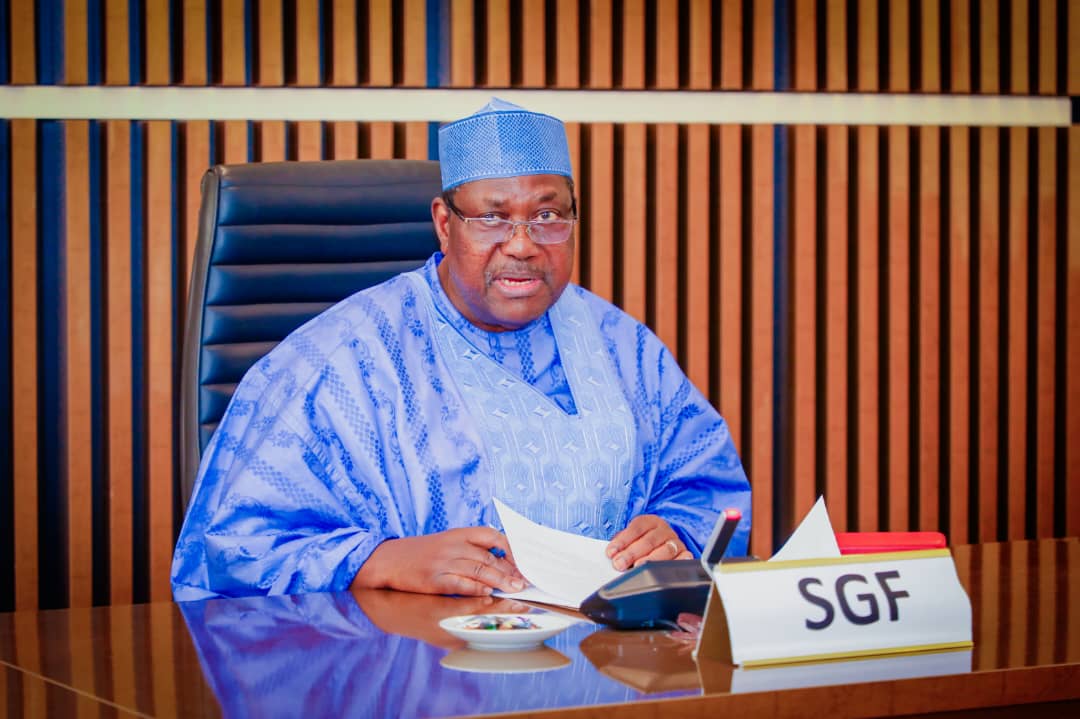
Speaking at a press conference to mark the 2026 Democracy Day celebration in Abuja, Secretary to the Government of the Federation, George Akume, said the government was aware of the hardship caused by its policies but argued that recent economic indicators suggested improvements in key sectors.

Akume stated, “The government, though with all hands on deck, would never claim that every challenge has been solved.

“While we pursue various reforms diligently, with purpose and with compassion, the government recognises that inflation has been painful, though it is on a downward trend.

“The government is similarly conscious of the fact that insecurity still threatens lives and livelihoods.”

The briefing, attended by members of the Federal Executive Council, formed part of activities marking 27 years of uninterrupted democratic rule and served as what the SGF described as an accountability exercise by the administration midway into its first term.

While acknowledging public concerns over the cost of living and security, the SGF insisted that government reforms were beginning to yield results.

“Evidence shows that the country is moving in the right direction,” he said.

Akume cited economic figures which he said reflected improvements in output and investment, noting that Nigeria’s Gross Domestic Product grew by 4.07 per cent in the fourth quarter of 2025 and 3.89 per cent in the first quarter of 2026.

The government also used the occasion to highlight the impact of its social intervention programmes, including cash transfers, student loans and consumer credit initiatives introduced since 2023.

See also  27 Reps dump PDP, others for APC, ADC in a defection tsunami

According to him, more than one million students have benefited from the Nigerian Education Loan Fund, with over N184bn disbursed for tuition and upkeep.

He also said millions of households had been reached through the Renewed Hope Conditional Cash Transfer programme, while government-backed credit schemes had expanded access to formal financing.

The administration further defended its fiscal reforms, including tax measures signed into law in 2025, arguing that the policies were aimed at improving revenue generation and strengthening accountability in public finance.

On anti-corruption efforts, Akume said anti-graft agencies had continued to recover proceeds of crime and prosecute offenders, adding that recovered funds had contributed to financing the student loan scheme.


He also linked Nigeria’s removal from the Financial Action Task Force grey list in October 2025 to reforms in anti-money laundering and counter-terrorism financing frameworks.

“Accountability in this administration is sacrosanct,” he said.

Despite the government’s claims of progress, security featured prominently in the SGF’s remarks, with Akume conceding that the challenge remained unresolved.

“We continue to confront internal security challenges. Government will not pretend that insecurity will disappear today without the active support of all Nigerians,” the SGF stated.

He said the administration was expanding the capacity of the armed forces and other security agencies through increased recruitment and funding, while also strengthening cooperation with neighbouring countries and international partners.

Akume appealed to citizens to support security agencies through intelligence sharing and vigilance, describing security as a collective responsibility.

The SGF also used the Democracy Day platform to call for national unity amid ethnic and religious divisions.

See also  Barcelona to face Athletic Club at renovated Camp Nou Stadium

“In a country as diverse and plural as ours, development is strongest when trust is stronger than division,” he said.

He noted that the government continued to support interfaith dialogue through the Nigeria Inter-Religious Council and recently approved a National Values Charter aimed at promoting citizenship, tolerance and national cohesion.

In what appeared to be the clearest indication yet of the administration’s political calculations ahead of the next election cycle, Akume said the government intended to build on ongoing reforms and seek public endorsement in 2027.

“Our responsibility is to finish what we commenced in 2023, and as we go into the cycle for the 2027 general elections seeking a revalidation of our mandate, we shall scale what is working,” he said.

He added that the administration was willing to have its record subjected to public scrutiny.

“This government remains prepared to be judged by evidence,” Akume stated.

In his welcome address, the Minister of Information and National Orientation, Mohammed Idris, described Democracy Day as a moment of national reflection and tribute to those who contributed to the country’s return to democratic governance, stressing its importance in strengthening national unity and institutional resilience.


Idris stated, “Democracy Day occupies a unique place in our national calendar. It provides an opportunity for us to reflect on our democratic journey, celebrate the resilience of our institutions, and honour the sacrifices of patriots who stood firm in the struggle for democratic governance.

“As we gather today, we pay tribute to the memory and enduring legacy of Bashorun Moshood Kashimawo Olawale Abiola, whose commitment to democratic ideals remains an inspiration to generations of Nigerians.

See also  South-West States Declare Holiday For Isese Festival

“We also acknowledge the many Nigerians, including President Bola Ahmed Tinubu, who played significant roles in the pro-democracy movement and contributed to the restoration of democratic rule in our country.”

The minister noted that 27 years of uninterrupted democratic governance represent a major milestone in Nigeria’s political development, describing it as evidence of the country’s resilience and commitment to democratic values.

“Twenty-seven years of uninterrupted democratic governance is a milestone worthy of celebration.

“It is a testament to the determination of Nigerians to uphold democratic values, strengthen national institutions, and continuously strive for a more prosperous and united nation.”

He further stated that this year’s Democracy Day coincides with the third anniversary of the administration, offering an opportunity to assess progress and renew commitment to national development.

Those present at the press briefing included the Minister of Livestock Development, Idi Maiha; the Minister of Water Resources and Sanitation, Joseph Utsev, among others.

Nigeria has recorded 27 years of uninterrupted civilian rule since the start of the Fourth Republic in 1999. The period has seen sustained electoral continuity alongside recurring governance, economic, and security challenges.

Inflationary pressures have been shaped by currency depreciation, fiscal reforms such as fuel subsidy adjustments, global supply shocks, and broader structural constraints in the economy. Security threats, including insurgency in the North-East, banditry in parts of the North-West, and communal conflicts in several regions, have remained persistent concerns across successive administrations.

punch.ng

FOLLOW US ON:

FACEBOOK

TWITTER

PINTEREST

TIKTOK

YOUTUBE

LINKEDIN

INSTAGRAM

Continue Reading
Click to comment

Leave a Reply

Your email address will not be published. Required fields are marked *

News

June 12: Atiku backed rotational presidency deal, insists Akume

Published

on

The Secretary to the Government of the Federation, George Akume, has said former Vice President Atiku Abubakar was among political leaders who supported the adoption of rotational presidency in Nigeria following the annulment of the June 12, 1993, presidential election.

Atiku Abubakar
Former Vice President Atiku Abubakar

According to the SGF, the annulment of the June 12 election, won by the late Chief MKO Abiola, prompted political leaders to take difficult decisions aimed at preserving national unity and strengthening democracy.

A statement by his Media Aide, Yomi Odunuga, said Akume made the clarification on Tuesday while responding to questions at a World Press Conference in Abuja, as part of activities marking Nigeria’s 27th Democracy Day anniversary.

He recalled that leaders of the Peoples Democratic Party met in Kaduna under the leadership of the late Chief Solomon Lar and Alhaji Adamu Ciroma to deliberate on the country’s political future, with the issue of power rotation featuring prominently.

“It was a tough argument before the issue of rotational presidency was agreed on. At the end, we had to concede. We must do this.

“June 12 annulment had complicated the whole thing. It was finally agreed that we’ll be alternating between North and South.

“Atiku was one of the leaders at that meeting, which was convened by Chief Solomon Lar. He was part of that agreement,” Akume was quoted as saying.

The SGF explained that the decision to alternate presidential power between the North and South was designed to address the political consequences of the annulled election and promote inclusiveness and national cohesion.

See also  Ibom Air bans ‘unruly passenger’ for life after airport row

Akume’s remarks come amid ongoing political debates over power rotation ahead of the 2027 general election.

Atiku, a northerner and the presidential candidate of the African Democratic Congress for the 2027 election, is expected to challenge incumbent President Bola Tinubu, who is seeking a second term in office.

Tinubu, a southerner, was elected President in 2023 following the completion of the constitutionally permitted two-term tenure of the late President Muhammadu Buhari, a northerner.

Atiku has been criticised by political rivals and the Presidency for running for the highest office and maintaining future presidential ambitions during election cycles when political consensus favours power rotation to the South.

Reflecting on the significance of June 12, the SGF described the annulment as a painful setback to the democratic aspirations of Nigerians.

“Abiola won that election round and square. That election was annulled by the military government. It was very painful because the people spoke, and they spoke freely. They made their own choice,” he said.

According to him, one of the major lessons from the June 12 experience is the supremacy of the people’s will in a democratic system.

“The first lesson is that the voice of the people must always be supreme; it must be sacrosanct. That’s the beauty of democracy. We prefer the ballot to bullets,” he stated.

Akume expressed confidence in Nigeria’s democratic institutions, particularly the Independent National Electoral Commission, saying the country had learned from the events of 1993 and would never allow a repeat of such an annulment.

“If an election is conducted very fairly, and one wins, no problem. The actors at the Independent National Electoral Commission are not young people; they were adults when this thing happened.

See also  27 Reps dump PDP, others for APC, ADC in a defection tsunami

“If we were to take a poll at that time, over two-thirds of Nigerians would have condemned that act of annulment,” he said.

The SGF further commended INEC officials, describing them as men and women of integrity committed to protecting the nation’s democratic process.

“Fortunately for us, those at INEC are men of honour and integrity. They are well-read, patriotic Nigerians, and they are determined to make a difference. Never again would such happen in this country.

“You win, you win. When you lose, go back and prepare for another election. Look at the American example. President Trump lost to Joe Biden. He didn’t bring America down. He went back, prepared and came back and won. That’s the beauty of democracy,” Akume said.

He noted that Nigeria’s 27 years of uninterrupted democratic rule reflected the country’s commitment to democratic governance and freedom.

“We have decided to embrace democracy. That is why, for 27 unbroken years, we have been enjoying this freedom in a democratic setting. We love the values and the morals of democracy, and there is no system that is as beautiful as democracy,” he said.

Akume also highlighted freedom of expression as one of the key benefits of democratic rule.

“It is under a democratic system that you can insult your president and insult anybody and still go to bed, and you don’t receive a midnight knock on your door. Try it under a totalitarian regime,” he stated.

The SGF urged political actors to embrace democratic principles, respect electoral outcomes and continue to strengthen the nation’s democratic culture.

See also  Nigeria @ 65 - FG cancels Independence Day parade

He added that Nigeria’s 27 years of uninterrupted democracy underscored its commitment to the rule of law, freedom of expression and peaceful political participation.

Continue Reading

News

Tinubu orders repatriation of 300 Nigerians held in Ethiopian prison

Published

on

President Bola Tinubu has dispatched a high-level delegation to Addis Ababa, Ethiopia, to secure the immediate repatriation of nearly 300 Nigerian nationals serving prison sentences in the country, The PUNCH learnt.

Sources within the Presidency and the foreign service familiar with the directive said the prisoners are held in deteriorating conditions at Kaliti, a maximum-security prison in Addis Ababa.

Tinubu mandated the delegation, which includes the Minister of Foreign Affairs, Bianca Odumegwu-Ojukwu, and the Attorney-General of the Federation, Lateef Fagbemi (SAN), to sign a Memorandum of Understanding with the Ethiopian government that would allow the prisoners to be transferred to Nigeria to complete the remainder of their sentences in Nigerian correctional facilities.

According to one source, the directive came directly from the President, with the delegation departing for Addis Ababa on Tuesday.

“We are leaving because we have prisoners. The President has directed us to get these prisoners back.

“He directed that we go there right away with the Attorney-General, get an MOU quickly signed, so that these prisoners can be transported back to Nigeria, so that they can serve out the rest of their sentences here,” the official revealed.

A second source told The PUNCH that the urgency was driven by the deteriorating physical condition of the inmates.

“They are dying. We have almost 300 prisoners in the open-air prisons in Ethiopia,” the official told our correspondent.

The directive marks the first direct intervention of President Bola Tinubu on the crisis, which has dragged on through several diplomatic channels for over three years.

See also  Ibom Air bans ‘unruly passenger’ for life after airport row

According to official Ministry of Foreign Affairs figures, more than 270 Nigerians are currently serving prison sentences in Ethiopia, largely for drug-related offences.

Most are held at Kaliti Prison in Addis Ababa, where, since 2019, advocacy groups have alleged overcrowding, starvation, lack of medical care and physical punishment.

On March 12, 2023, Chizoba Favour Eze, a Nigerian inmate at Kaliti Prison, died following alleged brutalisation by prison officials.

Another Nigerian, Uchenna Nwanneneme, died from tuberculosis on September 21, 2023, reportedly after receiving little or no medical attention.

A third Nigerian, Basil Lawrence Ilobi, also died in custody.

Their deaths drew protests from Nigeria’s mission in Addis Ababa and renewed calls from families of the incarcerated for the Federal Government to formalise a prisoner transfer arrangement.

In November 2024, Justice Inyang Ekwo of the Federal High Court in Abuja ordered the Ministry of Foreign Affairs and the Nigerians in Diaspora Commission to facilitate the return of the imprisoned Nigerians, noting that the Ethiopian government had admitted it lacked the budget to care for foreign inmates. However, the order yielded no immediate action.

On April 17, 2025, Ojukwu, then serving as Minister of State for Foreign Affairs, led a delegation to meet Ethiopia’s Ambassador to Nigeria, Legesse Geremew Haile, pressing for the immediate ratification of the MOU.

“Our people don’t want to hear that another Nigerian inmate died in an Ethiopian prison,” she declared during the meeting.

According to her, Nigeria had already completed its own side of the MOU formalities.

She said, “The ministry has fulfilled its own side of the formalities for the Transfer of Sentenced Persons MOU. It is the Ethiopian side that is stalling.”

See also  South-West States Declare Holiday For Isese Festival

Haile reaffirmed diplomatic ties but acknowledged that the MOU was still awaiting ratification by Ethiopia’s House of Representatives.

In September 2025, families of inmates at Kaliti Prison appealed directly to President Tinubu, the Senate and NiDCOM to intervene and activate the prisoner transfer arrangement.

In January 2026, the Ethiopian House of People’s Representatives ratified prisoner transfer agreements with China, Brazil and a criminal extradition agreement with South Africa.

In 2019, Ethiopia granted amnesty to Nigerian prisoners. However, several persons subsequently returned to the country and were re-arrested for similar drug-related offences.

Since the 1980s, the United Nations Office on Drugs and Crime has promoted model agreements for the international transfer of sentenced persons, encouraging countries to allow prisoners to serve sentences in their home countries to aid rehabilitation.

Advocacy groups say many Nigerians held at Kaliti are reportedly travellers transiting through Addis Ababa’s Bole International Airport, one of Africa’s busiest aviation hubs, who were arrested on drug charges.

They argue that some were unwitting carriers of narcotics allegedly planted in their luggage.

Continue Reading

News

Reps query defence spending, summon NSA, ministers on Insecurity

Published

on

The House of Representatives has summoned the National Security Adviser, Nuhu Ribadu, Minister of Defence, Gen Christopher Musa and his finance counterpart, Taiwo Oyedele, for questioning over the spike in kidnappings in some parts of the country.

Specifically, the House seeks details of funds released to the Ministry of Defence over the past six months and an explanation for the perceived lack of corresponding improvements in security nationwide.

The resolution followed the adoption of a motion of urgent public importance brought on the floor of the Green Chamber by the member representing Gummi/Bukkuyum Federal Constituency of Zamfara State, Mr Sulaiman Gumi, during plenary on Tuesday.

Speaking on the substance of the motion, the lawmaker lamented the sorry state of security in Zamfara and other parts of the North-West zone, noting that as a result of the campaign of violence by insurgents, the entire region is now battling the scourge of humanitarian crises made worse by the harsh economic realities of the times.

He said, “The House is aware that between June 1 and 6, 2026, rampaging bandits riding on about 250 motorcycles with three riders each invaded Gummi/Bukkuyum Federal Constituency, and some parts of Sokoto villages bordering Zamfara State, killing 93 people.

“The House is also aware that on the night of June 2, 2026, into the early hours of June 3, 2026, seven students of the Federal Polytechnic, Kaura Namoda, Zamfara State, were abducted by bandits at their off-campus students’ hostel.

“Earlier, two senior lecturers of the same polytechnic were kidnapped and held in captivity for more than two months, despite ransom payments for their release.

See also  Ramaphosa slams xenophobic violence, vows illegal immigrants arrest

“We are aware of the violent attack by bandits on Zurmi Local Government Area of Zamfara State, where four people were killed and several travellers abducted.

“In Talata Marafa Local Government Area, a councillor and a director were abducted while travelling from Jangebe to the local government headquarters over Hajj activities for intending pilgrims from Jangebe. The bandits killed both of them after refusing to collect any ransom.”

The lawmaker also drew his colleagues’ attention to the escalation of bandit attacks in other Northwest states, including Katsina, Kaduna, Kano, Kebbi, and Jigawa.

Gumi recalled that “On May 31, 2026, 17 villagers were killed when bandits in their hundreds and riding on motorcycles invaded Dangulbi community in Tureta Local Government Area of Sokoto State,” stressing that “more than 15 communities in Tureta and Sabon Birni local government areas of Sokoto State have been deserted due to constant bandit attacks.

“In Katsina State, a former Director of Defence Information of the Nigerian Army, Maj Gen Rabe Abubakar Batsari (retd), and his wife were abducted when their vehicle was ambushed along the Marabar Musawa-Kafinsoli road in Matazu Local Government Area on May 30, 2026.”

He continued, “Just yesterday (Monday), 50 elderly men were kidnapped and are still held captive in Zamfara State.

“In Kaduna State, bandit attacks remain a significant security challenge, with recent incidents heavily concentrated in areas like Kachia, Sanga and Birnin-Gwari Local Government Areas, while in Kano State, bandit attacks have primarily impacted rural communities sharing borders with neighbouring Katsina State, with the most severe incidents resulting in fatalities, livestock rustling, and abductions.”

See also  Leave before visa expires, UK warns foreign students

He expressed concern that the continuous, unchallenged movement of bandits between the towns, states and their hideouts severely undermined the credibility of the nation’s security, adding that if the trend was not checked, more lives would be lost, and the socio-economic fortunes of the region would be ruined.

Contributing, Jigawa lawmaker, Abubakar Yalleman, called for a speedy consideration of  all legislative proposals for the establishment of state police.

“I urge the National Assembly to expedite action on state police to help checkmate the deteriorating level of security in the country,” he said, a call backed by his Ogun counterpart, Mr Olumide Osoba.

Also speaking, the member representing Ikorodu Federal Constituency of Lagos State, Babajimi Benson, called on the Federal Government to revisit the cashless policy as a way of restricting incidences of cash payment to kidnappers.

“It is important to revisit the cashless policy because it is difficult to pay ransom through bank transfers,” he said.

Similarly, the member representing Shomolu Federal Constituency of Lagos State, Ademorin Kuye, called for strict regulation on the activities of Bureau De Change operators, among other measures.

“It is important for us to gazette the prohibition of ransom payment to kidnappers. The Central Bank of Nigeria should consider monitoring the activities of Bureau De Change operators  to address illicit financial flows,” he advised.

Following the adoption of the motion, the House resolved to summon the government officials at a date yet to be announced, while urging the defence minister to deploy adequate security personnel and necessary operational equipment to Zamfara State and the entire Northwest to strengthen the security of the region.

See also  Security crisis: Tinubu, Macron hold talks as US fact-finders arrive

It also urged ministers of agriculture, environment, education, humanitarian affairs and disaster management to explore other non-kinetic options of addressing the security challenges in the country.

The House thereafter mandated the Committee on Defence and other relevant committees to ensure compliance and report back within two weeks for further legislative action.

punch.ng

FOLLOW US ON:
FACEBOOK

TWITTER

PINTEREST

TIKTOK

YOUTUBE

LINKEDIN

INSTAGRAM

Continue Reading

Trending